Map: Detroit Population Forecast 2045

Screen Shot 2019-10-16 at 9.57.10 AM.png

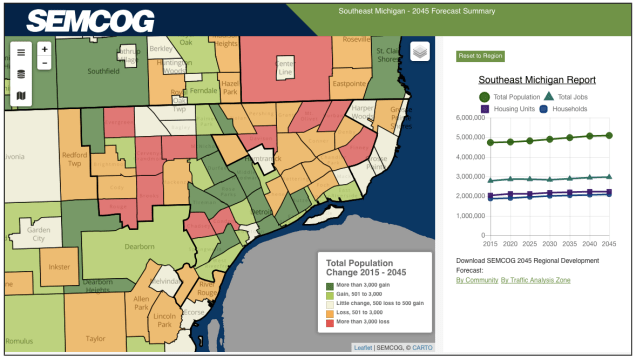
Across the Metro Detroit region, SEMCOG predicts population increases. However, the many areas in the City of Detroit are predicted to see significant population loss by 2045. With already record population loss, these predictions make for a difficult road ahead for the city still struggling to ensure basic services in every neighborhood.


Map: Auto Emissions in Metro Detroit 2017

Screen Shot 2019-10-10 at 10.50.27 PM.png

The New York Times completed an analysis of driving emissions from the CO2 estimates generated by Boston University’s Database of Road Transportation Emissions.

As the New York Times writes:

“Emissions from driving in the Detroit metro area grew faster than population between 1990 and 2017, which means emissions per person have increased.”

Similar models that we’ve posted about previously have shown the detriment of our auto-centric regional transportation networks, especially around expressways and arterial roads and related to greenhouse gas emissions.

Map: School Segregation in Metro Detroit 2015-16

Screen Shot 2019-10-06 at 10.26.37 PM

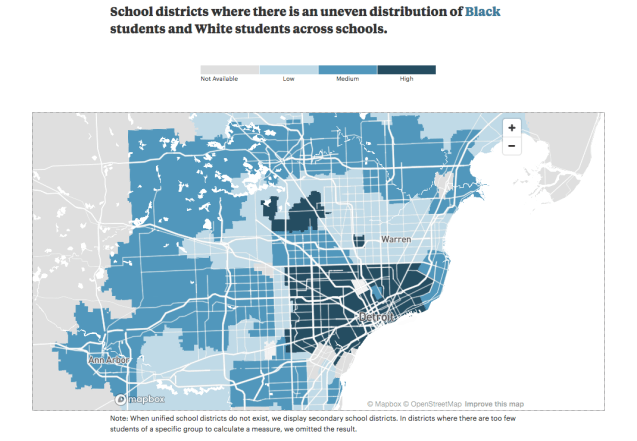
This map from the ProPublica “Miseducation” project stood out to me because the donut rings of the past have been recreated with inner ring regional suburbs having low segregation as African American residents have left Detroit for different school districts. Yet the next ring shows where school and likely community integration have slowed or stopped (i.e. Birmingham).

Map: Accidents involving Detroit Public School Children in 1935

Screen Shot 2019-09-19 at 10.55.53 PM

This map from the Detroit Traffic Survey 1936-1937 reminds me of the similar map from 1968 map highlighting areas where commuters run over black children and more recent map of children’s traffic fatalities within a 10 year timeframe. The report reads:

“Intersections adjacent to schools are guarded by patrol boys, police officers, and traffic signals, for a period of time immediately before the opening of school at 8:00 or 8:30 in the morning, during noon recesses approximately between 12:00 noon and 1:00 P.M., and again at the close of school shortly after 3:00 P.M. As appears in Figure 89, there are peaks in the injury and fatality curves at these times resulting, of course, from the fact that in spite of supervision given, the exposure of children to traffic is great in comparison with exposure during the hours in which school is in session.”

Screen Shot 2019-09-24 at 11.31.21 PM

Map: Updated Regional Transit Plan

Screen Shot 2019-09-16 at 11.11.51 AM.png

After the previous Regional Transit Authority (RTA) Director left, assuming because there was no more money for his position, the RTA has relaunched their regional plan for 2045.

Movement is already underway with unified fares under the new DART system for DDOT buses, SMART buses, and the Qline.

Map: Heat and Income in Detroit

Screen Shot 2019-09-10 at 8.38.21 AM

NPR‘s recent analysis of heat impacts using NASA/U.S. Geological Survey satellite imagery and U.S. Census American Community Survey data showed no correlation with income in Detroit. However, it has been well documented that extreme heat affects low-income cities more acutely.

Map: Detroit’s Coworking Landscape Stabilizing 2019

In 2014, I mapped out Detroit’s coworking landscape based on cost of monthly membership at a drop-in or “hot desk.” Besides using a bad map projection, I failed to account for the exclusive nature of many coworking spaces in Detroit’s Downtown. In 2017, I mapped the change in coworking spaces with a focus on locations that closed and increases in costs. Besides there being 12 new coworking spaces in the city in 2017 (7 closures), costs remained relatively stable.

det_coworking_2019.png

In 2019, the coworking landscape hasn’t altered much with just 2 new spaces (4 closures). Costs still remain stable with increases seen at some of the newer spaces launched in 2017 as new access points for marginalized groups, including parents and women. Ponyride is completely moving locations after selling their building as part of the Greater Corktown real estate boom spurred by Ford Motor Company moving into the neighborhood.

Coworking remains a predominantly Downtown and Midtown activity with just a few neighborhood opportunities outside of the 7.2 square mile area of concentrated revitalization. Seems that coworking efforts would be a strong opportunity for the libraries to get, keep, and innovate with new funding?


Map: Downtown Detroit’s Unbuilt Highline and Superblocks 1950s

civiccenter-superblocks

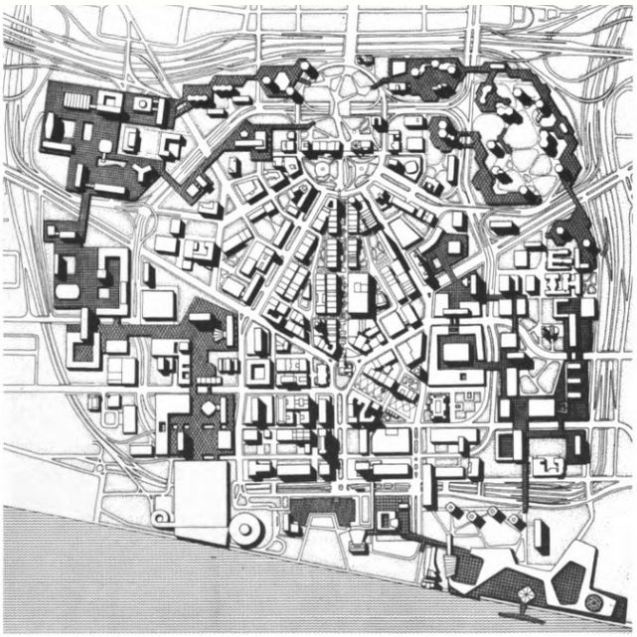
This conceptual plan takes the idea of dedicated space for people to gather to an entirely new level. If this plan had been implemented, Detroit would have had a Highline well before The collected works of Gerald Crane and Norbert Gorwic (CG) highlights their pedestrian focused plan for Downtown Detroit:

“In the superblocks surrounding the core system of elevated decks provides for the complete separation of pedestrian and vehicular traffic. The top of the decks form a new level of pedestrian squares and piazzas linked by pedestrian bridges, making possible an uninterrupted walk through the entire Central Business District. Vehicular access and parking facilities are provided beneath the decks.

Then came the People Mover, but could it be possible to link existing parking decks as rooftop parks connected by pedestrian bridges?


Map: Neighbor to Neighbor Community Outreach Zones 2018

NtoN2018-map.png

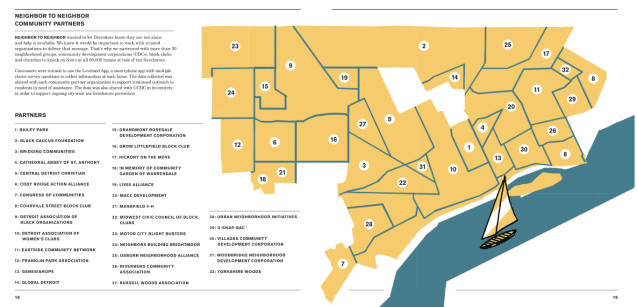
In 2018, the Quicken Loans Community Fund and the United Community Housing Coalition (UCHC) undertook the enormous effort of surveying every property headed to tax foreclosure and produced the Neighbor to Neighbor report. Early survey efforts in 2015 had previously taken place on a smaller scale as part of the Motor City Mapping project, although this report was given the tagline: “the first Detroit property tax foreclosure census.”

This map gives an interesting view of the reach and coverage of various community organizations in Detroit. Some are specifically focused on housing instability, but many of the community organizations that partnered have a wide range of issue topics that they engage in.

Map: Presidential Detroit 2020 Candidate Stops

2020debates-city

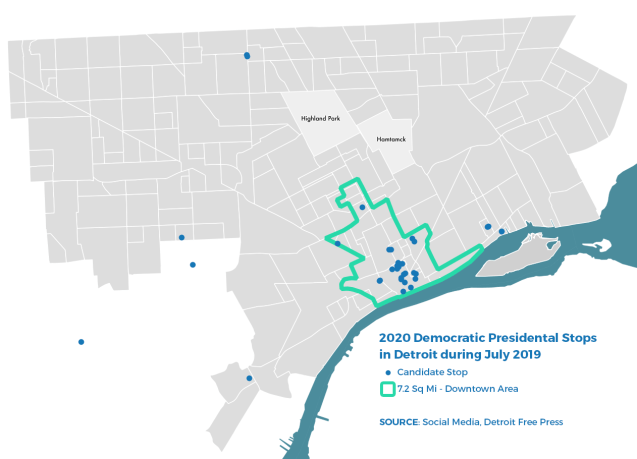
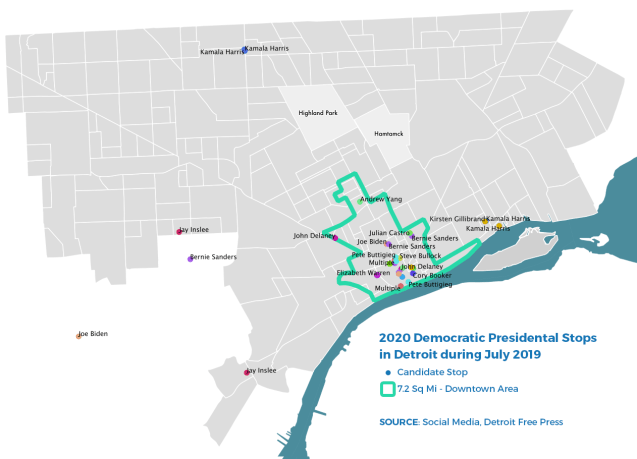
During the 2016 election cycle I tracked campaigns stops by candidates and their surrogates in Detroit. I wondered how the recent 2020 Democratic candidates reached geographically during the month of July before, during, and after the debates hosted in Detroit. The question I most often saw on Facebook and Twitter was: “Did any of the candidates make it out of the 7.2 square mile area of Downtown?”

The Detroit Free Press attempted to aggregate and map candidate stops and sightings, but had a number of missing events including the Qline shutdown caused by Joe Biden and Mike Duggan’s visit to Detroit One Coney Island.
2020debates-candidates

There were a few candidates that made the effort to go beyond Downtown. Notably, Jay Inslee visited 48217 and the Detroit Islamic Center, Kirsten Gillibrand spent a lot of time hanging out and working out in West Village, but by far Kamala Harris was all across the map in Downtown, West Village, and visiting struggling businesses along the Livernois Avenue of Fashion. Three candidates made it beyond Downtown, but much of Detroit was left unseen. Hopefully future candidate trips will seek to engage more residents across the city.


Workshop: Detroit Counter Cartography and Mapping

DMRJ Workshop(1)

Mapping is a powerful tool to influence positive change for people, programs, and policies. Participants will be lead through a skills-building in map creation, maps to highlight under-represented narratives, and mapping to advance social justice causes.

WHEN: Saturday, September 14th @ 9am – 2pm (Lunch provided)

WHERE: WSU Anthropology Computer Lab, Old Main Building (corner of Cass and Warren), Room 1143

RSVP: Link (limited to 22 participants)

Map: Detroit Square – Transforming Cultural Center

Screen Shot 2019-06-09 at 11.28.51 PM.png

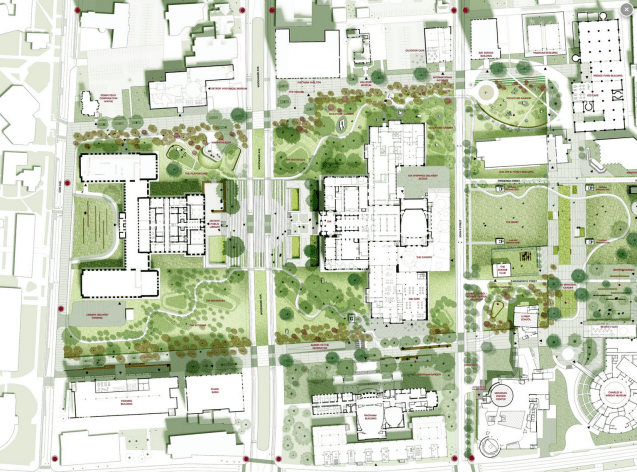
The design team has been selected from the three finalists to transform Detroit’s Cultural Center. The proposal seeks to radically change 10 blocks around 12 cultural and educational institutions in Midtown.

These efforts harken back to the 1970s plans by the Detroit City Plan Commission that included a large central park and long malls to connect various institutions.

Map: Metro Detroit’s Political Geography 2016

political-cities

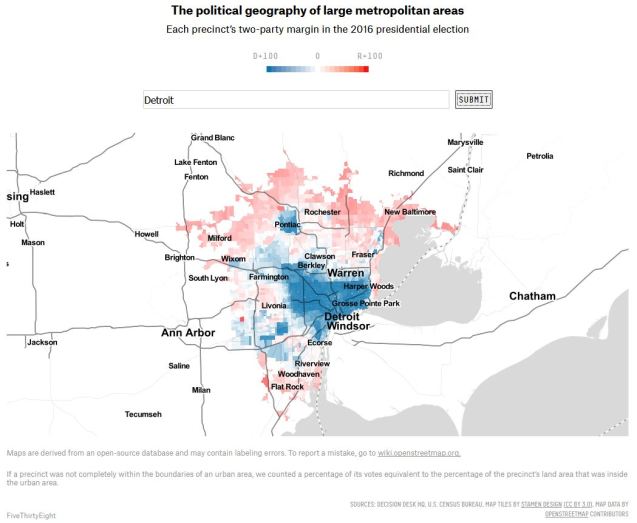
In FiveThirthyEight‘s recent project, they find the nuances of political geography for major metropolitan areas. Metro Detroit is not in the top 20 “most politically polarized” cities or regions. As the map shows, Metro Detroit, anchored by the City of Detroit, is heavily Democrat with a halo of evenly split inner ring suburbs, before dispersing to more Republican favored precincts around the edges of the region.

Map: Detroit’s Surveillance State 2019

d6r6bgxx4aaje0p

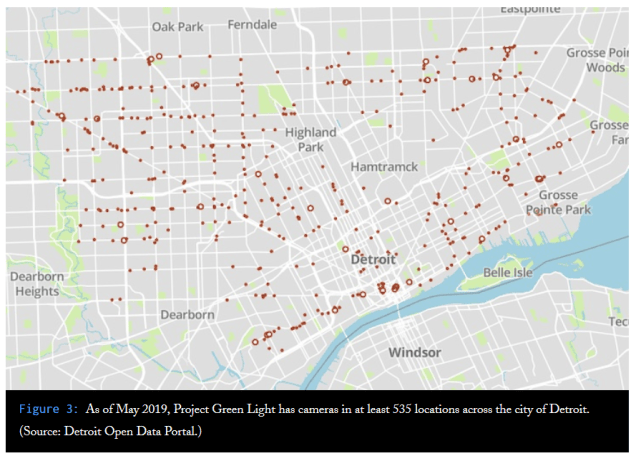
Project Green Light has become something more than imagined. More from America Under Watch:

“Detroit’s real-time face surveillance is designed to operate together with a program called Project Green Light Detroit, an initiative launched in January 2016 that has dramatically expanded the city’s network of surveillance cameras. The city has pitched the initiative as a way to deter crime and improve police response times to incidents at locales across the city. Its original focus was on businesses open during late-night hours such as gas stations, fast food restaurants, and liquor stores. Partner locations now also include churches, hotels, clinics, addiction treatment centers, affordable housing apartments, and schools.”
Map: Detroit’s Jewish Food Scene 2018

Jewish_Food_Detroit_11.5.18.jpg

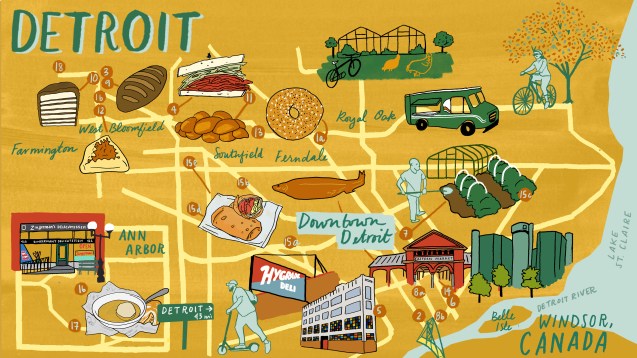
Food in Detroit is typically signified by Downtown dining, Eastern Market, and urban agriculture, but there are numerous ethnic enclaves bringing metro Detroit amazing foods to eat. Nosher highlights some of the best locations with this nice illustrated map by Aly Miller.

Detroit is a city defined by resourcefulness, entrepreneurship, and a fascinating tension between honoring the old and embracing the new. The same could be said of Detroit’s Jewish food scene, where iconic delis and bakeries operate beside upstart food businesses (yet everyone still sources Sy Ginsberg corned beef and Ma Cohen’s smoked fish), and where urban gardens that feed the local community are sprouting up on previously vacant lots.

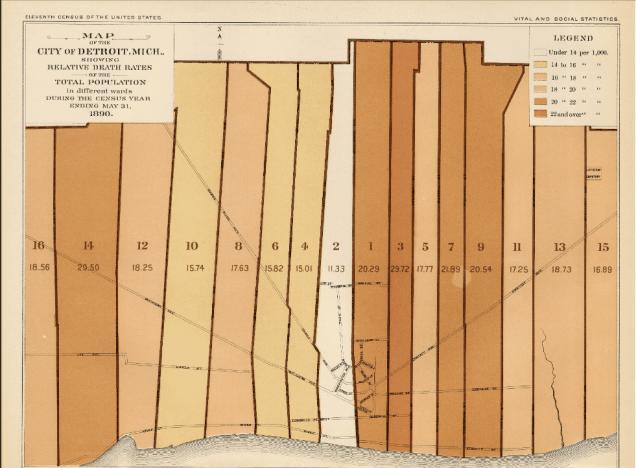
Map: Death Rates by Ward in Detroit 1890

Screen Shot 2019-02-20 at 7.48.42 AM.png

The 1890 Census report on Vital and Social Statistics specifically covered cities with over 100,000 inhabitants. In Detroit:

“The area of the city on June 1, 1890 was 13,173 acres, and the number of dwellings was 86,993, containing 42,200 families and a total population of 205,870, giving an average of 2.81 dwellings and 15.63 persons to an acre, 5.57 persons to a dwelling and 4.88 persons to a family.

The colored population of the city was 3,454, located principally in wards 1, 3, 5, and 7. In the remaining wards the population of this class was too small to give rates of any value.”

Each ward has a table breaking down death rates for different races as well as children under age 5. Even without the tables it is visually apparent there were racial health disparities in Detroit with the highest death rates in the same wards as the largest number of Black residents.

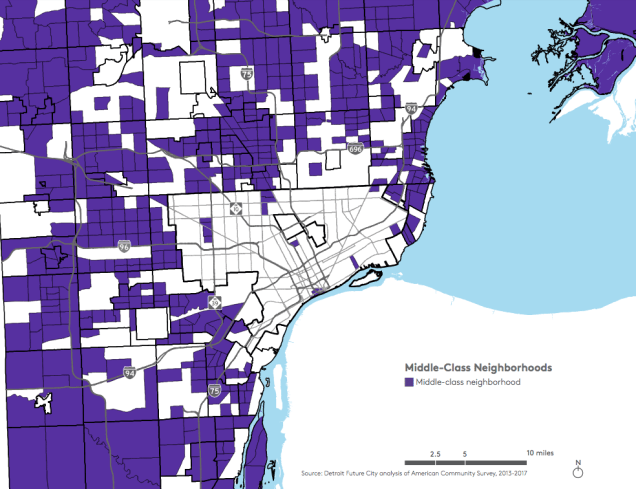
Map: Middle-Class Neighborhoods in metro Detroit

Screen Shot 2019-02-17 at 6.56.29 PM

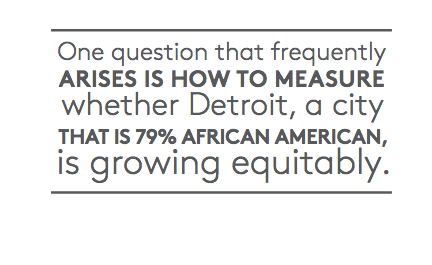
In the new report from Detroit Future City, their team highlights what is talked about less often and also what isn’t news: black families and middle class families leave Detroit and there are a host of problems that make them not want to come back or move here in the first place.

The city has set a goal to measure success by people moving back into the city, but perhaps the new metrics should be how many middle-class black families move back to the city?

Screen Shot 2019-02-17 at 6.59.19 PM


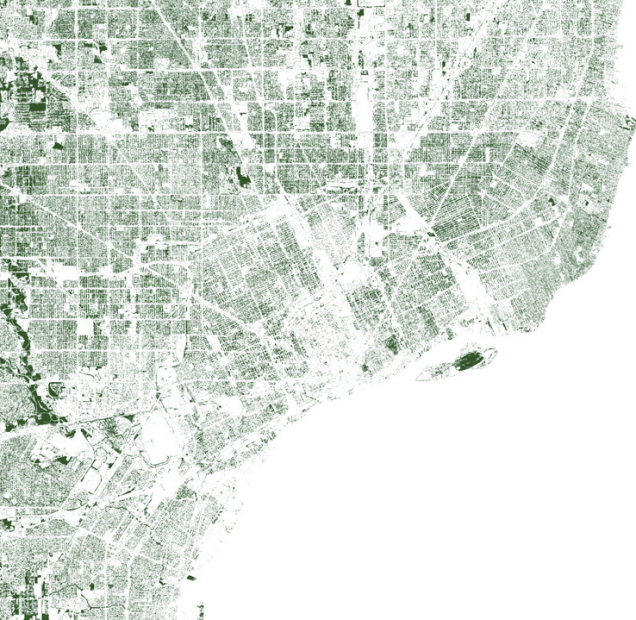
Mapping All the Trees in Detroit with Machine Learning

Screen Shot 2019-02-11 at 7.33.43 AM.png

Descartes Labs led by Tim Wallace, formerly of NYT Graphics, is mapping all the city trees. They note that many large cities pay huge sums of money for tree surveys, but those hardly capture all the trees and typically only count street trees. Machine learning with satellite imagery takes care of this so that you can see all the trees and their densities. Obviously, this is not new either, but the machine learning bit automates the process to be quicker than traditional tree canopy analyses.

It looks like Palmer Park has the most dense tree canopy in the city, followed by Belle Isle.

More from Descartes Labs:

Much fuss has been made over city trees in recent years. Urban trees reduce crime and help stormwater management (yay!). Cities and towns across the U.S. are losing 36 million trees a year (boo!). But, hold up—climate change is accelerating the growth of urban trees in metropolises worldwide (boo/yay?). Urban trees are under such scrutiny right now that the U.N. even had a World Forum on Urban Forests a few weeks ago to discuss the planning, design and management of urban forests and green infrastructure.

Map: Green Infrastructure Spatial Planning Model Detroit

screen shot 2019-01-28 at 2.44.21 pm

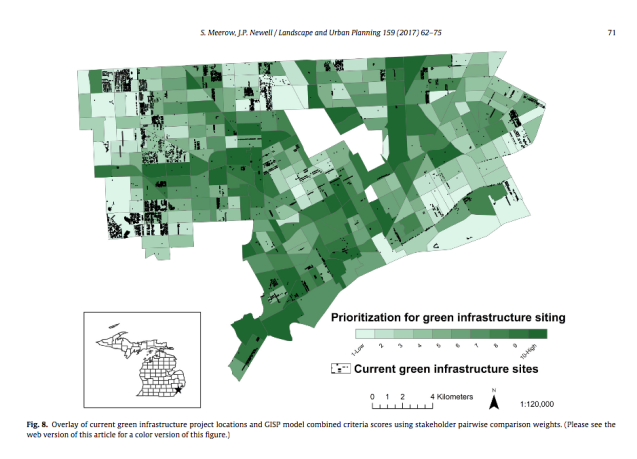
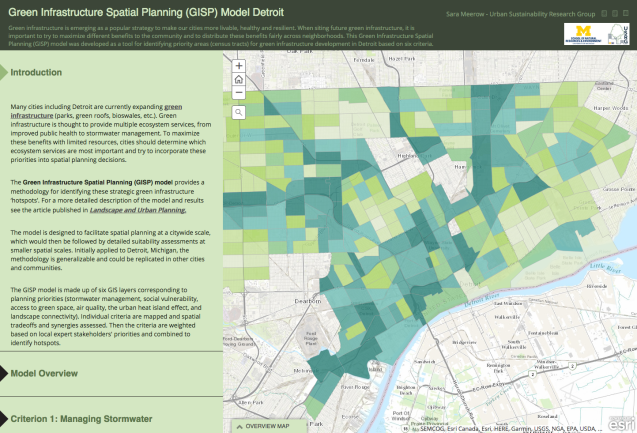
The Green Infrastructure Spatial Planning (GISP) model created by Sara Meerow of the University of Michigan Urban Sustainability Research Group provides a methodology for identifying strategic green infrastructure ‘hotspots’. 

The GISP model is made up of six GIS layers corresponding to planning priorities (stormwater management, social vulnerability, access to green space, air quality, the urban heat island effect, and landscape connectivity). Individual criteria are mapped and spatial tradeoffs and synergies assessed. Then the criteria are weighted based on local expert stakeholders’ priorities and combined to identify hotspots.

From her published research, Meerow also found that current green infrastructure efforts did not match with her model’s hotspots.

Screen Shot 2019-01-28 at 2.51.19 PM.png

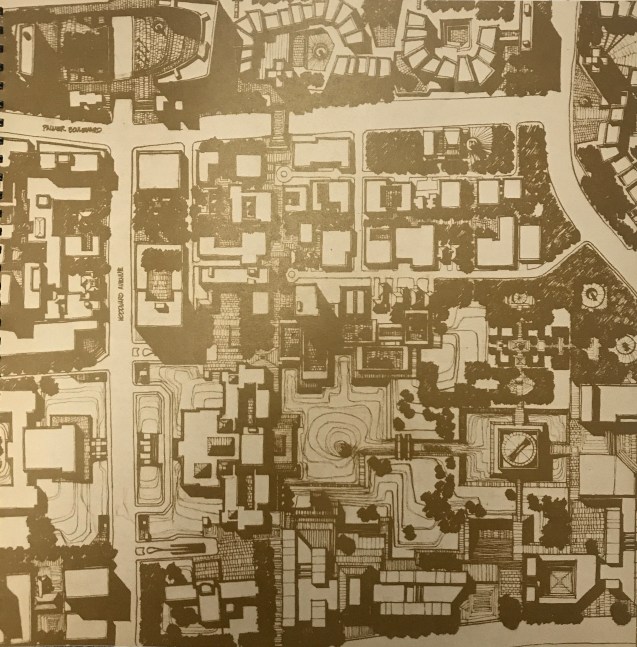
Map: Cultural Center Design Plan 1970

This map comes from “Detroit 1990: an Urban Design Concept for the Inner City” that the Department of City Planning published in 1970. This concept for the Cultural Center is especially interesting as competition continues to select a new concept for the DIA Plaza | Midtown Cultural Connections effort.

The City Plan Commission suggested expanding the Cultural Center in 1965 with a proposal for a large central park and long malls connecting various cultural institutions with links to the University and Medical Center areas.