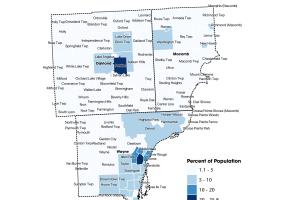
Detroit has had a significant Latino and Mexican American population since the 1920s when merchants and restaurants started showing up in the Irish enclave of Corktown. Today a Mexican-Irish festival has been held for a number of years showing the blend of cultures in Detroit’s oldest neighborhood.
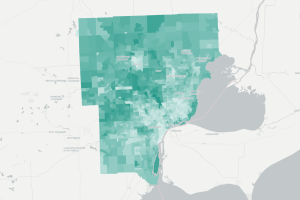
Regionally, the migration of the Hispanic/Latino population can be seen as higher overall percentages are seen in Downriver communities. I learned of this shift when making the taco map of Detroit and it shows in the Census data.
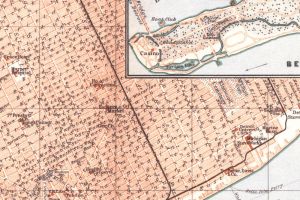
This map from the Library of Congress adorns the wall of the exhibition hall at the Dossin Great Lakes Museum on Belle Isle. I recently visited the museum for the first time with my son and just could not place this map from the wall. Typically I like to say that Windsor has been holding Detroit’s map legend since 1876, but that was not the case on this map. Windsor was labeled and the shoreline was fully populated. Thankfully, Emily Kutil recommended the US Lake Survey and there it was. The lake survey needed to map both sides of the river where locally we usually leave off our dear Canadian neighbors to the South.
Fun history bits on the map include the marshiness of the Grand Marais, the funky shape of Belle Isle before the ends were filled in to create Sunset Point, the well-defined Grand Trunk rail line encircling the city limits, and the demarcated farmland along the edges of the city. I personally adore the compass roses on this map.
Here’s to a pleasant map surprise on a random summer weekday!
This case study visualizes yearly housing cost burden across Detroit’s census block groups using 2024 American Community Survey data. A density chart plots block groups reporting both renter and owner median housing costs as a percent of yearly income. The near-zero regression slope between renter and owner cost burden suggests these pressures are structurally distinct, indicating a rental market that extracts disproportionately from tenants independent of neighborhood-level ownership costs. Block groups where at least 50% of renters are cost-burdened, spending more than 30% of their yearly income on housing, are highlighted alongside block groups where less than 50% of renters are cost-burdened. 43% of renting households spend over 30% of income on housing, and 12% of renting households spend over 40% of income on housing.
Localized housing cost is a variable in Detroit’s urban system that links individual financial uncertainty to neighborhood-level disinvestment, displacement, and resilience. Housing cost burden does not exist in isolation — it is a pressure point within a larger network of urban dependencies, where the share of income absorbed by rent shapes what households can spend, save, invest, and contribute to the communities around them.
Hannah VanWingen Eckertova is a researcher working at the intersection of data-driven decision-making and social equity. My broader practice is oriented toward the premise that rigorous, accessible data visualization is an art form of advocacy. When patterns become legible — spatially, statistically, comparatively — they become harder to ignore. I make visual art because I believe a more equitable world is built through better decisions, and that better decisions begin with better understanding through creative means.
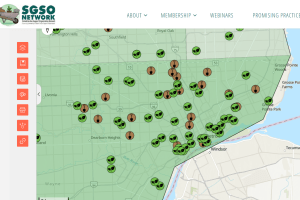
Within the City of Detroit there are 4,661 not for profit or nonprofit corporations registered with the Internal Revenue Service (IRS). There are 82 nonprofits registered in Highland Park and 73 in Hamtramck. The vast majority (n=3,268) or 70% of those nonprofits have $0 income. Most nonprofits are classified by the National Taxonomy of Exempt Entities (NTEE) as “christian” churches followed by “human service” organizations and “community improvement and capacity building” such as community development corporations (CDCs).
Income
Among the nonprofits that reported income, 966 reported some income under $1 million and 427 reported income over $1 million. The nonprofits with over $1 million that stand out in those very large yellow bubbles are:
Henry Ford Health System ($4.5 billion)
Blue Care Network of Michigan ($4.2 billion)
UAW Retiree Medical Benefits Trust ($3.8 billion)
DTE Energy VEBA Trust ($3.4 billion), and
Wayne State University ($1.4 billion)
Clearly this group of nonprofits are specific benefit funds that are massive in scale. The majority of nonprofits have budgets under $100 million. When nonprofits are filtered to just those with income over $0, “private foundations” become the dominant category of nonprofit making up almost 30% of all nonprofits making income in Detroit. Community economic development and capacity building nonprofits make up 16% and “christian” nonprofits make up about 11%.
Neighborhoods
All nonprofits were aggregated to the 56 Master Plan Neighborhoods to show spatial clustering and distribution. Nonprofits in the city have some obvious groupings in office heavy areas like Downtown, Midtown, the Woodward corridor, and Brewery Park in Eastern Market. After those areas, nonprofits follow a pattern of income with most nonprofits outside of Greater Downtown locating in the higher income Northwest Detroit neighborhoods.
Nonprofit 101
The City of Detroit Assessor is hosting a Nonprofit 101 Day on June 10th to learn about city taxes and compliance.
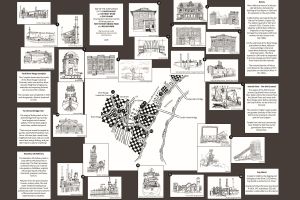
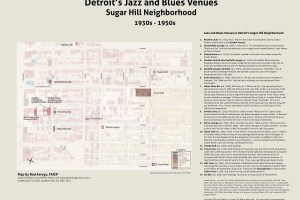
Before Motown put Detroit on the popular music map, the city was already swinging with jazz and blues venues. From the mid-1930s through the early 1950s, Paradise Valley and Sugar Hill — vibrant and mostly-Black neighborhoods clustered north of Gratiot, east of Woodward, south of Warren (Sugar Hill), south of Mack (Paradise Valley), and extending to Hastings Street (now the southbound I-75 service drive) — provided the beating heart of Detroit’s jazz and blues scene. Bars, cabarets, show bars, and nightclubs lined these blocks, drawing legends like Duke Ellington, Cab Calloway, Charlie Parker, and Dizzy Gillespie, and lifting up Detroit legends such as Milt Jackson and Yusef Lateef. In the Paradise Valley and Sugar Hill neighborhoods, there were over 50 venues in total. This map, created by urban planner, tour guide, and jazz archaeologist Rod Arroyo, charts 14 sites and 24 venues in the heart of Paradise Valley. They were community anchors, jazz incubators, and cultural gems in the city.
Rod Arroyo, FAICP is a Detroit-based urban planner, researcher, and educator with a Master of City Planning from Georgia Tech. A Fellow of the American Institute of Certified Planners, he served as a Partner at Giffels Webster, one of Detroit’s leading planning and engineering firms, and as an adjunct professor at Wayne State University. His research focuses on downtown and Detroit’s historic and predominantly Black neighborhoods, including Paradise Valley, Black Bottom, and Sugar Hill. Rod shares that expertise as a lecturer and as the owner of Detroit Legacy Tours, connecting residents and visitors with the city’s diverse and complex history.