Map: Detroit Transit Dependency Index

Screen Shot 2014-08-10 at 7.22.55 AM

This is another map from the research work of Nicholas Grisham, Terra Reed, and Kevin Shelton of the University of Michigan. As part of their deeper look into the Social Justice Impacts of Transit Reductions in Detroit, they developed a “transit dependency index” (TDI) index score for each Census Tract.

The TDI score is based on vehicle owership, elderly population, youth population, and median income within each Census Tract. The score doesn’t reveal any clear pattern across Detroit, but does show an interesting set of darker TDI areas along Detroit’s major avenues: Woodward, Grand River, and Gratiot. These routes have some of the highest bus ridership, but due to the nature of Census Tracts, might not make sense for all residents of Detroit.


Detroit Flood Insurance Map 1981

Detroit FEMA 1981

This map (with an interesting take on the Detroit border) is unfortunately timely in its discovery after the recent flooding. The map is a part of a 1981 study of flood insurance and flood plain issues in Detroit.

“This Flood Insurance Study investigates the existence and severity of flood hazards in the City of Detroit, Wayne County, Michigan, […]”

The study was to cover areas of low development for potential upcoming flood risk as far into the future as 1983 and there was a focus on the shoreline because it was highly developed and “susceptible to flooding and erosion.” The report later notes that the shoreline area of the City of Detroit had a very low likelihood of flooding. There haven’t been ferry boats on Downtown streets since composite photography made some stunning fake postcards in the early 20th century.

Source: Detroit Historical Society

The 1970s also saw some serious flooding:

“One of the most sever recent storms which affected the eastern portion of Detroit occurred on November 13 and 14, 1972. Storms on these dates, combined with a high lake St. Clair level, caused flooding which inundated approximately 800 homes within the city. This resulted in gross property damage estimated at $2 million. The storm of March 17 and 18, 1973, inundated an estimated 600 acres of the urban Detroit area.”

The study’s final recommendations were to develop a floodway that could handle a 100-year flood. It seems that the recommendations of this report were not followed.


Map: Detroit Pingree Potato Patches 1896

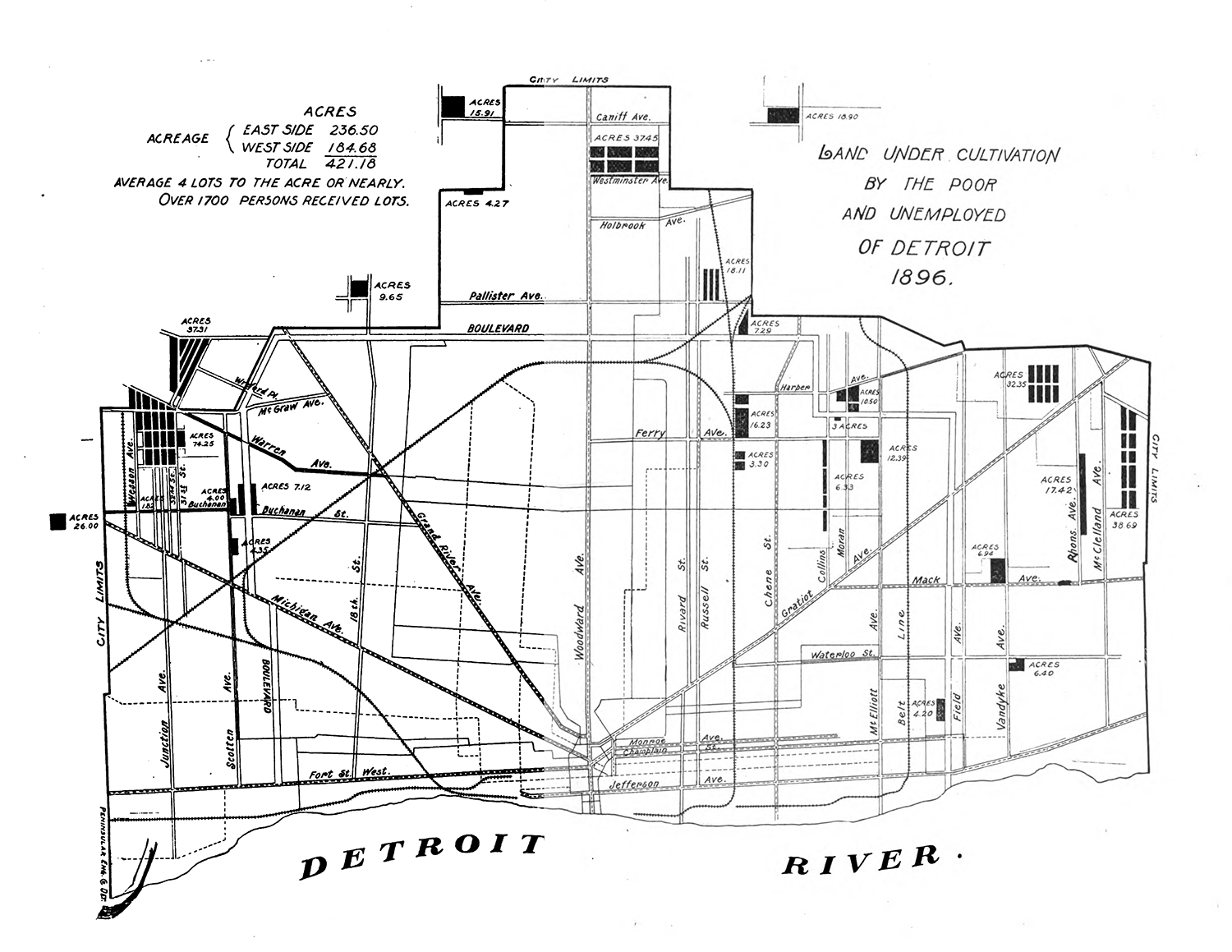
pingree_patches_1896Mayor Hazen Pingree launched an elaborate plan to help employ and feed Detroit residents affected by the economic depression of 1893, which was a result of overbuilding and financing of the railroads. In the Report of Agricultural Committee of the cultivation of idle land by the poor and unemployed, John Conline recommended:

“[…] that the city purchase, if practicable, 200 or more acres of land on either side of Woodward avenue, to be used as farms, fenced and provided with inexpensive store houses for tools, seeds, etc. with an intelligent overseer or superintendent for each division.

In short, have the Pingree Detroit Plan so systematically arranged in advance in all its details, that work which is now spread over six weeks, can be concentrated into one week or less time, and the entire issue of lots and seed be confined to a single day.

These farms can, as the city becomes larger, be converted into parks.”

Map: Detroit Transit Efficiency

transit_efficiency_mit

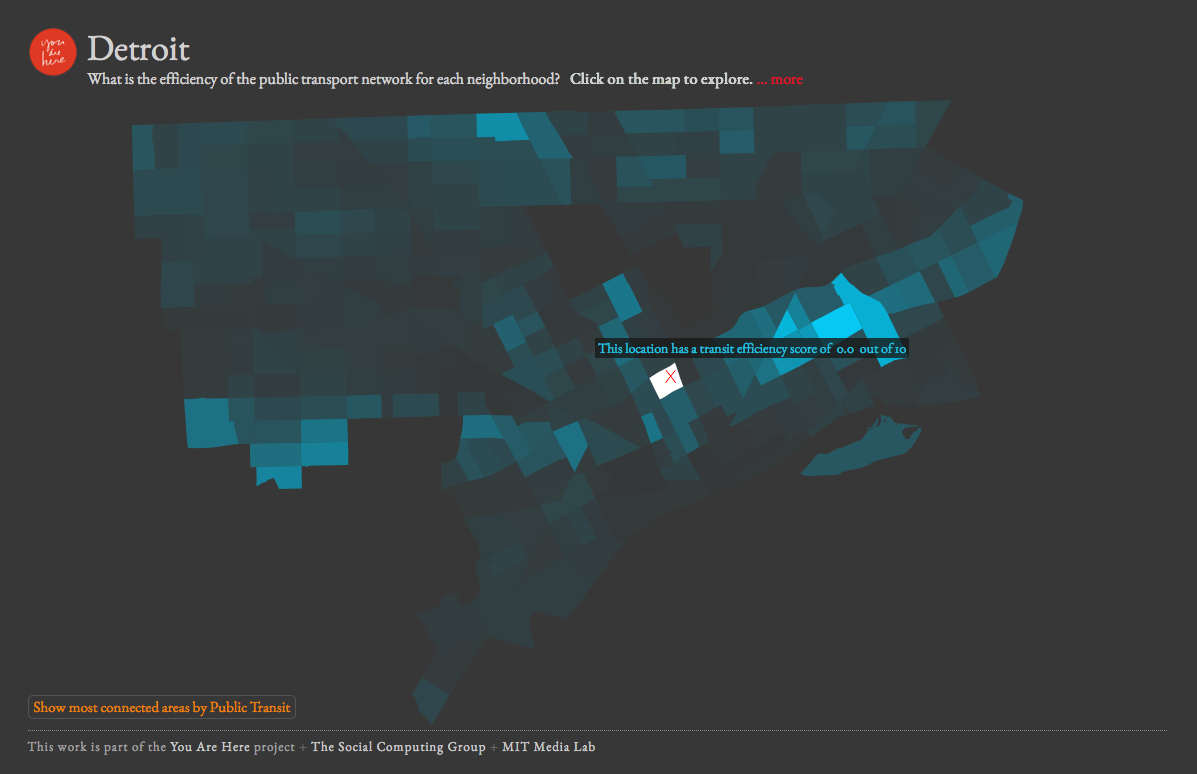
This is another project that comes from MIT Media Lab’s You Are Here that looks at transit efficiency. This one I have less of a problem with than StreetScore. There are glaring issues with public transit in Detroit and this map helps to show how much the system is potentially failing large sections of the city. The missing piece is obviously anecdotal information about how long it really takes to get from one point to another on DDOT buses, such as: wait times, delays, no buses, etc. My only critique would be to include some reference roads and streets because no one knows their Census Tracts. The pictured tract received a “transit efficiency” score of 0.0 out of 10.0. It happens to be the Census Tract where I currently live and indicates that I would need to walk a while before being able to efficiently use public transit.

“This map visualizes the efficiency of the public transit infrastructure for different neighborhoods in the city. For each point in the city, we query the times it takes to reach every other point by riding public transit and by driving a car. We then divide the former with latter. This ratio represents the efficiency of a transit system. We normalize each scores by dividing it by the maximum ratio in a city and multiplying by 10, giving a relative transit efficiency score for each neighborhood. Darker areas (closer to 0) are transit deserts where cars are a necessity, while lighter areas (closer to 10) are places where public transit represents a more viable alternative.”

Map: Detroit’s Black Neighborhoods 1940

scan0005

This map appears in The Origins of the Urban Crisis by Thomas Sugrue. It is often easy to forget that most of what is exciting and “happening” in Detroit today once represented the pinnacle of the Black middle class in America. Paradise Valley, extending from the Riverfront nearly to Highland Park, grew after Black migration to Detroit after WWII. It was a hot spot for music, entertainment, and also the seedy covert businesses that go along. The flip side of all of this was that these areas were also representative of the worst housing and conditions because Blacks were not allowed to live or buy homes anywhere else. This often led to overcrowding, disease, and concentration of poverty. This was the oldest housing and prone to fires. Sugrue notes that Paradise Valley represented 12% of the city’s housing, but one third of all fires. The Lower Eastside was also referenced as the “rat belt” because there were 206 rat bites between 1951-52.

The Westside neighborhood around Tireman and Grand Blvd. was where many sought to get away from the overcrowding. These families represented more upwardly mobile black families (ministers, business leaders, professionals) who took great pride in their “high-level” homes and neighborhood.

Eight Mile-Wyoming was an area settled by Black migrants in the 1920s when it was still empty farmland. Families built temporary homes and usually farmed the adjacent vacant lots.

Conant Gardens was considered the most exclusive Black neighborhood where residents had the highest incomes and the majority owned their own homes. Residents here actually sided with White homeowners in opposing the Sojourner Truth housing complex because it would bring down their exclusive status.

Source: Sugrue, T. J. (2005). The origins of the urban crisis: Race and inequality in postwar Detroit. Princeton University Press.

Detroit Bus Ridership Map 2013

ddot_bus_2013

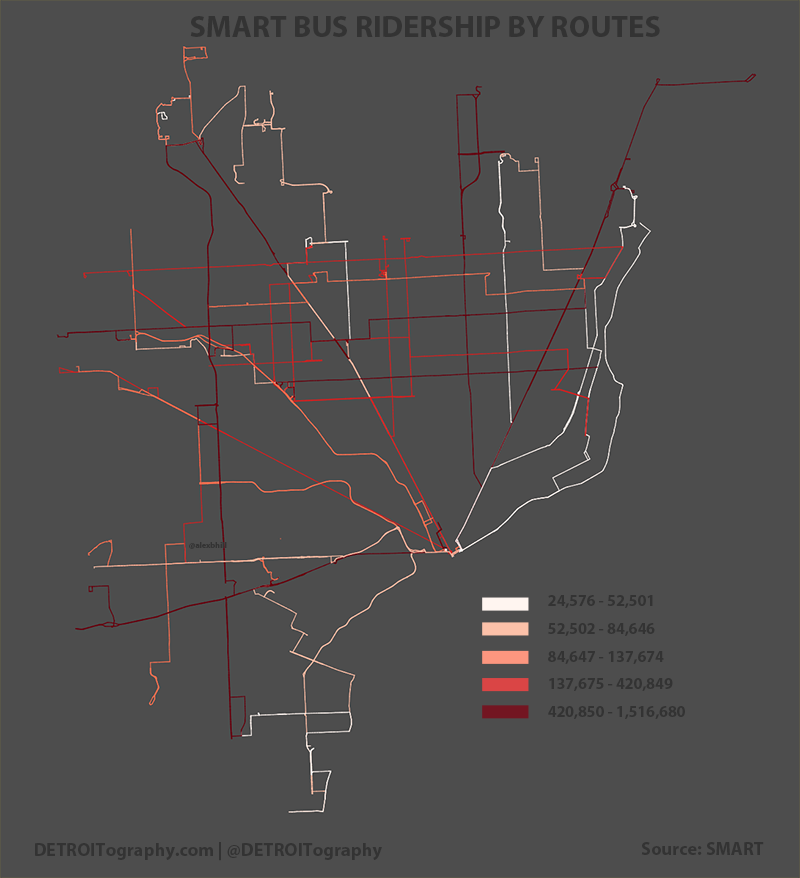
After looking into the DDOT data via TextMyBus for a while, I had been very interested in ridership and where people were riding the bus the most. All the issues with DDOT aside, my main question was: ‘what routes were transporting the most people.’ The data that I have obviously doesn’t account for where people got on or off, but rather an aggregate number of riders for the year on a particular route. Not surprisingly, the busiest routes are on Detroit’s main artery roads:

Agency Route Num Name TOTAL
DDOT 53 Woodward 3,029,371
DDOT 16 Dexter 2,549,735
DDOT 21 Grand River 2,399,730
DDOT 34 Gratiot 2,038,153
DDOT 45 Seven Mile 1,573,339

The crosstown routes were also busier than others with 7 Mile, 8 Mile, Crosstown, and Jefferson routes all moving at least 1 million riders.

The top SMART routes also follow Detroit’s main arteries (Gratiot, Michigan, Grand River), but tend to have an expected focus on routes that travel North-South from suburbs to city, such as Van Dyke or Southfield-Greenfield. With the passage of the recent SMART millage, these data show that SMART is an important connector for many people to travel between the city and suburbs and vice versa.

smart_bus_2013

Map: Educational Achievement Authority Schools in Detroit

EAA-school-map2

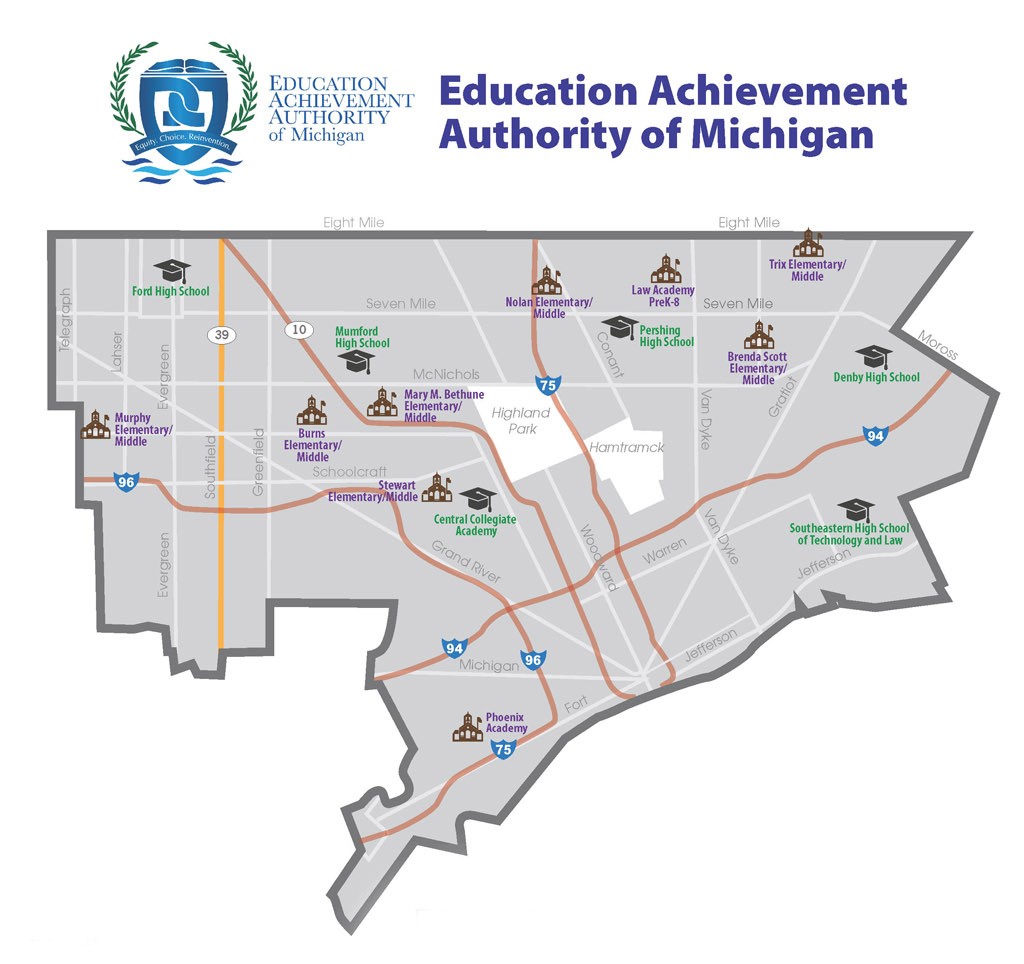
The controversial Educational Achievement Authority (EAA) was established by Governor Snyder as a statewide school district for failing schools. However, the EAA only consists of Detroit Public Schools and has faced difficult legal, financial, and safety concerns through its operations. The most alarming fact that demonstrates that people are not happy with the program is that EAA schools have seen student enrollment drop drastically (24% drop in enrollment).

There doesn’t seem to be anything geographically significant within the city limits. There are notably no EAA schools near the Downtown/ Midtown areas of “revitalization.”

EDIT: 08/07/14 Read this excellent look into the world of charter school profiteering in Detroit, The Charter School Profiteers

Data: 2014 Adopted and Maintained Detroit City Parks

cityparks

Out of 4763.78 acres of city parks, excluding golf courses and cemeteries, 3256.89 of those acres are being regularly mowed by the city or have been adopted by a community organization, church, corporation, etc. What do you do with 1506.89 acres of unmaintained city-owned greenspace? Obviously, maintaining vacant land and keeping track is difficult, but there must be a better system to keep check on these kinds of community assets.

Unfortunately, the adopted parks list, the scorecards, and the mowing schedules lists had many discrepancies in park names, spelling, etc. These various issues must have come from disparate databases. Alfonso is changed to Alonzo, Ramsey is changed to Ramsay, Dr. AW Diack Playground is listed as simply “Diak,” Max Sawyer is referred to as Sawyer Playground – I’m not sure how the city can keep it all straight. I couldn’t tell you how many double name parks were just reversed (i.e. Beland-Manning –> Manning-Beland) or hyphen versus ampersand versus “and” versus a slash. You would think that there would be a single database used within the same department. The parks are a good test case for updating and improving city databases and tracking systems. There should be a single, solid database of information on parks, adoption, and tracking.

[Detroit Park Locations – Polygons] “Location of Detroit Park Areas in polygon format (shows boundaries) including size, condition and use of park.” – Detroit Data Collaborative (D3), 02/24/11

[Parks Landmarks] “Municipal Parks and Landmark features for the City of Detroit. Includes golf courses, City Airport and civic plazas. Does not include all school parks, unless they are maintained by Detroit Parks and Rec. This layer was developed by Data Driven Detroit by adding to a GIS file that was provided by the City in 2010. Some parks in the file may have been “abandoned” and are not maintained any longer.” – D3 Open Data, 02/11/14

Even these two openly available GIS files were full of errors with naming and did not match. Not to mention the polygons were different shape and quality.

Data sources:

Highlighting: Yellow (city mowing + adopted), Red (naming discrepancy or missing from city lists)

Map: Detroit’s Class Divide

detroitcityWEB

This map comes from a series by Richard Florida of The Atlantic’s City Lab looking at class in the USA through the lens of the Census Bureau’s American Community Survey (ACS).

“[…] today’s three major classes: the shrinking middle of blue-collar workers in manufacturing, transportation, and maintenance; the rising numbers of highly paid knowledge, professional, and creative workers in the creative class; and the even larger and faster-growing ranks of lower-paid, lower-skill service workers.” (Link)

It is not surprising to see the pockets of Detroit’s creative class in the well-known neighborhoods (Lafayette Park, Corktown, East Riverfront, Midtonw Palmer Woods, Grandmont-Rosedale) that get a lot of attention while the rest of Detroiters are primarily in service worker roles. The expansive service class represents the loss of Detroit industry and the loss economic opportunity for Detroit’s residents.

More from the author:

“Much of the city outside of the downtown core has literally been abandoned. More than 25 percent of the city’s residential parcels (more than 90,000) are empty lots, and another 10 percent (33,500 parcels) are vacant homes, according to a comprehensive 2010 survey.

Detroit’s creative class is located along the lakeshore in the city, as the map above indicates, in a narrow strip that runs north along Jefferson Avenue from downtown through historic Indian Village towards Grosse Pointe. Home to Wayne State University and major arts and cultural institutions, rapidly revitalizing Midtown has also drawn a growing creative class population.

The purple blotch in the north is upscale Palmer Woods, noted for its large Tudor homes close to Detroit Golf Club. The neighborhood was founded in the early 20th century as an exclusive enclave for auto industry barons, including the founders of Fisher Body, and is where a number of Motown recording artists live today.”

Map: The Future of Detroit’s City Parks

cityparks

Parks in Detroit have had an interesting history and have had a busy few years. Some started as urban gardens on vacant land while others have been donated by families. Some parks have historic designations while others still have private land deed holders. This summer WDET has started a Detroit Park Watch blog and has been commenting on how Duggan has been managing to keep parks open and maintained. The volunteer “Detroit Mower Gang” sees fewer parks that need help, but also community gardens and greenspaces have been cleared or mown down by the city. There is also controversy over the city selling 15-acre Lipke park to the Salvation Army.

I did some mapping with parks data in 2012 when Mayor Bing announced the closing of 51 city parks, but it was very difficult since park names were listed differently in different databases. Bing was able to raise $14 million to keep the parks and recreation centers open that summer as part of the “Active & Safe” program. 119 churches and nonprofits stepped up to “adopt” parks and a 10-14 day mowing schedule was instituted for high use parks, while low use parks were placed on a 3 week mowing schedule. The program also allowed for a permanent staff member at 5 parks: Palmer, Patton, Clark , Farwell, and Lasky for daily maintenance.

Mayor Mike Duggan has continued a similar program of selecting “premier parks” (n=23) and encouraging park adoption (n=76) to keep as many parks open as possible. There is a current list of 76 adopted parks ranging from corporations to churches. Something new that Duggan’s administration has started is a scorecard for groups that have adopted a park based on how well they have maintained mowing, trimming, etc. Partners who have adopted a park are given a score between 1 and 9, the average so far is a 6 for most parks. The city has mowing schedules for 165 city parks, but these also overlap with 16 adopted parks, so it is unclear if they are scoring themselves or their park “partners.” Additionally, that leaves 112 “city maintained” parks without a clear plan. Among those 112 is one of the city’s “premier” parks, Stoepel No. 1.


Detroit Rapid Transit Planning Map 1945

det-highway-planning-1945

It is always interesting to find old transit plans in Detroit. In 1945, the plan for rapid transit was still young. You can see the East-West route slides down to Jefferson near Conner Ave and seems planned to end where the Jefferson North Assembly Plant is today. This plan I think still holds relevance today because the continued importance of Detroit’s spoke streets and main road arteries. Grand River, Woodward, Gratiot, and Michigan Avenues are all still very busy and key routes in and out of Detroit.

What stands out the most from this plan is the various modes of transit: streetcar, trolley, rapid bus routes, and even a planned subway. Just imagine if today the M-10 Lodge Freeway was instead a subway system? How many parking lots would we see Downtown?


Map: Watch Detroit’s Businesses Wake Up

Detroit_awake

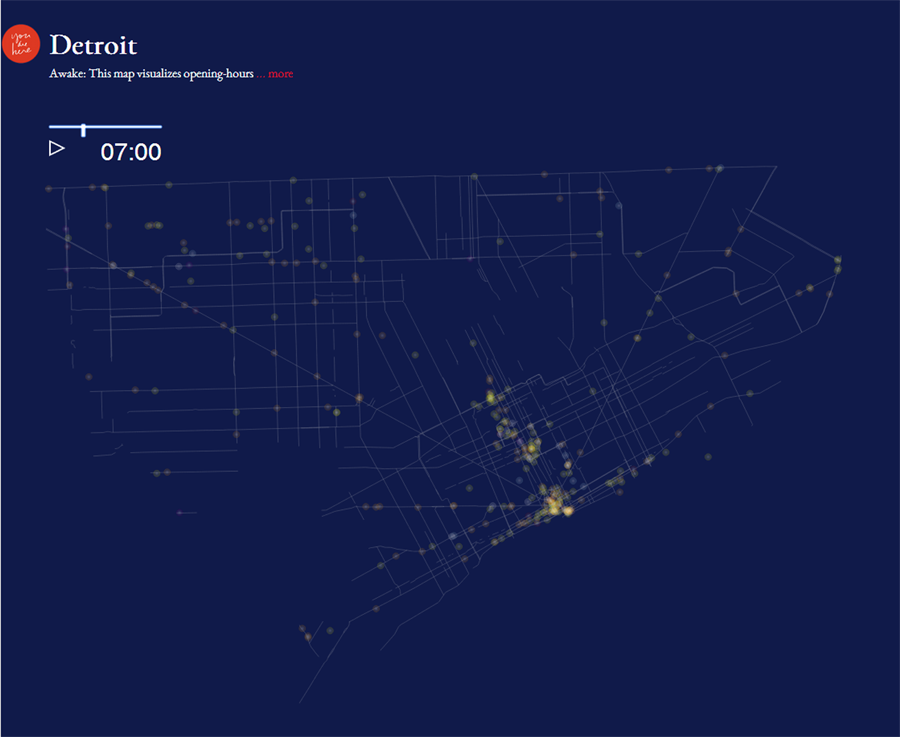
This fascinating visual from The Social Computing Group at MIT Media Lab called You Are Here relies on opening hours of Detroit businesses. By 8am the whole city seems to be awake and into the early hours of the night/morning there are only a handful of 24 hour businesses. There is obviously a lot of businesses focused Downtown, but I wonder how comprehensive their dataset is for smaller businesses outside of the Downtown/Midtown area?

They also did a cool thing where they paired down roads to the most active for businesses throughout the day.

Map: Detroit Motor Bus City Routes 1924

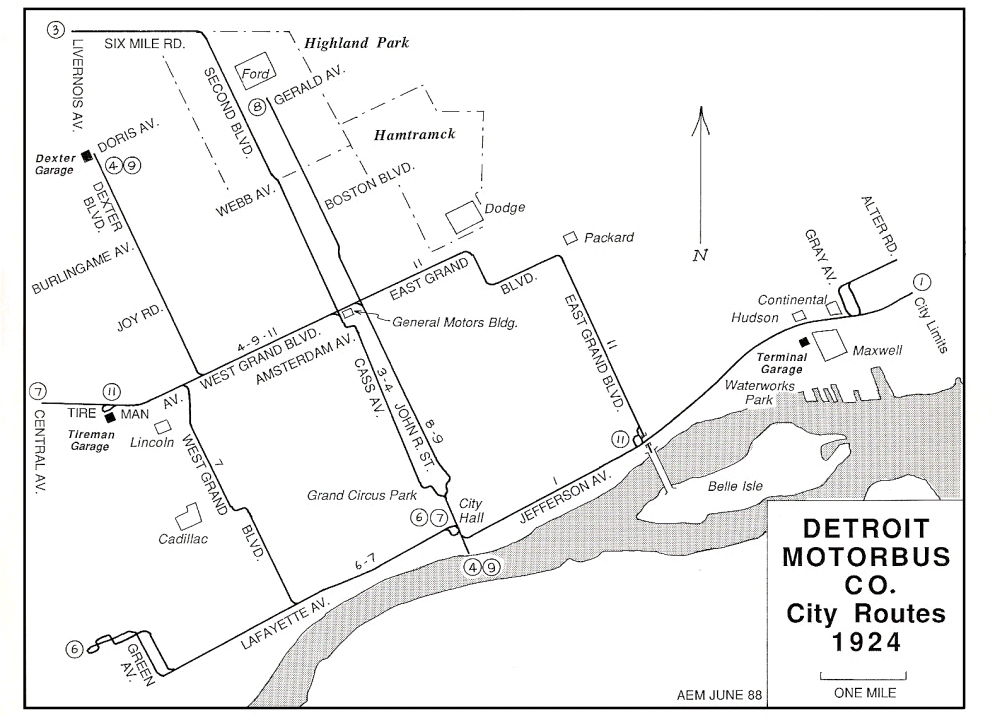
DMB_routemap-city1924I came across this map from the Detroit Transit History website and immediately thought of The Detroit Bus Company.

Organized back in 1919 by Herbert Y. McMullen (an automobile accessory and supply distributor), the Detroit Motorbus Company would become the first permanently successful transit bus company to provide motor coach service within the city of Detroit.  To help gain the support of the public as to the type of service it would be providing, the company began operating a sample prototype double-decker bus on demonstrator trips to hotels, banks and department stores within the central business district, and along Woodward Avenue.

It is hard to imagine a time when buses did not traverse the city of Detroit, but largely up until 1924 public transportation was all street railways. The Department of Street Railways (DSR) began its first bus lines in 1925. By 1930, the Detroit Motorbus Company (DMB) was running 395 buses within the city and the suburbs. In 1931, the city began negotiations with DMB to takeover its operations as a way to eliminate competition. By 1932 many of the DMB lines had been taken over by the city and many of the DMB’s suburban lines still exist as SMART bus lines today.


Map: Industrial Corridors of Detroit 1958

industrial-corridors-1958

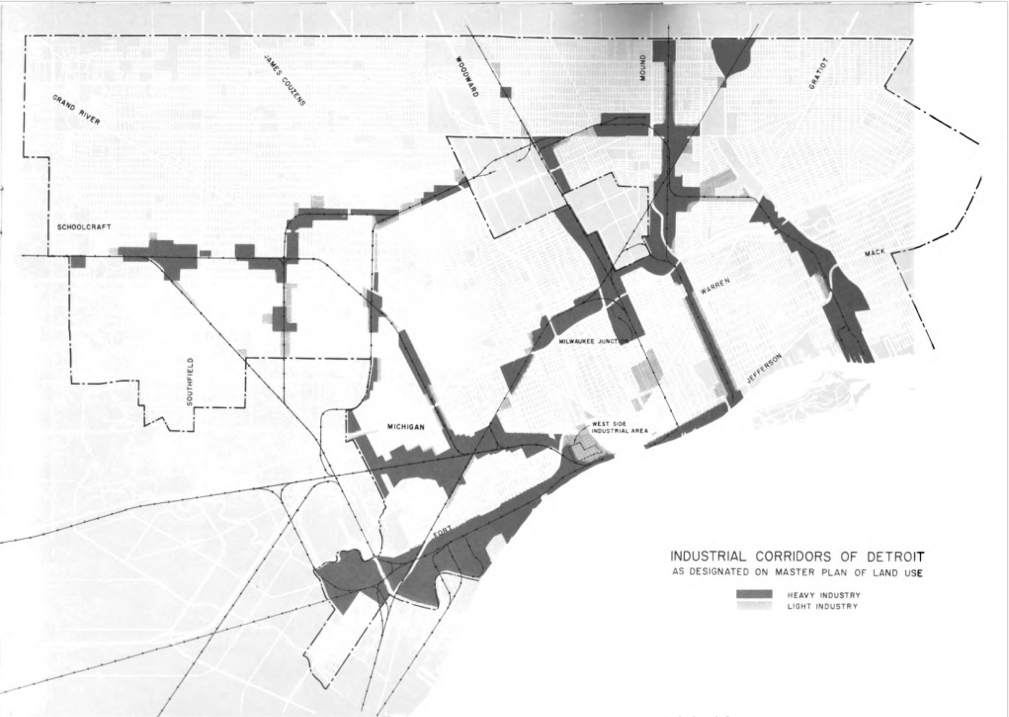
Urban renewal and redevelopments are common in any large city. In 1958, the West Side Industrial District was an attempt to revitalize and stoke some industrial activity in the area near Michigan Central Station (MCS). The introduction page of the planning report reads:

“This publication is prepared to describe a program which Detroit is undertaking to clear one of its oldest and most blighted residential districts and to prepare it for rebuilding by means of federal assistance provided in the Housing Act of 1949.”

The hope was to capture “modern industry” through warehousing and plant locations with rail access and plenty of space. While there is an area of Detroit known as “West Side Industrial” the modern industry is lacking. Some have decided (jokingly?) to ironically refer to the area (and Hubbard-Richard neighborhood) as Corktown Shores.

Map: Detroit Rambling recreates the Smells of the Midtown Loop

midtownloop-day062714

jacqui Au of the Detroit Area Rambling Network took some time and recreated my “smells of the Midtown Loop” map with her own smell experiences. Additionally, with some beautiful hand drawn maps! Here is an excerpt from her post:

“Daytime is much smellier for the Midtown Loop than night, with thirty-two scent events compared to eighteen after hours. While I wasn’t struck by its unpleasantness while walking, exhaust fumes were abundant on my daytime loop, accounting for eight scent events where traffic lined up at stoplights. The nighttime walk was dominated by five great woodsy whiffs of fresh mulch. More mysterious scents floated through the night air — chlorine, gasoline, and a funny plastic reek, none of which had an origin visually evident.”

She concluded that the Midtown Loop was designed more for visual than scent experience. jacqui walked the loop both during the day and night to do a comparison.

“The relatively clear air after dark is a significant benefit for pedestrians uninterested in basking in noxious fumes and harmful particulates as they stroll along a greenway.”

Thanks jacqui!

Map: Thrift Gardens in Detroit 1934

IMG_0267

Thanks to Joe Cialdella, PhD candidate at University of Michigan for sharing this map and great info. Joe has been researching the history of urban farming and gardening in Detroit. He recently published “A Landscape of Ruin and Repair: Parks, Potatoes, and Detroit’s Environmental Past, 1879-1900.”

This map appeared in the Annual Report of the Thrift Garden Committee, 1934, which is part of the Detroit Thrift Gardens manuscript collection at the Burton Historical Collection at the Detroit Public Library.

I wrote last week about the data shared by the Detroit Historical Society. There were 6,600 gardens covering 400 acres in Detroit in 1932. It is interesting to see most of the thrift gardens around the outer edges of the city where there were smaller populations and likely more open land to use for gardening. How many of these remain as gardens or parks today?

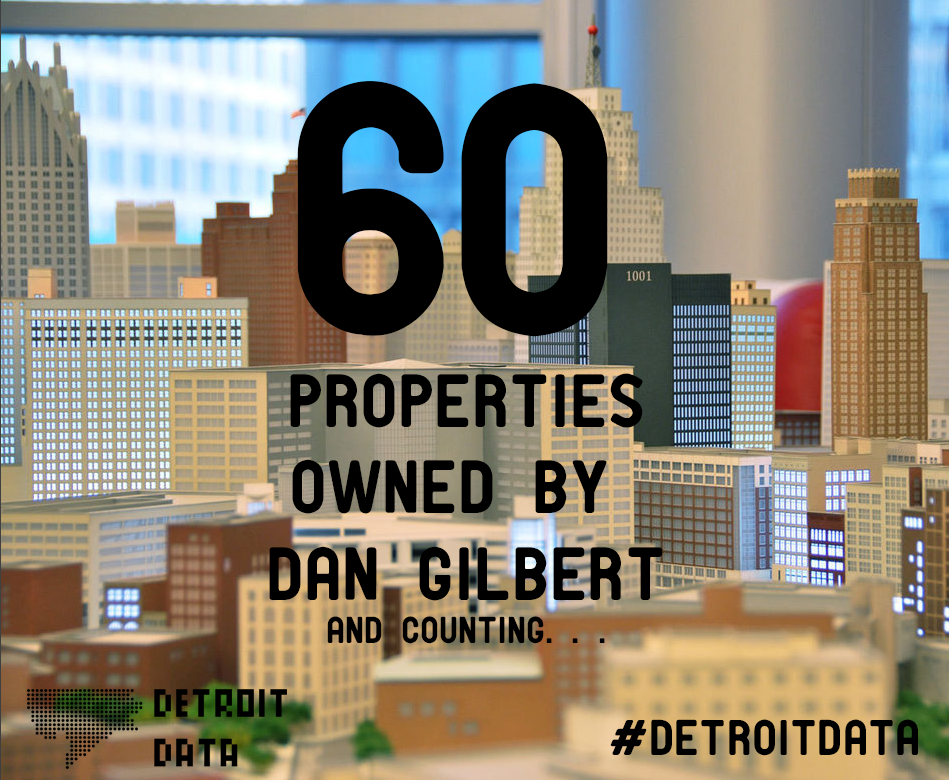
Data: 60 Dan Gilbert Owned Properties in Detroit

dan_gilbert_properties

If you’ve heard about Detroit, then you’ve definitely heard about Dan Gilbert. The CEO of Quicken Loans has been buying up properties in Downtown Detroit and implementing his own plan of change and revitalization as he goes. He has increased business capacity and brought more businesses to the Downtown area. While some see Gilbert’s purchasing as a sort of takeover, the lasting impact of Gilbert’s efforts in Detroit are yet to be seen. Recently, Gilbert has had to face-off with other potential buyers when he used to be able to more easily purchase what he wanted.

Help us update our list and fill in missing information. Leave a comment on a particular cell of the spreadsheet if you have more information. Thanks! Access the spreadsheet HERE

Map: Top 40 Delinquent Commercial Water Accounts in Detroit

detwater

A list was finally published of some of the top commercial water customers with delinquent accounts. They have ranged from companies who have been in trouble in the past with Michigan’s Licensing and Regulatory Affairs (LARA) to individuals who seem to have attempted business ventures that failed. What is most surprising is that among the top 40 delinquent commercial accounts there is a cluster in Midtown and Downtown – the newly named “Innovation District.”

The Detroit Water and Sewage Department (DWSD),a not-for-profit by Michigan mandate, estimates that 18,073 commercial accounts make up about $26 million of the deficit or almost a quarter of accounts past due.

We looked into a few of these corporations and found some odd things:

  • Vargo Golf – with the highest amount past due, manages six golf courses in metro Detroit with three in the City of Detroit – Palmer, Rouge, and Chandler.
  • Borman LLC was taken to court in 2010 for defaulting on a commercial mortgage, the property at 18718 Borman St. is a large industrial property located where I-96 and Southfield Fwy meet.
  • Metro Livernois LLC received millions in brownfield redevelopment funds for work on the Metro Plaza Redevelopments, it is unclear what or where that project is
  • State of Michigan-DMB, one of the downtown locations, claims that it doesn’t owe the city this money
  • G F H Enterprises could not be found listed anywhere
  • Brodhead Armory, built 1930, has not been used by the military reserves since 2004. Check out the abandoned building on detroiturbex.

Peruse the full list of data HERE, let us know if you have other information on any of these accounts.

detroitdata_get

Detroit Map Cutout at City Bird

photo (13)

The boutique shop, City Bird, located in the Design District of Cass Corridor within the Midtown area, has a nice wood cutout of Detroit hanging on their wall. The accuracy may be a little off (Southwest squiggle), but it is always fun to see a map of Detroit as interior decor. The shop carries a wide variety of Detroit map goods from cutting boards to beer glasses and postcards.

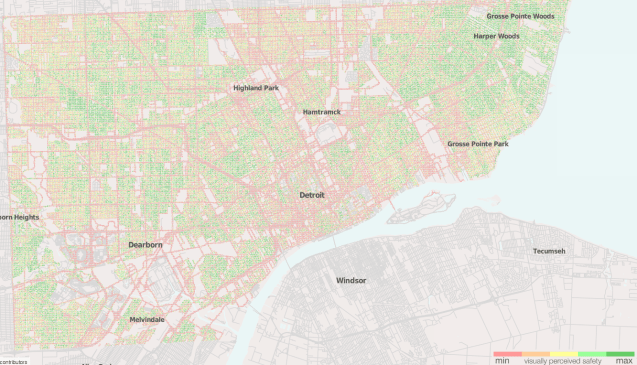
Map: StreetScore algorithm of safe streets in Detroit

streetscore

I came across this new exciting tool for perceived safety in cities. Among New York, Boston, and Chicago was also Detroit. I was almost too excited that Detroit was being geographically studied alongside those other cities until I read into the project further.

Place Pulse aims to quantitatively recognize which areas of a city are perceived as wealthy, modern, safe, lively, active, unique, central, adaptable or family friendly.

With enough user participation, Place Pulse can identify which neighborhoods in Bangkok are perceived better than neighborhoods in New York City or to examine how the distribution of a certain perception in Mexico City compares with that same perception in Tokyo.

For curious researchers, the Place Pulse dataset can even be used to study the association between urban perception and other datasets, such as violent crime, creativity or economic growth.”

Place Pulse creates its output via an algorithm called StreetScore that depended on at least 7-10 clicks per city image, of which there are about 100,000 for 54 different cities (not including Detroit). The StreetScore algorithm was then applied to Detroit based on characteristics found in other cities. However, I’m not sure how well it matches with Detroit.


streetscore_good

Streetscore assigned this vacant house on the Eastside with a high score although the area is not the most well maintained. I can only assume that the algorithm saw a lot of greenery in the image and thought it was a park or green space. I clicked on a number of highly scored vacant lots and abandoned houses, which I would have given very low scores.
streetscore_bad

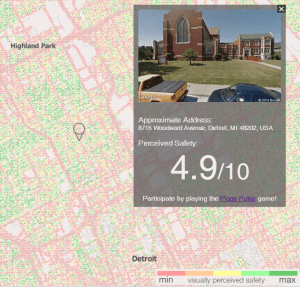
The flip side was also true. Locations where I have driven and walked show up with low scores. This particular example is St. John’s Church with grass mown, cars always out front, and an obviously well cared for building. This church is located in not the best area, but this particular image would make me feel more safe than an abandoned building.

I think the StreetScore is an interesting idea, but it is too difficult to quantify perceptions, which are inherently qualitative and likely vary for people across cities, countries, and continents.