Map: Park Acres Per Resident in Detroit

ParkAcresPer1000.png

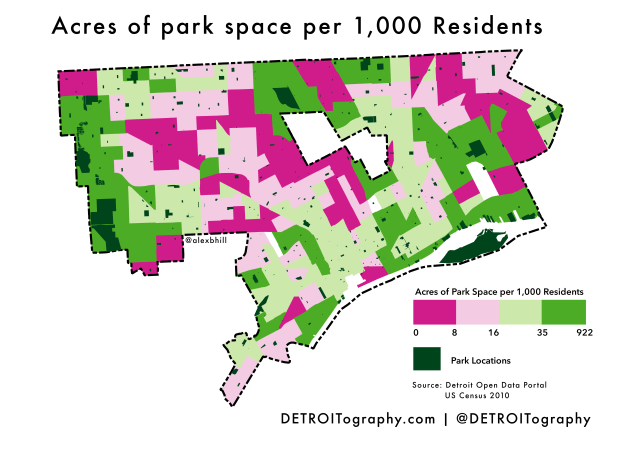
A while back I saw this analysis completed by the WNYC Data News team on park access and wanted to recreate it for Detroit.

There has been a lot of change with parks over the years from the near closing of 50+ parks during Mayor Bing’s time, to an influx of funding to keep them open, then the widespread adoption of parks by community groups, now the new parks master plan, and $11.7 million being dedicated to 40 smaller neighborhood parks this summer.

The map was created by giving every census tract a half-mile buffer and then calculating how many acres of park space fell within those extended boundaries for each census tract. Those acres were then matched to the number of residents living within each census tract.

Some of Detroit’s more populated areas have much smaller parks. With more people and smaller park spaces that leaves fewer acres per person. Many people in the city benefit from Detroit’s many large parks, however the key missing variable here is safety/crime in parks as well as community perceptions of using park space for leisure or physical activity.


Map: Detroit Infant Mortality Rate 1922

Screen Shot 2016-04-06 at 8.13.20 AM

This map comes from the Detroit Department of Health’s report titled “A birdseye view of Detroit’s health status for the year 1922.” The city existed as 23 districts with “populations sufficiently large to make the comparison of rates worth while.” Infant mortality was tracked the same way we track it today as, “deaths under 1 year … per 1,000 living births.”

Some things don’t change which makes it possible to track improvements. Detroit’s infant mortality rate has improved significantly from 1922, but there is still work to be done in 2016.

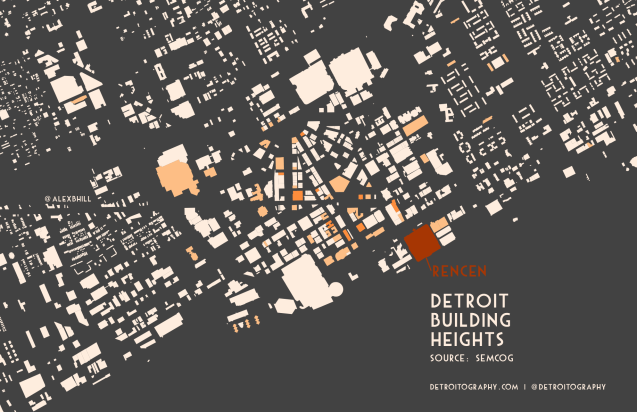
Map: Detroit Building Heights

DET-buildings-height.png

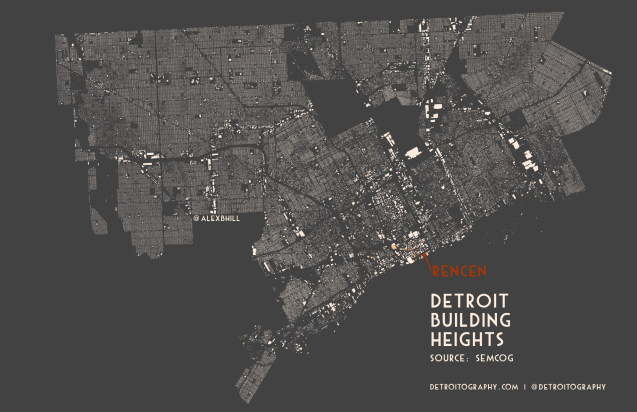
The Renaissance Center (RenCen) can be seen from just about anywhere in the city. Why is that?

It is easy to forget that Detroit as a big city is in reality a city and suburbs combined. The outer neighborhoods first functioned as suburban enclaves to retreat to after a day’s work in the inner city and increasingly suburban factories.

Of Detroit’s 419,882 buildings, the tallest is the RenCen stands at 73 stories.

With only 47 unique building heights including just 5 buildings reaching 40 stories or more, Detroit is a stout city. There are only 44 buildings in the 20 – 39 stories range. The vast majority of buildings in Detroit are below 2 stories tall (n=397,744).

The tallest buildings are located Downtown.

DET-downtown-buildings-height


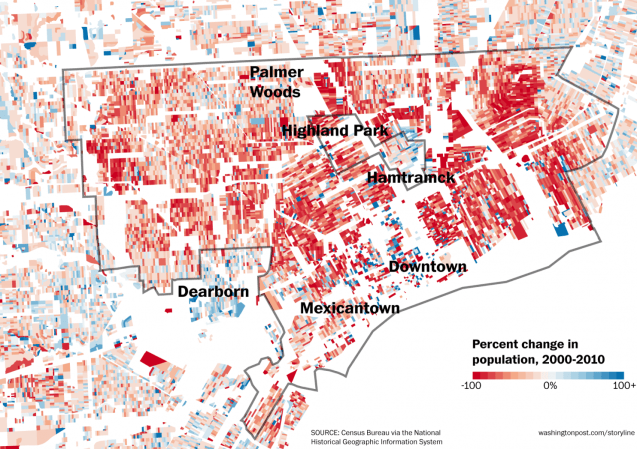
Detroit’s population change by block 2000-2010

wapo-popchange-block

This map ran as part of a 2014 Washington Post piece featuring 6 maps that show people abandoning Detroit. Now we are more than halfway through the next decade and Downtown is reporting population growth while investments have increased in some neighborhoods and others are still in great need.

The most important story that this map tells is that not everyone’s Detroit story is the same. The people and their experiences change in the small distance between blocks.

Map: Detroit Building Age Density Map

detroit-building-age

Nothing beats a good ol’ dot density map. In this case each land parcel was assigned a centroid (center point) and visualized by the year a building was built on the parcel. This accounts for newly vacant parcels, but not parcels that have more than one building.

Most of the newer construction has occurred in the more vacant areas, which could also represent larger land parcels being reduced to a point location (i.e. a hospital). There is some very interesting clustering of Pre-1900 and 1980-Present construction in Midtown, west of Midtown, and Corktown. At least in construction, Old Detroit and New Detroit prefer to be closer together?

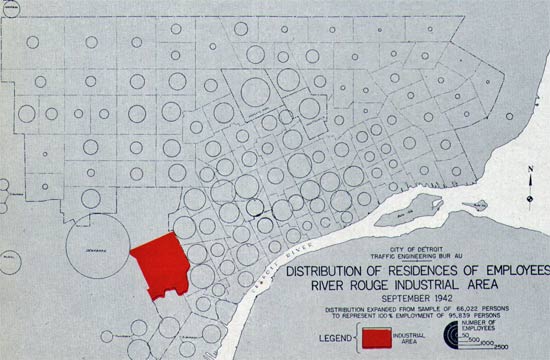
Map: Residences and Industrial Areas of Employees in Detroit 1942

det-employees-river-rouge

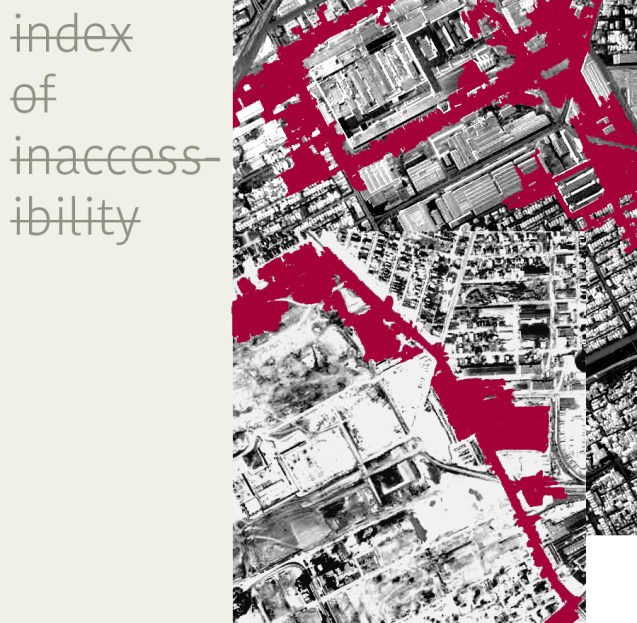
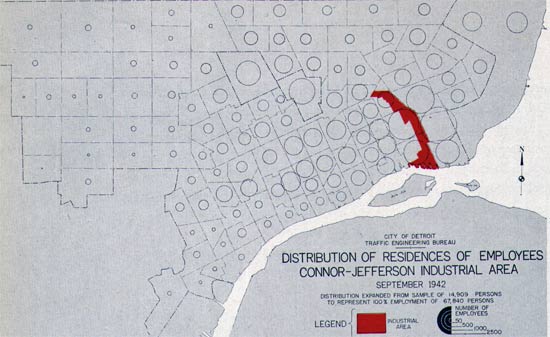
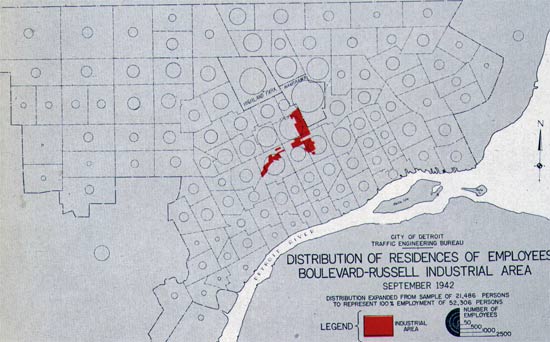
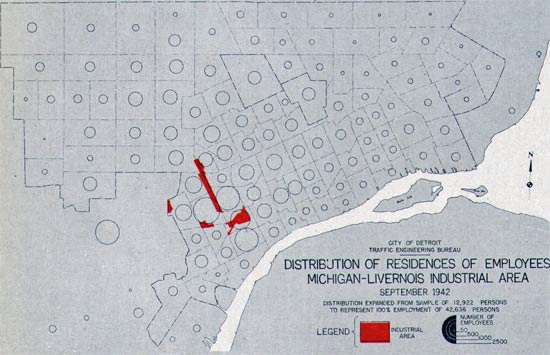
The geographic distribution of jobs and access to opportunity is a major issue of the current revitalization effort. Many people cannot easily reach jobs that they need because they are too far away in the suburbs. These maps give an interesting picture of where people lived and worked when Detroit’s major industries were moving full tilt. All in all, people mostly lived fairly close to where they worked. The Henry Ford River Rouge Plant (above) was a key employer of the day in 1942, the jobs are not as many these days. Much of their workforce was pulled from Dearborn, but a substantial number of people lived nearby across Detroit. det-employees-connor-jefferson

The Connor-Jefferson industrial area may be one of the few that is still very active with the Chrysler Plant going strong.

det-employees-blvd-russellThe Boulevard-Russell industrial area is not so active anymore. There are some smaller companies left, but the Russell Industrial Center houses artists and lofts rather than industrial jobs.

det-employees-mich-livernois I’m not aware of any continued industrial activity in the Michigan-Livernois area besides some logistics and trucking activity. Anything else?


Map: Archipelago Detroit – Colonial Farming, Industrialization, and Transitions

Archipelago Detroit 12

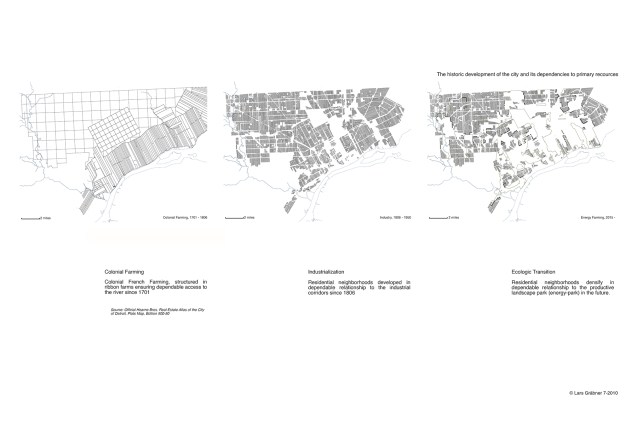
In 2010, Lars Gräbner of Volume One Studio and the University of Michigan Taubman College, began conducting a mapping study of Detroit in order to conceptualize a future for the city. The above series of maps were based on the Official Hearne Bros. Real Estate Atlas of the City of Detroit, Plats Map, Edition 500-50.

More from Lars Gräbner:

Colonial Farming

Colonial French Farming, structured in ribbon farms ensuring dependable access to the river since 1701.

Industrialization

Residential neighborhoods developed in dependable relationship to industrial corridors since 1806.

Ecologic Transition

Residential neighborhoods densify in dependable relationship to the productive landscape park (energy-park) in the future.

These maps were featured in Mapping Detroit (Chapter 8: Mapping the Urban Landscape: Revealing the Archipelago) available from the WSU Press.

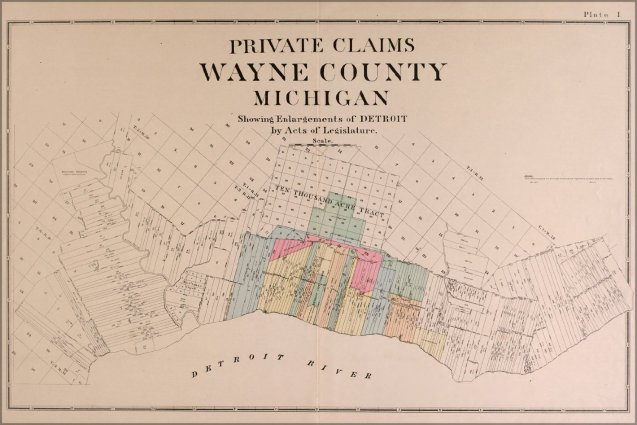
Map: Detroit Annexation and Wayne County 1922

Map-of-WayneCounty-1922

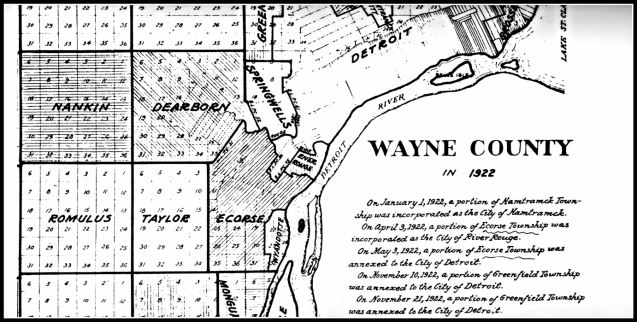
Map from“A History of River Rouge, Michigan” by Frances E. Manor

“On January 1, 1922, a portion of Hamtramck Township was incorporated as the City of Hamtramck.

On April 3, 1922, a portion of Ecourse Township was incorporated as the City of RIver Rouge.

On May 3, 1922, a portion of Ecourse Township was annexed to the City of Detroit.

On November 10, 1922, a portion of Greenfield Township was annexed to the City of Detroit.

On November 21, 1922, a portion of Greenfield Township was annexed to the City of Detroit.”

Map: Landscape Park in Detroit Context

Archipelago Detroit 10

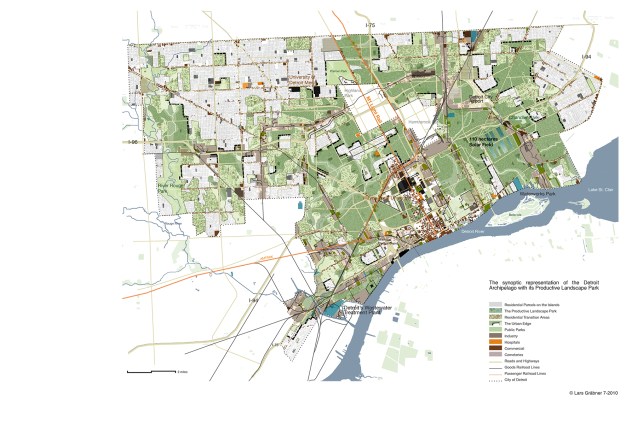
This is the final product of the research and mapping that Lars Gräbner, of Volume One Studio and the University of Michigan Taubman College, completed in 2010. The concepts that came out of his research are in full bloom with this map that demonstrates the landscape park with existing Detroit infrastructure and planned future developments (such as M1 Rail).

More from Lars Gräbner:

The synoptic representation of Detroit’s landscape park.

These maps were featured in Mapping Detroit (Chapter 8: Mapping the Urban Landscape: Revealing the Archipelago) available from the WSU Press.

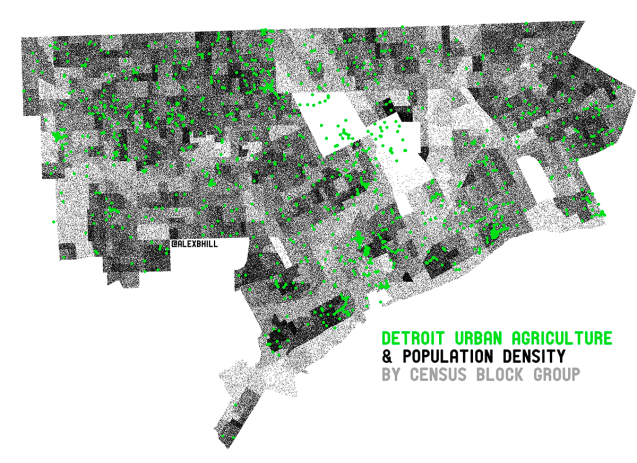
Map: Urban Agriculture in Detroit 2014

detroit_urban_ag

I created this map to be included with an article, titled “Urban Agriculture: It’s not a Food Desert, it’s about Food Sovereignty,” that I contributed to the Progressive Planners Network publication.

Without running any statistics, there are some obvious overlaps in where people are and the locations of gardens and farms. In particular, there is a higher density of people (and incomes) on the Westside and similarly a higher density of gardens.

The data is based on information shared by Keep Growing Detroit and the US Census Bureau.

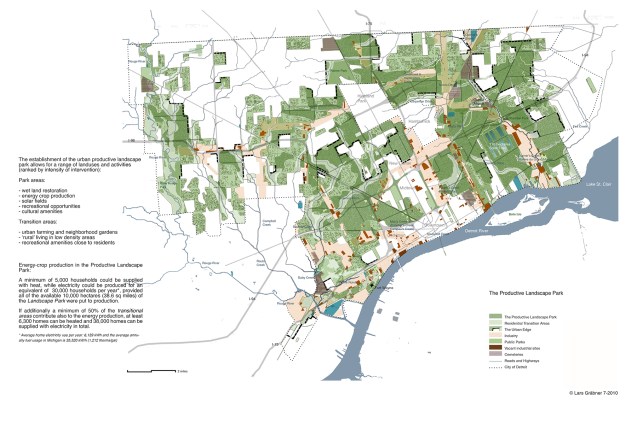
Map: The Landscape Park and Energy Production in Detroit

Archipelago Detroit 09

In 2010, Lars Gräbner of Volume One Studio and the University of Michigan Taubman College, began conducting a mapping study of Detroit in order to conceptualize a future for the city.

More from Lars Gräbner:

“The establishment of the urban productive landscape park allows for a range of landuses and activities (ranked by intensity of intervention):

  1. wet land restoration
  2. energy crop production
  3. solar fields
  4. recreational opportunities
  5. cultural amenities

Transition areas:

  • urban farming and neighborhood gardens
  • ‘rural’ living in low density areas
  • recreational amenities close to residents

A minimum of 5,000 households could be supplied with heat, while electricity could be produced for an equivalent of 30,000 households per year*, provided all of the available 10,000 hectares (38.6 sq miles) of the Landscape Park were put to production.

If additionally a minimum of 50% of the transitional areas contribute also to the energy production, at least 6,300 homes can be heated and 38,000 homes can be supplied with electricity total.

*Average home electricity use per year: 6,139 kWh and the average annual fuel usage in Michigan is 35,520 kWh (1,212 therms/gal)

These maps were featured in Mapping Detroit (Chapter 8: Mapping the Urban Landscape: Revealing the Archipelago) available from the WSU Press.

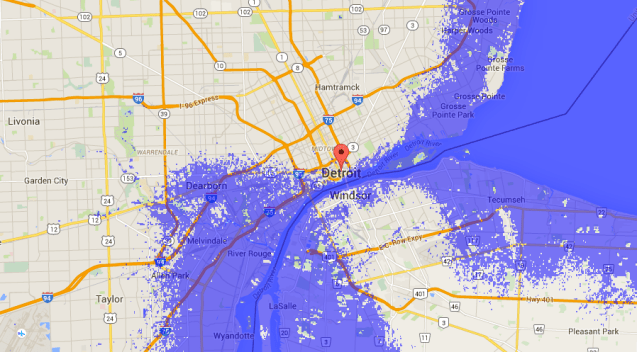
Map: If the Detroit River Flooded

Screen Shot 2016-01-29 at 4.20.39 PM

This is a purely hypothetical map from the same group that created the flawed “Detroit Elevation Map.” This map is based on water level rising by 600 feet (183 meters). They’ve utilized Nasa’s 90m resolution SRTM data and modeled it based on potential sea level rise.

If the 2014 floods were any indicator, the river and sea level rise are the least of our flooding worries.

See also: 1981 Flood Insurance Map


Map: Ecological Urban Intervention Zones


Archipelago Detroit 08

In 2010, Lars Gräbner of Volume One Studio and the University of Michigan Taubman College, began conducting a mapping study of Detroit in order to conceptualize a future for the city.

More from Lars Gräbner:

“The levels of urban intervention range from the opportunity for entire restructuring processes and clearance from structures (darkest color) to reinterpreting low density neighborhoods (lightest color).

These maps were featured in Mapping Detroit (Chapter 8: Mapping the Urban Landscape: Revealing the Archipelago) available from the WSU Press.

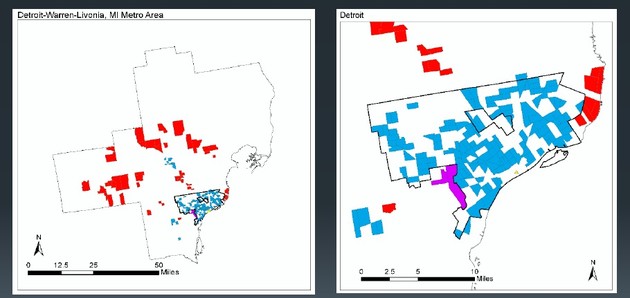
Map: Detroit’s Racially Concentrated Areas of Affluence and Poverty

rcap-detroit

A while back The Atlantic included these maps from researchers at the University of Minnesota in an article titled, “Where the White People Live.” The red areas are racially concentrated areas of affluence and the blue are racially concentrated areas of poverty.

According to the research:

“Detroit [region] has 55 racially concentrated areas of affluence and 147 racially concentrated areas of poverty, […]. Detroit’s racially concentrated areas of affluence are just 1.1 percent black. Its racially concentrated areas of poverty, by contrast, are 76 percent black.”

The research also tracked federal dollars in these areas and found that three times more federal money is spent in racially concentrated areas of affluence, effectively subsidizing the segregation of housing, mobility, and place.

La Riviere du Detroit 1764

detr1764

No collection about maps of Detroit would be complete without what might be one of the most reproduced early maps of Detroit. This map is also assumed to be the first printed map of Detroit.

The map is titled, “map of Detroit’s settlement and French fortification” and it is easy to pick out the French ribbon farms along the river. The map was created by Jacques Nicolas Bellin, who was the official French royal hydrographer and ingéniuer géographe de la marine et du Dépot des Cartes et Plans. His responsibilities included the creation of atlases of sailing charts for military, royal, and commercial use. This map in particular was first published in his “Le Petit Atlas Maritime” in Paris (1764), however Detroit had already changed significantly from the time the map was created.

A lesser known fact is that this Bellin’s map was based on the 1749 land survey work of Gaspard-Joseph Chaussegros de Lery who was first commissioned for engineering work to New York in 1742. Later he was transferred from Montreal to Detroit in 1749 where he assisted in the engineering and planning of Fort Detroit.

Map: Restoring Detroit’s Ecology

Archipelago Detroit 07.jpgIn 2010, Lars Gräbner of Volume One Studio and the University of Michigan Taubman College, began conducting a mapping study of Detroit in order to conceptualize a future for the city.

More from Lars Gräbner:

“The restoration of the hydrologic system is guided by the levels of opportunity, generated in this series of maps (phasing).

First priority: restoration of wetlands in areas of highest potential for urban intervention.

Gradual expansion of the landscape in areas of high levels of opportunity.”

These maps were featured in Mapping Detroit (Chapter 8: Mapping the Urban Landscape: Revealing the Archipelago) available from the WSU Press.

Map: Driving on $50 from Detroit

5-cost-of-driving-Detroit-1a16

The people at HowMuch.net created these maps to visualize just how far you can get with our current record low gas prices. Their estimates are based on a car that can get 24 miles per gallon and gas price estimates from GasBuddy.

From Detroit we could reach nearly all major cities on the East Coast. Our key location where we can drive South into Canada allows us amply opportunity to explore our neighbor to the North. The opposite is also true, our friends on the East Coast or to the North can easily reach us on $50 of gas.

Map: Detroit Birth Rate 1922

Screen Shot 2016-02-17 at 7.53.45 AM.png

This map comes from the Detroit Department of Health’s report titled “A birdseye view of Detroit’s health status for the year 1922.” The city existed as 23 districts with “populations sufficiently large to make the comparison of rates worth while.”

The report was put together via typewriter and hand drawn maps. It even looks like the colors were painted on with watercolor.


Map: Returning to Nature with Detroit’s Streams

Archipelago Detroit 06.jpgIn 2010, Lars Gräbner of Volume One Studio and the University of Michigan Taubman College, began conducting a mapping study of Detroit in order to conceptualize a future for the city.

More from Lars Gräbner:

“The identification of existing and former rivers, streams and creeks with their wetland zones allows the establishment of a new structural base for the ecological urban intervention.

These maps were featured in Mapping Detroit (Chapter 8: Mapping the Urban Landscape: Revealing the Archipelago) available from the WSU Press.

Map: Detroit’s Connors Creek Sewer System 1895

connors-creek-sewer

Many of Detroit’s early waterways have become it’s current sewer system.

In the late 1910s, the Creek had become a dumping ground for area residents. Thanks to the railroads that the area’s founder, P.W. Norris, secured for the area, industry was increasing and the river retained little of its former usefulness as a key component of rural mills and irrigation systems.  By the mid 1920s, much of the Creek was already diverted underground either to build factories on top of it or to turn into sewers. Today, the only aboveground section is a half-mile stretch before the Creek meets the Detroit River.  However, even this section has changed.  The course of the river’s mouth was completely altered in the early 2000s when a new water treatment plant was built: the direction of the creek was rotated and it no longer even actually flows into the river.  Instead, the Creek ends in little more than a small pond attached to the river; the flow essentially stops once it enters the treatment plant.  Both the treatment plant and the sewer are evidence of the many changes that have been instituted in Detroit, which have knowingly (and intentionally) changed the appearance of the area.

Source: Silas Farmer and Co., “New Map and Guide of the City and Environs of Detroit,” Map, 1895, M 4114 D4 1891-1900, University of Michigan Bentley Historical Library.