Map: Detroit Master Plan Trafficways 1951

Screen Shot 2016-06-13 at 8.03.33 AM

In the 1950s, Detroit planning seemed to be all about expressways. This map from the 1951 Master Plan shows the Edsel Ford (I-94) partially built and the Lodge (M-10) creeping Northwest with dotted lines planning to build many more expressways.

The Master Plan also notes that there was a large park within 20min drive or bus ride for every resident of the city.

Map: Detroit’s Woodward Avenue Subway Plan 1915

Screen Shot 2016-06-08 at 7.35.49 AM

According to the 1915 “Report on Detroit Street Railway Traffic and Proposed Subway” (Barclay, Parsons & Klapp), the Woodward lines saw significantly increased utilization between 1904 (12,990,027 passengers) and 1914 (47,457,294 passengers).

Downtown, where all the routes terminated, impeded efficient movement of people in and out of the city. Therefore, their report proposed a series of rerouting of lines as well as a Woodward Avenue subway system.

Map: Detroit’s Pattern of Growth 1960s

This gem of a video (from sometime in 1960s?) that I wish I had known about years before now has been circulating on social media, but needs to be shared more widely.

Former Chair of the Geography Department at Wayne State University, Robert J. Goodman (d.2005), and Gordon W. Draper created this important look at the history behind Detroit’s street patterns.

“To an overhead observer the street pattern of Detroit presents a strange mosaic of conflicting systems which seem to start and end with no apparent reason and to have no relation with each other.”

Who knew that Gratiot jumps one block north before Brush St. so as not to cut through Elijah Brush’s orchard? Or that Detroiters donated 90% of the land in order to create Grand Boulevard? Did you know the Streets in Highland Park are narrower because that city is much older than the areas of Detroit that grew around it? Even Palmer Woods and Sherwood Forest neighborhoods were labeled as “exclusive” at the time with their curved street patterns.

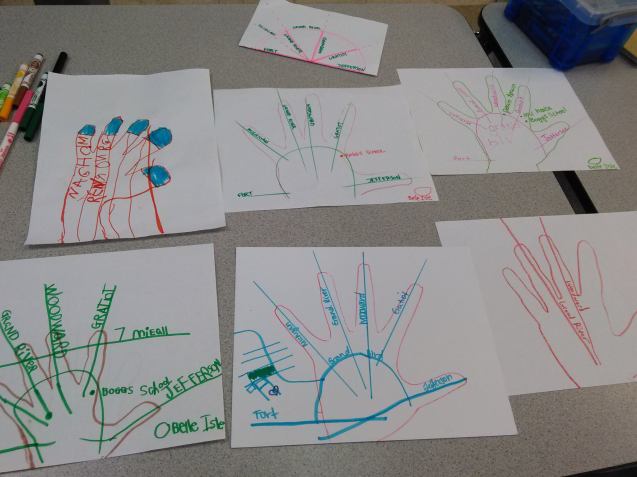
It is all to easy to forget the deep history of Detroit from the original Indian trails that inspired the spoke streets to the varied roads patterns planned at different points in the city’s history. Don’t forget you can use your hand as a map of Detroit if you ever get turned around.

dgei_hand

Map: Geography of Baseball Diamonds in the Detroit Region

terrapattern-baseball-detroit-region

Terrapattern recently launched to investigate typologies of similar places across cities via satellite imagery.

“…the Terrapattern prototype is intended to demonstrate a workflow by which users—such as journalists, citizen scientists, humanitarian agencies, social justice activists, archaeologists, urban planners, and other researchers—can easily search for visually consistent “patterns of interest”. We are particularly keen to help people identify, characterize and track indicators which have not been detected or measured previously, and which have sociological, humanitarian, scientific, or cultural significance.”

I decided to click on the baseball diamond at Tigers Stadium to see what places were similar in “Detroit” – Terrapattern’s sample area for Detroit includes a broader area beyond the city limits, but also cuts off the Far Westside.

terrapatttern-baseballThe result is this great geographic plot of similar images and a series of snapshots of other baseball diamonds. Terrapattern even gives you a nice GeoJSON file to play with if you want to export your search results. Obviously, this isn’t all baseball diamonds in the city, especially ones that might be overgrown or covered in grass.

terrapattern-baseball-detroit

The resulting sample area shows the Far Westside cutoff. However, taking into account the significant clustering (z-score: -9.4) in both the suburbs to the east and Downriver, there appears to be a greater level of access to baseball diamonds and/or maintained baseball diamonds.
Map: New Detroit Regional Master Transit Plan 2016

RTA foldout map_1464612396571_6448641_ver1.0.jpg

The unprecedented level of collaboration the Regional Master Transit Plan for Southeast Michigan has produced a hopeful future for a connected region. With over 60% of Detroiters working outside the city limits and over 70% of Detroit jobs held by non-Detroiters, this plan has big potential to improve access to opportunity and equity in our metro-Detroit region.

The map is pretty nice too!

Map: Increases in High Poverty in Detroit 2013

Detroit_Segre-02

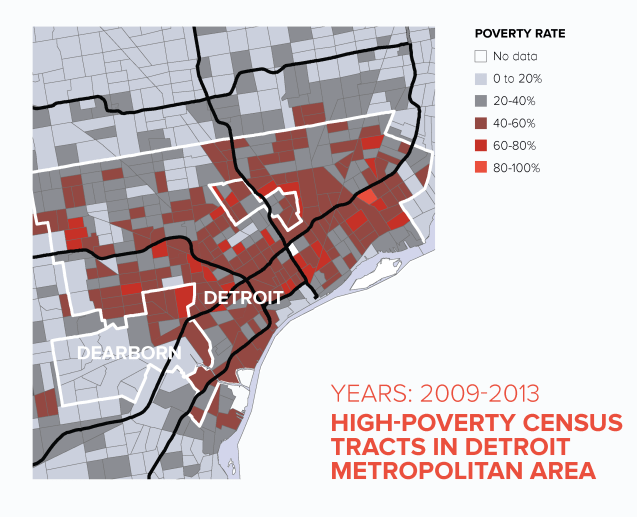
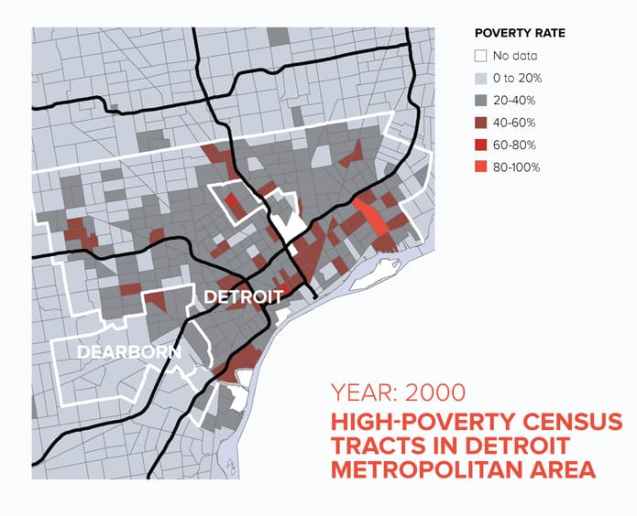
Poverty is a regular topic in Detroit, but there is much more to the data and narrative than an elevated rate of poverty. Since 2000, the Detroit metro area has seen some of the largest increases in racially concentrated poverty (see 2000 map below for comparison).

detroitsegr-1439235033-49


Map: Detroit Watershed Planning 2013

Screen Shot 2016-05-23 at 7.29.47 AM

These maps are part of the Liquid Planning Detroit report from the Detroit Sustainability Indicators Project that sought to reimagine urban infrastructure in Detroit as population is not expected to grow significantly for some time.

“. . .the redrawing of territorial boundaries within the city of Detroit thereby shifting from an infrastructural logic to water-driven one (from sewersheds to watersheds).”

Map: Kelly-Tatarian Property Speculation 2009

Kelly_Tatarian_Speculator_Properties

Back in 2009, Rob Linn dug through City of Detroit Assessor data to look at private land ownership specifically looking at some of the city’s largest private land holders. Michael Kelly and Matthew Tatarian had nearly 1,500 properties in 2009.

Investors such as Allen Shiffman, Matty Moroun, Michael Kelly and Matthew Tatarian often buy property from the city and county at steep discounts with hopes to resell the properties to other parties – including, ironically, the city and county – at a huge profit. The business models of each speculator range drastically, however, so it is difficult to predict their behavior at auctions.”

The Property Praxis project has found similar high numbers of property under Michael Kelly and Matthew Tatarian’s names in the 2015 City of Detroit Assessor data.

Map: Property Praxis – Speculation in Detroit

pp-map-large

Land in Detroit has been widely covered in the media as the city and it’s residents have grappled with widespread subprime mortgage lending, myriad tax foreclosures, and targeted blight removal.

The primary connection between these major crises and efforts in Detroit is property speculation.

At least 20% of land in Detroit is owned by property speculators, defined by the amount of property they own that is not registered to an owner that lives in the same neighborhood. Property speculators benefited from the new inventory of property created by the mortgage crisis, but in turn fueled the decline into blight of once intact neighborhoods.

This collaborative mapping project is not the first to examine individuals and corporations that have held large swaths of land in Detroit, but it is the first to examine the true extent of property speculation by digging into the records of shell companies and LLC that are often used to hide ownership or skirt tax payments. Not all property speculators are bad people, but the process of speculation has far reaching negative impacts on neighborhoods and the people who live in them.

Explore the map here: http://propertypraxis.org

Map: Detroit Transportation 1939

Screen Shot 2016-05-10 at 9.45.46 PM

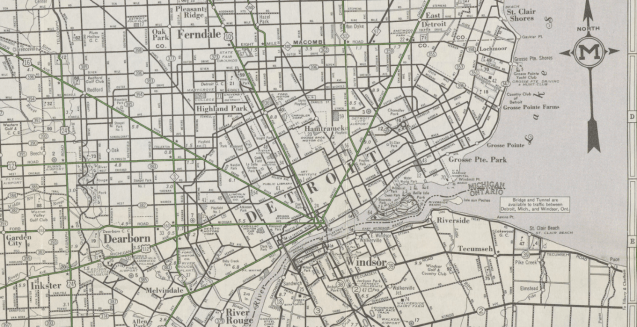
From the New York Public Library (NYPL) digital collections, this map from 1939 shows all the main roads and their status as paved or dirt. Main roads are highlighted in brilliant green.

However, there is no indication of streetcars or any alternative transportation options other than roadways, which seems odd since Rand McNally began by printing timetables for the railroad industry. I guess initiating the numbered highway system and shifting business to publish road atlases for Gulf Oil in the 1920s shifted their focus to roads over rails.

Map: Shrinking Cities Community Radio in Detroit

brumit-pioneers-x-map-3-web

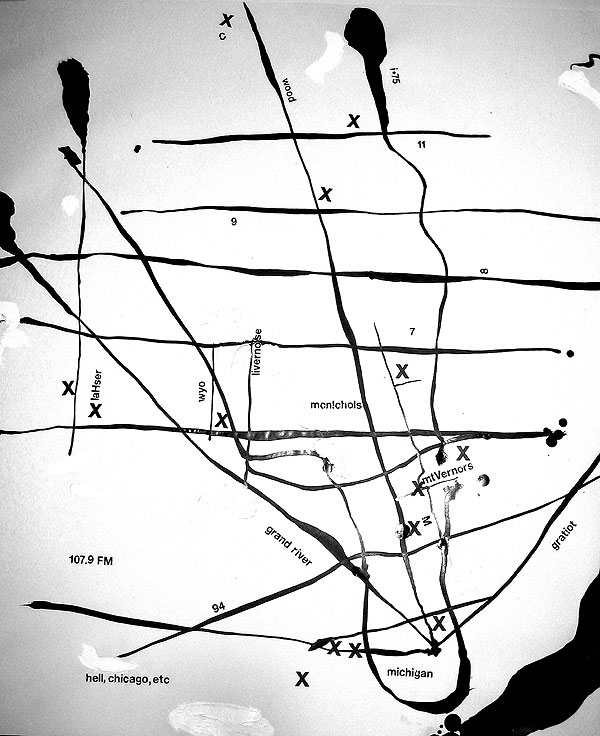
This is the project map from “PIONEERS,” which was commissioned for the “Shrinking Cities” exhibit cohosted by MOCAD and Cranbrook Art Museum in 2002-2008. The PIONEERS project consisted of 12 mini-programs broadcasting on 107.9FM as a way to lift the voices of Detroiters’ to tell the stories of their histories, goals, neighborhoods, communities, and city.


Event: #Maptime Detroit – Psycho-Geography

maptime-may-fb.png

WHEN: May 12, 2016

WHERE: Riopelle Gallery, 1492 Gratiot Ave. (Eastern Market)

WHAT: We’ll be utilizing our senses to make walking maps of the Eastern Market area.

Psycho-geography (Dérives “drift”) is an activity designed to take a person “off the beaten path” and take a more critical look at their surroundings.

You’ll need:

  • A smartphone
  • A friend (provided)

Beginners are welcome, mapping is for everyone!

View on Facebook

Map: Detroit – Center of it All 1949

Screen Shot 2016-05-02 at 7.33.07 AM.png

It’s always nice to see Detroit as the focal point for national or regional maps.

“Detroit’s proximity to the geographical center of the nation’s population is obvious.”

This map comes from the 1949 master plan for the “Detroit Festival of the Great Lakes” to be held in 1951 at the 250th anniversary of Detroit’s founding. The Michigan State Fair Grounds were the chosen spot because of easy access via U.S. 10 (Woodward Ave.) and Michigan 102 (Eight Mile) as well as U.S. 16 (Grand River) and U.S. 112 (Michigan Ave.). The new Grand Trunk Railroad passenger platform at the Fair Ground was also projected to be used.

It was written that:

“The Michigan State Fair Grounds is conveniently located for both the farm families and the city families of Michigan. It is central to the heavily populated southeastern part of Michigan. 3.5 million people live within 50 miles of the grounds, almost 3/5 of the residents of Michigan, plus 150,000 in the neighboring Canadian province of Ontario.”


Map: Desired Pathways in Detroit’s Cass Corridor

cass-desirelines.png

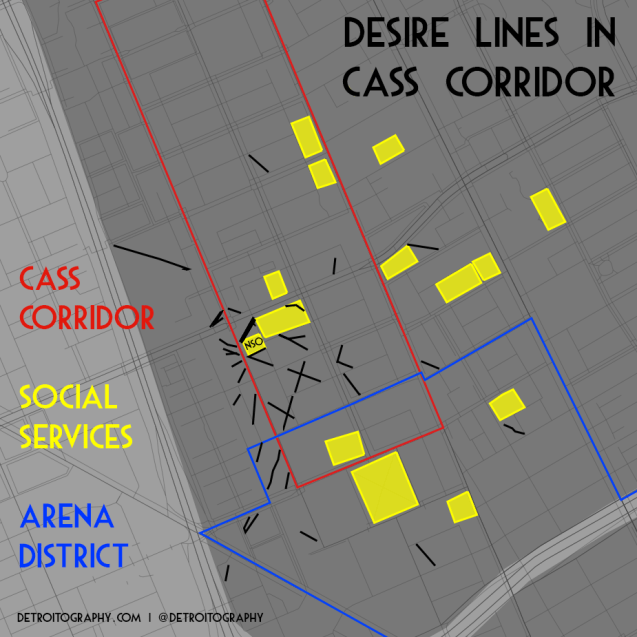
Major changes have been taking place in the Cass Corridor and those changes have accelerated in recent years. Concerns were raised by nonprofits in the early 2000s with the creation of “Midtown” and those same concerns are being raised as the new Red Wings arena is being constructed and property values skyrocket.

This map is a representation of the pathways of the often invisible people in the Cass Corridor. Detroit’s Neighborhood Services Organization (NSO) provides programming and resources to the city’s vulnerable neighbors, many of whom are located in the Cass Corridor area. Desire lines or desire paths are the wore trails that people create between places and spaces when there isn’t necessarily a planned route. The mobility of the vulnerable people in the Cass Corridor is visible here as the desire lines have a clear radial pattern around the NSO building.

Map: Detroit Storefront Index

Screen Shot 2016-04-27 at 8.31.18 AM.png

In the new City Report, “The Storefront Index” from City Observatory, the Detroit metro area ranks 51st as one of the least dense city centers with storefronts (businesses within a 3 mile radius of a Downtown).

“One of the best indicators of the vitality of an urban space is the presence of customer-facing retail and service businesses.”

Important to note is that the database utilized by the report found that the Customs List under-reported businesses in Detroit and had to then rely on a secondary sources, USAInfo.


Map: Index of Inaccessibility & Border Plants in Hamtramck and Detroit

During last year’s Porous Borders Festival in Hamtramck there were a handful of great examples of engaged mapping projects:

porous-copia

Index of Inaccessibility” attempted to re-draw one of the borders of the GM Assembly Plant by walking around it. The intent by the artist-organizers Ludmila Ferrari, Juan Leal, and Félix Zamora was to create a new map of the border that is not constituted by the presence of the GM Assembly Plant.

Maia-Plant-Map

The Border Plant Mapping Project” set out to document any accessible plants along the Detroit/Hamtramck border and result in a map that anyone can use to find the mapped plants. This project was developed by Maia Asshaq, a writer and performer living in Hamtramck.


Event: Open Data DiscoTech

13071826_1715589595366159_1871532450365687452_o

The Detroit Digital Justice Coalition (through Allied Media Projects) and Detroit Community Technology Project are partnering with Grace in Action to present a Data DiscoTech, April 23rd, 11:00am – 2:00pm at the Grace in Action church (1725 Lawndale St.) . The event is free and open to the public!

DiscoTech” is short for “Discovering Technology.” The DiscoTech will offer interactive stations to demystify technology concepts related to open data and the City of Detroit’s Open Data Portal.

At the DiscoTech we will:

  • Demystify data.
  • Understand the risks of open data.
  • Understand how to use data in community organizing efforts.
  • Use data in creative ways.

Read more about the DiscoTech here. See you there!

Map: Detroit’s New Urban Form?

Screen Shot 2016-04-20 at 8.13.30 AM

This concept comes from the American Institute of Architects (AIA) Sustainable Design Assessment Team report titled: “Leaner, Greener Detroit” (2008). In this concept the “urban villages” are the traditional, sometimes titled “viable” neighborhoods such as Mexicantown,  Midtown, and New Center. The AIA team assumes these urban villages to be self sustaining, walkable, and community-focused.

Map: Private Land Claims in Detroit 1810

Screen Shot 2016-04-13 at 8.47.02 AM

The first official land survey of Detroit was conducted by Aaron Greeley. After the US gained control of the Michigan Territory they needed an official record of land holdings. Greeley surveyed land in Detroit from 1809 to 1810 and his records were approved by Congress in 1812 which made his survey map the authoritative source of land claims.

However, Greeley’s survey did not include informal land grants or awards. As a result many Southeast Michigan residents appealed to Congress and eventually around 100 land claims were approved. Yet the boundaries of land claims continued to be contested for years following.


Map where a raindrop falls in Detroit

epa-enviroatlas.png

Wondering where all this rain ends up? The EPA’s Environmental Atlas provides some really interesting tools, including tracking where a raindrop ends up when it lands in Detroit. After zooming into Wayne County, Michigan, in the gray navigation bar choose “Analysis Tools” and select the “Raindrop Tool.”

This is a great way to check out sewer/drainage infrastructure and how a raindrop nearly always ends up in the Detroit River.