Map: Archipelago of Housing Conditions 2010


Archipelago Detroit 02

In 2010, Lars Gräbner of Volume One Studio and the University of Michigan Taubman College, began conducting a mapping study of Detroit in order to conceptualize a future for the city.

More from Lars Gräbner:

The excess supply of fragmented vacant land allows no clear prediction of how the city might develop and in which way the built and spatial environment will adapt to the situation. Based on the traditional means of planning, the new city is hardly amenable to planning.

An unconventional and creative strategic framework is inevitably necessary. The questions will arise: Which patterns of change in land use will occur? What kind of reoccurring planning and urban design patterns will emerge?  What kind of new social and economic opportunities might reveal themselves?

These maps were featured in Mapping Detroit (Chapter 8: Mapping the Urban Landscape: Revealing the Archipelago) available from the WSU Press.

Map: The Fight for “Uptown” – Detroit’s Newest Branded Neighborhood

uptown

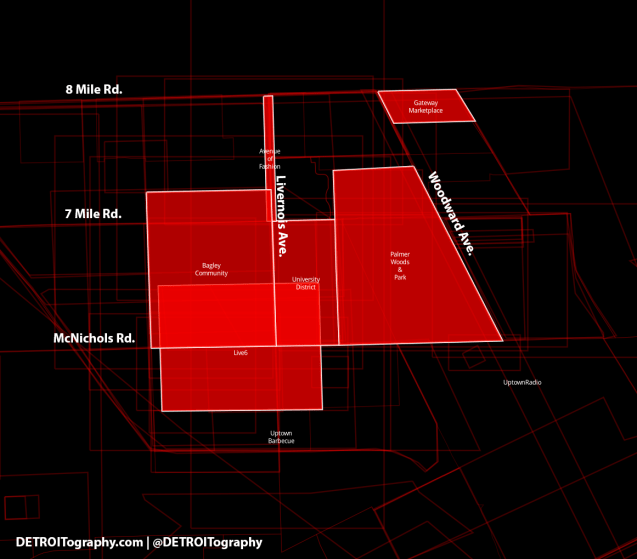
In recent years we’ve seen Midtown expand its reach and Downtown extend its boundary to include the Arena District. The next segment of the Woodward Corridor to see renewed interest is “Uptown.”

You may be familiar with Uptown BBQ down by the University of Detroit-Mercy on Livernois Ave. or perhaps you’ve noticed the faded lettering on the dilapidated “Uptown Radio Appliance” in Highland Park. The first Detroit neighborhood that I moved to was the University District and I always felt that “Uptown” was a good name for the area.

In a 2014 Urban Innovation Exchange profile, MJ Galbraith named Barbara Barefield the, “Dynamo of the Uptown arts scene” (UIX), which appears to include Palmer Woods and the adjacent Palmer Park.

I honestly haven’t done my historical research to discover the origin of the “Uptown” name, but now that there is money behind it I have a feeling we’ll be hearing a lot more about “Uptown.” The Live6 Alliance is centered on the Livernois -McNichols intersection and hopes to apply the Midtown success in another area of Detroit with a density of “anchor institutions” (Marygrove College, University of Detroit-Mercy, etc.). The Kresge Foundation is the primary funder of the initiative. The area includes the historic Livernois “Avenue of Fashion” which has received a good chunk of funding from DEGC and other groups pushing the economic revitalization of the area.

“It’s Uptown,” Alicia Biggers-Gaddies, Bagley Community Council (MLive)

The MLive article states that Gaddies has lived in the Bagley neighborhood since 1996 and started referring to as “Uptown.” However, she isn’t the only one hoping the “Uptown” moniker sticks to her development efforts. Tami Salisbury, Executive Director of the Eight Mile Boulevard Association, has been trying to rebrand the area known as the Gateway Marketplace (Meijer, Applebees, etc.) as “Uptown” in order to build a new identity for 8 Mile (Model D).

“We spend an awful lot of time with downtown Detroit, we spend an awful lot of time with Midtown. I think it’s time to spend some time with Uptown,” Wayne County Executive Warren Evans (AP)

There is something to be said for a branded investment district in an area of Detroit where there are already a density of long-time Detroit residents making things happen. If all of the above mapped areas were included in a new “Uptown” district, they encompass roughly 11 square miles. Could it be a new district that rivals Greater Downtown‘s 7.2 square miles?

Detroit Map of 1812

Detroit1812.jpg

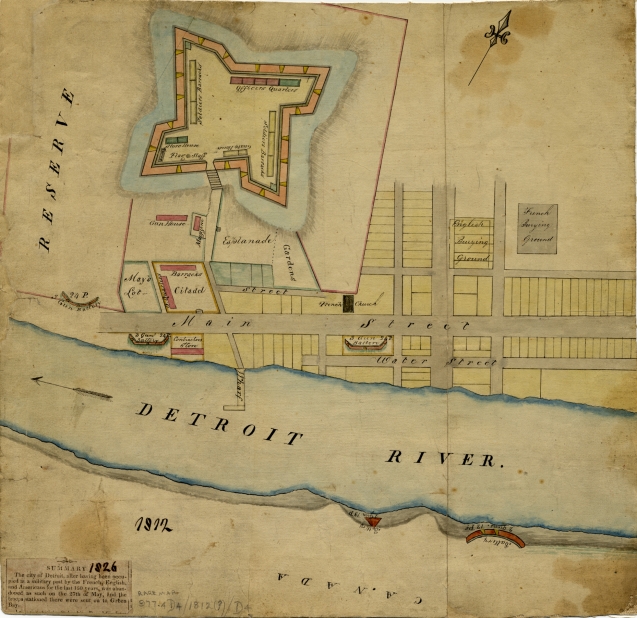
This map available in the Detroit Public Library Digital Collections, Burton Historical Collections includes the description:

“Summary. The city of Detroit, after having been occupied at a military post by the French, English, and Americans for the last 150 years, was abandoned as such on the 27th of May, and the troops stationed there were send on to Green Bay.”
It’s easy to see that Detroit was a fortified city preparing for the War of 1812 with numerous gun batteries along the river. The piece that stands out most to me are the separate English and French “burying grounds” just a block North of Woodward and Jefferson. I wonder what 19th century ghosts haunt One Detroit Center. . .

Map: Inhabited and Vacant Parcels in Detroit 2010

Archipelago Detroit 01In 2010, Lars Gräbner of Volume One Studio and the University of Michigan Taubman College, began conducting a mapping study of Detroit in order to conceptualize a future for the city.

More from Lars Gräbner:

The city of Detroit has labored under the mistaken premise that a city that once almost had two million residents will regain its population and with that the needed tax base. After tumultuous years of battling with the loss of population and the paradoxical attempt to maintain the original infrastructure, services, and administration, the city and its citizens have come to the realization that the situation will need to be faced with a different approach. For the first time the city government leaders have used the term ‘right sizing’, also referred to as ‘shrinking.’  With the awareness that the population will not grow, the city has entered a new era of realism.

Numerous organizations are already working on ideas and concepts to not only acknowledge the situation, but also find ways to tackle the new direction. The excess supply of fragmented vacant land allows no clear prediction of how the city might develop and in which way the built and spatial environment will adapt to the situation. Based on the traditional means of planning, the new city is hardly amenable to planning. An unconventional and creative strategic framework is inevitably necessary.

These maps were featured in Mapping Detroit (Chapter 8: Mapping the Urban Landscape: Revealing the Archipelago) available from the WSU Press.

Workshop: Data, Mapping, and Research Justice

coopen_banner_data-300x300

I’ll be teaching the workshop on data and making maps again this February 2016 with Allied Media Projects/ Co.Open. We’ll journey through the entire process; from paper survey to digital database and then basic map visualizations and analysis. We will only be working with free and open source software (LibreOffice, Google Sheets, QGIS, Gimp).

Check out some of the past projects:

Monday nights in February (4 weeks long) 6-9pm

Sign up at store.alliedmedia.org

Map: Detroit Street Guide 1947

nypl.digitalcollections.8a72eb30-f3d7-0130-18ce-58d385a7b928.001.g

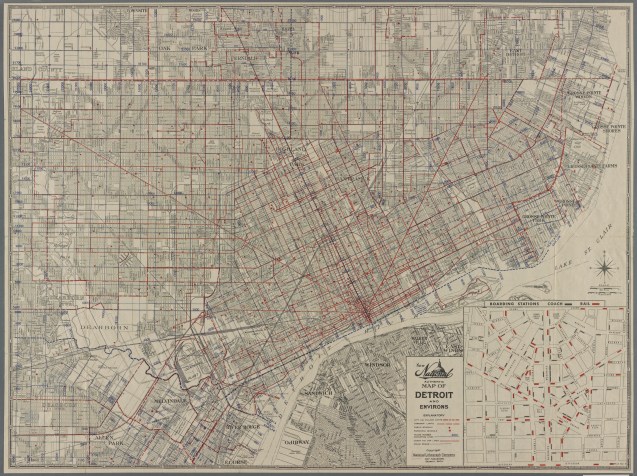
This map in the New York Public Library Digital Collections is one of my favorites. It shows all forms of transit in Detroit from streets, streetcar rail, and motor coach (bus).  In 1947, Detroit was nearing its peak population recorded in the 1950 Decennial Census. There was a great need for multi-modal transit options across the entire city network.

Map: The Urban Archipelago in Detroit 2010

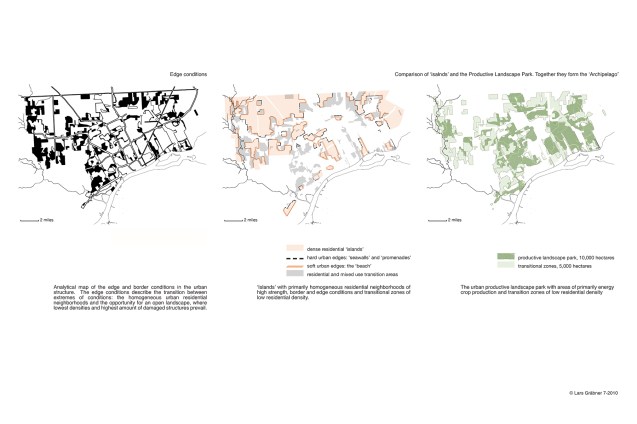
Archipelago Detroit 11In 2010, Lars Gräbner of Volume One Studio and the University of Michigan Taubman College, began conducting a mapping study of Detroit in order to conceptualize a future for the city. This was well before the Detroit Works Project (DWP) and Detroit Future City (DFC) even entered the “future planning” arena. You can see many of his ideas reflected in those plans, but with an absence of his goal to consider the indeterminate and highlight the potentially liberating practice of mapping for the future.

We’ll be sharing a map each week (12 total) from his Detroit mapping project, which was featured in Mapping Detroit (Chapter 8: Mapping the Urban Landscape: Revealing the Archipelago) available from the WSU Press.

More from Lars Gräbner:

Although the reductive nature of maps suggests a spatial and compositional truth, the mapping project on Detroit is not meant to reflect objective reality, but rather bears a certain level of indeterminacy.  Indeed, the project is rather meant as a liberating tool for orchestrating the conditions into new, creative combinations.

The results of the following investigation might seem to be of morphological and visual nature; however, through the process of mapping, the urban landscape will eventually reveal spatial border conditions, urban transitional situations, productive field conditions as well as coherences in the existing urban context.

Turning our attention to the matter of urban perforation as it appears in Detroit, we will find an astonishing potential in the landscape, when looking through the analytical lens of the map.


Map: What is Greater Downtown Detroit?

greaterdowntown

This is somewhat of the same old story where different groups of people with a lot of money don’t agree on what boundaries matter.The question is really less: “what is Greater Downtown” and really more “What will Greater Downtown become?”

Downtown

There have been a slew of recent articles noting the growth and expansion of Detroit’s “heart.” Whatever that means. Bedrock Real Estate and Rock Ventures have pushed the Quicken Loans Downtown plan with Capital Park quickly being renovated, assumedly with the Woodward Corridor being next (M1 streetcar). Dan Gilbert has said that its time to start going vertical Downtown before office space runs out and seems to have firm plans to build skyward on the old Hudson’s site.

Midtown

Always in the news for the events, cultural attractions, and new happenings, Midtown doesn’t have as much new development left except around the edges. There are a handful of housing pockets getting filled in around Art Center (Cultural Center) and on Palmer Street with plans for a highrise apartment on a Wayne State parking lot. The Midtown edge along Third Street has seen renewed interest as the Illitch’s Olympia builds up the neighboring “Entertainment District.” The Woodward Corridor will also soon see a large housing development at the former Professional Plaza across from Orchestra Hall.

Brush Park/ Brewster

Brush Park has been a highlight in the news following the final demolition of the Brewster Douglass housing complex. The stalled announcement noted that the Rec Center will be renovated, housing built, and restaurants added. Dan Gilbert, Duggan, and Co have bought up all the available land to build new housing, including renovating historic homes like the Ransom Gillis House.

Eastern Market

Bert’s Warehouse is up for auction a third time. More new restaurants have opened in the area. Housing plans seem to have faltered after the Bing/Pulte collaboration to raze a large swath of vacant lots. However, plans remain to expand the boundary of the Eastern Market district and include more residential housing.

Corktown

There’s always some new restaurant opening in Corktown. The latest development news came when Galapagos Art Space decided to put their original warehouse location back on the market (for 12 times what they paid) because they secured three times the space in Highland Park. This year the Old Tiger’s Stadium is also set to be remade with a mixed-use development.

East Riverfront (Rivertown)

An area targeted for increased development since the 1970s, the riverfront and riverwalk are key growth areas for housing and retail. The riverfront is a key connector between Downtown, Lafayette Park, and The Villages (Indian, East, West, Islandview, and Gold Coast).

Woodbridge & New Center & Lafayette Park

On the edges of everything that is happening, these areas will likely see increased interest in housing, rising costs, and more potential in-fill housing developments.

AREAS TO WATCH

Milwaukee Junction & Northend & Medbury Park

Located adjacent to the Woodward Corridor, these two areas have already been targeted for redevelopment and investment. New housing and art space is set to expand in Milwaukee Junction and the Northend has seen an increase in investment for the arts.

Henry Ford & Techtown

In what had been known as Lasalle Gardens, Henry Ford Health System has looked south to invest in warehouse space for a new medical supply venture and opportunity to offer live-work options for employees. Wayne State University just recently opened the iBio Building to further the advancement of medical tech innovations. Other big changes are on the horizon as well with renovation of the viaducts and future placemaking plans.

Core City & Hubbard Richard & West Side Industrial

As Corktown and Southwest continue to see successes and expansions, I can only imagine that these neighborhoods will quickly see more development in housing and retail options.
 

Map: Cadillac is proud of Detroit Annexation 1903

12375293_10205526551462955_4875604527643402559_o

Another gem discovered by the Detroit’s greatest archive comber, Paul Sewick.

The cartoon appears to depict Antoine de la Mothe Cadillac crossing off various “suburbs” to expand Detroit’s borders. Around this time of annexation, Detroit swallowed up St. Clair Heights, Village of Springwells, North Detroit, and others until reaching its current city limits within the next three decades.

Source: The Detroit Free Press, 10/17/1903

Map: Downtown Detroit Population Loss since 1900

dox_downtown_detroit_1900_1960

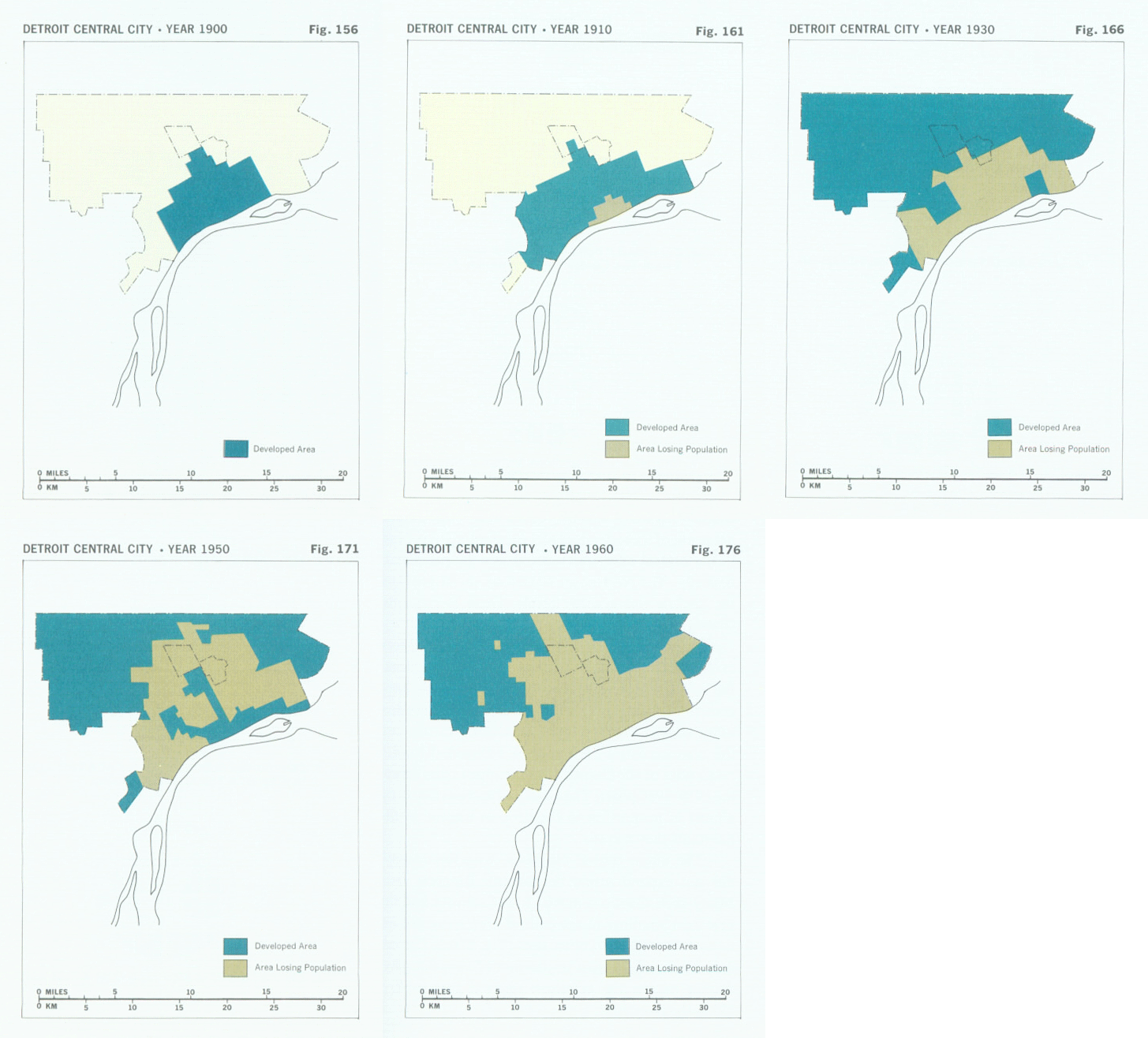
The recent population gains Downtown and the increased purchasing, speculation, and construction are a divergence from Detroit’s past. The Downtown area was losing population as far back as 1900 largely due to the number of factories creating polluted air and water. As Detroit continued to expand outward, Downtown didn’t see a resurgence until the 1950-60s era of “urban renewal” which saw rampant inequality put to use for urban planning gains for limited success.

In the current Downtown redevelopment, a different strategy must be employed if we are to avoid the failings of the past. Perhaps if Downtown is so important then investments will be made to more easily allow the whole city and region to enjoy and benefit from its redevelopment?

Source: “Emergence and Growth of an Urban Region – The Developing Urban Detroit Area, Vol. 3”, Doxiadis Associates, Wayne State University and The Detroit Edison Company, 1970

Map: Wayne State University Student Parking 1960

wsu-parking-1960

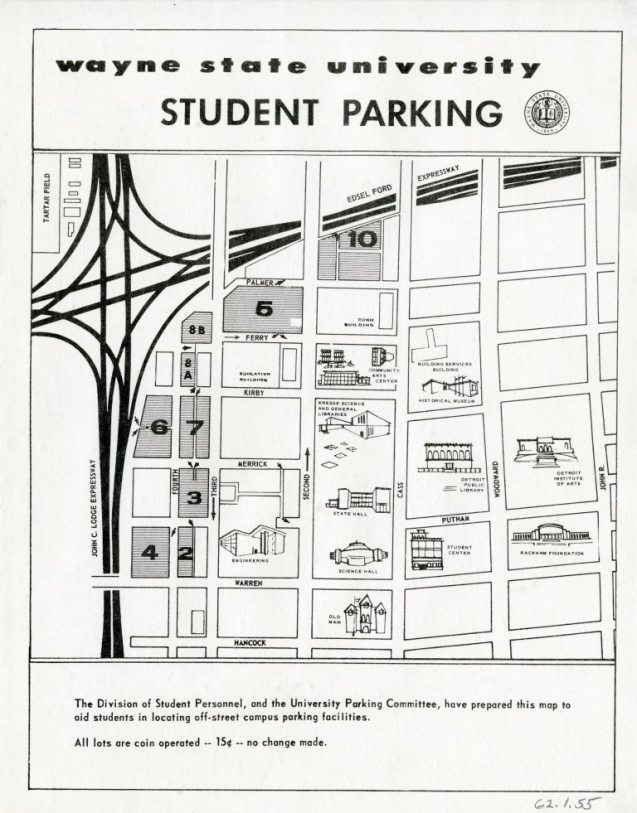
There is far more parking these days at or around Wayne State University. Did you attend WSU in the 1960s and remember parking?

In 1960, parking rates were 15 cents per hour. This past year (2015) parking rates increased at lots across the campus with new parking lots  being added as the campus footprint expands.

Map: Building Conditions in the Grand Boulevard Sector Detroit

dox-grand-blvd-conditions

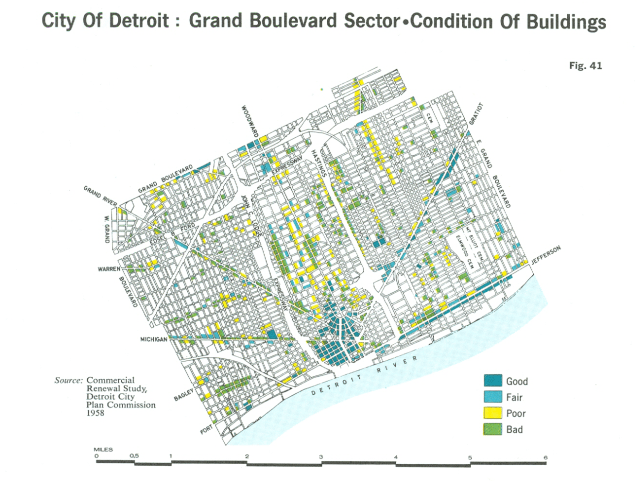
From Doxiadis’ “Emergence and Growth of an Urban Region” Volume 2 based on data from the Commercial Renewal Study by the Detroit City Planning Commission in 1958.

What is interesting about this map is that we can compare to today’s conditions as this “Grand Boulevard Sector” encompasses the current hotspots for redevelopment: Downtown, Midtown, Corktown, Eastern Market, and the East Riverfront. In 1958, we can already see from the map the pre-1960s economic and industrial decline in the city’s core with a cluster of poor conditioned buildings along Woodward in what is now Midtown.

Map: Detroit Neighborhood Coffee Shop Density 2015

DetroitCoffeeDensity

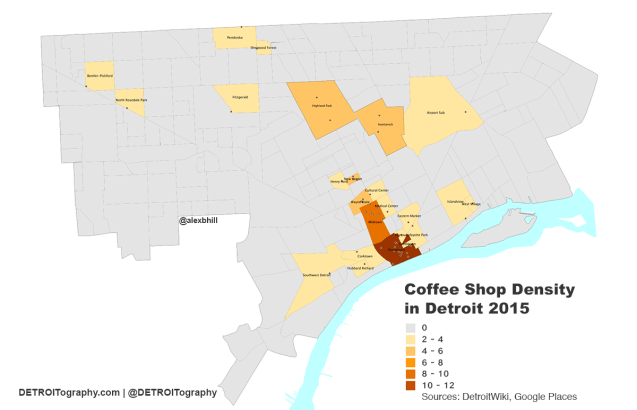
Some research has said that the existence of coffee shops is a marker of gentrification (Papachristos et al., 2011). A Zillow study found a correlation between Starbucks locations and rising rent and home values. The problem is that Starbucks stores often locate in wealthier neighborhoods, so it becomes difficult to say what is the true relational direction. However, in 2008 Starbucks closed some 600 locations in relatively poorer areas. If anything the jury is still out on coffee shops being a driver or simply an indicator of broader social policies that contribute to gentrification.

Specifically in Detroit, where do home values have to go but up? Demolished seems to be the only other option. In October 2015, Dynamo Metrics release a report funded by the Skillman Foundation and Rock Ventures that attempted to model spatial-temporal impacts on home values from demolitions. The study followed commonly held knowledge that blight depresses home values combined with tracking pre- and post- home values adjacent to demolition sites.

In Detroit, demolitions are the new coffee shops?

Map: Detroit Cultural Workforce 2011

Screen Shot 2015-12-16 at 2.23.21 PM.png

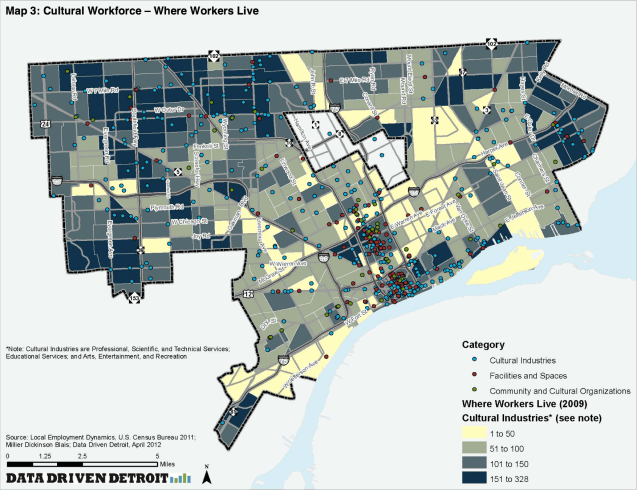
This map generated by Data Driven Detroit and Miller Dickinson Blais accompanied a Kresge Foundation report called “Creative Vitality in Detroit: The Detroit Cultural Mapping Project.”

What is most interesting is that the cultural spaces and industries are concentrated in areas where the cultural workforce does not live. Those who are created and maintaining Detroit’s cultural assets are unable to live near them. The creative economy is often touted as an element of Detroit’s revitalization, but this map presents a stark picture of where and who is benefiting.

Map: United Strohs of America

Screen Shot 2015-12-11 at 12.15.54 PM

Detroit’s iconic beer brewer has a storied past of fire brewing beer in copper kettles, switching to near-beer during Prohibition as well as ice cream to finally losing all of its billions of dollars after the company tried to take on national brands without the necessary budget.

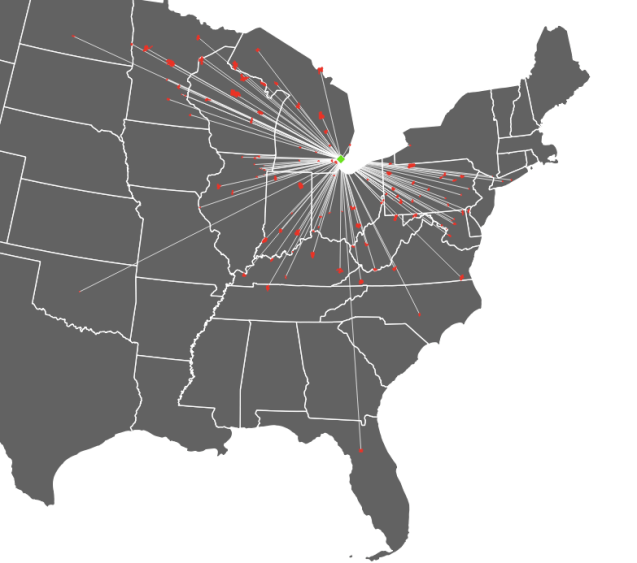
Currently Stroh’s is distributed 126 zipcodes in 21 states. The Stroh’s brand is now under Pabst, which manages a number of small yet iconic beer brand names.

My colleague Matt Elliott and I began wondering where can you get Strohs in Detroit right now? Is it on tap anywhere?

Map: Climate Adaptation Strategies in Detroit

esa-lawson-journal

As with many large cities in the US, Detroit is increasingly contending with the negative effects that climate change has on its population. In particular senior populations are more susceptible to extreme heat events which are occurring at more regular rates.

The article discusses extreme heat, which poses a threat to the livability and sustainability of cities, and disproportionally harms marginalized groups. The frequency of extreme heat events is expected to increase in the future as climate change exacerbates urban heat island (UHI) effects. Common UHI mitigation strategies – such as cool pavements (light-colored surfacing or permeable pavements), cool roofs (often categorized as “white”, “blue”, or “green” roof strategies to differentiate the approaches), and increased planting of vegetation – vary in effectiveness depending on a city’s baseline climate, as well as on city size and layout.(source)

Map: Three Square Miles of Downtown Detroit 1889

Map_image_detroit

This birds-eye view looking north from Downtown Detroit provides a good representation of the density of the Downtown area compared to today as well as the heavy pollution that drove wealthier residents to the soon to be annexed “suburb” areas of Detroit.

The rays of light to the north appear to be calling people to move away from the polluted Downtown. Perhaps that was the goal of this map published by the Imperial Life Insurance Company?


Map: Landscape of Children vs. Elderly in Detroit

children-elderly-det2

I’ve been interested in the impacts of various issues on children in Detroit, from traffic fatalities to areas with the most children. The flip side, focusing on the elderly, is also very important and often overlooked in current development efforts in the city.

The age balance or imbalance across the geography of Detroit results in some interesting areas where children or the elderly make up a majority. Not surprisingly many of the areas with the most children also have fewer elderly residents. The riverfront has a larger elderly population often associated with the senior apartment high rises. Grand River cuts an interesting pattern along the Westside where there are more elderly above the Avenue and more children below.

Map: Indian Trails in metro Detroit

Screen Shot 2015-12-01 at 1.17.18 PM

This map is featured in “Trafficways for 3 million people” published in 1954 by the Detroit City Planning Commission and the Detroit Streets and Traffic Commission. The map presents a look at the history of how people moved in our region long before European settlers displaced local populations and automobiles dominated transportation.

The metro Detroit region already had a hub-and-spoke street pattern long before Augustus Woodward was inspired by Pierre Charles L’Enfant’s design of Washington D.C.

Map: Detroit Expressways and Emissions

Screen Shot 2015-11-30 at 1.47.55 PM

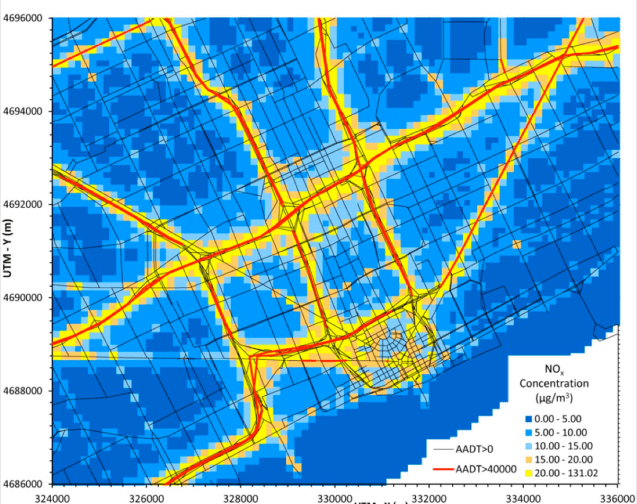
Researchers have long been working to better analyze and model the impact of environmental pollutants. Stuart Batterman, Rajiv Ganguly, and Paul Harbin have a new model that also is visually impactful.

Vehicle traffic is one of the most significant emission sources of air pollutants in urban areas. While the influence of mobile source emissions is felt throughout an urban area, concentrations from mobile emissions can be highest near major roadways. At present, information regarding the spatial and temporal patterns and the share of pollution attributable to traffic-related air pollutants is limited, in part due to concentrations that fall sharply with distance from roadways, as well as the few monitoring sites available in cities. This study uses a newly developed dispersion model (RLINE) and a spatially and temporally resolved emissions inventory to predict hourly PM2.5 and NOx concentrations across Detroit (MI, USA) at very high spatial resolution.

Read more: http://www.mdpi.com/1660-4601/12/4/3646/htm

Detroit Traffic Volume Map

Screen Shot 2015-11-12 at 3.21.45 PM

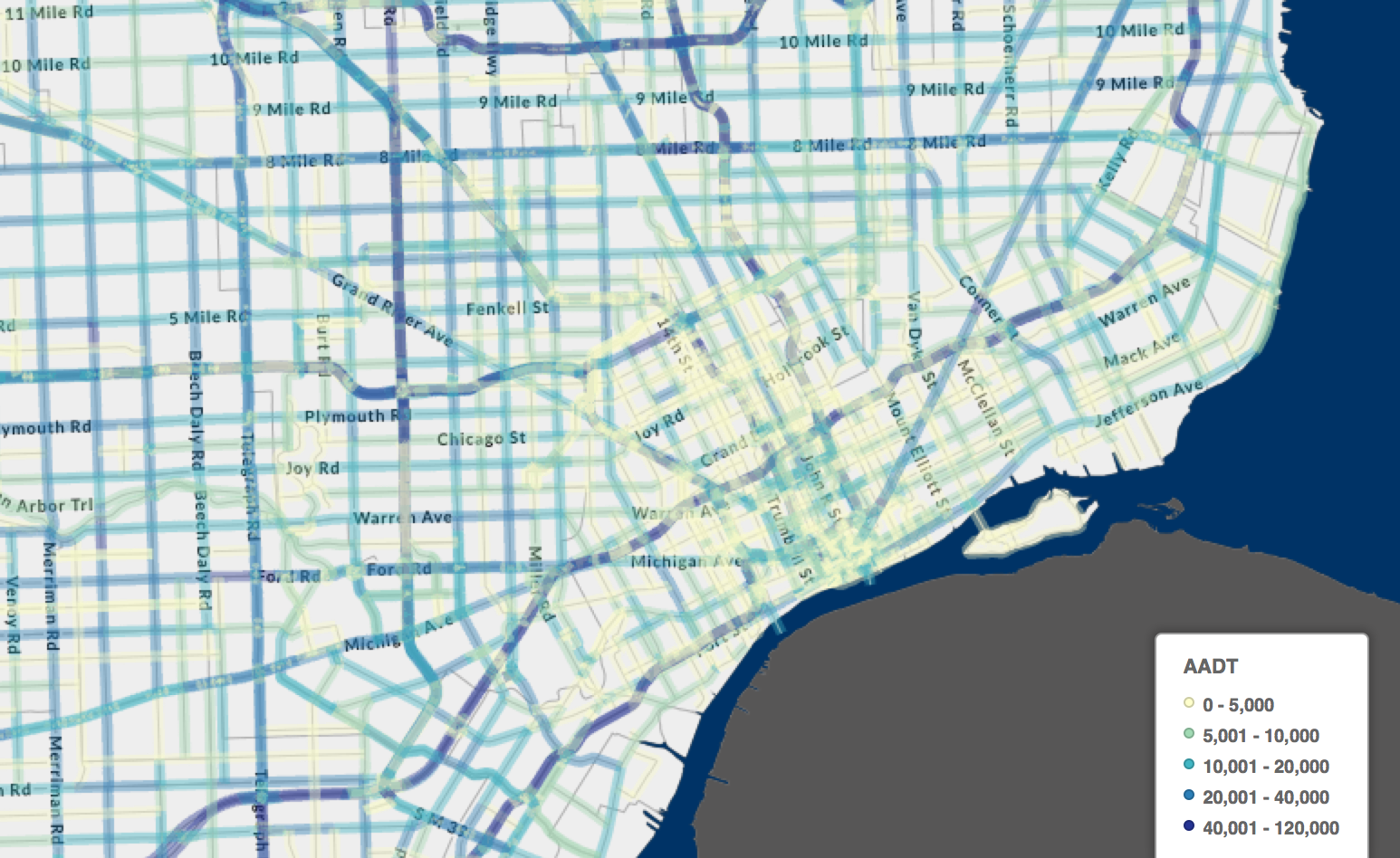
SEMCOG’s traffic volume map represents Average Annual Daily Traffic (AADT) for roads in Southeast Michigan that are eligible for Federal Funds.

The three types of AADT’s represented:

1. Observed – actual counts taken on the segment

2. Interpolated – calculated based on adjacent counts

3. Default – calculated based on county, number of lanes, and functional class.