7 Great Hand Maps of Detroit


hand1nn313

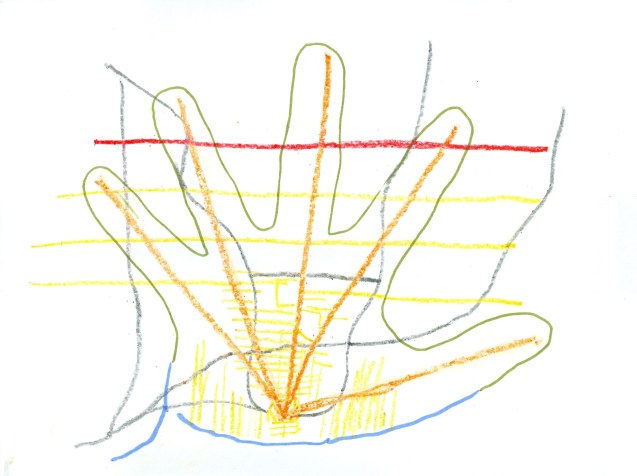
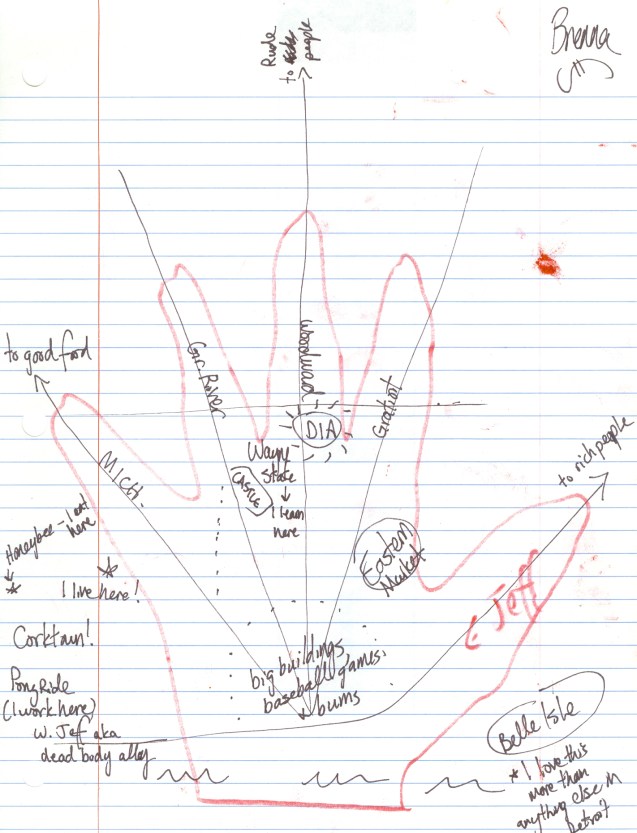
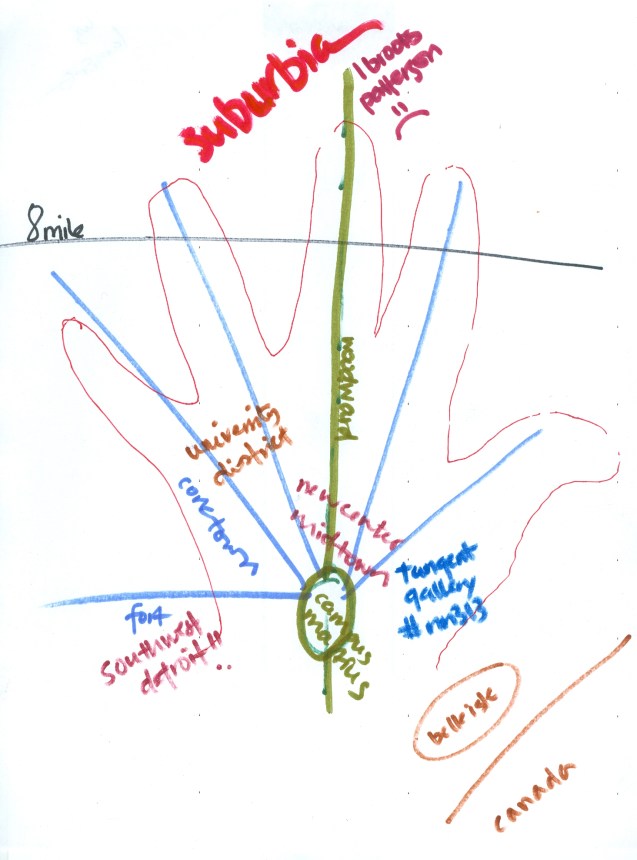
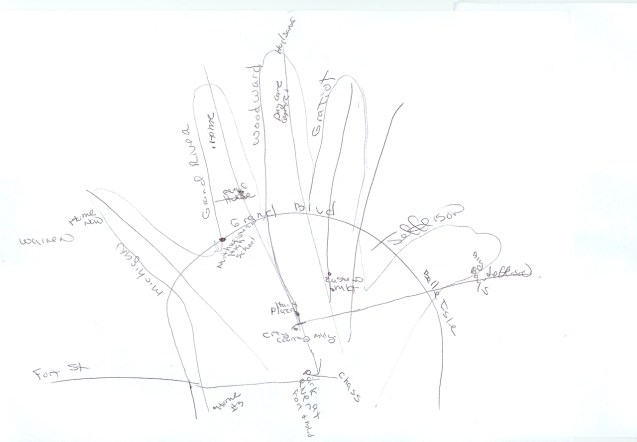
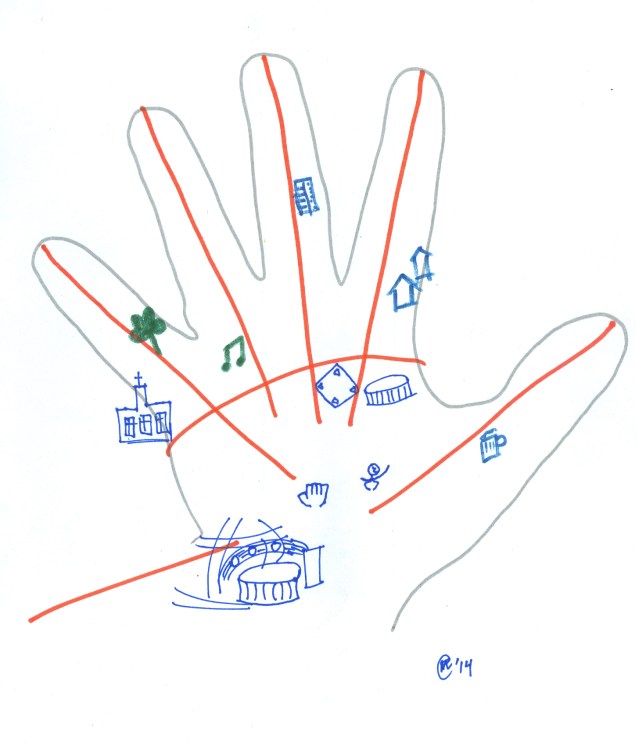
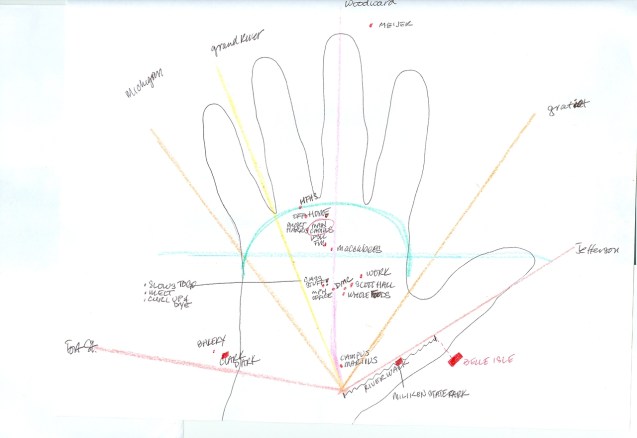
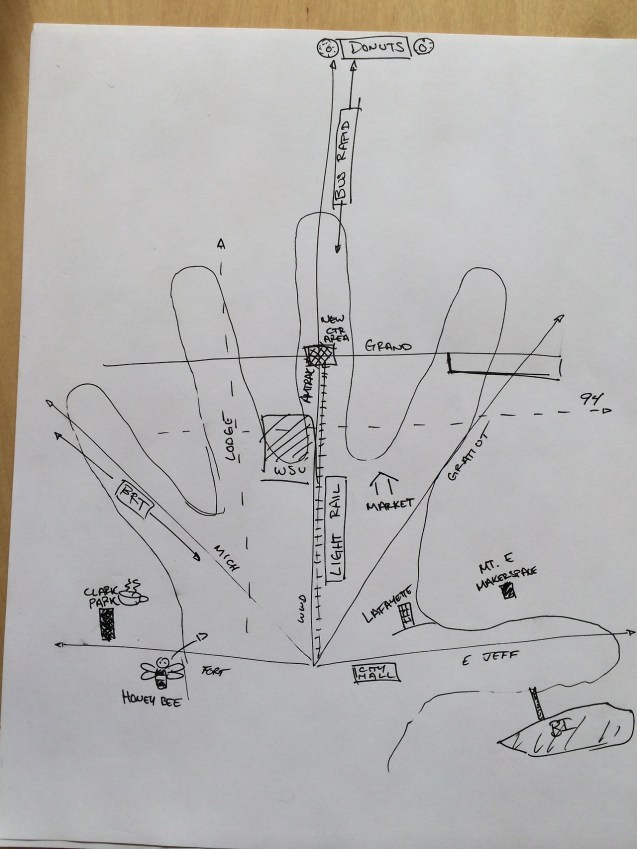
I first came across the idea of using your hand as a mental map of Detroit from the Detroit Geographic Expedition & Institute (DGEI) Field Notes I. The group had collected anecdotal information from a Checker Cab driver in 1968 and started using the “hand map” of Detroit to help visiting students and researchers to get around. This past year I began asking residents to draw their own maps of Detroit using their hand as a guide. Among all the geographic information systems (GIS), parcel surveys, and other technological means that aren’t always accessible – your hand is a map right in front of you. Many of these maps have been collected anonymously while others have chosen to sign their maps. I did not create any of the maps shown here and am grateful to those who have participated.

Participate and submit your own hand map –> Participate & Submit


brennahand

lizhand

CThand

hand3nn313tthand

mhhand


Map: Cass Corridor 1971

cass_corridor_official

There has been recent confusion over what is considered the Cass Corridor.The area got its name because it is the former farm land of Lewis Cass, second Governor of Michigan.

Being engulfed by the idea of “Midtown,” the Cass Corridor has lost some of his important historic meaning. As I’ve written before, the Cass Corridor once had the highest crime and poverty in the whole state of Michigan. The effects can still be seen if you walk south on Cass Ave. towards Downtown. Just past Alexandrine St. you will begin to notice less new development, homeless encampments, and the various social service organizations that help those in need.

Some history from Field Notes III of the Detroit Geographic Expedition & Institute:

“Generally, those who lived there were white and came from the mountains of Tennessee, West Virginia, Kentucky, and western Pennsylvannia. The neighborhood remained primarily Appalachian after the war [Second World War] , and in the early 1960’s, Student Non-violent Co-ordinating Committee (SNCC) workers referred to it sarcastically as “Little Kentucky.”

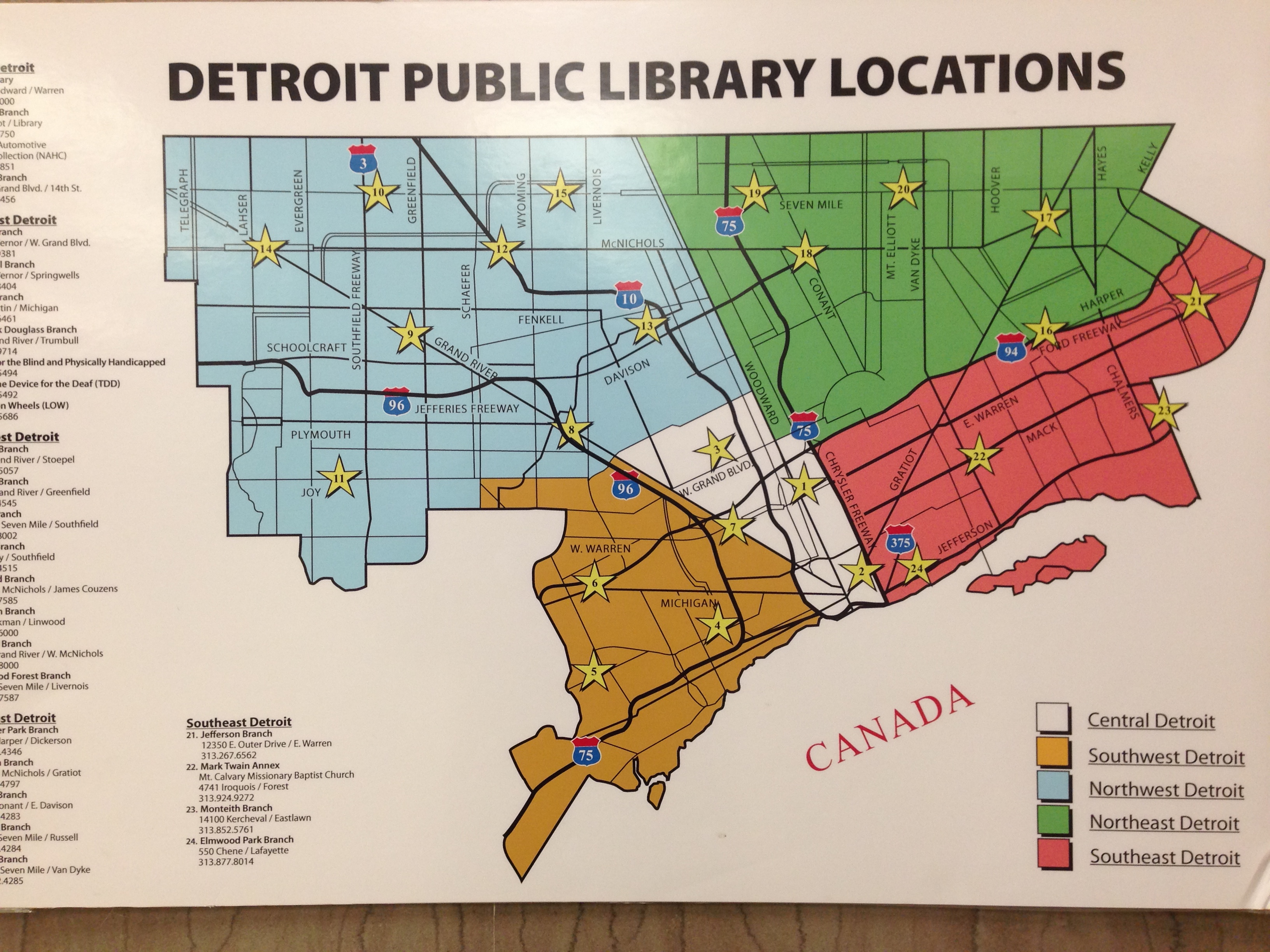
Map: Detroit Public Library Locations

map_lib_locations


I discovered this map in the Detroit Public Library (DPL) Main Branch. My first thought was that many of the locations are no longer open. Then I noticed the way the city is broken into 5 parts, most interesting is the “Central Detroit” area. Anyone know where these areas may have come from?

I was also extremely saddened to learn that the “Map Room” no longer has any maps. When I asked where I could find maps, I was told by staff that they are all in the basement. I would have to search the catalog and then request to see a specific map.

Map: Non-Local Land Ownership in Detroit

nonlocal_landuse

The Detroit Geographic Expedition and Institute (DGEI) led by William Bunge mapped out “nonlocal land use” in 1969. I’ve been interested to see how it might compare today. This map is obviously different in that it is looking at who owns the land as opposed to land use, but still offers interesting perspective. It appears that Detroit’s commercial zones along major roads as well as industrial zones are largely held by companies and groups outside the city. What is surprising is the increase in outside land ownership of housing parcels. The map appears gray because there are individual housing parcels held by non-local owners across the city.

Here is a close up of Downtown/ Midtown area.

downtown_landuse

Thanks to Loveland Technologies for sharing data to make this map possible.

Map: Citywide pattern of children’s pedestrian deaths & injuries by automobiles

citywide pattern child auto 1971

Building off of William Bunge’s similar map, this map comes from the Detroit Geographic Expedition and Institute’s Field Papers III.

“[…] All the area about a mile going out from downtown Detroit is one-way traffic and runs right through the heart of the Black community. And on one specific corner in six months there were six children killed on one corner by commuter traffic. But, naturally, these deaths of these children or the injuries or whatever it happened to be were disguised as something else. They never said that a certain business man who was working for BUrroughs downtown who was on his way to Southfield went through the Black community by way of this commuter traffic and killed my people – Black children. Even in the information which the police keep, we couldn’t get that information. We had to use political people in order to use them as a means of getting information from the police department in order to find out exactly what time, where, how and who killed that child.

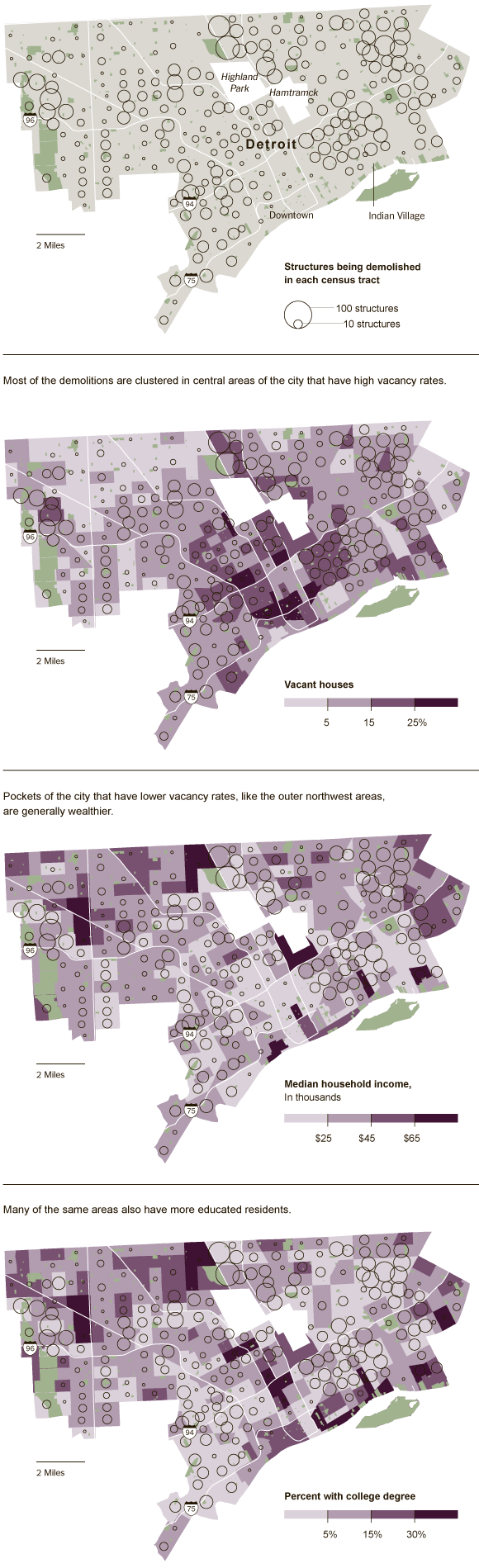
Maps: Demolitions, vacancy, income, and education in Detroit 2011

0406-nat-webDETROIT


The New York Times completed a series of maps about shrinking Detroit in 2011. They looked at where structures were being demolished and where vacant houses still stood. They posited that the city was looking for which neighborhoods to save in the process and also created maps looking at median income and college degrees.

These are nicely designed maps and help to show the contrasts of the city where problems reach all corners, but funding and solutions are more concentrated and disparate.

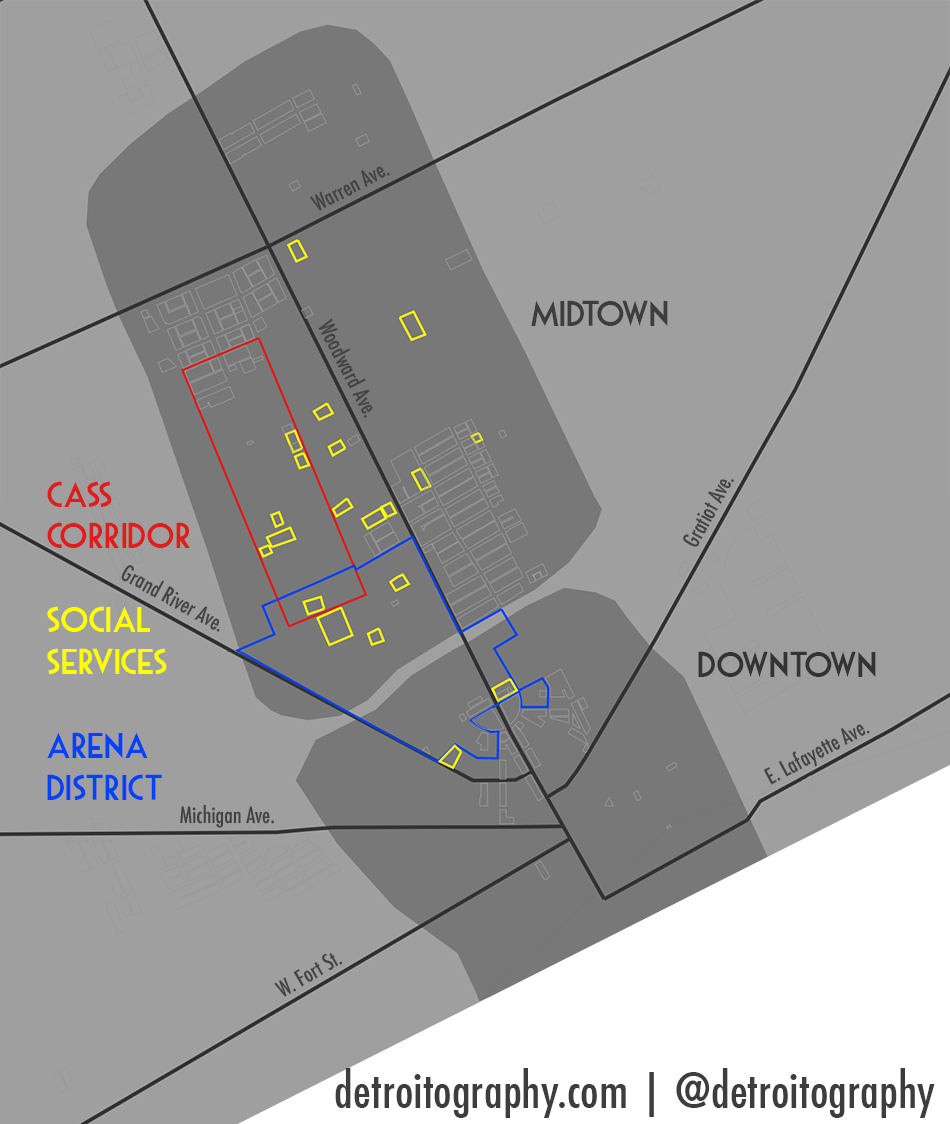
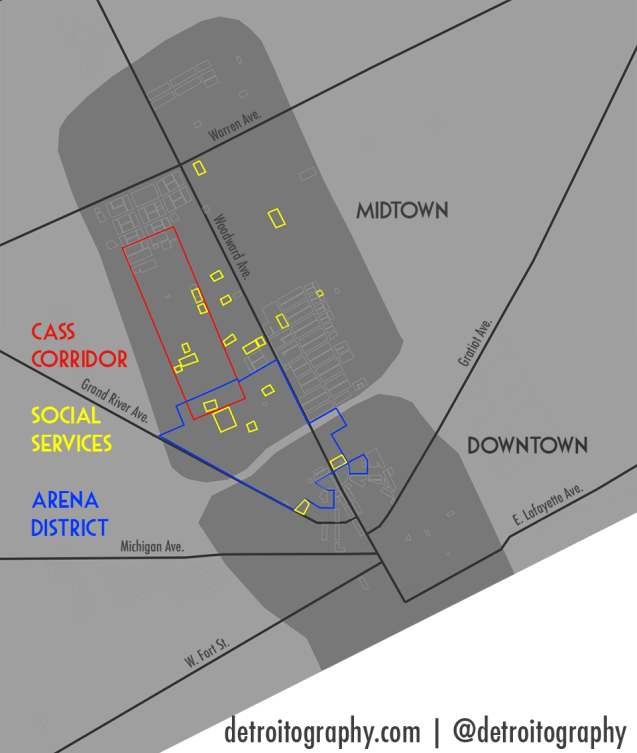
Map: the future of Social Services in Detroit’s new city within a city

socialservices_development


The idea of “Midtown” (district? region? neighborhood?) beginning around 2001 pushed the area to the forefront of Detroit’s most recent efforts to revitalize and bring people and businesses back into the city. At the same time Midtown developments were at odds with an area that had become historically known for its crime, poverty, and drugs. Well into the 1970s and 1980s, the Cass Corridor was the most impoverished area of the entire state of Michigan. Likewise, Cass Corridor had one of the highest crime rates in all of Michigan.

It is no surprise that what followed were a series of social services organizations and programs to assist the high populations of poor, homeless, and recovering addicts. In 2004, A Detroit Free Press article titled: “Development clashes with needs of homeless” highlighted the two different faces of the new Midtown area; the chain-link fence of a homeless shelter serving predominantly black men to the wrought-iron gates of a new condominium development where mostly affluent white people lived.

The serious concerns that low-income people were being moved out of Midtown have arguably not improved over the last decade. In 2003, Salvation Army treatment facility and offices relocated and in 2004 Crossroads of Michigan had to relocate from its original building.  In 2005, NSO was supposedly in talks with the City of Detroit to relocate out of the Cass Corridor.

The new Arena District, land owned and controlled by the Illitch family (Little Caesar’s, Fox Theatre, Red Wings, Tigers), will bring a new hockey arena as well as new development to connect many of the Illitch investment sites to create a strong entertainment zone for Detroit. I can’t imagine that the Illitch’s plan to have social services and homeless agencies as their neighbors. The concerns raised in 2004 have not been resolved and the increased level of development will only exacerbate the issue of resource disparities in Midtown, Detroit’s new city within a city.

“Overall, I think what’s happening here [Midtown] is exciting. I just wish our clients could be a part of it.” (Mary Honsel, 2004)
Map: Potential for School Integration 1967

integration1967

This map from the Detroit Geographic Expedition and Institute (DGEI) comes from Field Notes III, which was focused on all aspects of education in Detroit, represents areas of the city that were more likely to do well with integrating races in schools. It just so happened that these areas (darkest) were also the wealthiest. “Good” integrated education was available to the highest paid black families and middle or high income white families.

More from the report:

“The geographic phenomenon [integration] is not the result of pushy people aggressively invading other peoples’ neighborhoods, it is simply natural proportional growth. Further, the cause of white flight from integrated areas is not necessarily simply racism. “Integration” to whites too often means bad schools; and young liberal white families, the ones more likely to integrate, will not do so at the expense of their children’s education. The low quality of education, especially the predictable tremendous overcrowding that accompanies expanding black neighborhoods, is precisely the overwhelming factor that drives out young liberal white couples from integrated areas. The condition of the schools themselves are the most active instrument of segregation in the city today in spite of an officially proclaimed policy of integration.”

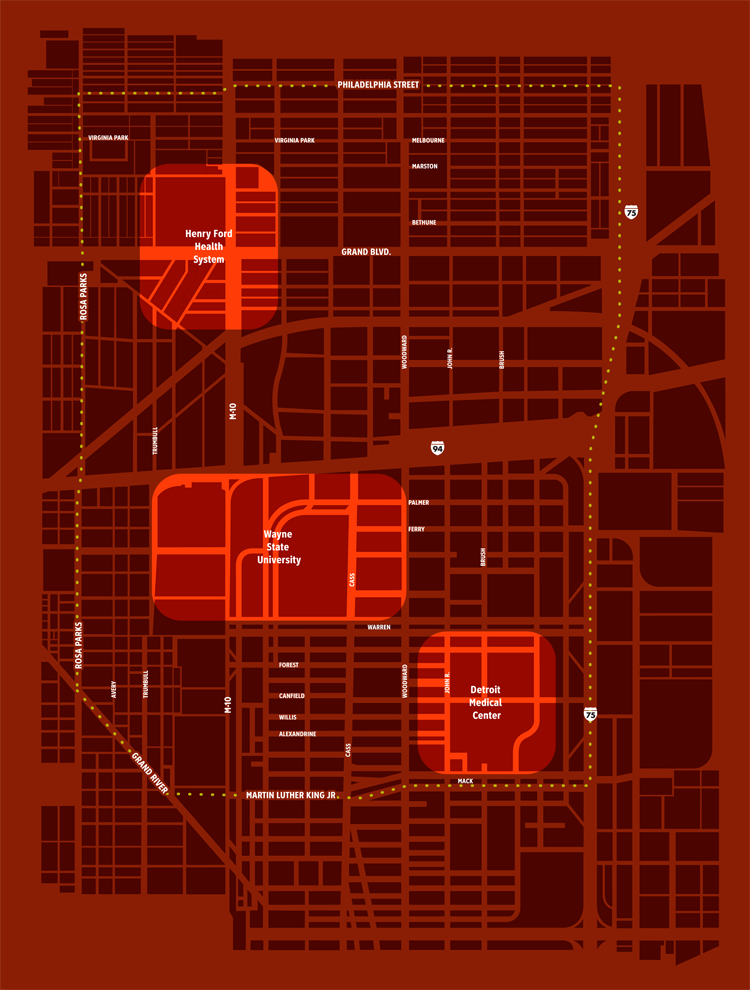
Map: Midtown Boundary is Expanding

LiveMidtownMap1

The LiveMidtown housing incentive program was launched in 2011 after University Cultural Center Association (UCCA) merged with the New Center Council to form Midtown Detroit, Inc. The most recent announcement is that the program area has been expanded to include the historic Boston-Edison neighborhood north of New Center.

Midtown is considered Detroit’s premier neighborhood where young people flock and new business compete for space. Midtown is home to what could be considered Detroit’s core industry of health care with DMC campus, WSU Main and Medical Campus, and Henry Ford Health System.

Prior to 2001, Midtown did not even exist and now under Midtown Detroit, Inc. it has become a driving force behind the place-making, investment, and future development of one of Detroit’s core areas. Where will the Midtown boundaries expand to next?

Map: 2013 Gardens with Detroit City Council Districts

2013-Map_City-Council-Districts_Final

This map comes from Keep Growing Detroit, part of the Greening of Detroit. We have been asking for data on gardens for a number of years and it is nice to finally see some data shared even if it is just in map image form.

It looks like there is a high concentration of family gardens in Northwest Detroit, which makes sense and matches with population density. Missing is the similar concentration in the population dense Northeast. I wonder if there is correlation with income level and gardening? The Westside has a higher median income than the Eastside.

Hopefully this data will be opened up at least for market, community, and school gardens?

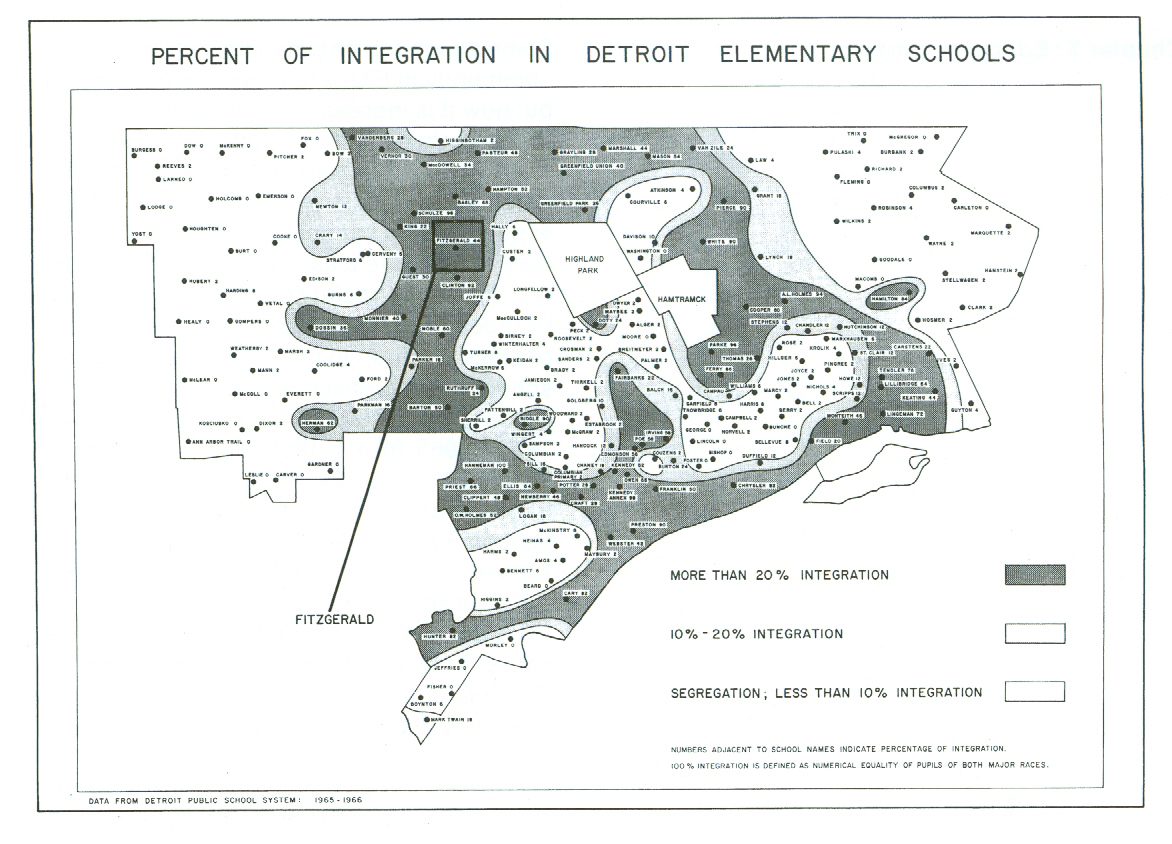
Map: Percent Integration in Detroit Elementary Schools 1965-66

integration_detroit

Published in Fitzgerald: Geography of a Revolution, this map compliments the work of the Detroit Geographic and Expedition Institute (DGEI) in looking at equality, race, and integration within Detroit’s school system. The map key shows that 20% integration is the highest among any of the schools.

Detroit Street Map 1898

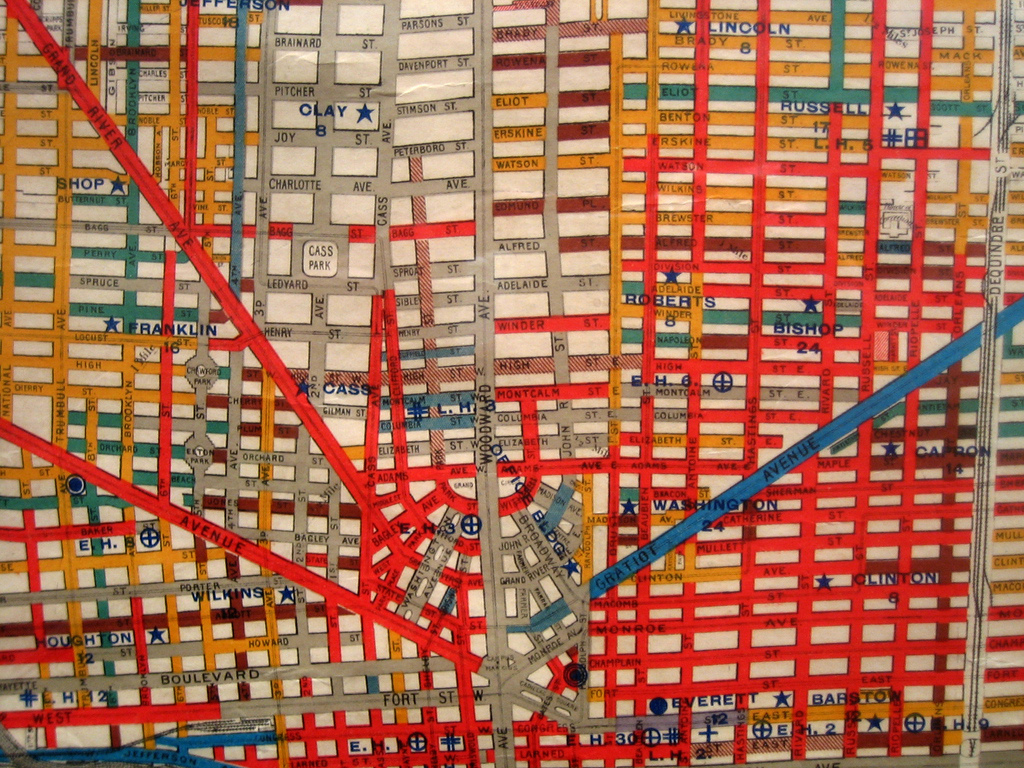
Detroit street map 1898It is so easy to forget that Detroit used to be so much smaller in land area and more dense in population. I always have to remind myself when I drive across Greenfield Rd. that the area used to be considered a suburb of Detroit, included with Springwells Township, Highland Park, and Hamtramck. This street map from 1898 is a good example of the road density that allowed street railways (carriages pulled by horse) to proliferate.

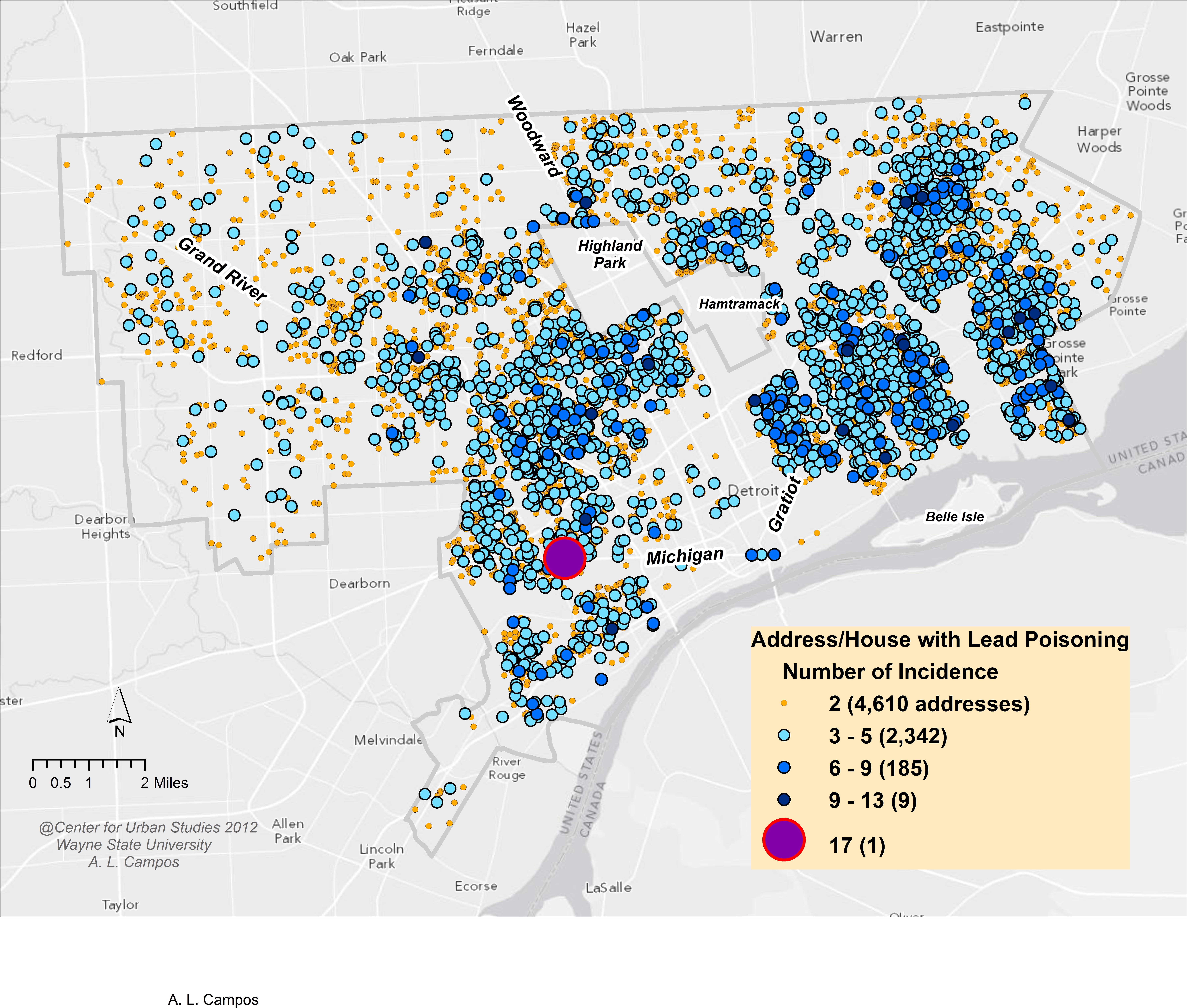
Cases of Lead Posioning in Detroit 2011

mostdangeroushouses11Annalie Campos at the WSU Center for Urban Studies created this map based on 2011 lead poisoning incidence.

The above map shows the number of lead poisoning incidences per address/home in the City of Detroit. The yellow dots show that there are 4,610 homes in the city with two occurrences per home; these are the most frequent. However, the blue dots, which show  three to five or six to nine occurrences per home, cover more of the map because of the higher number of people affected. There was one home in the southwest portion of the city that had 17 lead poisoning cases, according to the map.

Issues with this map:

  1. Poor design choice to use all point level data making it impossible to account for all colors and shapes of incidents. Some get covered up or overlap resulting in lost data.
  2. Colors don’t offer any real distinction due to the overwhelming amount of data/ number of incidents.
  3. Lack of analysis – beyond the poor choice of displaying point level data, there is no clear understanding to a reader as to what to take away from the map.
  4. Lack of citation for source of data.
  5. Another potential dataset where a map may not be the best option.

Map: Inferior Education in Detroit 1960

inferior-edThe Detroit Geographic and Expedition Institute (DGEI) spent much of their Field Notes II publication looking at the state of education in Detroit. This map, based on test scores, demonstrates the racial divide that matched the resources and education divide in the city.

Map of Inner-City Detroit 1999

Detroit_Map

This map comes by way of Suzanne Smith’s book, Dancing in the Street: Motown and the Cultural Politics of Detroit and was created by the University of Wisconsin Cartographic Laboratory. There are a few problems here namely the use of “inner-city” in its true urban planning context is good, but leaves out the reality of Detroit’s inner-city in the 90s. It could be argue that in the 90s there was a broader understanding of “inner-city” and this map does little to give anyone a geographic understanding of Detroit’s “cultural politics” past or present [the 90s].

Smith, Suzanne E. Dancing in the Street: Motown and the Cultural Politics of Detroit. Cambridge, Massachusetts: Harvard University Press, 1999.

Map: Detroit’s Sympathetic and Unsympathetic Ethnic Groups 1960

sympathetic-ethnic-groups

The city was fairly diverse in the 1960s, yet there were underlying tensions between different ethnic groups and their particular sympathies towards Detroit’s black population. In this map the Detroit Geographic and Expedition Institute (DGEI) mapped out those various relationships based on Census data.

Proposed Detroit City Council Districts and Neighborhoods Map

d3_districts

NOTE: These proposed districts were never adopted. They were one of many proposed district boundaries.

Data Driven Detroit created a map of their proposed plans for the new City Council Districts in 2011 along with the “neighborhoods” cataloged by Arthur Mullen of Cityscape in 2003. These are not the city council districts that were officially chosen, nor are the neighborhoods set in stone or widely agreed upon. This map is an important representation of how organizations and institutions with power and influence change and shape discussions about the city.

Does every area of Detroit need a name? Does it make more sense to talk about the city by District, neighborhood, school catchment area, or another distinction? Who decides these distinctions?

Map: Fitzgerald in Past, Present, and Future Detroit

fitzgerald_history

William Bunge wrote about urban geographies being very similar. In his book Fitzgerald: Geography of a Revolution, he discussed the changing nature of the Fitzgerald neighborhood from its existence in the Michigan wilderness in 1830 to becoming an affluent suburb in the 1920s. His question is whether the slums will continue to expand and include Fitzgerald, which at the time was considered a middle class neighborhood situated in between the suburbs and the slums.

I think the unfortunate answer to Bunge’s question is that Detroit continued to decline and the residents of Detroit continued to lose jobs and city services.