Map: Cass Corridor Land Owners 2016

cass-owner-2016-2

In comparison to the 1971 map based on similar data, this map of the 2016 property information posted on the Detroit Open Data portal shows changes over time and space. The data that was mapped is based on the tax payer address for each property and some properties are held by the same tax payer or “owner.”

Ownership in the Cass Corridor area has remained spotty with no real concentrations, however ownership within the Corridor Area has continued to be most dense for land parcels in the northern half of the area rather than the southern half. Similarly, ownership of Corridor land in the USA has not significantly changed, but there are a handful of additional US States represented.

The biggest change in ownership has been within the City of Detroit and Region. In 1971, there were strong concentrations of land owners in the neighborhoods at the north end of Woodward (Palmer Woods, Green Acres, University District) where more well to do Detroiters lived. However, in 2016 the most dense concentration of land owners is now focused around the Corridor area (Midtown) and Downtown. Additionally, the suburban sprawl process seems to have expanded land ownership to more far flung regional suburbs. For example, Ann Arbor was not represented in 1971, but now has a number of land owners. There have also been suburbs such as the Grosse Pointes that have less ownership in the Corridor area than in 1971.


Population Density Map 1925 Detroit City Census

This excellent dot map was published in “The Detroit Educational Bulletin” Research Bulletin No. 9 – October 1925. The report gave population totals for each of the 570 Census zones (now called Census Tracts).

The nationality breakdown for 1925 showed the top five groups as:

  1. U. S. White – 598,041
  2. Poland – 115,069
  3. Canada – 83,685
  4. U. S. Colored – 81,831
  5. Germany – 54,223


Event: Data Discotech – Community Science Fair about Open Data

screen-shot-2016-10-02-at-10-27-27-pm

The Detroit Digital Justice Coalition (through Allied Media Projects) and Detroit Community Technology Project are partnering with Butzel Recreation Center to present a Data DiscoTech, October 15th, 11:00am – 2:00pm at the Butzel Recreation Center (10500 Lyndon St.) . The event is free and open to the public!

DiscoTech” is short for “Discovering Technology.” The DiscoTech will offer interactive stations to demystify technology concepts related to open data and the City of Detroit’s Open Data Portal.

At the DiscoTech we will:

  • Demystify data.
  • Understand the risks of open data.
  • Understand how to use data in community organizing efforts.
  • Use data in creative ways.

See you there!

Map: Detroit River and Adjacent Country 1813

detroit-windsor-1813

This map based on work by a British Engineer shows how Detroit fit into a different kind of region as controlled by the British in the early 1800s.

Today we think of the Detroit region as Southeast Michigan, but for a very long time “Detroit” was all about the river as a center point and the region that it touched along the way.

Map: Detroit New Urban Configuration 1920 – 2010

Screen Shot 2016-09-02 at 11.46.04 PM

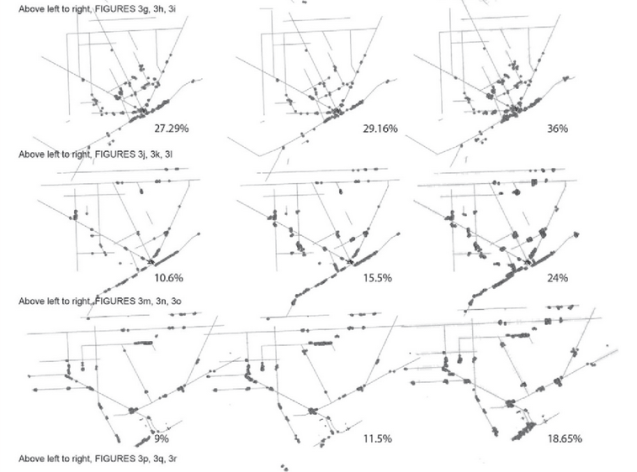
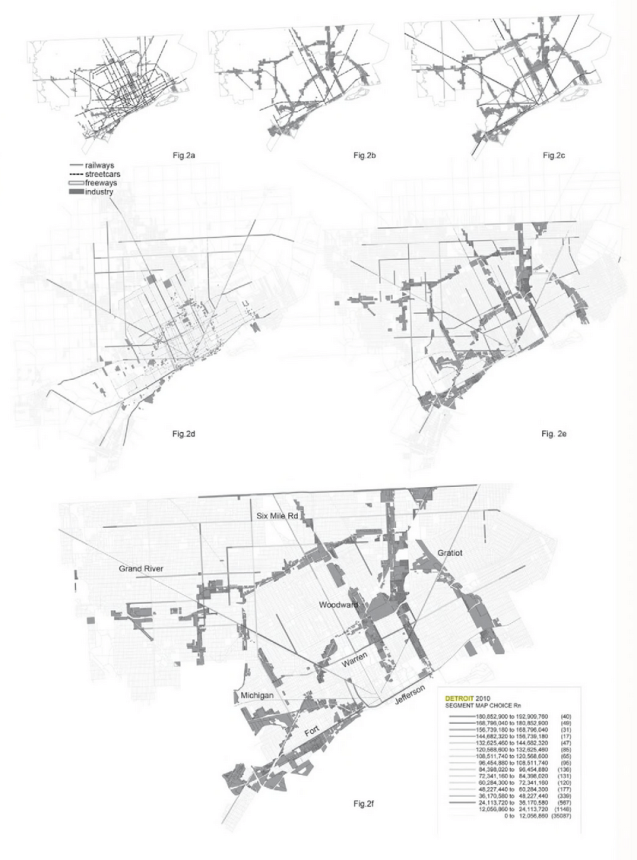
In the book, New Urban Configurations, the City of Detroit and City of Turin (Italy) are compared for their former industrial power and post-industrial decline. Turin was once called the “Detroit of Italy” and the process of mass production has had similar effect on the local economy. The authors write:

“We suggest that Fordist mass production manifesed specific spatial patterns that had profound impacts on the urban character of both cities and their capacity to adapt to changing economic models.”

In particular, the authors are focused on the impact of road network expansion contributing to the loss of manufacturing in the city (see maps below).

Screen Shot 2016-09-02 at 11.44.59 PM

Map: Ride the Green Dragon in Detroit, Route 16 Dexter

green-dragon-dexter-map.png

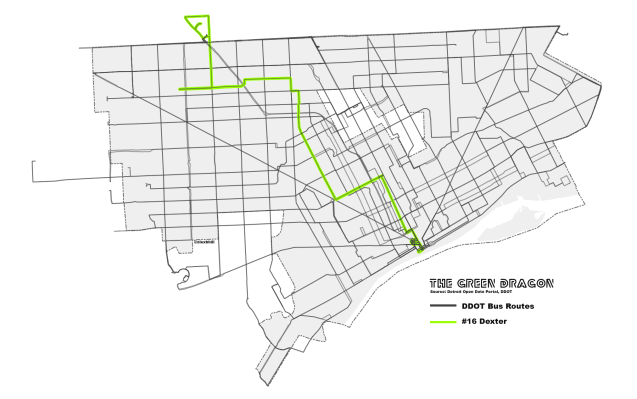
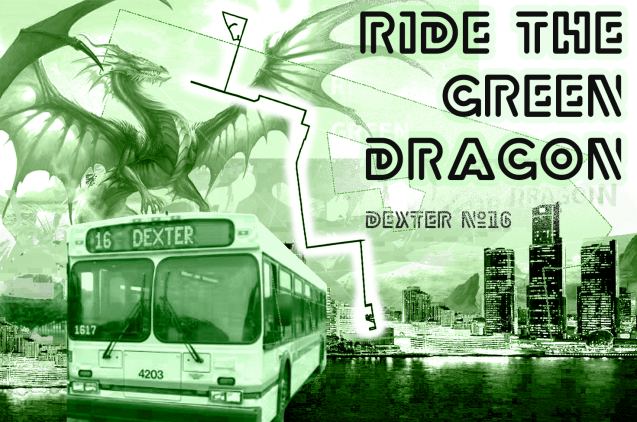
The Dexter #16 bus route can be seen slithering and clawing it’s way north from Downtown Detroit to Northland Mall (now closed) in the northern suburbs of Southfield.

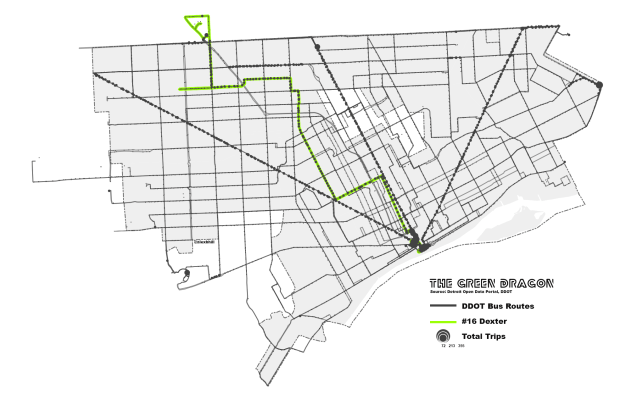
green-dragon-dexter-map-trips

As well as being one of the longest, Route 16 Dexter is also one of the busier routes, right behind the 3 major artery Avenues (Woodward, Gratiot, Grand River). I assume because the route passes through the more densely populated Northwest side as well as stopping at the former Northland helped increase the number of trips.

The marketing could be awesome for this route, “Ride the Green Dragon!”

green-dragon-dexter

Map: Detroit Business Investment and Streetcar Lines 1915

LOC_industrial_streetcar.jpg

This map comes from the Library of Congress and depicts both the growth of industry and rail transit in Detroit. In the early days of streetcar development, real estate developers funded new rail lines to be able to link their new developments to other city amenities.

Seems the city was thinking early of “transit oriented development.”

Map: Detroit Murals in the Market vs. Graffiti Tickets

murals-graffiti-map.png

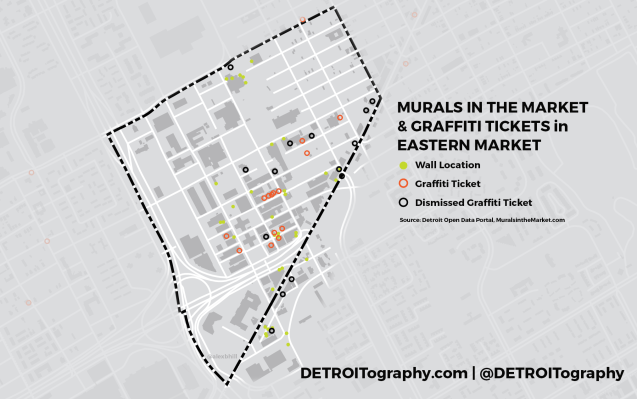
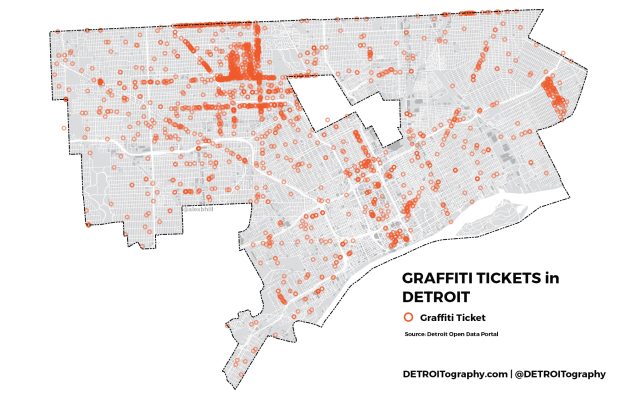
The city has ramped up ticketing for blight violators and that includes properties with graffiti. In some reported cases the graffiti tickets included sanctioned murals and street art, for example Eastern Market, Brooklyn Street Local (restaurant), and the Grand River Creative Corridor. Those tickets led the Mayor to apologize and dismiss all graffiti tickets for murals and signs.

As the artwork for Murals in the Market 2016 has started coming together. I started wondering how many of these graffiti offenses involved buildings in Eastern Market, where there is already a high number of sanctioned murals.

In some cases there have been buildings with both a new mural wall location and a graffiti ticket, but the majority of those have been dismissed graffiti tickets for sanctioned murals. There were 28 graffiti tickets in Eastern Market between 2015 – 2016 and 14 have been dismissed. The majority of businesses ticketed for graffiti along Division St. and Winder St. remain responsible for paying their fees, some are hosting new murals this year.

Citywide graffiti ticketing:

graffiti-citywide-map.png

Map: Baist’s Property Atlas of Detroit

baist-perrien-park.jpg

This is a section of “Baists property atlas of the city of Detroit, Michigan” from the DPL Digital Collections Burton Historical Collection. Property data had to be compiled from official records, private land claims, and land surveys.

For Detroit, this atlas took up 3 very large bound volumes in 1896. I can’t imagine how many volumes would be needed today.

Map: Detroit Expressway Knots

screen-shot-2016-09-09-at-9-34-20-am

Artist and web-developer, Nicholas Rougeux, first started collecting aerial imagery of “road knots” which then led him to start breaking down the world’s most interesting “spagetti interchanges.” One of these interchanges of more than 3 converging roads is in Detroit, down by the Ambassador Bridge. Did the expressways ever look so beautiful?

Check out the project, all interchanges are available to purchase as posters too!

Workshop: Data, Mapping, and Research Justice

coopen_banner_data-300x300

I’ll be teaching my workshop on data and mapping again this October 2016 with Allied Media Projects/ Co.Open.

During the 4-week course we will journey through the entire mapping process; from paper survey to digital database, basic map visualizations, and finally analysis. We will be working with free and open source software (LibreOffice, QGIS, Gimp, etc.).

Check out some of the past course projects:

Thursday nights in October (4 weeks long) 6-9pm

Sign up at store.alliedmedia.org

Map: Cadillac’s Village of Detroit in 1708

This map is a reproduction of the original “Plan From Conveyances of Cadillac” made 1707 – 1708 published in the book “Cadillac’s Village” or “Detroit Under Cadillac.” The author was none other than Clarence Monroe Burton (Burton Historical Archives).

Burton writes:

“[…] Of all these conveyances I have a complete copy, and have undertaken to arrange them in a manner to construct a map of Detroit, as it was in 1708. […]

It may be that this map is faulty. I have no doubt that it is, in some particulars. But it will do as a foundation to work from, and a better one may be constructed hereafter, when more information can be obtained from which to work. […]

In order to prove the accuracy of the map, I had it traced on the present city map, and find the lines of lots existing before the fire of 1805, many of which still serve as boundary lines of present buildings, coincide very nearly with the Cadillac conveyances.”

Map: Detroit Tipping Point Geographies

blight-taskforce-tipping-point

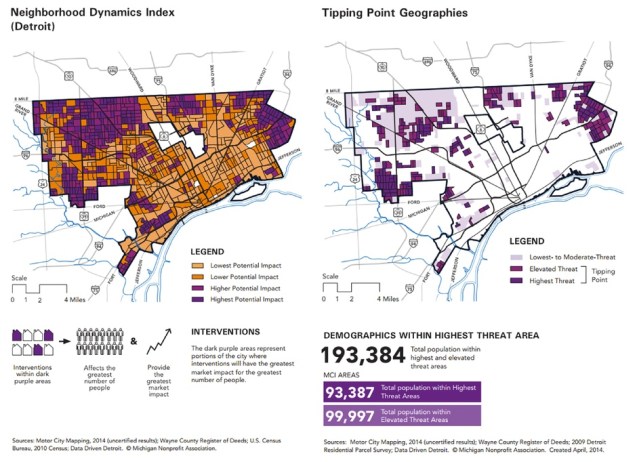
The 331-page report titled “Every Neighborhood Has a Future … And it Doesn’t Include Blight,” was released in 2014 by the Detroit Blight Removal Task Force (an organization convened by President Obama in the Fall of 2013). Referring to blight as a “cancer,” it recommended the removal of 40,000 unsightly properties within five years.

Map: Vehicles for Commuting in Detroit 2014

vehicles-commuting

I’ve posted similar maps before, but the confusing narrative remains that people do not have cars in Detroit. It’s true many people have limited mobility, specifically those living in poverty and the elderly. The Motor City has far fewer cars than its nearby neighbors, but that doesn’t mean the majority of Detroit isn’t still car dependent. There really is no other way to reliably get around the city.

For example just 6% of households with someone 65+ living alone do NOT have a car. The most important information about transportation might not be how people are getting around, but where they choose to go and how far away they travel for things like groceries, doctor’s appointments, etc.

A good start would be to look at areas where people are commuting by car regularly and build public transit options to match in the hopes of improving access to jobs and opportunity.

Map: Detroit Electrical Transmission System 1924

det-electric-1924

This map demonstrates the electrical system in Detroit as of 1915 projected to 1924. The interconnected dual generating plant system in the city supplied over 300 miles of electrical cable across the city. However, by 1922 the Detroit system was becoming strained for capacity. As the surrounding region continued to grow the Detroit system became overtaxed and additional plants had to be constructed in Monroe and Marysville to bear the load of the electricity demand.

Map: DDOT Expanded 24-hour Routes

24hourroutes

In a major advancement in Detroit public transportation, DDOT announced that it will expand 24-hour service to a number of routes.

Since the major reductions in DDOT services in 2012, this is an incredible and welcome change. The increased mobility and services will hopefully improve the day-to-day experiences for many Detroiters.

Map: Land Acquired by Parks and Recreation 1940-1950

Screen Shot 2016-08-21 at 11.09.14 PM

In 1940, the Department of Parks and Boulevards was merged with the Department of Recreation to aid “economy and efficiency.” The new Department inherited 4,162 acres  of land in 138 locations:

  • 38 parks
  • 56 parkways, boulevards, etc.
  • 25 plagrounds
  • 10 playfields
  • 3 community centers
  • 2 utility sites
  • 1 summer camp

In 1946, the new Department added an additional 1,005 acres with plans for an additional 269 acres at 41 sites to bring the grand total by 1950 to 5,521 acres.

Map: The Heart of Detroit’s Negro Community 1955

Screen Shot 2016-08-21 at 3.38.06 PM.png

This map serves as the cover art for a report titled: “some notes on the Detroit negro vote.” The map notes that the Fifth Ward and area best known historically as Paradise Valley has been a majority African American area. The report goes on the chart the Black vote in Detroit and its precipitous decline in support of Republican politicians between 1932 – 1952. It notes that in 1932 the majority of the Black vote went to Hoover over Roosevelt.

Map: Pokemon Go Redlining in Detroit?

pokemongo_detroit_large

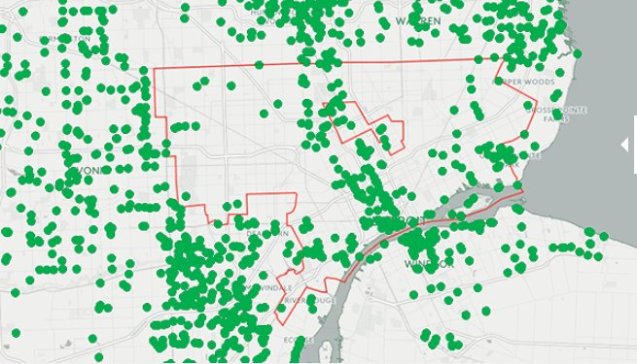
Amid the firestorm that was/is Pokemon Go, an interesting geographic disparity was discovered. The above map has been shared widely and articles have covered why majority Black cities have fewer pokestops. The map displays “claimed” pokestops and not all pokestops, but regardless demonstrates serious disparities.

The problem is that pokestops relied on a database of historic markers and crowdsourcing. Locations were crowdsourced from Ingress, a previously established real-world/virtual reality game. The most important point being here that the crowdsourcing is only as good as the crowd. For Detroit that means a heavy density in Downtown, Midtown, and along the Woodward Corridor, but not as much in the neighborhoods.

Internet access disparities, smartphone reliability, service coverage, opportunity and income gaps – sometimes it is the little things that demonstrate the most persistent problems we face.

HT @niftyc

Map: Detroit’s Artesian Water 1917

Screen Shot 2016-08-09 at 9.43.43 PM

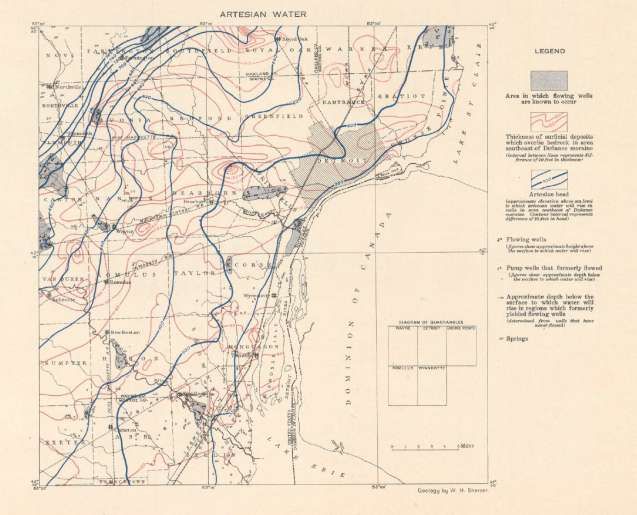
Artesian, not to be confused with the wave “artisanal” foods and other products these days, refers to the geology of accessing underground water sources. From USGS:

Groundwater in aquifers between layers of poorly permeable rock, such as clay or shale, may be confined under pressure. If such a confined aquifer is tapped by a well, water will rise above the top of the aquifer and may even flow from the well onto the land surface. Water confined in this way is said to be under artesian pressure, and the aquifer is called an artesian aquifer. The word artesian comes from the town of Artois in France, the old Roman city of Artesium, where the best known flowing artesian wells were drilled in the Middle Ages. The level to which water will rise in tightly cased wells in artesian aquifers is called the potentiometric surface.

This map is included in the 1917 “Detroit folio, Wayne, Detroit, Grosse Pointe, Romulus, and Wyandotte quadrangles, Michigan” with geological analysis by W. H. Sherzer. It is interesting to see that Springwells was historically an area where flowing wells were “known to occur.”