This simple map of main roads and expressways served as a minimalist route map for the Detroit Edison Co., what would become DTE Energy. The most interesting element is the typed title of the source and publisher of the map “Generation Engineering, Cartography.” DTE had a cartography division into the 1980s and I wonder how much of a bridge that team was from the grandiose maps and plans of Doxiadis commissioned by DTE to the present day mapping of power outages.
This map is part of the Hill Map Collection digitized in partnership with the Reuther Library and Archives as part of the Detroit Atlas Project funded in part by the WSU Union of Part Time Faculty (UPTF) Professional Development Fund.
by: Connor Pierce, Wayne State University (Intro to GIS, Fall 2023)
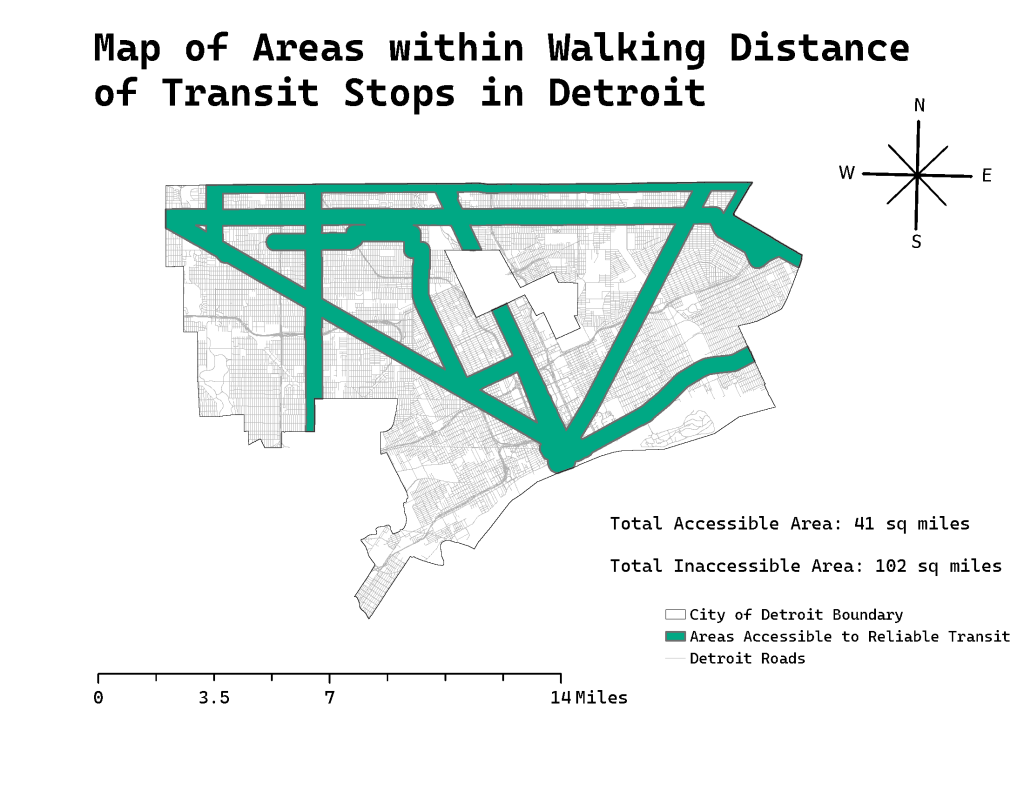
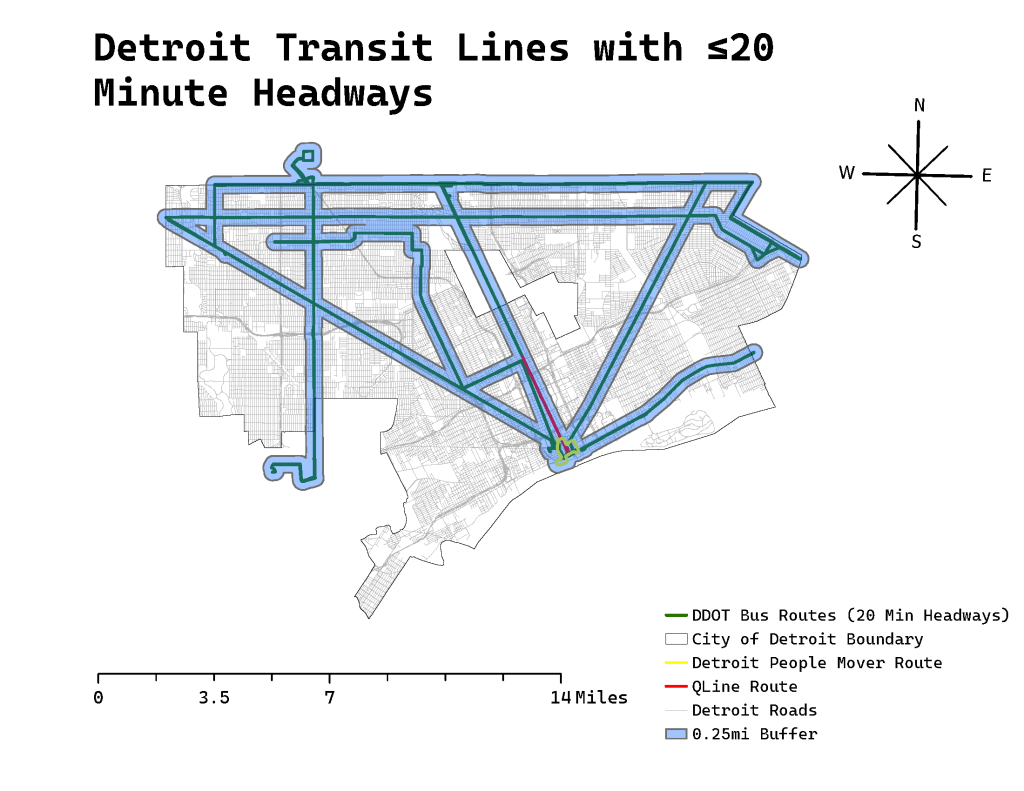
I believe transit frequency to be one of the best metrics for evaluating the success of a public transportation network. If a system has long wait-times between vehicles, it reduces the reliability of the system for the average rider. If a person is traveling on more than one transit line, the chance of making their transfer becomes increasingly lower as headways become higher. Long waits can manifest a decrease in overall ridership, as they turn away would-be passengers who require a high degree of reliability for commuting to work or school. I also view frequency as an accessibility issue. Accessible spaces on buses and other non-paratransit vehicles is limited, and if all available spaces are taken, riders should only need to wait a short while for the next vehicle to arrive. Additionally, if a rider needs to exit the bus to take care of a medical issue before resuming their trip, it is important for them to be able to onboard the next vehicle within a reasonable amount of time. Therefore, when evaluating a city’s public transportation system, it is important to know where the high-frequency transit lines are located and which areas fall within their catchment zones. The map above shows the location of these areas for the City of Detroit.
This was done by importing transit stop and route data for the QLine, People Mover, DDOT buses, and SMART buses (in addition to street and city boundary shapefiles) from data.detroitmi.gov. I then, capped the frequency at 20 minutes for peak times to show which routes operate with lower headways. These routes included the People Mover, QLine, and eight DDOT bus lines, including the: #3 Grand River, #4 Woodward, #6 Gratiot, #7 Seven Mile, #9 Jefferson, #10 Greenfield, #16 Dexter, and #17 Eight Mile routes. None of the SMART bus routes have headways of 20 minutes or less. Then, I created a quarter-mile buffer around these transit lines to show which parts of the city fall within the catchment area of these stops.
The initial map of this post represents the results found in the second map. It includes the total calculated size of the catchment area for frequent transit lines in Detroit compared to the size of underserved areas. The underserved areas of the city make up almost 2.5x the area that is served by frequent transit. I see these shortcomings as a sign that the city should invest in improving the frequency of bus services on existing routes rather than attempting to create new infrastructure for other modes of transportation. If infrastructure improvements are made, they should be to improve bus services in the city (i.e. creating dedicated bus lanes, bus rapid transit upgrades to existing routes, improving bus stop shelters, etc).
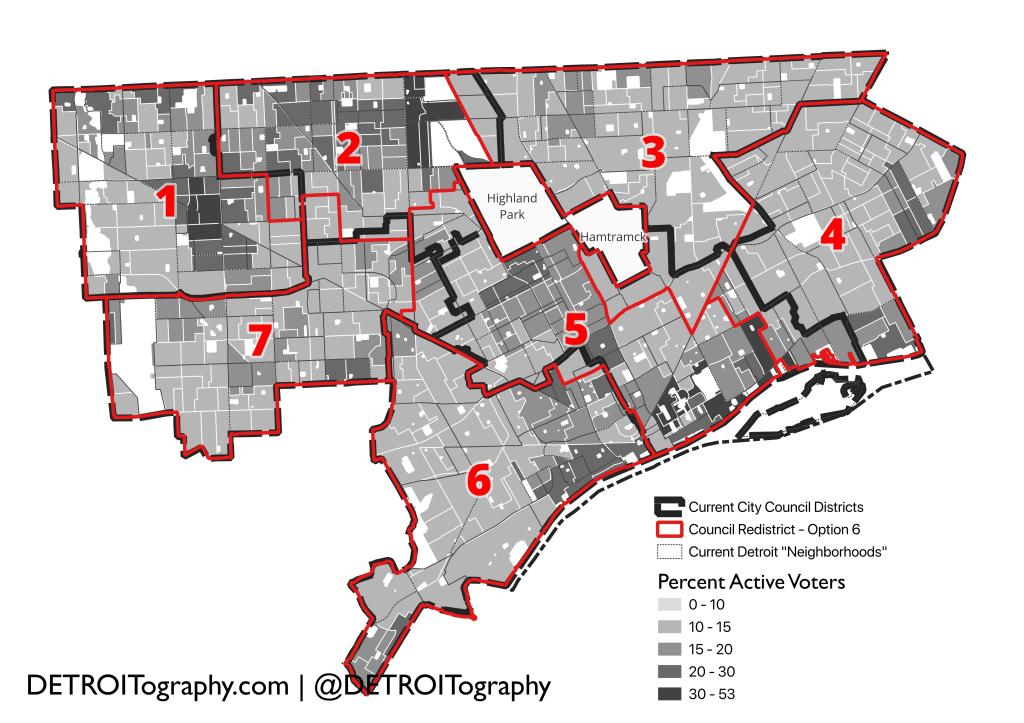
During their vote on February 6, the Detroit City Council swiftly selected “Option 6.” It was the last requested council redistricting map option that creates the least amount of change, but meets the bare minimum of the redistricting requirements for population distribution. The most populous, District 1, will still have 8% more people than the least populous District 3. I’m not sure that the council has truly taken on the task of redistricting adequately. The new districts will take effect on January 1, 2026 after new city council members will have been elected based on the new districts in November 2025.
During the January 16th City Council Public Hearing on Council Redistricting, Council President, Mary Sheffield asked the City Planning Commission (CPC) whether they had considered the impact on “neighborhoods” or neighborhood groups that might be split by the new boundaries. Jamie Murphy, CPC staffer, responded that they had not considered that because the city’s neighborhood layer didn’t correspond with what residents felt their neighborhood boundaries were.
Residents of Grixdale Farms came out in force to the public hearing and other meetings to voice their opposition to being removed from District 2. The Lower Eastside Action Plan (LEAP) at Eastside Community Network (ECN) advocated for a boundary that kept their members together. The HOPE Village initiative also submitted a map that would keep their focus area from being split. If you ascribe to the city’s definitions of neighborhoods, there is a lot of significant change. Notably, “The Villages” are split down the middle and Wayne State moves from District 6 to District 5.
Besides an imbalance in population across the districts, there is also an imbalance of voter participation. The political challenge with redistricting is getting physically drawn out of your District. The political opportunity is to get elected with very low turnout like in District 3, 4, and 7. District 4’s expanded boundary provides it a handful of more active voters while District 3 and 7 haven’t gained in similar ways.
Homeless families report domestic violence (City of Detroit)
$16.5 million
Awarded to the City government for service line replacement in two areas: Midtown (Cultural Center, Medical Center, Midtown) and Barton-McFarland [McFarlane?] (EGLE)
1 million
Qline riders in 2023, a 50% increase from 2022 (QLINE)
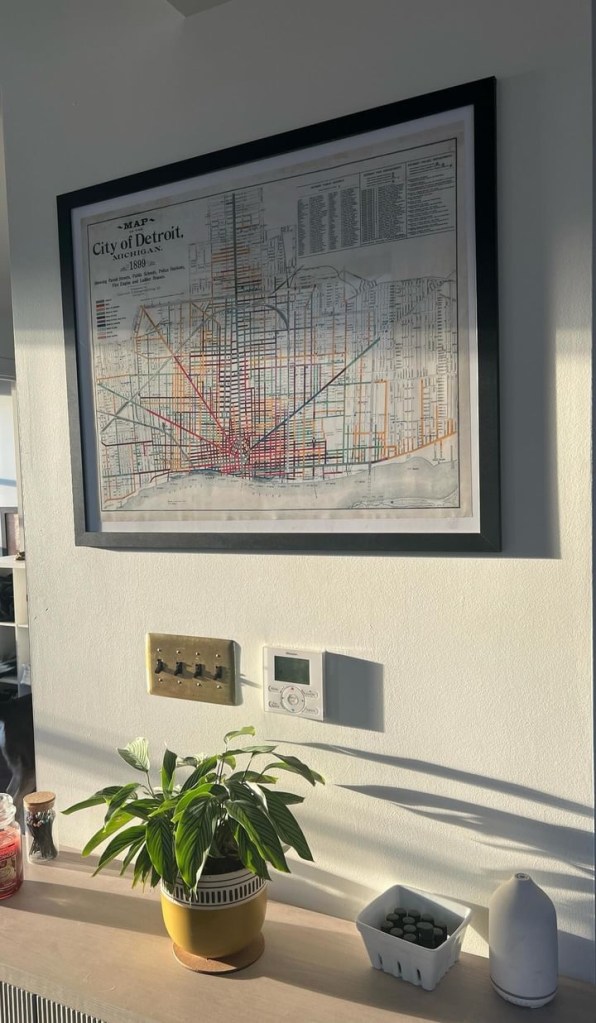
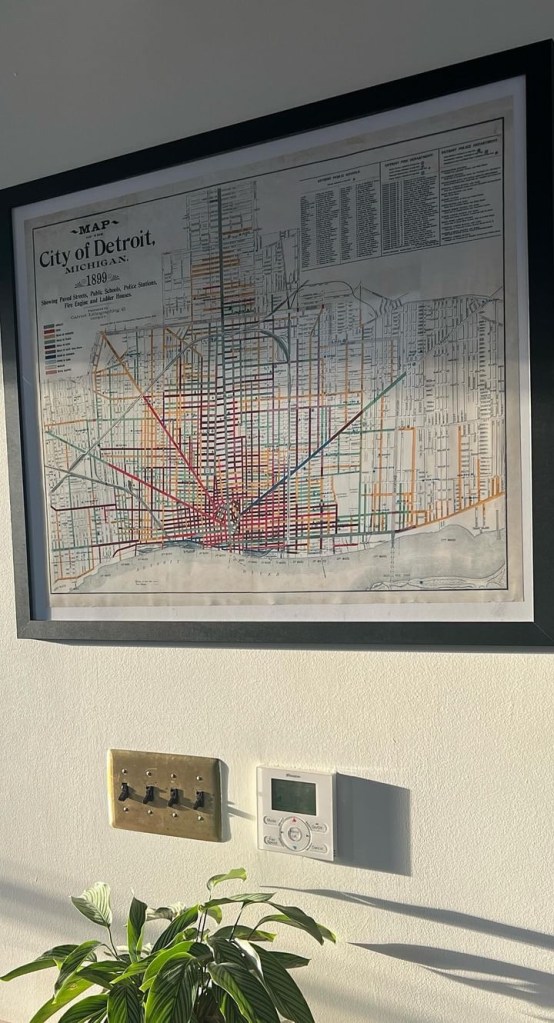
This 1899 Map of the City of Detroit reprint shows paved streets (of various materials), public schools, police stations, street names, and more!
Where did you find/acquire the map?
I purchased this map from a historical map print seller on Etsy.
What made you hang it on your wall? What stood out to you? What details do you enjoy about the map?
I love maps – I’ve been gifted and purchased a few of my own. Detroit is the city that introduced me to my profession of urban planning, the city that I’ve studied most in-depth, and ultimately the city that I wanted to work in.
This particular map stood out to me because of the intersecting colored lines and the bold symbology – it reads like a piece of art. Detroit is my favorite city, so to have a piece of “art” that reflects this City’s history on my wall is special to me.
What in your background has drawn you to maps?
As an urban planner, I’ve spent a lot of time analyzing maps, and now creating maps. Maps are such a powerful medium that tell a unique story of place, how it functions, and how it changes over time.
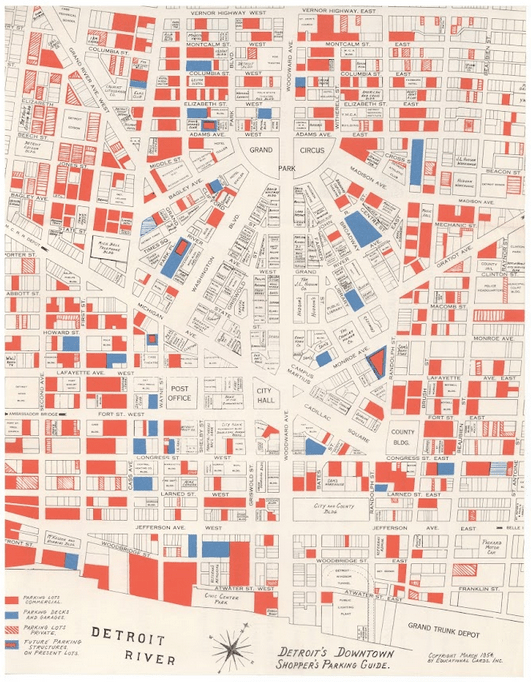
Downtown Detroit was literally built on the premise of parking lots when the city population was at its peak of over 1.8 million people in the 1950s. This “Shoppers Parking Guide” in 1954 promoted the message, “To Shop Drive Car, To Work Ride DSR.” The pamphlet notes that there is always a parking space available and if you find yourself at a parking lot that is full, simply use the guide to find another parking option. The guide shares the tax benefits of parking Downtown and that Downtown has a “greater and better” concentration of amenities and attractions.
The pamphlet guide and map were produced by Educational Cards Inc. and are clearly hand drawn and hand colored to denote parking lots and parking decks or garages as well as future parking. Detroiters and national pundits alike often shout the ills of dedicating land to parking, but perhaps the real metric is the parking space relative to population?
This map is part of the Hill Map Collection digitized in partnership with the Reuther Library and Archives as part of the Detroit Atlas Project funded in part by the WSU Union of Part Time Faculty (UPTF) Professional Development Fund.
median income went up in Detroit per new U.S. Census Bureau data, but rent costs are increasing at a higher rate (U.S. Census Bureau)
80-81
updated Tree Equity Score for Detroit from American Forests and the Detroit Tree Equity Partnership, which falls into their moderate category for desired tree canopy coverage. They find 24% of block groups have a score less than 75 and need more tree equity
252
lowest number of homicides in 50 years in 2023, Detroit also has the lowest population numbers in 50 years. Overall the homicide rate per 100,000 people dropped from 50 in 2022 to 41 in 2023. Typically, the “justifiable homicide” rate is also quite high with 24 in 2022, but per the city’s open data there were just 5 justifiable homicides in 2023. (FOX 2)
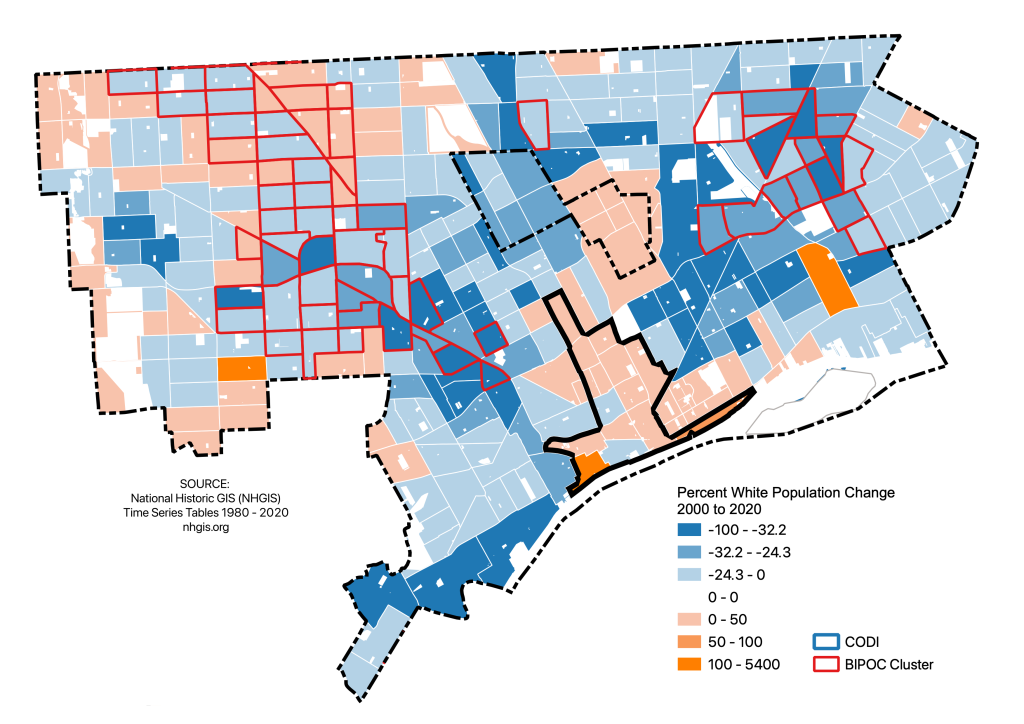
Population in Detroit is often talked about as losses, which has been a long-term trend that has not reversed under the current mayor. As a majority Black city, the losses are among Detroit’s Black middle class and families who seek better schools and safer neighborhoods. White population isn’t discussed as much, but presents some significant influences on population dynamic.
The white population increased by 115% within the city’s 7.2 sq mi Greater Downtown area, even though it decreased by 12% citywide since 2000.
The City of Detroit has made a handy interactive tool to compare proposed options for City Council redistricting. I’m still confused why “Election Precincts 2023” are listed when the only known update was made in 2022 before the midterm election without any record of approval by the Detroit Election Commission (DEC). The last time I know the DEC met was in August 2022 and it lasted all of 20 minutes. The Detroit Documenters covered the October 23, 2023 meeting and it seems that election security was the primary topic, but the meeting was a similar mess to what I saw in August 2022.
When were 2022 election precinct changes reviewed and approved? When were 2023 precinct updates made? Both the city council redistricting and the redistricting of statewide offices show how important and unaccounted these small precinct changes are for the people’s political representation.
I’m sharing this map from my book, Detroit in 50 Maps, because I’ve seen a lot of the old maps shared recently from 2010 and 2000. I also keep getting requests to update those maps. On this map in particular one dot equals 25 people and data come from the 2020 Decennial Census.
Not too much has changed from the earlier maps except for the significant population losses. The border of Detroit can still be easily picked out without needing the boundary line drawn. Some notable difference from the 2020 Census data is the increased Downriver migration of Latino populations as noted in my mapping of taco places with Tostada Magazine as well as the continued growth of the Bangladeshi community in Hamtramck and bordering areas within Detroit.
An important limitation of the Census data is that race and ethnicity are not well defined for all groups. For Southeast Michigan, that means that the Middle East/ North African populations are grouped into the “white” racial category. The other limitation is that much of Detroit is categorized as “hard to count” meaning the Census is the best data, but we might not have the best representation of everyone in Detroit.
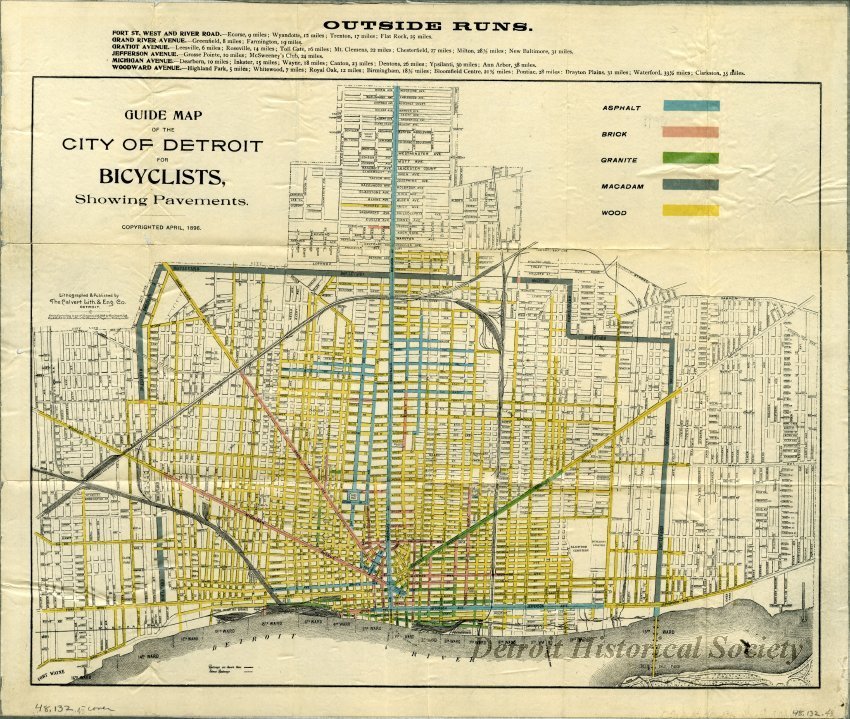
In honor of the 155th anniversary of the first bicycle ride on Detroit’s streets in 1868 I’m going to finally post this historic gem of a map that somehow I have never posted in the 10 years of cataloging Detroit maps. The map’s title points out the critical map detail: the color-coded pavement types, ranging from unpaved to wood to brick to asphalt.
Even though the League of American Wheelmen had formed over a decade earlier, this map was published in the peak of the Good Roads movement, when cities across America were responding to demands for better rights-of-way for bicyclists by paving their roadways. While most of Detroit’s streets were paved with wood, its large radial avenues and other high-traffic roads had been upgraded to granite or asphalt by 1896. Along with the numerous freight railway lines (the Dequindre Cut shows up as a railroad line that it was at the time), other streetcar lines are noted for bicyclists’ convenience.
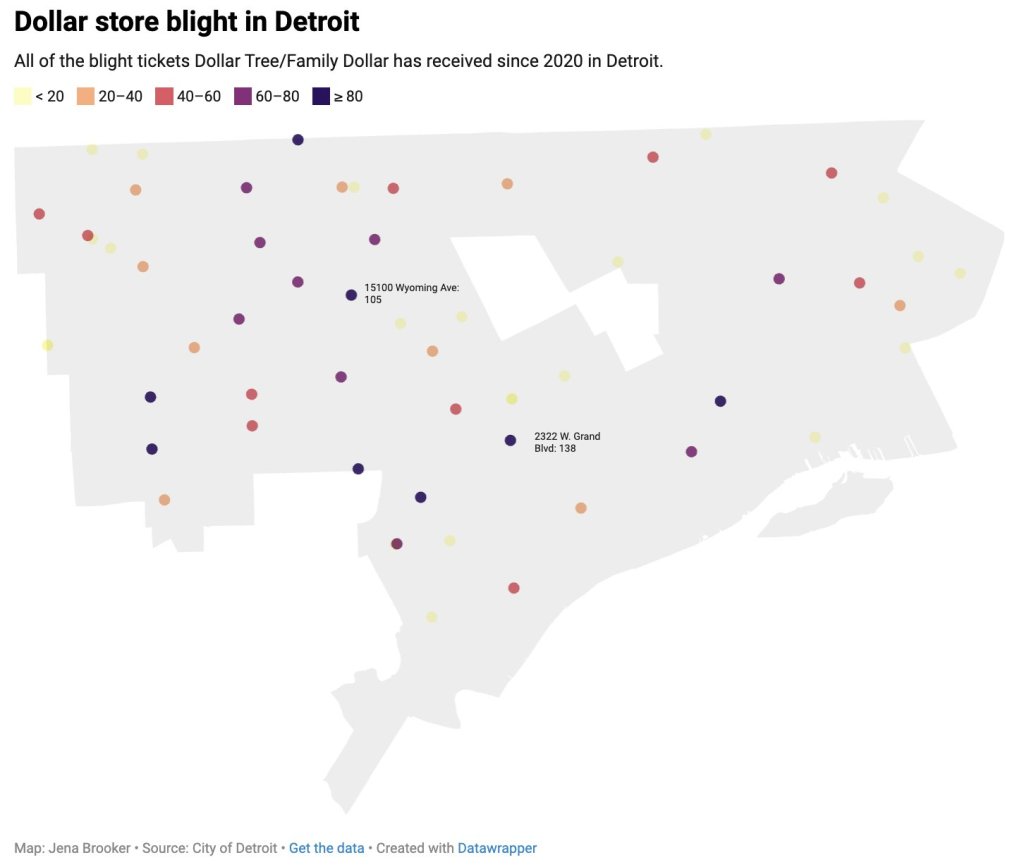
Bridge Detroit reporter, Jena Brooker, did some incredible open data digging to find that Dollar Tree, owned by Family Dollar, was cited with 2,400 blight tickets since 2020. Dollar store moratoriums have been put in place in more than 50 cities. Nationwide, dollar stores are known to have higher rates of crime, lower quality products, and have a negative effect on suppressing new grocery stores.
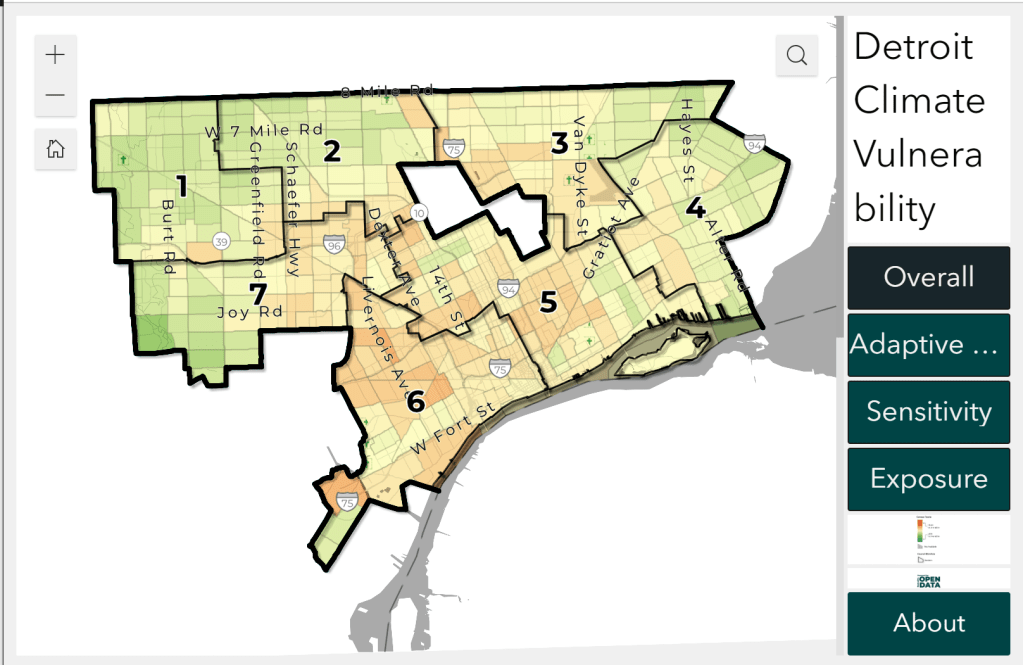
This map is part of the City of Detroit Climate Strategy informed by the Climate Equity Advisory Council. The goal of this map is to visualize climate vulnerability factors at the census tract scale. From the site:
Mapping climate vulnerability is important because the impacts of heat, flooding, and air quality are not felt equally across the city. Some areas and populations are more likely to be harmed by climate hazards than others, and visualizing what areas are most impacted can help in decision-making.
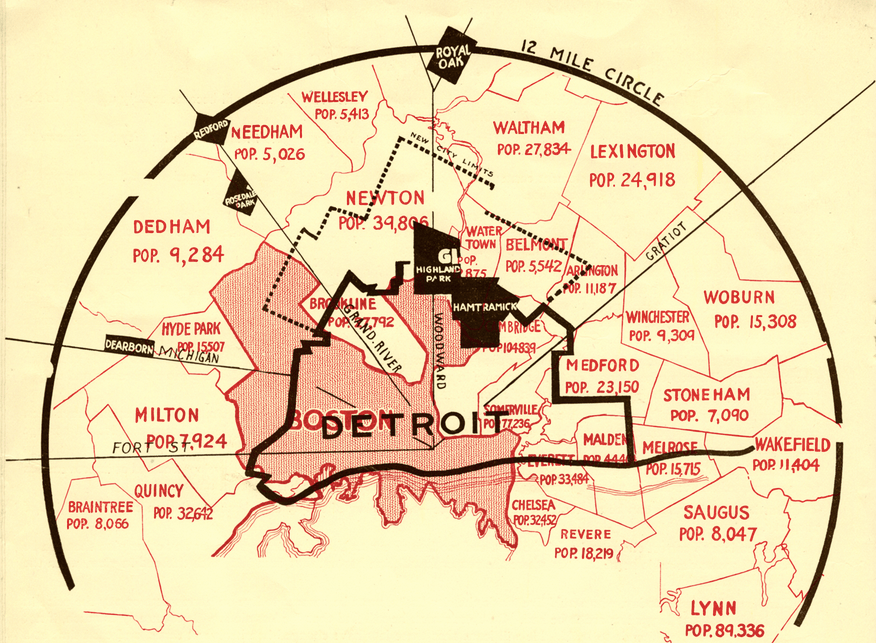
In a 1919 brochure for the Rosedale Park development highlighted the clean air “out of the smoke zone” and the great opportunity of a growing region. At this point, Detroit was still relatively small by today’s city boundary definition, but the comparison to the Boston regional development and cooperation – specifically on public rapid transit – was another selling point for Rosedale Park (future rapid transit that was never constructed).
“The maps reveal a striking contrast and furnish an example of what must take place around Detroit with the coming of better transportation and a comprehensive plan of city development. Other cities would show a proportionate contract with Detroit, but Boston was selected because of having many of the same features in common with this city.”
And:
“The people of Boston solved their problem because it had to be solved. It will be done in Detroit for the same reason.”
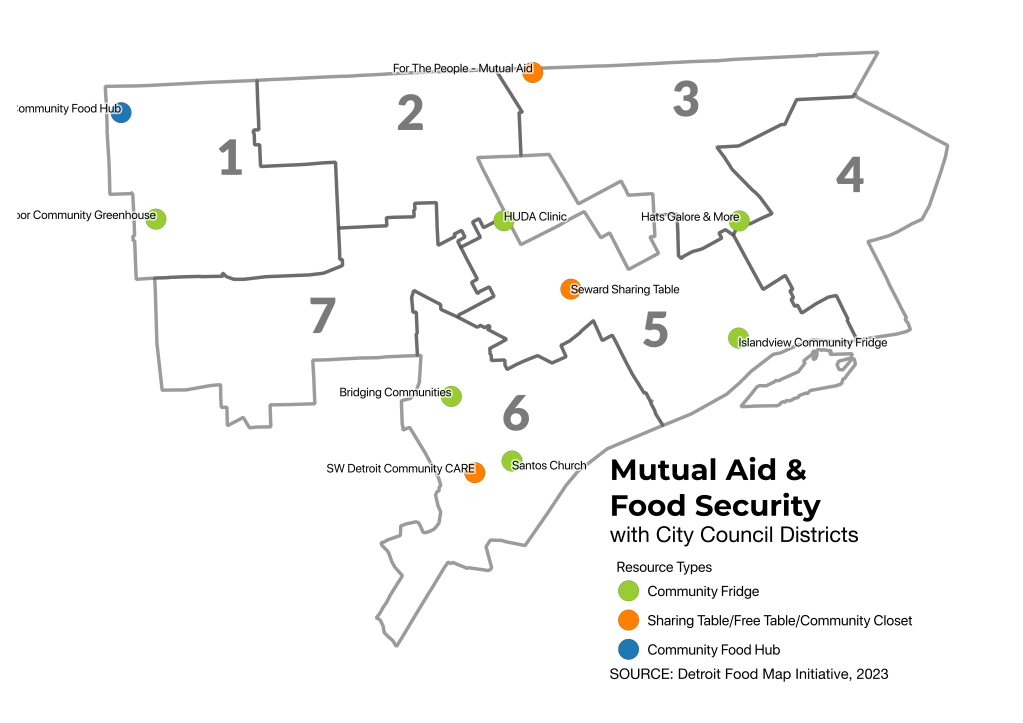
I worked with the Detroit Food Policy Council (DFPC) to produce their latest Detroit Food Metrics report. This map in particular is helpful to understand resilience in Detroit communities and adaptation in the food system.
“Detroit’s hunger crisis is far from over. Pandemic benefits reduced the burden significantly, but now many families and elderly residents are falling back into regular food insecurity as benefits end. In some communities mutual aid has filled the gaps.”
for NHL sports bars near Little Caesar’s Pizzarena with 35 bars within 1 mile (Detroit Free Press)
71%
of unhoused households experienced “first time homelessness” according to new report led by Homeless Action Network Detroit (HAND) (Bridge Detroit)
13%
of all Arabic speakers live in Metro Detroit (Axios)
3.5
miles of riverwalk expansion that opened this month on the, hopefully soon to be renamed, “Uniroyal Promenade” (a corporate polluter who couldn’t clean up their mess shouldn’t get a riverfront promenade named after them)
Alex Hill has 20 years of experience working with nonprofit organizations on campaigns that impact policies and communities. He launched the Detroit Food Map initiative in 2011 and founded DETROITography in 2013. His first book, Detroit in 50 Maps, was published in 2021. As a data nerd and anthropologist, he loves sifting through spreadsheets and sitting down with people to tell meaningful stories. By combining human experiences with data and analytics, he’s able to evaluate and elevate the strategic impact for all types of organizations through mapping, infographics, and campaigns. His personal research is focused on food access, racial justice, data literacy, and health equity.
The obvious answer is yes, Detroit neighborhoods have been mapped many, many times by many different people, groups, and entities. Some Detroit neighborhoods are best understood as historic districts, others are born of strong neighborhood associations (for better, for worse), some are simply terms given to a geographic area, and others are strictly defined by non-profits and investing organizations.
“I vote that the people who live there get to decide and history must be referenced.”
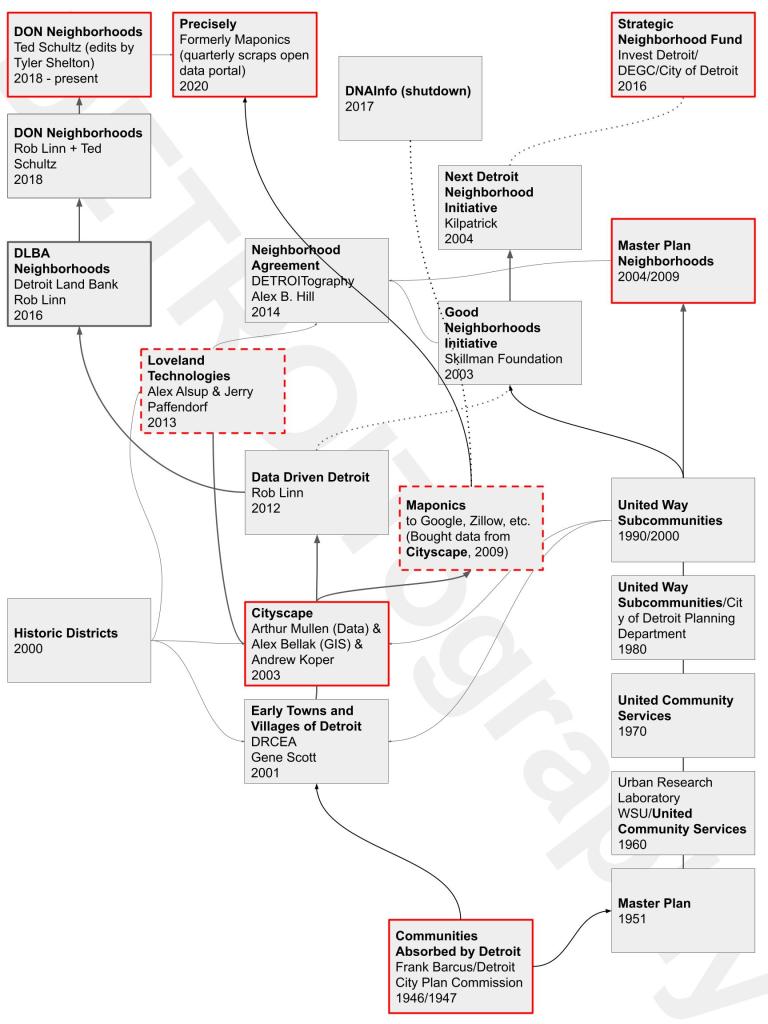
Historic neighborhood areas have had staying power. Most notably Corktown, although it has gone through significant changes over the years, remains the oldest neighborhood, oldest neighborhood name in continuous use in Detroit. One of the most influential programs that defined much of the city’s neighborhood was the United Community Services, what became the United Way, “subcommunities” that were drawn after each Census as a way to subdivide and track change over time in the city. Through the 1960s and 1970s those defined areas were referred to as Detroit’s neighborhoods, but with population loss many of those neighborhood names were forgotten or at least much less recognizable. The former subcommunitites were adopted as Detroit’s official master plan neighborhoods.
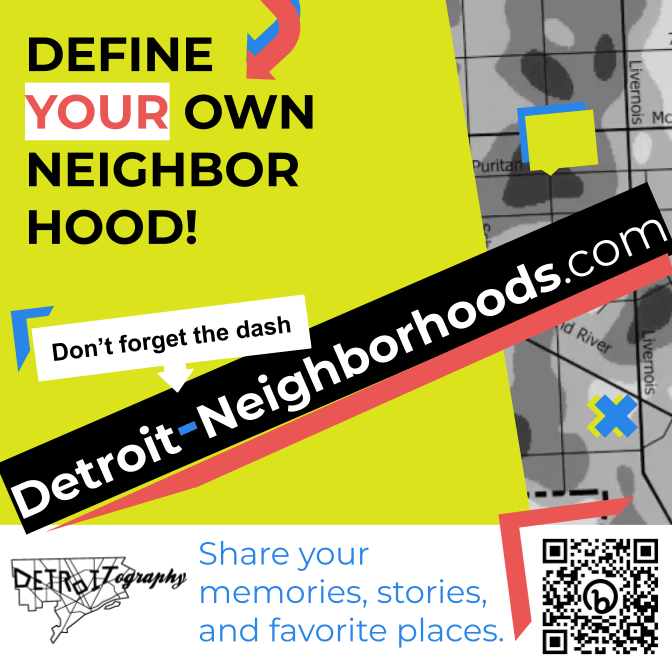
There is a genealogy to Detroit’s neighborhood maps and naming choices. Often times, the line drawing and naming have not involved Detroiters let alone the very people who reside in a geographic area because naming and claiming space can be very political or have broader economic or real estate aims that are not concerned with resident perspectives. That is the very reason that we launched Detroit-Neighborhoods.com
Countless “paper neighborhoods” have proliferated in Detroit. I questioned all of the “neighborhood” map products available in 2013 and others had similar concerns about places called “The Eye” or “Fishkorn” and the, at the time, “Corktown Shores.” Presently, the neighborhood name that is most confusing is “Buffalo” near the recently named Banglatown neighborhood at the Hamtramck border, that was quietly renamed “Buffalo-Charles” for the street intersection. Yet, no residents of the area have ever use or have heard of the name. Even the Planning Department’s outreach for the Strategic Neighborhood Fund (SNF) Banglatown framework never listed either Buffalo or Buffalo-Charles. Since the City’s Department of Neighborhoods (DON) has defined the name, it has entered the media discourse – including a handful of recent mentions in 2023.
Neighborhood naming by City government has larger implications too. All of the incorrect names or made up boundaries that the City DON has adopted get added to the open data portal, which is then downloaded – not by Google – but by a group called Precisely, formerly Maponics, that has made its business to map every neighborhood in the world. Precisely and Maponics were the preferred data providers for real estate companies like Realtor.com, Zillow, etc. that wanted to optimize searching for a new home, but were quickly contracted by any new digital company offering a map and search function. The neighborhood names many people were mad about on Google Maps came from Precisely/Maponics not Google itself.
Detroit neighborhoods can be mapped, but I’d like to see every resident have the opportunity to provide input.
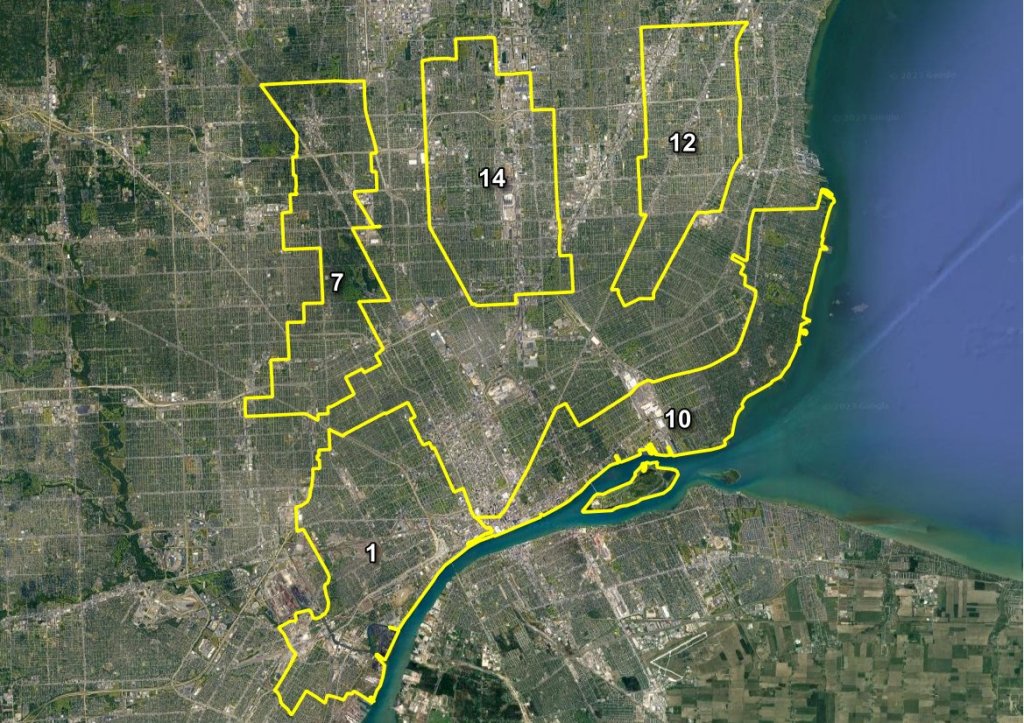
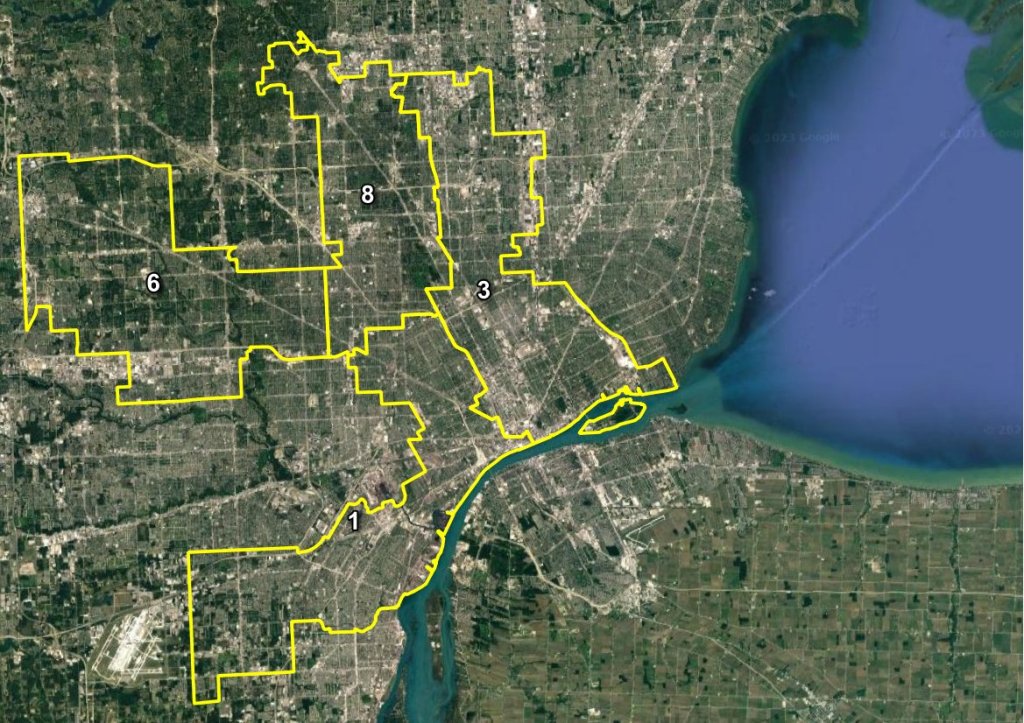
Here are the Michigan legislative districts mapped by Will Ferguson that the U.S. District Court ruled will be allowed to go to trial on grounds that their drawing violates the Voting Rights Act. If the lawsuit succeeds it is likely that much of Southeast Michigan will again be redrawn to be more compliant.








 DETROITography