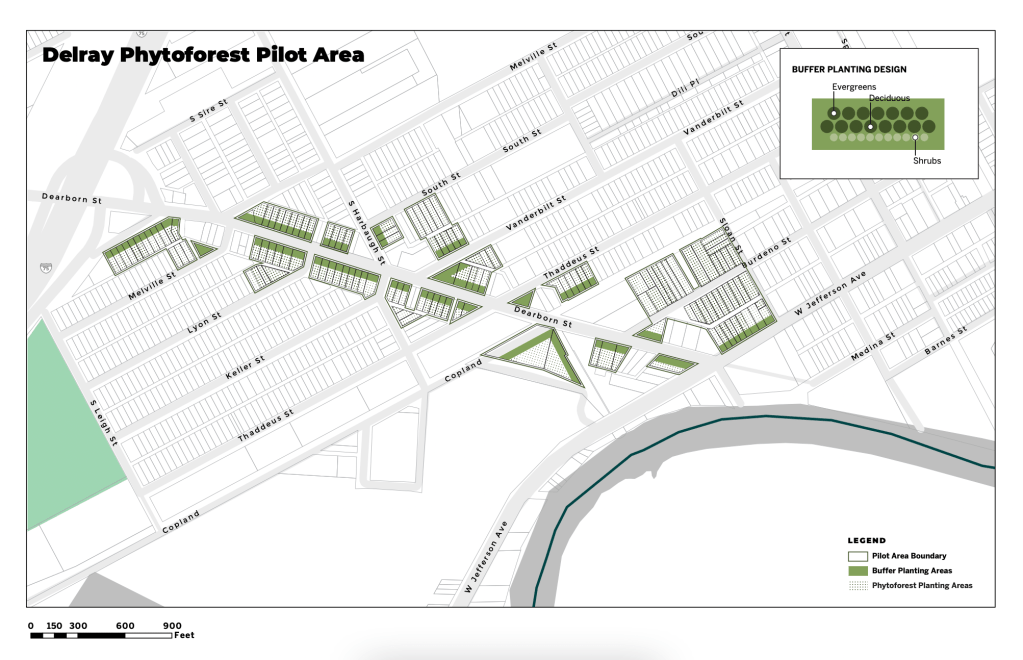
Malachi Barrett of Bridge Detroit reports that the “Delray Phytoforest Pilot” project is underway. The concept came out of the city’s 2021 neighborhood framework plan. City Council approved the transfer of 64 Detroit Land Bank (DLBA) properties for the project where 4,000 trees and shrubs will be planted to act as a vegetative buffer in the very polluted area. Based on our 2021 analysis of potential sites for tree buffers, Delray had very few DLBA properties available to effectively mitigate pollution from expressway or industrial sites. The greatest benefit may be leveraging existing city owned properties with increased tree plantings.
We’re a hosting partner for the City of Detroit GO DATA Commission’s new annual data art competition and exhibit. The inaugural theme is “Detroit data storytelling.”
What: Detroit data art exhibit
When: Submissions due by November 8, exhibit will happen during Detroit GIS Day November 15th.
The City of Detroit’s Office of Digital Equity and Inclusion has a series of data points and maps that set the baseline for their work on increasing access to high speed internet across the city. They’ve calculated Council District and Current “Neighborhood” rates using an interesting methodology based on occupied housing units per census tract.
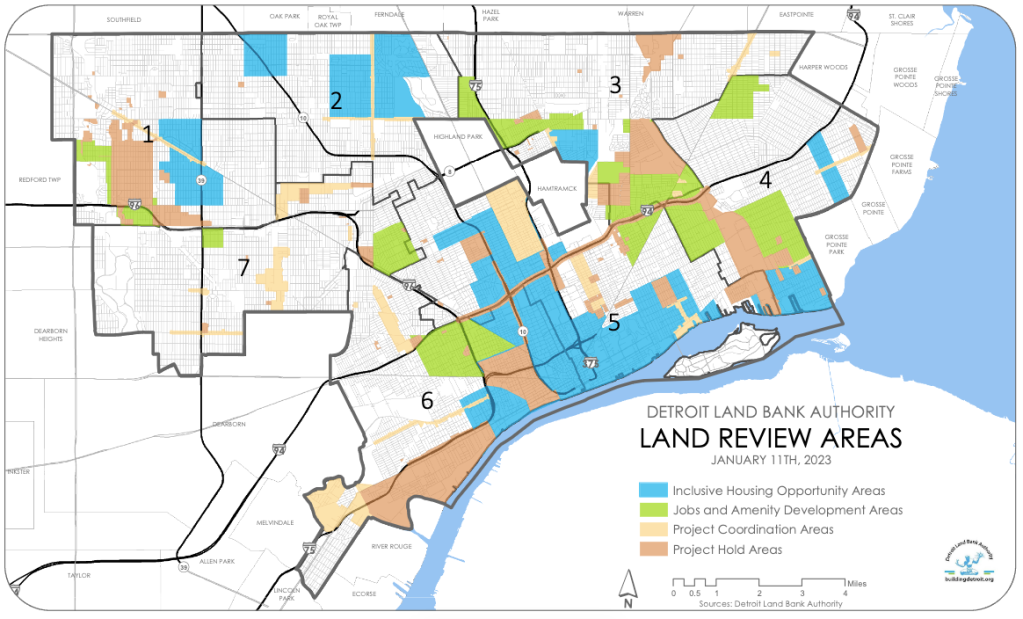
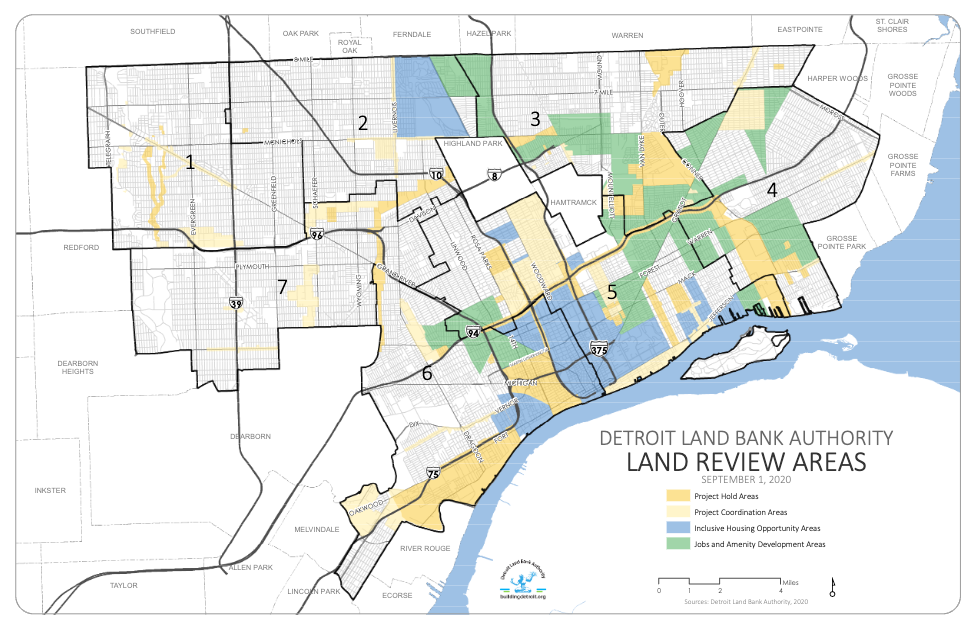
Many Detroiters have stories of trying to work with the Detroit Land Bank Authority (DLBA) to acquire land, move an agricultural project forward, or just secure the side lots near their home. Typically I have heard these stories involve a denial with not clear reason given. I stumbled across this map that seems to be semi-regularly updated with “project areas” that may be the cause of many negative interactions with the DLBA.
The DLBA website outlines the definitions for these areas and link to the longer policy document:
Inclusive Housing Opportunity Areas: where home sales have averaged $100/square foot, or more, over the last year. These are areas where housing inclusivity is, or is likely to become, a pronounced challenge.
Jobs and Amenity Development Areas: where publicly owned vacant lots account for a third or more of all parcels. These may create opportunity for the development of large-scale public or private Revitalization projects.
Project Coordination Areas: where City planning, housing, infrastructure, economic development, or recreation agencies have formally requested that the DLBA coordinate sales in connection with planned or ongoing Revitalization projects that use DLBA properties.
Project Hold Areas: where City Revitalization Offices have agreements in place barring or restricting the sale of DLBA property in that geographic area.
Same map below for 2020. In 2023, there have been expansions mostly on the Westside for inclusive housing, job and amenity development, and project holds.
I’ve added the term “access” to the City of Detroit’s listing of “tech hubs” since that seems to be a term with a wide and varied definition. In this case the City is talking about:
[…] free wifi, devices, and basic digital literacy training
The sites range from support from major telecom companies like Comcast and ATT to the Connect313 efforts. Previous researchers have also included a broader number of access points with free wifi like McDonalds and municipal buildings. The City of Detroit Office of Digital Inclusion notes that 42.6% of households lack high speed internet access up from 40% in 2013.
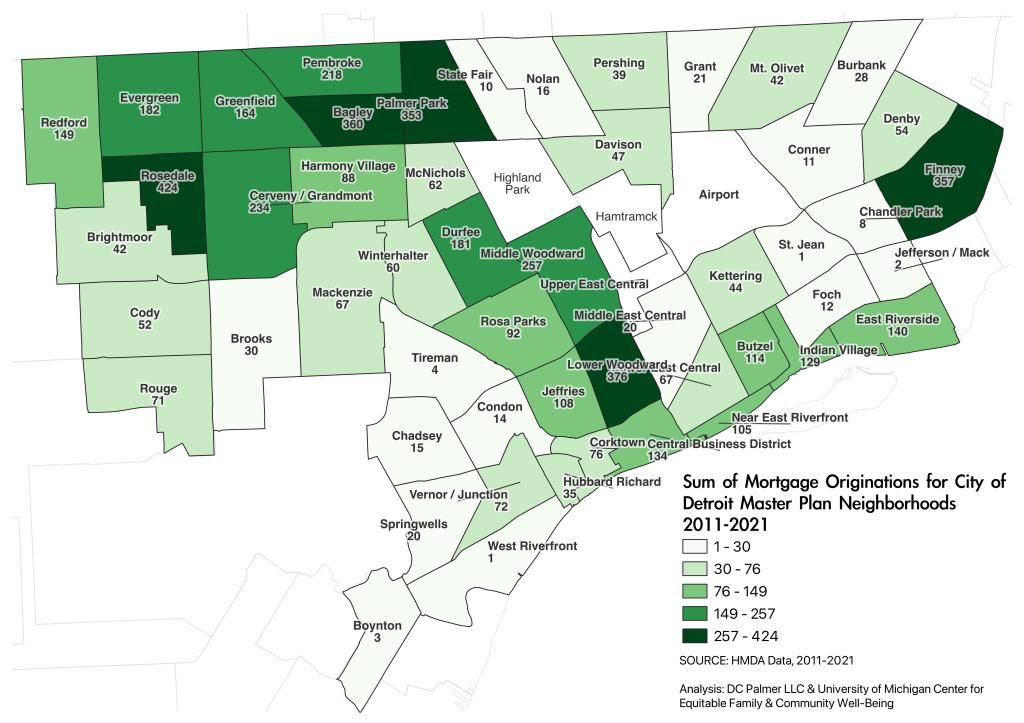
I contributed some mapping support to the research conducted by DC Palmer and the UM Center for Equitable Family and Community Well-Being on home mortgage data in Detroit.
“According to Anthony Smith, the City of Detroit DPA program manager, as of May 11, there were 2 applications successfully originated (closed), 11 vetted for approval, and 35 applications in process. By June 20, Dina Harris, CEO of National Faith Homebuyers – the contract organization managing the program for the city – reported that 38 home loans were originated (closed), 53 were approved pending closing, and 49 were in the application process. With roughly $5 million available for DPA assistance, there are enough funds for at least 200 successful DPA applications available on a first come first serve basis. City officials and contractors have hinted that there is an opportunity to re-seed the fund with additional dollars if the program is successful. If these trends hold true, current City of Detroit DPA funding will be exhausted before the fall of 2023.”
The short answer is yes, it is time to reassess City Council District boundaries.
The City Charter calls for updated Districts 120 days before the next City primary election. The release of Census 2020 data files gave the City a pass up until now. The 2020 decennial census data was released to State governments for redistricting efforts in August 2021, but the City election in 2021 was already well under way. The next City election for Mayor and City Council seats will be in 2025.
For the 2012 City Charter, the City Planning Commission did the work of creating and proposing Council Districts which would then be approved by the 3-member Detroit Election Commission (City Council President Sheffield, City Clerk Winfrey, Corporation Counsel Mallett). The City has until around February 2025 to finish a Council redistricting process before the April 2025 City primary election (prior to the general election in November 2025).
Sec. 3-108. Geographical Basis for Electing Council Members.
There shall be seven (7) non at-large districts and one (1) at-large district established in the City and one (1) member shall be elected from each non at-large district and two (2) members shall be elected from the at-large district. New district boundaries created within one hundred twenty (120) days of a City Primary Election shall become effective after the General Election.
City Council shall establish district wards that are as nearly of equal population as practicable, contiguous, compact and in accordance with any other criteria permitted by law. District wards shall be apportioned in subsequent years as required by, and in accordance with, the Home Rule City Act, MCL 117.27a, and other applicable law.
COMMENTARY: According to the Home Rule City Act, districts must be drawn based on a specific set of criteria which includes, equal population, compactness and contiguous boundaries. MCL 117.27a(5). Additional language has been inserted to allow for consideration and use of factors not necessarily prohibited by law (e.g. keeping intact precinct boundaries).
Lastly, pursuant to the Home Rule City Act, district boundaries are required to be redrawn after every decennial census. MCL 117.27a(4). This section includes this legal requirement.
Precinct Changes
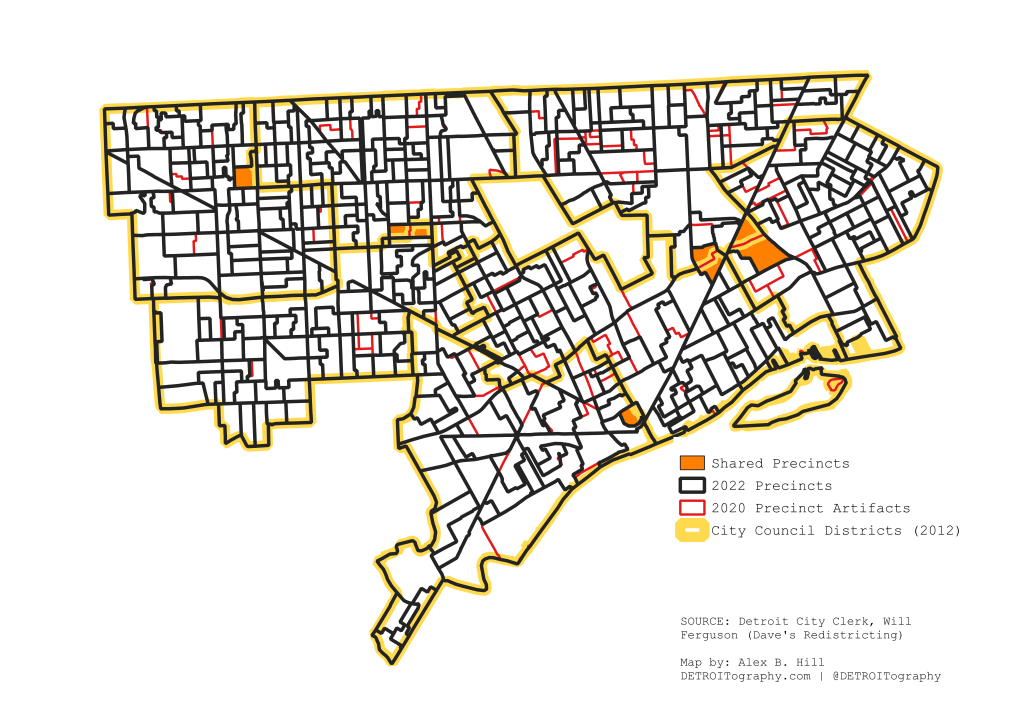
Unfortunately, the City Clerk’s office is not known for keeping great records or administering elections well. There were again surprises with Voting Precinct changes the day of the election – a regular occurrence. Before the 2022 Midterm, a large number of precincts were merged, yet I can find no record or vote by the Detroit Election Commission to approve those changes. It’s not the biggest reason, but concerning to have so many precincts change since 2020 causing 5 precincts to cross Council District boundaries (highlighted in orange).
Since 2020, 52 precincts were merged with nearby precincts. Precincts 17, 28, 37, 48, 54, 57, 67, 76, 87, 96, 99, 104, 106, 108, 109, 110, 113, 114, 117, 141, 142, 149, 152, 154, 163, 170, 179, 181, 187, 196, 206, 235, 237, 270, 322, 388, 391, 412, 451, 454, 455, 456, 459, 465, 467, 469, 476, 478, 487, 492, 494, and 499 were all removed in 2022. Big thanks to Will Ferguson for remapping the precinct changes that, as far as I can tell, were only shared out as an unuseable PDF map (04/05/22 2:10PM). Give the people machine-readable, open data!
What may be the most important change is that Detroit has only continued to lose population. When the Council Districts were formed in 2012, they were each roughly 100,000 people. Since then District 6 has gain 5,000 residents (+5%) along with gains in District 1 (+2,618), District 2 (+3,780), and District 7 (+858). District 5 (-4,689), District 4 (-3,024), and District 3 (-4,652) have all seen population losses making for a serious West versus East imbalance in city political representation.
Population is not evenly distributed in Detroit making it difficult to draw lines that balance the more dense pockets of the city.
Population density really shows the disparities in the revitalizing city where there is a Greater Downtown bubble, a ring of low density around Greater Downtown, and most Detroiters living in the Southwest, Northwest and Far East sides.
I’ve lamented the data issues with matching ZIP codes to Council Districts as well as using Census Tract level data that have new estimates every year with Council Districts because the reality is that Council Districts were drawn along voting Precinct boundaries not Census geographies. Demographics be damned the Tract don’t vote.
New City Council Districts
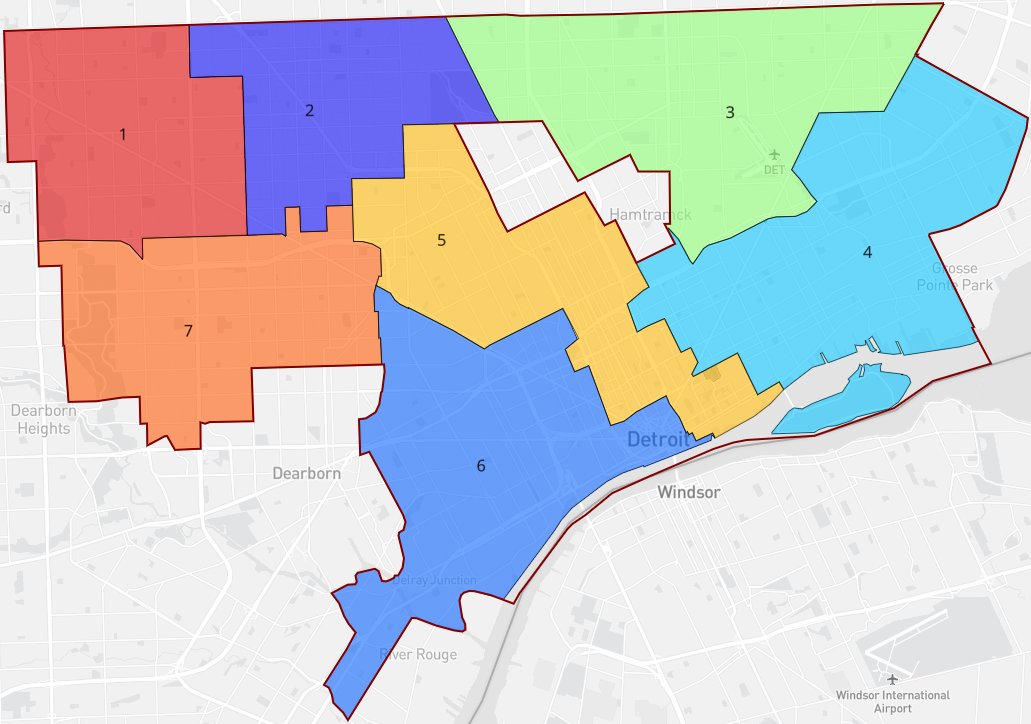
Detroit’s current population calls for equally distributed Districts of roughly 90,000 people to meet the criteria of being, “nearly of equal population as practicable, contiguous, compact.” This is my attempt to align with Precinct boundaries as well as the City’s current “neighborhoods” as a means to not split potentially cohesive groups of voters. There are roughly 5 “neighborhoods” that get split in this proposed redistricting, but choices were made based on population numbers. There are plenty of other ways to redraw the lines. I mostly wonder why we haven’t had that conversation yet as a city at large. What would you change?
We’re a hosting partner for the City of Detroit GO DATA Commission’s new annual data art competition and exhibit. The inaugural theme is “Detroit data storytelling.”
What: Detroit data art exhibit
When: Submissions due by September 18, exhibit will happen during digital inclusion week October 2-6.
Detroit Disability Power (DDP) audited 261 polling locations, 167 of which were in the City of Detroit, for four assessment criteria for accessibility:
An accessible parking area with a clear pathway into the building.
An accessible entrance.
A fully accessible voter assist terminal (VAT).
An accessible booth for casting paper ballots privately.
The resulting report is not promising and leaves a lot of room for improvement. Just 12% of the 167 polling locations in Detroit were found to be fully accessible.
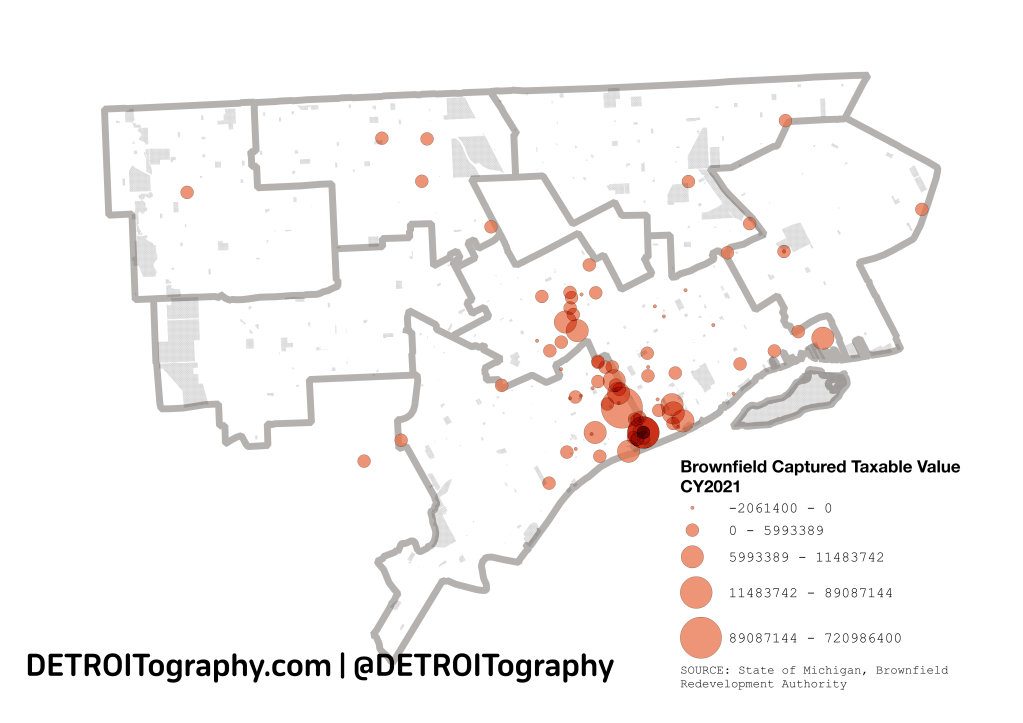
Brownfields are properties that are “contaminated, blighted, functionally obsolete, or historic properties.” Regardless of their classification, all brownfields face economic barriers to reuse and redevelopment.
Through the Brownfield Redevelopment Financing Act, Brownfield Tax Increment Financing (TIF) allows applicable taxing jurisdictions to receive property taxes on the property at the current level and capture the incremental increase in tax revenue resulting from a redevelopment project. In Detroit, the majority of these sites are located in the Greater Downtown area – they may also be some of the larger sites where TIF is lucrative enough to offset a big project.
Luckily, the Brownfield Redevelopment Authorities are required by law to report Act 381 Brownfield TIF to the Michigan Economic Development Corporation (MEDC). Reporting data is due no later than August 31, 2023 via the online portal. BRAs are not considered compliant until MEDC Brownfield Staff have reviewed and approved all reported data. The 2021 data was the latest available. I’m not sure how negative tax capture can be reported, but that’s what was included in the MEDC data tables for some brownfields.
The Detroit BRA is led by the Detroit Economic Growth Corporation (DEGC), which I believe is the largest BRA in Michigan by project volume and amount of tax capture.
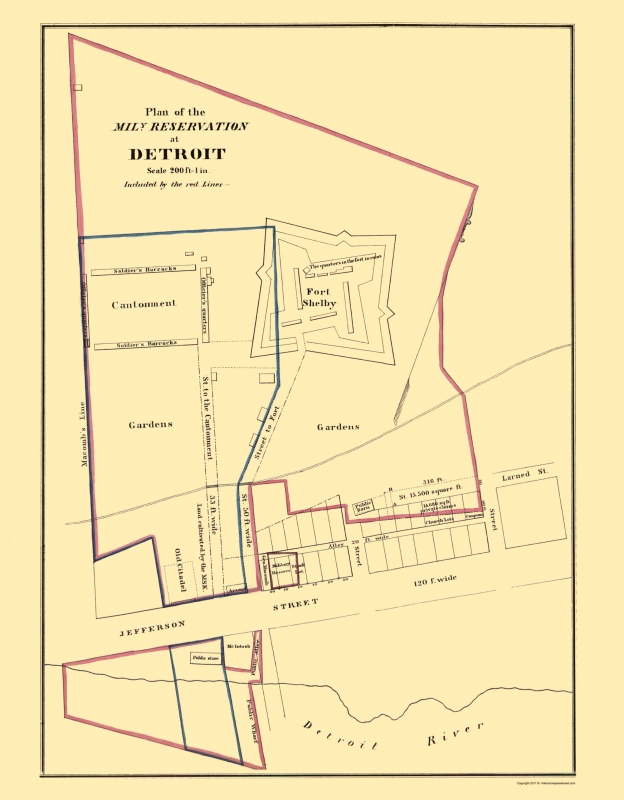
Detroit has always been notable for its strategic military vantage point. As a choke point on the Detroit River, the area was settled under a guise of colonization and control.
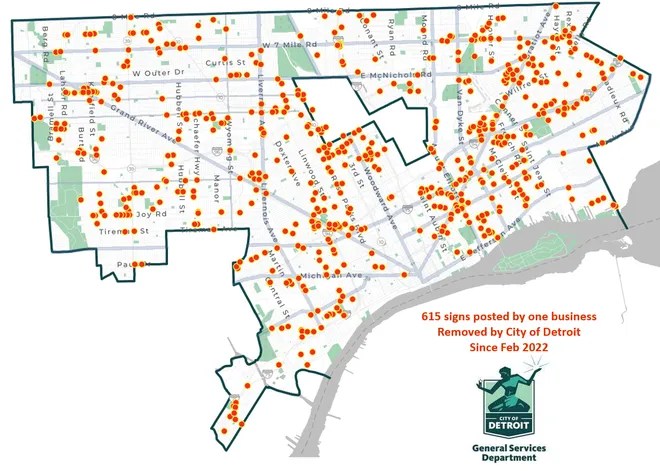
This map comes from reporting by Sarah Rahal about the abundance of signs placed by local and regional businesses all across the city. The City of Detroit seems to be implementing its “sign ordinance” against unapproved commercial signage along with enforcement.
In total, 16,000 signs have been removed in 18 months. The city’s Blight and Remediation Team has removed 615 signs from Shaw’s Plumbing business since February 2022.
Since 2017 there have been 5,539 sinkholes reported for investigation on the Improve Detroit app. That’s a big number, but overall make up just 1.15% of all issues reported on the app.
Most of Detroit’s sewer and water pipes are more than 90 years old
Outlier Media recently reported that there are 300 active sinkholes and that number seemed too high on my initial reading. What I actually found was 1,299 sinkhole reports that haven’t been closed yet through the open data portal. As of August 10, there have already been 41 new sinkhole reports this month.
Detroit’s water mains burst 80% more often than the North American average, according to a 2017 report.
The 5,539 number is easily an over-count based on likely inaccurate reports on the Improve Detroit app. However, if there are 300 active as reported out of the 1,299 open sinkhole investigations that is still about 23% accuracy rate. The infrastructure woes of Detroit are not unknown, but this one is quite massive.
Data show reports citywide, every corner, every neighborhood experiences sinkholes. Hot spots appear in the Greater Downtown area as well as New Center/North End, Near Eastside, Southwest, and Grandmont-Rosedale area.
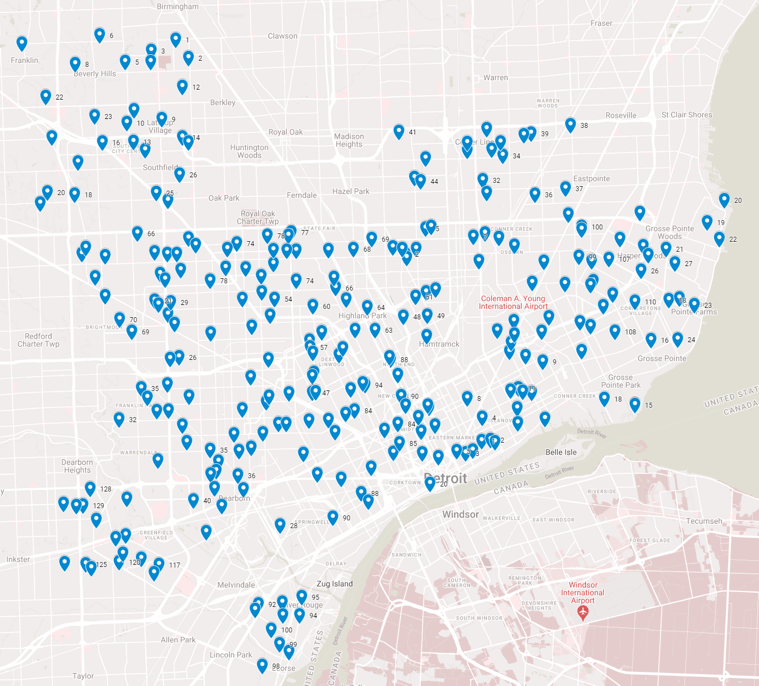
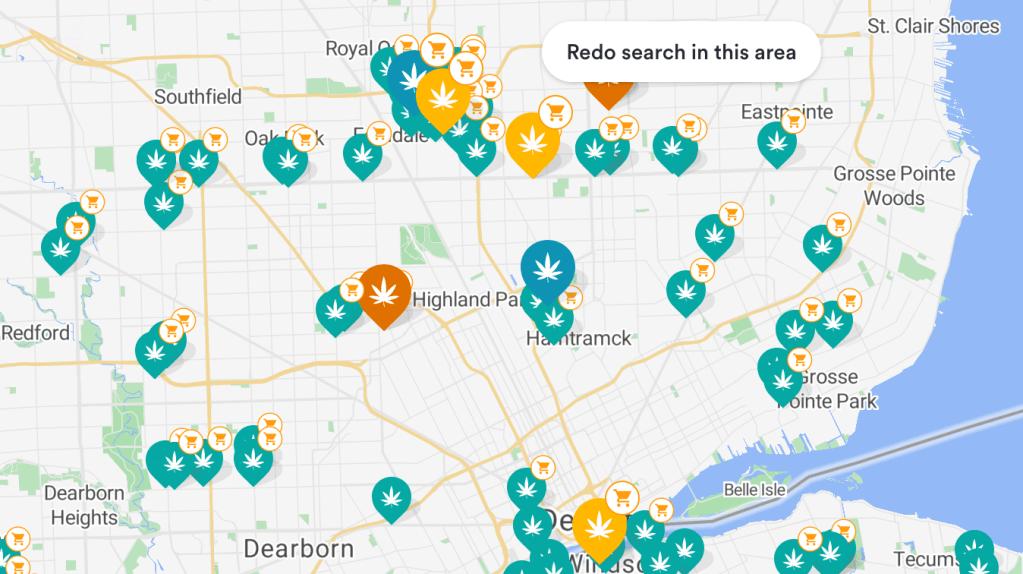
Detroit’s City Council pushback on marijuana (marihuana) dispensaries has taken years to resolve. Council first approved recreational marijuana licenses in 2020 with a “likely unconstitutional” preference for Detroit-based businesses. A revised ordinance was passed in 2022 and took effect in April 20th. Based on WeedMaps.com it would appear that not many businesses still have engaged in the licensing process with just a few locations on Gratiot Ave., Lyndon (Westside), and a few in Corktown/Southwest while nearly every border of the city is clustered with recreational marijuana dispensaries.
The actual number the Mayor used was 452, but still that number just didn’t sit right. I began searching high and low for where the Mayor possibly sourced the data. The open data portal came up empty, the new business data explorer was no help, even point of interest (POI) data providers didn’t show much. Meanwhile colleagues on the open data, GIS, and data strategy teams all said they had no involvement in the MPC data efforts on auto/scrap yards.
Finding Data
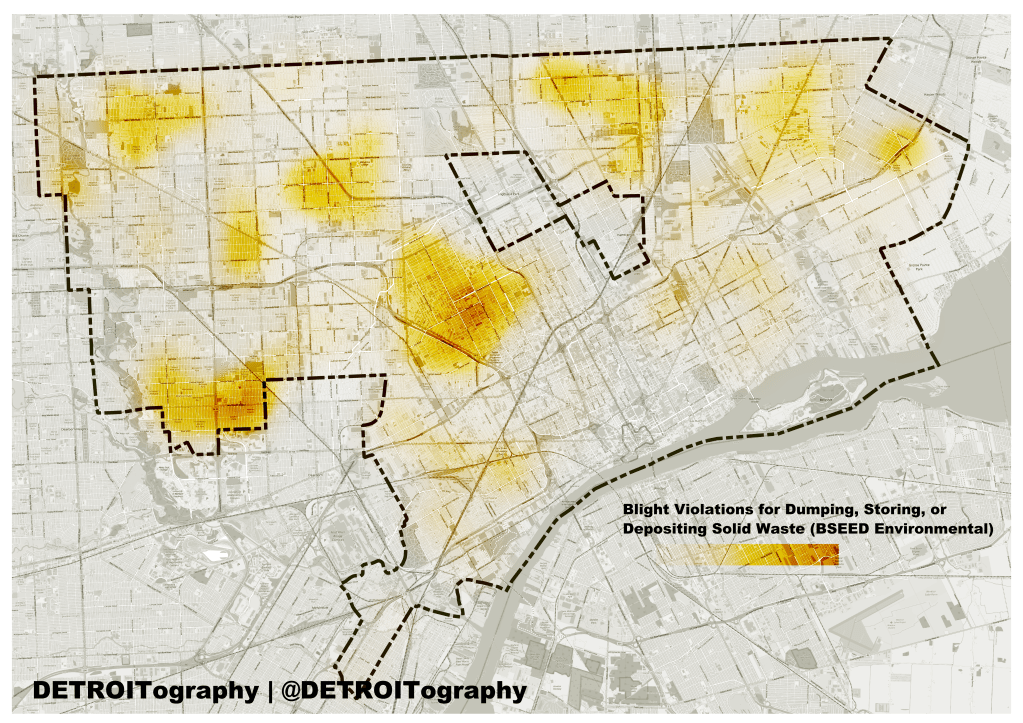
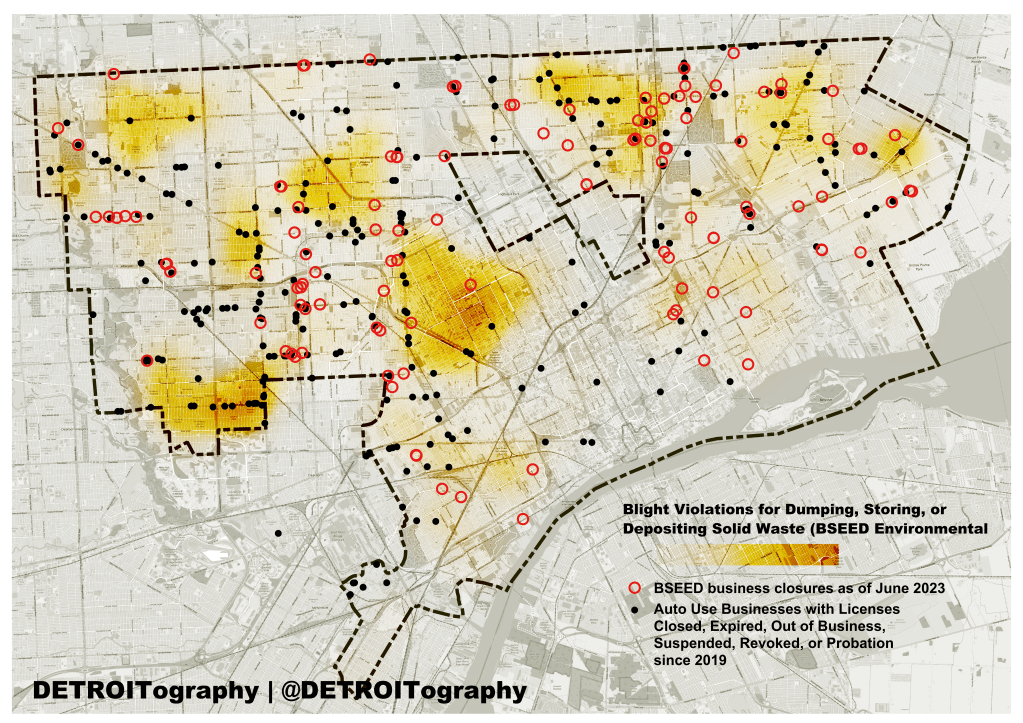
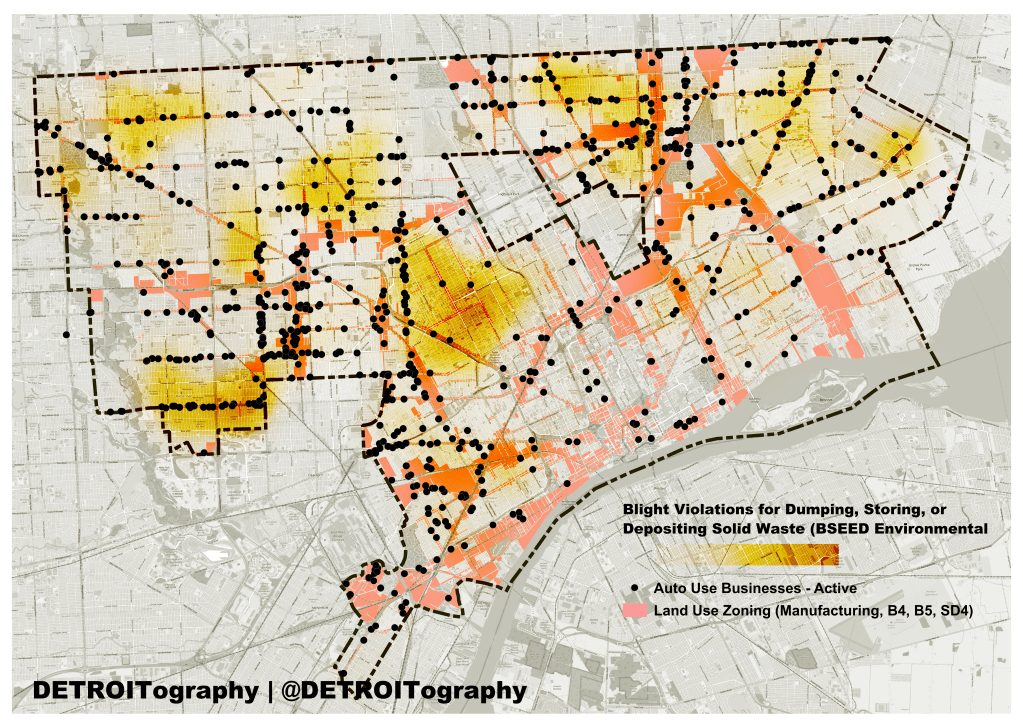
I first checked the BSEED blight violations of bulk solid waste on the open data portal, assuming these sites might show up. There were a few varied definitions, but I stuck to the below categories to begin exploring what became a new set of sites well above the 452 auto/scrap yards.
BSEED Environmental Affairs
Totals since 2006
Dumping, storing or depositing medial or hazardous waste on any publicly-owned property, or private property or water, without a permit
0
Dumping, storing or depositing solid waste on any publicly-owned property, or private property or water, without a permit
279
Dumping, storing or depositing solid waste 5 or more cubic yards on any publicly-owned property, or private property or water, without a permit
475
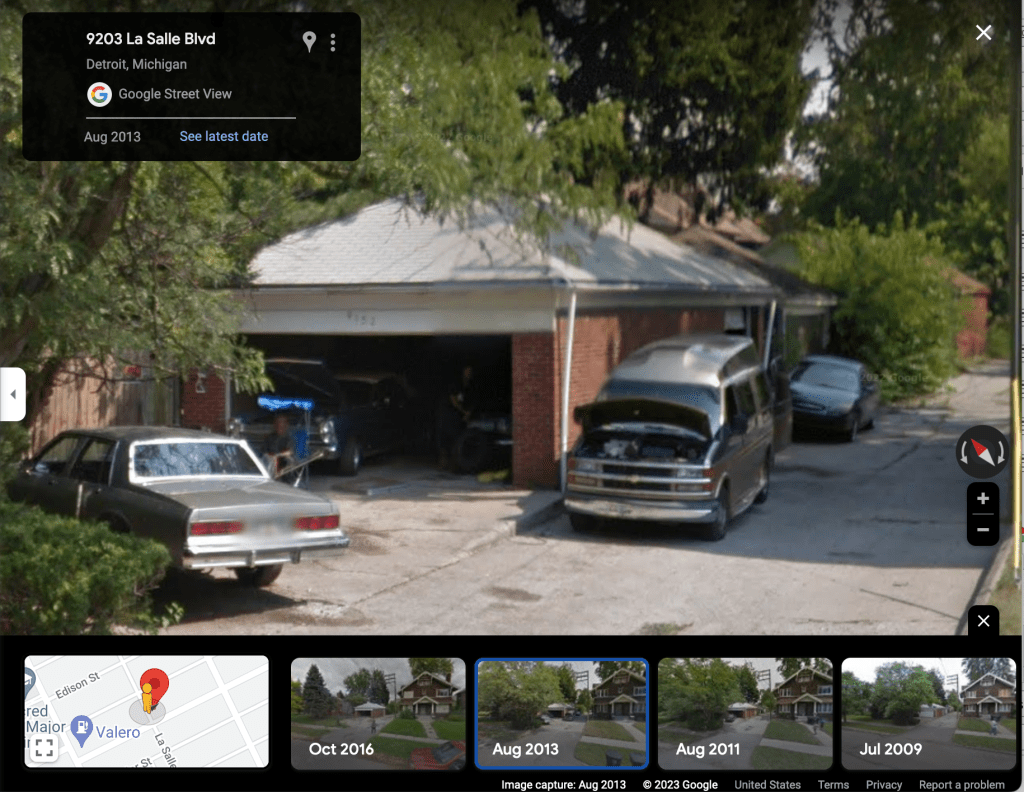
One of the first sites I checked on Google Streetview actually did appear to be an auto/scrap yard operation in a residential alleyway. There were too many sites to individually verify each, so I shifted my focus as to how these locations might be regulated.
Comparing Data
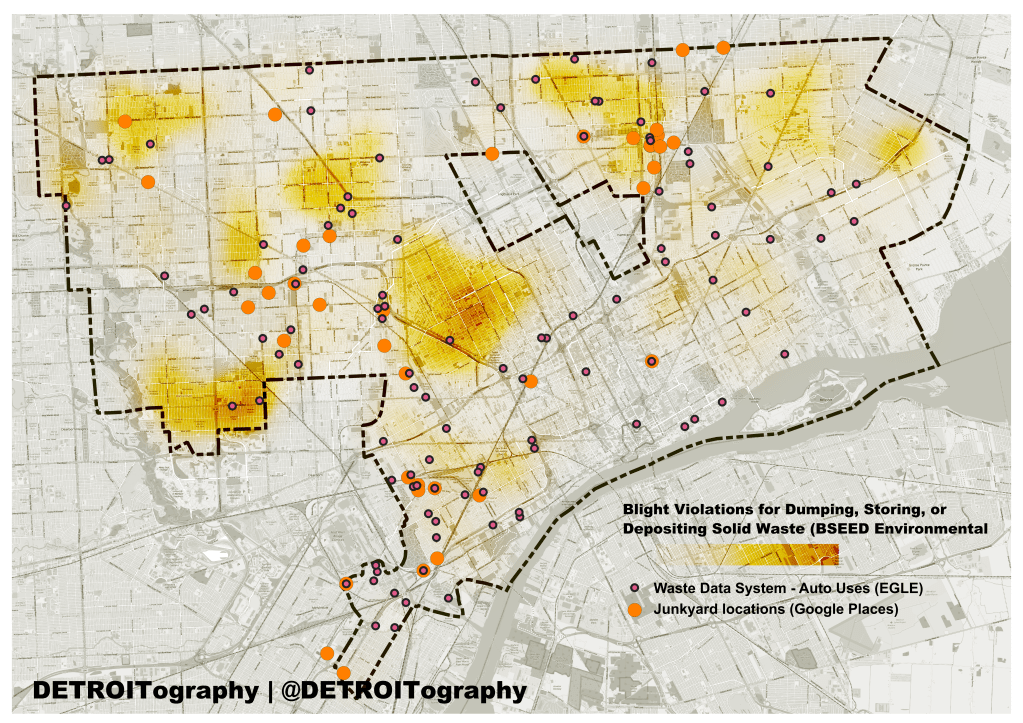
The State of Michigan Department of Environment, Great Lakes, and Energy (EGLE) ended up having a more helpful and knowledgeable social media team than their legal team handling FOIA requests. I was able to search the public “Waste Data System” to find 110 used auto parts and metal recycling sites. Still a very low number compared to the 452. A quick search of Google Places also got me to the number of “junkyards” in the city (n=37).
I decided to start engaging the Mayor’s office for some clarity on data sources. That yielded insight into where some of the numbers came from, but only more confusion related to auto/scrap yards. I finally realized that this was part of the Mayor’s January 2019 moratorium on new auto or scrap yard businesses as part of the “blight to beauty” campaign and tracked down a June 2022 presentation made by BSEED to the City Planning Commission (CPC). The end goal of the effort being updates to zoning, code, and enforcement for auto related businesses and land uses. In a 2022 DONCast video presentation Dilip Patel of BSEED noted he used Secretary of State data sources to compile a list of sites. The Secretary of State maintains searchable databases for both auto repair and auto dealers as part of their online services.
June 2022 Presentation to CPC
BSEED/Mayor’s Office Memo
SOS Data check
Enforcement Effect??? since 2019
2023 Totals
Source
Auto/scrap yards
1548/1405
1414
1248
—
925
Towyards
11
—
—
—
14
Google Places
Junkyards
95
122
110
—
110
EGLE Waste Data System
Auto repair
925
920
725
221
504
SOS online services
Auto dealer
374
372
413
116
297
SOS online services
Now, not much of this made sense. The Mayor’s office shared a memo written by BSEED that attempted to lay out some methodology, but that included an assumption that 50% of auto repair shops were or were not active at a given time. BSEED notes they have a master list of 1,414 sites which is slightly higher than what they mapped out in June 2022.
They also shared a spreadsheet of 121 business shutdowns related to auto uses enforcement. I was interested to see what kind of impact there was from the legal effort. I assumed there would be overlap between BSEED’s list and the Secretary of State’s, but there wasn’t much. Since 2019, 116 auto dealers and 221 auto repair facilities had closed, had their license revoked, expired, or suspended.
Among the locations that closed since 2019, just 7 overlapped with BSEED business closures. A few seemed to just be name changes such as Saad Motors to Platinum Auto Parts. The license expired, but the new entity was still shutdown by BSEED. Interestingly, none of the actual scrapyards were part of the BSEED closure dataset. Now I’m not sure what 114 additional sites BSEED closed are as part of the crackdown on auto/scrap yards.
Conclusion
Maybe this numbers story isn’t done, but the conclusion is that what many observers assumed was widespread scrapping in the city. In reality there is a small subset of scrapping happening (likely larger than in other cities), but the majority of the concern is around piles of old cars and their parts that have been left to decay and create eyesores. I think those are two separate stories. Unfortunately, because of the way the data was presented, one mostly negative narrative has emerged about scrapyards in Detroit that includes small businesses operating as car mechanics or used car sales.
Data is a hot commodity and its tough when used in unverifiable or confusing ways. When the city references data in public it should be readily available on the city’s open data portal in the same way that meeting minutes could be checked for accountability and transparency. The numbers help us track progress and identify what assets we have available. Data and numbers matter, maybe not as much to every person, but they seed the narratives of our city and drive perceptions of the people who live in Detroit.
This map was shared by the Detroit Historical Society and is an interesting look into the past. Some project names are even in the works today, like Lee Plaza. Big projects of this time period included: West Side Industrial, Medical Center, Elmwood, and University City (Wayne State).
The Detroit Housing Commission prepared this map in 1969 to highlight areas of low income housing, redevelopment, and code enforcement.
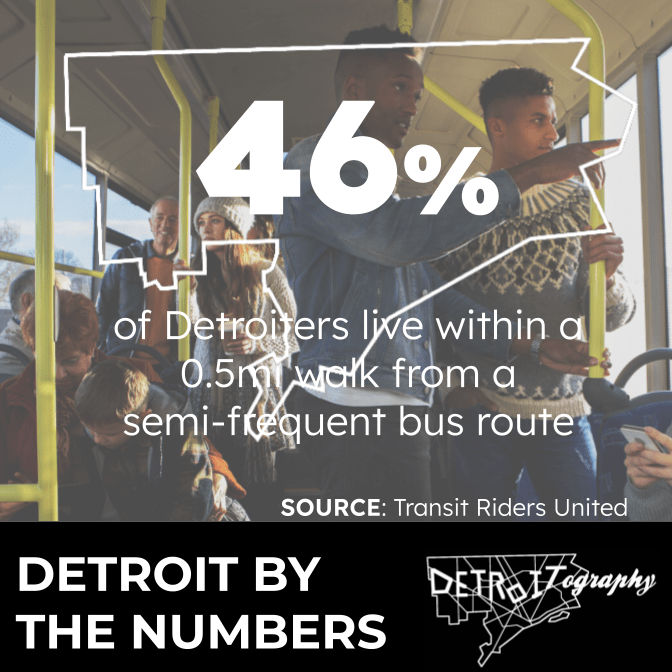
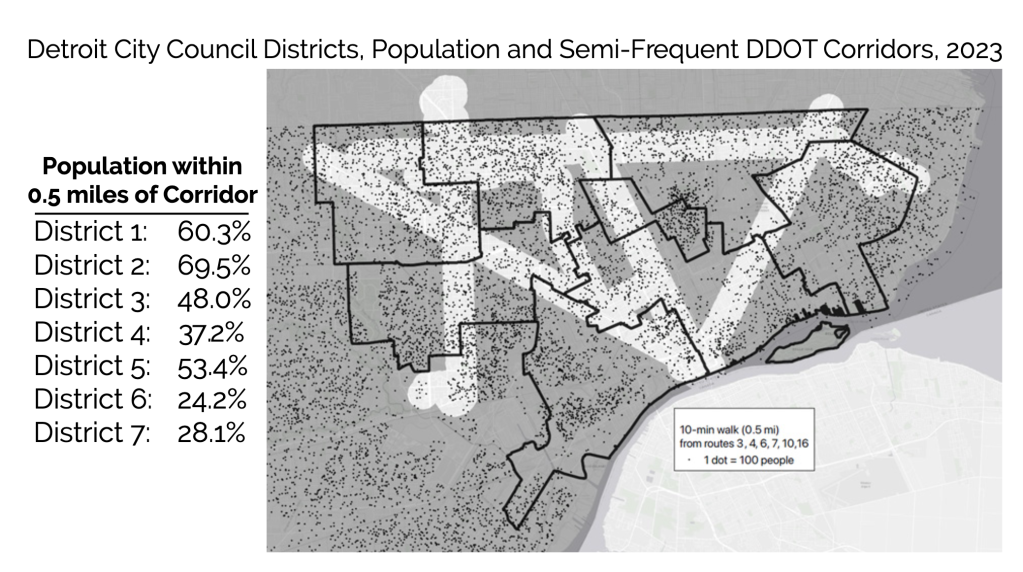
In the latest report from Transit Riders United (TRU), Save Our Service, they dig into the failure of DDOT and SMART to return to pre-pandemic levels of service compared to other cities.
The map below shows the current extent of semi-frequent DDOT service, running every 20 minutes during the day on weekdays. As seen, in four of the seven Detroit City Council districts, a majority of residents live more than one-half mile from these semi-frequent routes.
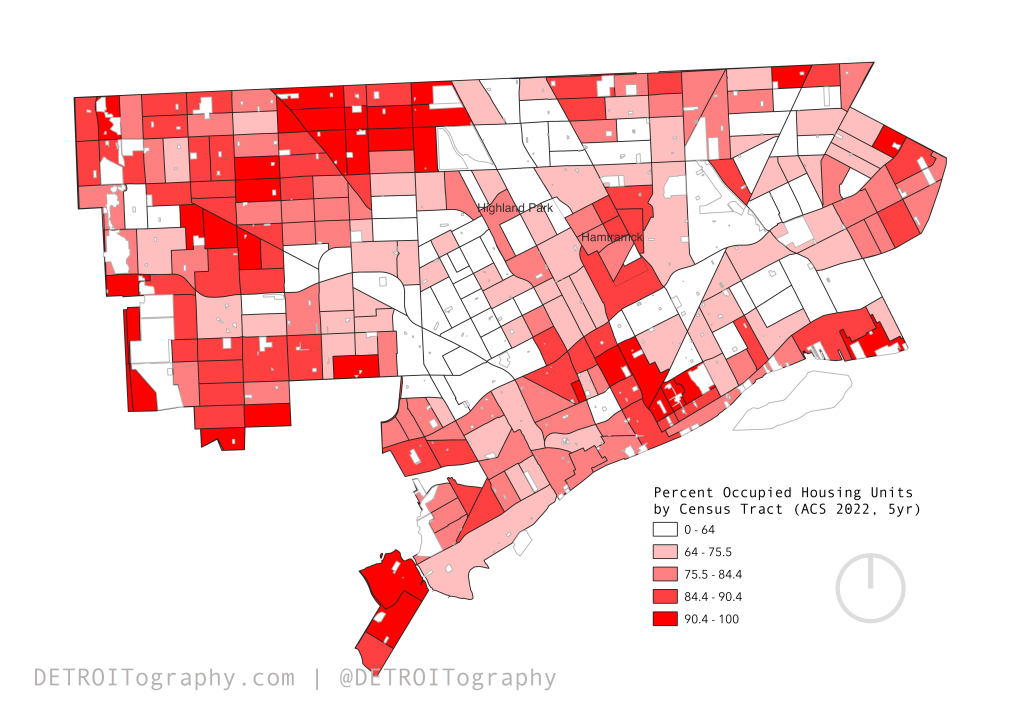
Understanding occupancy and vacancy in Detroit is a constant data battle. The known crises of low home mortgage origination, large-scale evictions, and property speculation make Detroiters unduly mobile having to secure housing by various means and face multiple barriers along the way.
The last subjective assessment of occupancy in Detroit came with the 2014 Motor City Mapping project, but relied on responses of surveyors. The City’s current in-house streetview imagery could be used to do the same, but might not capture indicators like utility turn-ons. The DLBA used to run a quarterly “occupancy index” model that included DTE account information to better assess occupancy, but as far as I have heard the data sharing agreement fell apart years ago.
The next best option is Census data on occupied housing units or USPS data on vacancy. I try to opt for the more positive data indicator with where people are in housing. We see a familiar pattern that maps onto the population dense clusters across the city.
Contact
Submit a map or just get in touch. Thanks for following!










 DETROITography