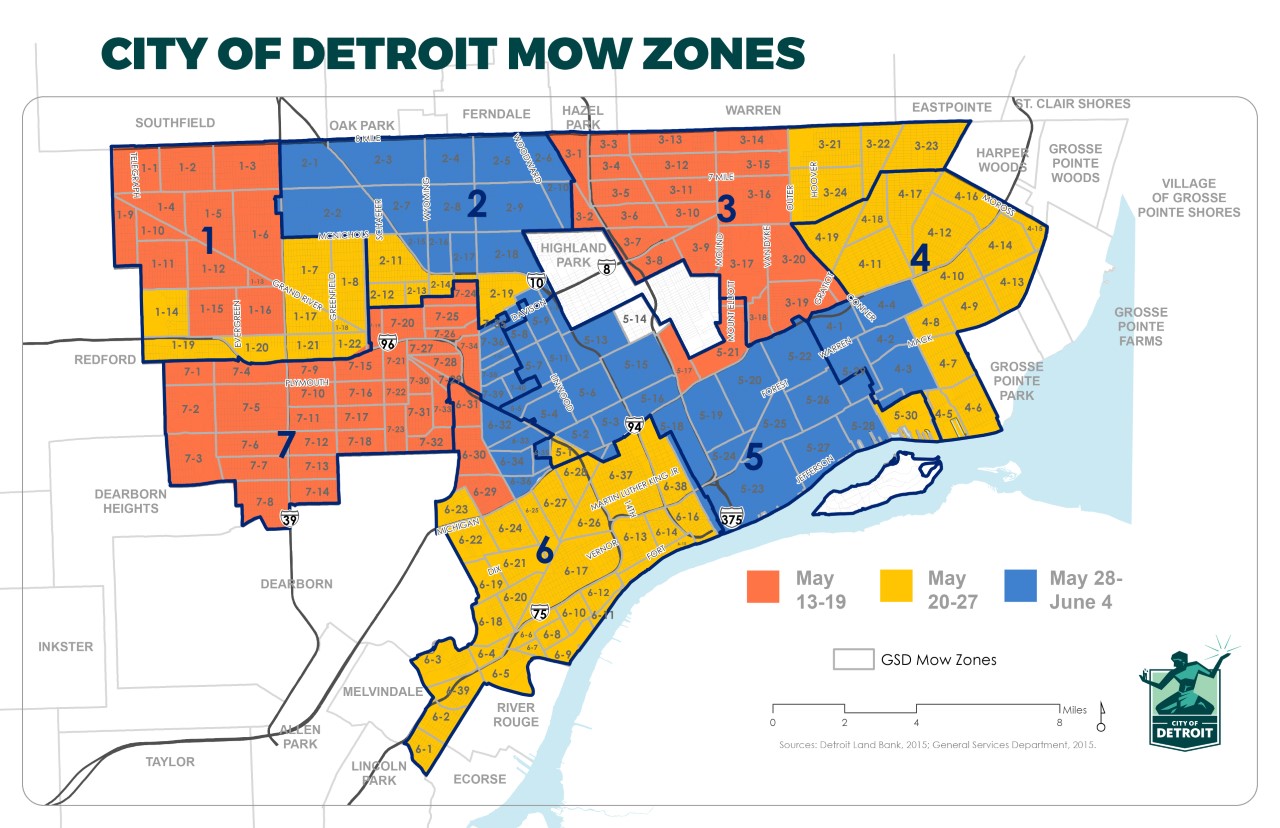
Map: Detroit Mow Zones 2020

mow zone map colored

There is a lot of weird history with the mowing of vacant lots in Detroit from private volunteer groups tackling the effort to local gardens getting mowed over and finally an entirely new department formed to deal with it – General Services Division, which now controls the Parks Department and more recently the Recreation Department.

If you have a garden and are concerned about it being mowed over the website guidance notes:

“In cases where block clubs, homeowners, or community organizations maintain gardens or generally maintain the lot themselves, please place a 3-4’ wooden stake on the front of the property. The wooden stake should be painted hot pink at the top or have a secured hot pink ribbon tied on it.

If vacant lots are not clearly marked crews may cut the lot.”

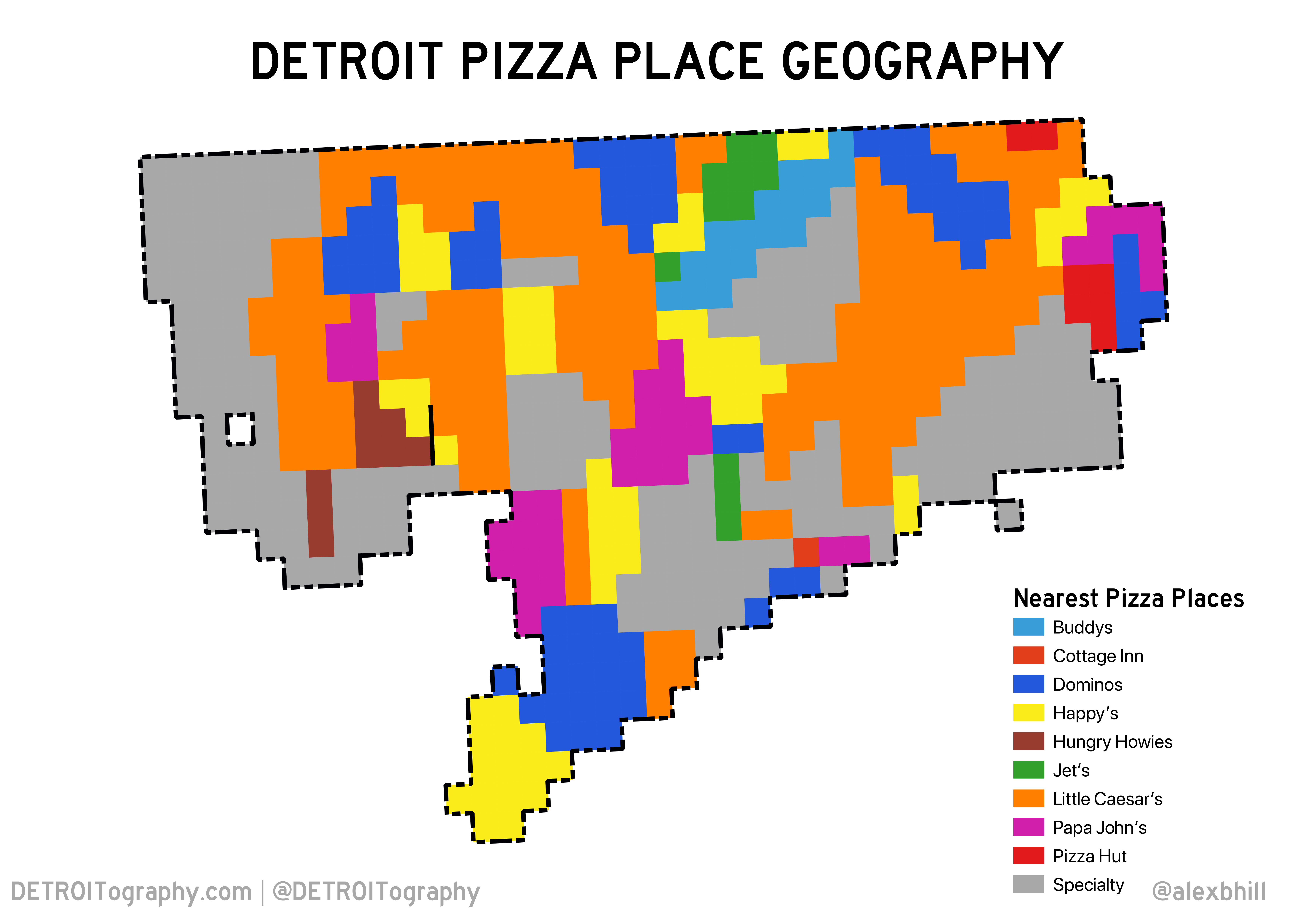
Map: Detroit’s Pizza Place Geography

Detroit-pizza-geography-map

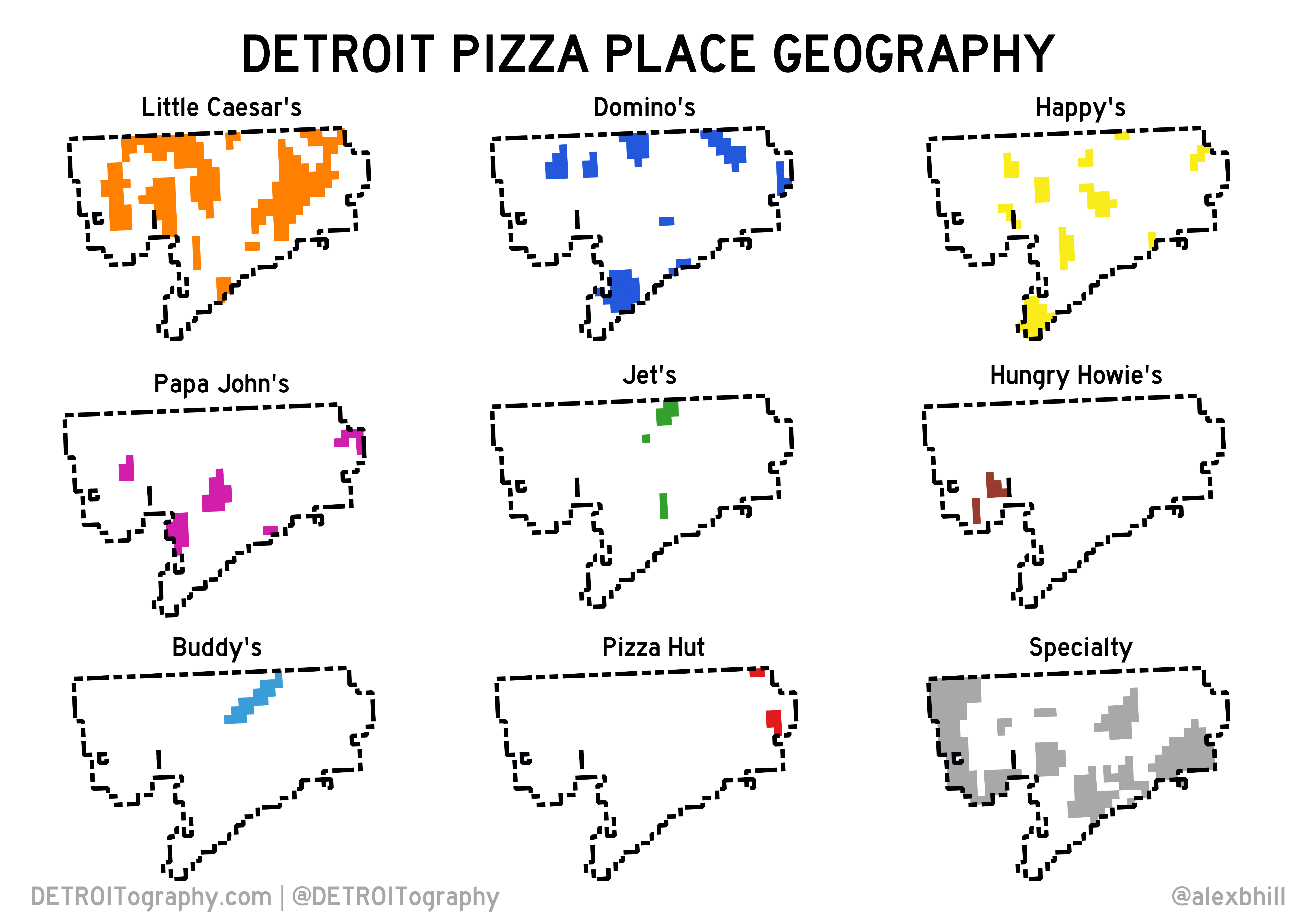
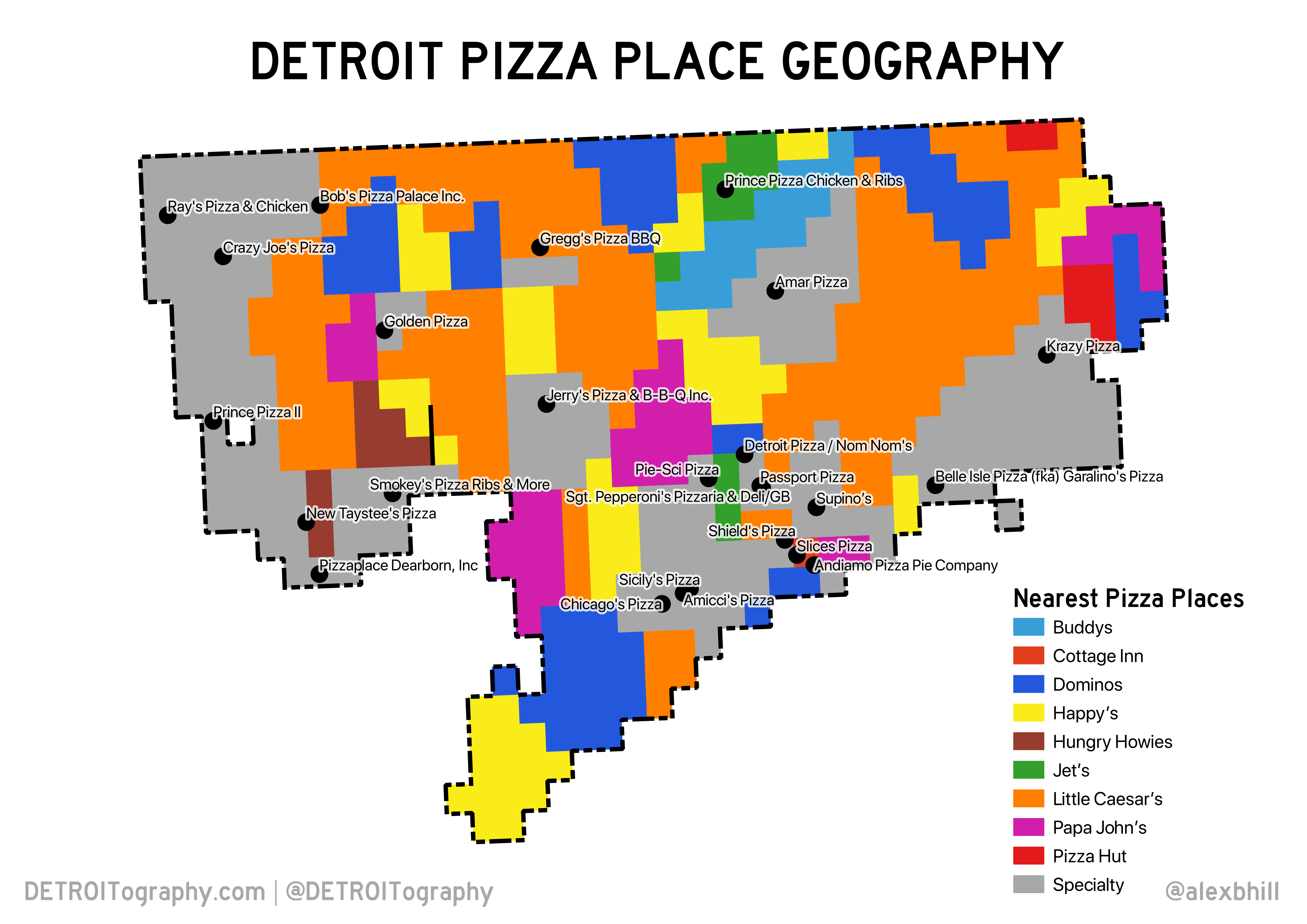
This map idea has been sitting in the back of my head ever since Nathan Yau of FlowingData analyzed the pizza place geography of the United States. The map is based on which pizza place is nearest to particular areas of the city broken down into a grid (microhoods actually – shout out to Motor City Mapping project).

Numerous recent news reports highlight the hoarding of frozen pizza, the rallying of pizza chain stock prices, and the overall growth of pizza chains during the coronavirus pandemic. Pizza Hut, Papa John’s, and Domino’s all reported plans to hire more workers to meet the demand. Where might those people be in Detroit?

Detroit-pizza-geography-multiples

Detroit is home to the headquarters or birthplace of multiple pizza chains including: Little Caesar’s (HQ, founded in Garden City), Buddy’s (claim to the “Detroit-style”), Happy’s (founded 1994), and the specialty pizza spots only found in Detroit including Eastern Market staple Supino’s (temporarily closed), Belle Isle Pizza, Amicci’s, Sicily’s, or Pie Sci (my newest favorite). Over half the pizza industry is independent and Detroit has its fair share of unique pizza places including Halal Pizza near the Dearborn border and local chain Pizza Papalis of Greektown.

Detroit-pizza-geography-special

When it comes to pizza, Detroit has you covered. You might not find your favorite national chain everywhere, but there’s always a unique pizza option close-by.

EDIT: I think my data is actually bad. The two Pizza Hut locations in Detroit have actually been closed for a while.

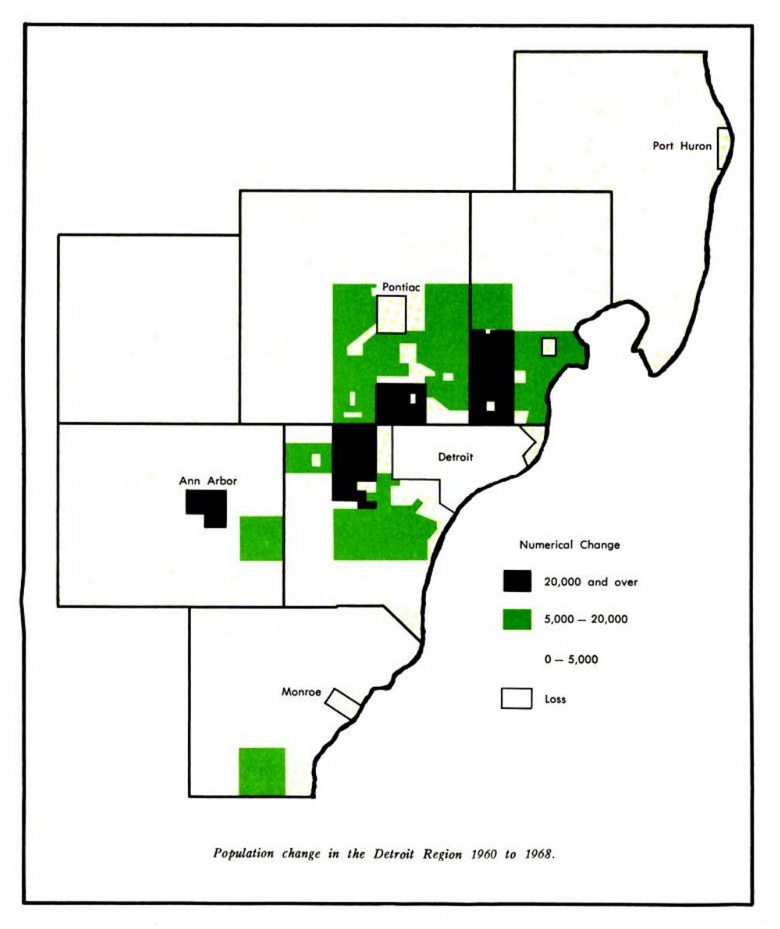
Map: Detroit Population Change 1990 to 2000

Screen Shot 2020-03-31 at 9.12.30 PM

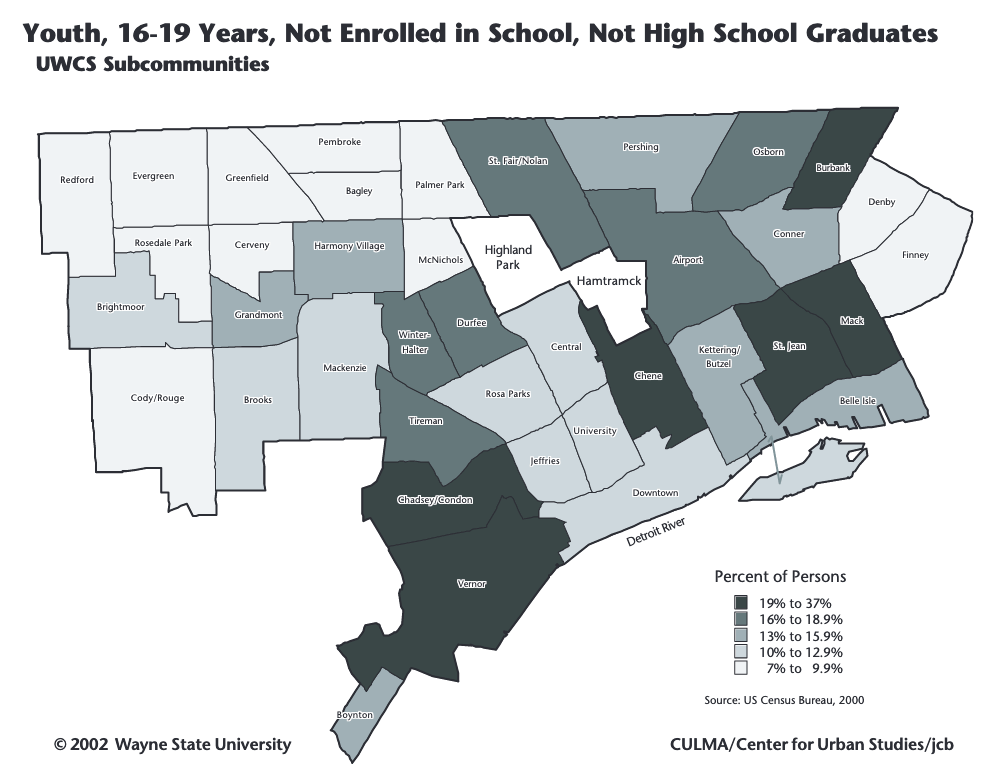
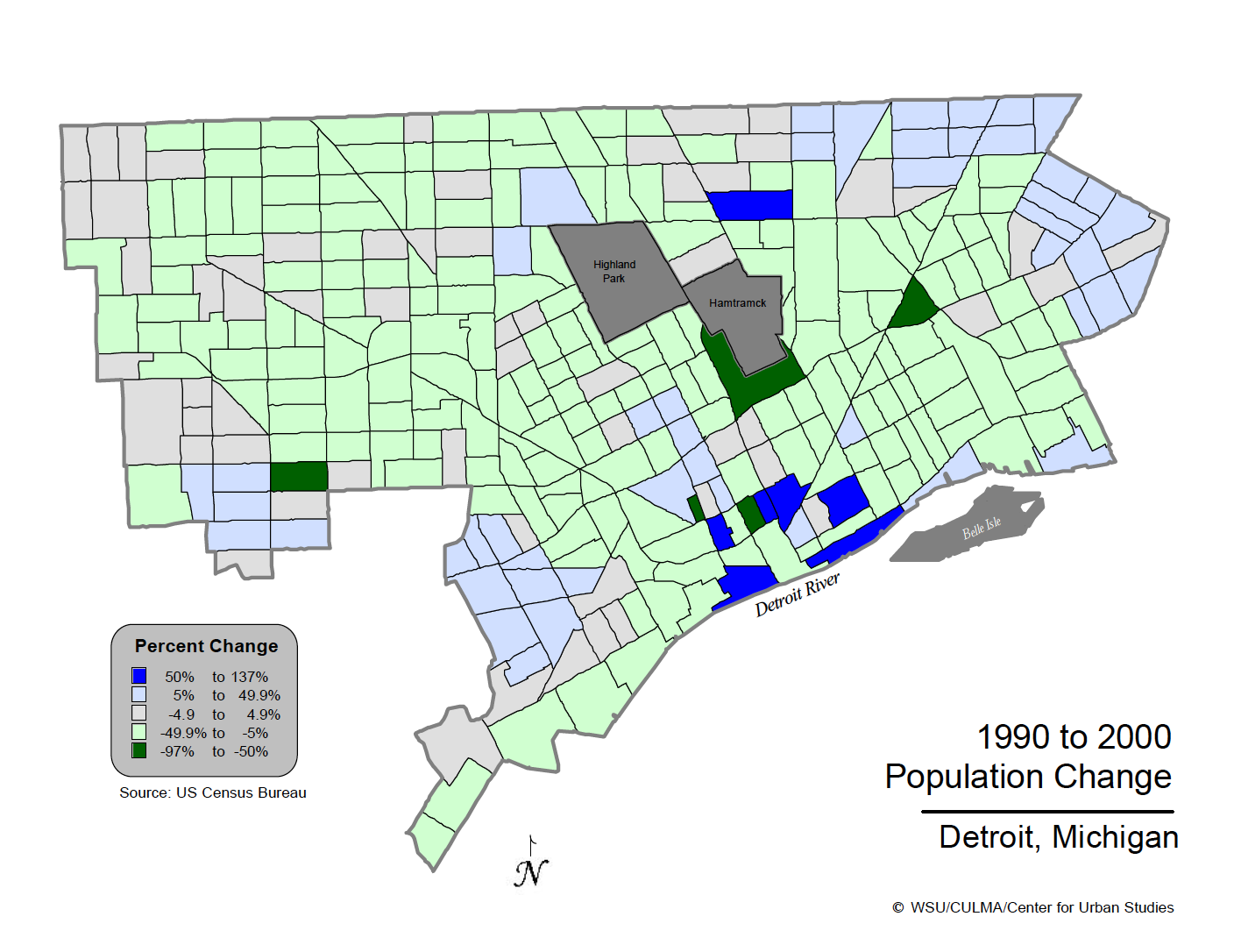
Sometimes we forget recent history, this is a throwback Census map form the WSU Center for Urban Studies.

The city’s now notorious 25% population loss from 2000 to 2010 is most often mentioned in news articles, but you can see the widespread population declines across the majority of the city in the preceding decade from 1990 to 2000.

Map: Metro Detroit COVID-19 Case Prevalence by ZIP Code

COVID-ZIP-Prevalence-051420

Note: All data as of 05/14/20

While some areas are seeing new cases slow down, Michigan cases continue to increase. In Southeast Michigan many hotspots have cooled, but Detroit continues to have a heightened burden of cases and deaths in the region.

Expanded testing is coming from  health systems, Wayne State University, MDHHS, and local governments.

Map: Detroit’s Altered Grocery Landscape 2020

DFM-covid-grocery-050820Food isn’t the same in Detroit anymore. All independent grocers have reduced their operating hours – many have reduced staff as workers stopped showing up for fear of exposure. Restaurants are becoming small grocers, “groceries” are distributed in drive-thru lines, and emergency food providers have become a lifeline as unemployment has skyrocketed.

Retailers are now mandated to limit the number of people inside their stores, require all employees (and customers) wear masks, and offer special hours to vulnerable populations.

As part of the Detroit Grocery Coalition, convened by the Detroit Food Policy Council, I’ve been tracking changes along with colleagues at the City of Detroit. Independent grocers are holding steady in the neighborhoods although at reduced staffING, hours, and sometimes supply chain – but the landscape of support during COVID-19 shows specific food access opportunity patterns across Detroit.

Map: Wayne County and Detroit Health Organization 1955

Screen Shot 2020-04-29 at 8.29.42 AM

Political and economic structures influence how cities respond to crisis.

Looking back to 1955, this map shows the multitude of personnel dedicated to public health in Wayne County be they part-time as a team of one, part-time with a group of staff, or full-time (only Detroit). In 1955, part-time health officers in smaller cities were supported by the Wayne County Health Department.

Today, only the full-time health officer departments have survived with a Wayne County Health (Human Services and Department and the Detroit Health Department.

Metro Detroit COVID-19 Hotspots by ZIP Code

COVID-ZIP-Prevalence-042320AH

I have to start with the caveat that I strongly dislike (hate is a strong word) ZIP Codes with a passion for mapping out any data, but desperate times and desperate measures (be on the lookout for an improved spatial process soon). Not all of eastern Washtenaw County is a hot-spot nor is all of northern Monroe County. Ypsilanti and Carleton are likely hostpots.

ZIP Code has become an default for municipal governments and in particular for health data. I assume because of the perceived “safety” of releasing case data that might be impossible to pinpoint within a ZIP Code rather than say a smaller geography like a Census Block Group. There still remains the possibility that there are only 10 houses in a ZIP Code and you could easily determine which of the 10 has a case of a particular disease.

At any rate, all the counties in the Southeast Michigan Council of Governments (SEMCOG) region are publishing a data dashboard that includes case counts at the ZIP Code level. However, not all of them present the data in the same way.

  • Detroit only offers a map image by ZIP, no machine readable data tables.
  • Wayne County locks down their data dashboard and reports at the “community” level, which thankfully in Wayne County (except for Dearborn) largely matches with ZIP Codes.
  • Oakland County includes death counts. They normalize by cases per 10,000 people
  • Macomb County has a detailed dataset of daily new cases, but reports limited data at the ZIP Code level beyond a case “count”
  • Washtenaw County shares a “frequency” of cases by ZIP Code
  • Monroe County shares case counts
  • Livingston County shares a map, but the dataset API isn’t open to the public so was dropped when I made the map

ZIP Code data may be more geographically specific than County, but still needs more nuance and clarity.

Map: Arsenal of Health in Detroit 2020

arsenal-of-health

During both World War efforts, Detroit’s factories and their manufacturing might was flipped from automobile production to support for the war effort. During World War II, at least 110 factories in Detroit retooled to produce parts for aircraft, tanks, and weapons.

arsenal-of-democracy

Recently, the news media (Crains, Free Press, Detroit News) have reached back into history in an attempt to compare the Coronavirus global pandemic to a war effort. There are serious issues with comparing a public health response to a war, but today is all about the geography.

Detroit no longer has an arsenal from which to pull. There are no longer over 100 factories within the city limits. The auto industry’s operations are no longer are located in Detroit. The reverse prohibition trend in Detroit has led to the city’s strongest response as Detroit-based breweries and distilleries have started mass producing hand sanitizer rather than beer or spirits. Detroit’s industrial sewing ecosystem has also taken on the task of making face shields, gowns, and masks.

Screen Shot 2020-04-09 at 2.11.00 PM

GM’s effort is largely focused at their China and Indiana facilities with a handful of metro Detroit suppliers involved. Ford is split between a South Dakota facility and a supplier in Plymouth, MI making that has already made 1 million face shields. Dow (Midland, MI headquartered) has marshaled their global reach to produce hand sanitizer.

Indicative of Detroit’s decline, global industry (specifically the auto industry) largely functions outside of the city in suburban factories, southern facilities, or where a lower cost workforce resides. Shout out to Detroit businesses shifting focus to address much needed supplies:

  • Detroit Bus Company
  • Detroit City Distillery
  • Two James Distillery
  • Eastern Market Brewing Co.
  • Atwater Brewery
  • Detroit Denim
  • Pingree Detroit


COVID Community Vulnerability Map for Detroit

Screen Shot 2020-04-08 at 9.45.03 AMThe healthcare data firm Jvion, which utilizes artificial intelligence (AI) approaches in predictive analytics and machine learning, has create a vulnerabilty map based on 30 million de-identified patient records. The patient data was then modeled against respiratory viruses similar to COVID.

Map: Targeting Potential Areas of High Risk for Coronavirus in Detroit

COVID-SVI-2020

The “why Detroit” question has continued to be asked pointedly and lamented by others. If you look at a lot of data for the city, you will be no stranger to large numbers, overwhelming burdens, and unfortunate top rates for bad indicators.

I’ve lamented the “food desert” term in my work and found it to truly be an expression of the compound burden faced by many Detroiters that lack opportunity and live daily with high degrees of social vulnerability. The Centers for Disease Control (CDC) developed an index based on multiple Census data points in order to identify high risk areas in order to plan for environmental crisis. I’ve found that it works very well for non-environmental crises as well.

In this map, you can see there is a fair degree of overlap between dense areas with COVID-19 cases and high risk areas (very socially vulnerable: no car, low income, etc.) or areas with a large percentage of senior citizens (at greater risk of death from COVID-19).

This is not a perfect measure, but does provide a snapshot into geographies of vulnerability when considering where there might need to be additional outreach, for example, to seniors on the Lower Eastside, communities in Southwest Detroit, or Near Westside due to high risk or high vulnerability.


Map: Diphtheria Contagion from Detroit 1892

Screen Shot 2020-03-31 at 9.19.35 PM

Detroit is no stranger to excessive contagion.

The cholera epidemics of 1832 and 1834 led the city to develop a sewerage (yes that is the correct term) system that most comprised of cementing over historic rivers and creeks (i.e. Connors Creek). Cholera was found to spread when human waste was dumped into the river and collected along the wharfs that no longer jut out from the riverfront.

The 1918 spanish flu pandemic led to mass support for investment in the public health system with additional funding for the Herman Kiefer Health Complex, which opened in 1919. The complex was shuttered in 2013 and has since been sold to a developer in 2015.

The map above is from the [Michigan] State Board of Health – Report of Secretary, 1893 showing:

[…] instances where diphtheria was reported to have been carried from one locality to another; the lines connect the localities, and the arrow-heads indicate the direction of movement in each case. […]

It will be noted that in 1892 Detroit was the greatest source of contagium. The evidence in this map bears upon statements made later in this article, that “The evidence of the spread of diphtheria from cities is conclusive, etc.”

Map: Detroit Coronavirus Cases Heatmap 2020

Positive StoryThis map was downloaded from the City of Detroit Coronavirus webpage on 03/29/20 after the latest 3pm update by the State of Michigan Department of Health and Human Services (MDHHS).

The City of Detroit’s coronavirus data are being tracked with a Tableau dashboard that include a heatmap of individual cases that I assume map on to individual patient addresses.

The map, as many have already noted, follows population density patterns in Northwest and Far Eastside Detroit, however there is a major gap in Southwest Detroit. From past work on asthma medication management I wouldn’t be surprised if similar issues of care access, documentation concern, and language barriers are exacerbating coronavirus impacts in Southwest Detroit where a major risk factor – air pollution – is also prevalent.

EDIT: Map with geographic references.

Screen Shot 2020-04-03 at 9.11.51 AM

Map: Detroit Metro Hospital Beds by Craigslist ZIP Code Regions 2020

craigslist-hospital-bedsI’ve been exploring the geography of hospitals and health care resources during the COVID-19 outbreak. Reporting information at county level isn’t ideal because the patient who lives in Macomb then went to the Henry Ford Hospital in Detroit. Similarly, a patient living in Detroit decided to go to a Beaumont Hospital in Oakland County.

In the absence of detailed data on patients and human mobility I immediately thought of John Nelson’s project to generate zones based on Craigslist Economic Zones based on ZIP Codes. These seemed a potentially better indicator of patient region than County or the often used Hospital Referral Regions (HRR) developed by the Dartmouth Health Atlas, which represent health care markets based on tertiary care. In the case of metro Detroit, the HRR cuts off at Detroit’s western border and it has been well documented that Detroiters travel for resources towards the northwesternly.

John Nelson liked my suggestion too, read more about how he combined hospital beds by Craigslist Zones.

Map of the City of Detroit 1873

1873-detroit-map

I’m always surprised when I find a historical map that I haven’t yet shared. This map from 1873 is a great reminder that whether it is the 1800s or present day, all maps rely on good data sources and often some data wrangling, compiling, and cleaning.

This map data in particular was compiled by Eugene Robinson, who was a city surveyor for the Library of Congress and began work on this map in 1871. The map was produced and printed by the Calvert Lithographing (and Engraving) Company.

Map: Existing Solar Arrays in Detroit via Google Imagery 2018

Screen Shot 2020-02-28 at 11.00.51 PM

Google’s Project Sunroof has found that Detroit has nearly 200,000 roofs (or about 73% of roofs) that have capacity for solar with an estimate of 3 million megawatts of electricity generated each year. Google combed it’s imagery data collected between 09/2014 — 06/2015 for this analysis.

It seems wild to think that there are that many solar arrays in Detroit, but also that there could be so many more!

Map: Detroit’s Hotel Fort Wayne in City Directory 1928

FullSizeRender
This advertisement for the now vacant Hotel Fort Wayne (hello Ilitch family, please redevelop!) was included in the 1928 City Directory. It’s is interesting to see the various places called out as city highlights of the time.
My eye was first drawn to how active the riverfront was with multiple ferry companies and water transportation opportunities, including two river crossing options for Windsor and Walkerville.
I was similarly drawn to the prominence of Grand Boulevard which would have been one of the city’s crowning achievements in that time period. The “New Art Institute” is prominent on the map along with all of the motor companies (although I’d never heard of “Hupmobile” – Hupp Motor Company).
Thanks for finding and sharing Bill McGraw!

Detroit Expressway Assignment Coding Map 1955

Screen Shot 2019-12-18 at 9.16.16 AM.png

I stumbled across this hand drawn map and found it fascinating. It’s really interesting to think about the breakdown of planning an expressway from its ramps, interchanges, trip directions, construction sections, etc. If you couldn’t guess the area pictured is Northwest Detroit. I assume this coding has lived on until today, but haven’t verified yet.

Map: New Chrysler City Project 1986

Screen Shot 2019-11-05 at 9.13.36 PM

As Fiat Chrysler Automotive (FCA) finishes its recent expansion adjacent to their existing facility, including swallowing up a roadway and increasing toxic emissions on the Eastside, I happened across the original 1986 plans for what was then deemed an industrial “revitalization” for a new Chrysler plant.

The full plan is called the Jefferson-Conner Industrial Revitalization Project. The map included here represents all of the existing buildings and businesses that may be subject to toxic evaluation (i.e. removal of underground tanks at gas stations, etc.). The existing plant in faded gray was demolished.