Detroit Streetlights Overhaul Map

detroit_street_light_plan

After Charlie Le Duff’s report on the horribly outdated street light infrastructure and the pushpin map to track street lights, this map from the Detroit Free Press  sheds more light on the City’s plan to survey and improve street lights in Detroit. What is most interesting here is the choice to start with the outer neighborhoods where there is higher population density as opposed to improving downtown first. It is likely that downtown has already gotten the investments to improve street lighting, but this is a positive step in prioritizing areas where there is high density of Detroit residents over corporate or commercial interests.

Map: Integrated Voting Attitudes 1969

bunge_vote_integration_1969

This map was a part of the Detroit Geographical Expedition Institute’s Field Notes II on school decentralization. The argument this map portrayed was that idea that the opposite of racist was integrationist. DGEI found that the school board was placing all the power in the hands of those with racist attitudes. The totally white areas of the city represented increased racist attitudes in voting. The other part of DGEI’s argument was geographic proximity of people of different races along with their voting attitudes.

Detroit Population Change Map 1950 – 2000

detroit_popchange_2000

This fun infographic comes by way of the New York Times and utilizes US Postal Service data on vacancy rates as well as Census data on population density. The best part of this infographic are the 3D representations of population density. It’s very interesting to see the shifting population over time.

Detroit White Population Map 2011

det_white2

There have been maps of Detroit’s black population through every decade, but what about its white population? I decided to make this map after taking some friends around to a few hot spots in Detroit. We hit up Northern Lights before getting dinner at Green Dot Stables and then headed over the Sugar House for evening drinks. The venues progressively became less diverse. The Corktown area establishments seemed to be dominated by the young, hip, and white of Detroit.

This map demonstrates the divide in new neighborhood developments in the city: Hamtramck as a hip place to live, Downtown and Midtown bringing in students and young professionals, and Corktown/ Southwest as the coolest place to live in Detroit. It also represents the racial/ ethnic association with being “white.” Southwest Detroit appears to be a most densely white, but in reality many individuals of Latino heritage respond to the Census Bureau with “white” as their race/ethnicity. The numbers may be skewed, but there is no doubt that these areas do have growing young and white populations along with increased investment dollars.

Compare with Wayne County White Population

Map of Detroit School Closings 2010 – 2012

ecity-map1

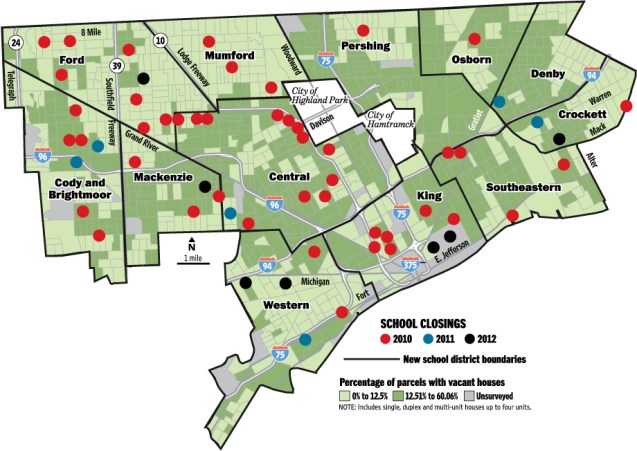
Detroit has seen many schools close in the last decade. Many schools closed in 2007 due to low enrollment numbers. In, 2009 it was announced that almost half of the schools in Detroit would be closed. In 2010, consolidation of high schools was announced. School closings have slowed since then, but there have still been a handful of school closings in recent years.

Anyone know where we can find a comprehensive list of school closings since 2007 or 2009?

Hyperloop Transit from Detroit

Hyperloop Detroit

After the popularity of the Detroit Area Regional Transit map from jwcons, someone mentioned the Hyperloop and here it is as crafted by Michael Kelly for Popular Science. We captured the map with Detroit as the central hub. Imagine being able to get from Detroit to Washington D.C. or Atlanta in about 2 hours or Miami in 3 hours. It would become no big deal to visit Chicago (36min), St. Louis (57min), Pittsburgh (36min), Toronto (1hr), New York City (1 hr), etc. Have a meeting in Silicon Valley, no problem it’s just a day trip (3hrs 30min). Prefer to go skiing in the Rockies (2 hrs), just a couple hours and you’re there. The hyperloop doesn’t make any sense for a regional solutions, but would be an exciting future for a national transportation system.

More from the Popular Science article (also visit the article for an interactive version of the map):

In August, Silicon Valley darling Elon Musk—CEO of SpaceX and Tesla Motors—unveiled his concept for the Hyperloop, a high-speed system of 28-person pods that would shoot through low-pressure tubes on air bearings. Musk’s published proposal calls for the Hyperloop to link San Francisco and Los Angeles; pods would blast down the I-5 corridor at 760 mph, reducing the journey from five and a half hours by car to just 35 minutes.

Musk envisions the system connecting cities less than 900 miles apart—beyond that, he writes, “I suspect supersonic air travel ends up being faster and cheaper.” Using the 900-mile limit, we calculated other areas that could be connected by the Hyperloop. Theoretically, pairs such as Memphis and Chicago or Salt Lake City and Seattle could bridge the distance of a morning commute, blending economies and cultures, and reshaping the continent.

Map: Parks, Open Space, and Recreation in Detroit

Screen Shot 2013-12-15 at 1.34.09 AM


Detroit Future City has some grand plans for expanding green spaces in the city. I would argue that the city already has  more parks than it can manage with the closing of 51 parks last  year (map). Belle Isle is set to become the “Mackinac Island of the South” and others have grand plans for Rouge Park while there is still the development of controversial Hantz Farms/ Woodlands and SHAR Recovery Park. If these green spaces can be better developed and maintained it can help boost the health of Detroit residents and reduce crime.

The “areas to consider new parks” seem to create barriers between areas where there is higher population density and the Downtown/ Midtown region. Seems like areas to consider new parks would better fit where former industrial sites might have been. The exciting part of this map is the development of Greenways. I can’t wait for the loop to be complete that will connect the entire city in a bikeable pathway. Any future development of bus rapid transit or streetcars needs to also include dedicated and buffered bike lanes along major road arteries, such as Woodward, Gratiot, Jefferson, Grand River, Michigan Ave.

Hand and Finger Map of Detroit

Screen Shot 2013-12-14 at 2.44.41 PM

Have you ever wanted Detroit in the palm of your hand? Now you can! Other cartographers have made fun maps with their hands such as finger planning in Portland and hand turkey maps of Boston.

This hand based map of Detroit comes from the Field Notes I, Discussion Paper No. 1 by William Bunge. The Detroit Geographical Expedition needed a way to help orient its “field members,” typically students, many from “out of town.” This example comes from a checker cab taxi driver names Lee in 1968. Supposedly in the 1960s this was taught to school children and people in the streets would use it to give directions. I think this needs to come back because it works so well with fingers as the main arteries in Detroit. Perhaps it would make more sense to have the pinky finger be Michigan Avenue and say that Fort St. follows along the river just like Jefferson Ave? Where is that six-fingered man when you need him?

Send us your maps (in hand form) of your favorite places in Detroit! Click the Participate link

An Intelligent Transit Center for Detroit’s Future

DETtransit_map

I won’t claim to be an expert on Detroit transit history, but public transit is a major issue in Detroit that no one living in or visiting Detroit can ignore. I just took my wife and my best friend for the first time on the Detroit People Mover (DPM). We parked near Cobo to avoid a Tiger’s game and the accompanying traffic/ parking insanity, then we took the DPM to Broadway station to grab dinner at Small Plates. The whole ride I kept thinking about the critical link between the amount of parking available downtown and the lack of reliable public transit.

Want to increase public transit? Get rid of parking

Parking could be an entire rant of its own, but I want to focus on public transit. Detroit’s most well known piece of industrial “ruin porn” is Michigan Central Station (MCS), originally owned by the New York Central Railroad and built by the same architectural firm that constructed Grand Central Station in New York City. The building was supposed to exude elegance and grandeur, but was marked as an oddity due to the disconnect between the three-story train station against a backdrop of an eighteen-story nondescript office tower.

A Real Public Transit System

The trains arrived in Michigan Central terminal and a passenger could decide to catch a streetcar down Michigan Avenue to downtown or choose to take a horse-drawn carriage (later replaced by taxis). At its peak in 1914, nearly 200 trains left the station each day and in the early 1940s over 4,000 passengers rode the trains daily. Henry Ford even had his own private car that he took between New York and Detroit. During the years of World War II, streetcars were mandated over buses in order to conserve gasoline and rubber. These were the glory days of public transit in Detroit, when you could catch a regular train to Chicago or New York and had the option to take a working network of streetcars throughout the city. Michigan Central Station was a working transit center for the city. In the 1950s, rail travel dropped off significantly with the rise of the auto industry and the construction of the highways. By 1956, all of the streetcars had been converted into Ford coach buses. In 1975, MCS was sold to the newly formed Amtrak, but they couldn’t maintain the costs associated with the massive building with so few passengers and again sold MCS in 1985. With less than a dozen trains a day, the last train left for Chicago from MCS in 1988. Now the building sits on the historic registry, but is unsalvageable and unfeasible as a transit center any longer.

Detroit’s public transit system has been plagued by issues for years. Transit received a boost in 2005 when the Detroit Economic Growth Corporation (DEGC) announced plans for the Rosa Parks Transit Center, which would run alongside the Michigan Avenue People Mover station. The magnificent tensile roof structure wasn’t awarded a contract until 2007 and was finally completed in 2009. Unfortunately, it seems that the only long term planning that occurred was to place it next to a People Mover station. The Rosa Parks Transit Center is located in an odd section of downtown that does not lend itself to integration with a larger citywide or regional transit system. Detroit’s downtown has an iconic hub-and-spoke street design making it fun to look at on a map, but difficult to maneuver for public transit. Likewise, Rosa Parks Transit Center was not constructed to act like other transit centers in large cities.

In other large cities, which Detroit is arguably no where near similar, transit centers are located roughly an average 2 miles away from the city’s main tourist attractions. New York City is allowed to be different because of its high density and small area.

CITY TRANSIT MODES ATTRACTION DISTANCE
Chicago Union Station Amtrak, Metra Rail, “L” Rail, City Bus, Bike Share Navy Pier 2.4 mi
Washington D.C. Union Station Amtrak, Metro Subway, City Bus, Bike Share White House 2.4 mi
New York City Grand Central Amtrak, Subway, City Bus, Bike Share Times Square 0.8 mi
Detroit Rosa Parks City Bus, People Mover Rail Comerica Park/ Grand Circus 0.7 mi
PAST
Detroit Michigan Central Amtrak, Streetcar Rail, City Bus Comerica Park/ Grand Circus 2.0 mi
FUTURE
Detroit New Center Amtrak, M1-Rail, City Bus, Bike Share Comerica Park/ Grand Circus 2.5 mi

A good example of the lack of long term planning is the filming of movies downtown (i.e. Transformers 4). The Rosa Parks Transit Center was shutdown during filming due to its proximity to downtown. This begs the question, do we really think nothing else will happen in downtown Detroit that might cause a disruption of transit service? My bet is “No” we hope there will be a myriad of events and happenings downtown that will bring in crowds of people on a regular basis. Then why was a transit center planned in the middle of downtown? There needs to be distance between attractions and transit centers to make public transit systems a viable  alternative. The other key factor for a transit center is that they are multi-modal: Amtrak + local rail + bus system + bike-share, etc. Thankfully, Megabus also uses the Rosa Parks Transit Center as a pickup and drop-off point. DDOT and the Detroit Bus Company are also using the Rosa Parks Transit Center as their Detroit pick-up location for the Detroit Airport Flyer feasibility study connecting Detroit, Royal Oak, and DTW.

A New Transit Center in New Center

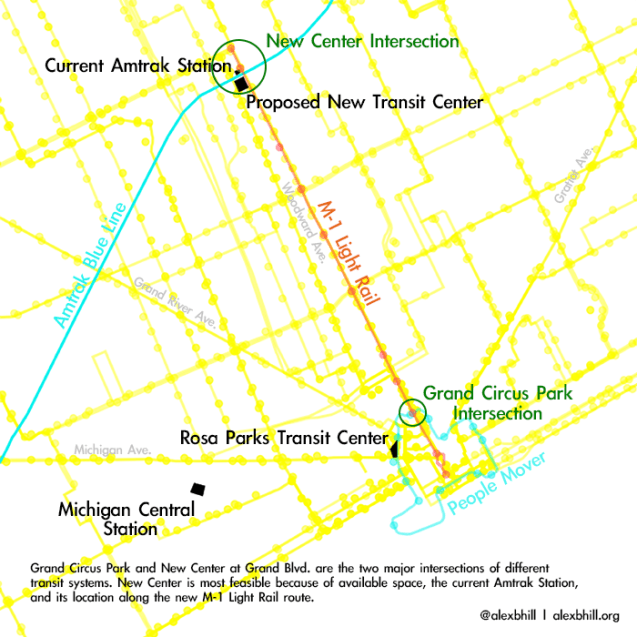
This all leads me to my pitch for a new and intelligent transit center for Detroit. The New Center area marked by the Fisher Building is a perfect area to house an intelligent transit center. There is plenty of space for parking, an existing large workforce that needs to commute, and an Amtrak train station – not to mention it will also be situated along the new M1-Rail line, which also meets up with DDOT bus stops. After mashing up transit pathways for DDOT, SMART, DPM, Amtrak, and the new M1-Rail I came to the conclusion that expanding the existing Amtrak station across the tracks would make sense to bring together a multi-modal transit system for the city where you could catch a DDOT bus off the M1-Rail or take the M1-Rail downtown to the People Mover or catch the commuter rail from the Amtrak station.

As I was preparing to write all these ideas down, I came across this video from America2050, which proposed a high-speed rail connecting Chicago and Detroit (developing “megaregions“) and depicted a new fictional transit center located exactly where I had imagined it should be! A new transit center in New Center matches what other large cities have with a multi-modal center located roughly 2.5 miles away from a city’s main attraction. The New Center Amtrak station will also be one of 5 stops (Ann Arbor, Ypsilanti, Detroit Metropolitan Airport, Dearborn, and Detroit) along the new commuter rail being developed by SEMCOG. New Center is also a nice way point between the suburbs, offices in New Center, and attractions downtown allowing people to utilize it for multiple reasons. The parking lot where I am proposing a new transit center near New Center is already managed/ owned by MDOT/ DDOT. This could not be a more perfect scenario. There is no need to obtain the land or convince a business to hand it over for a transit project, it is already owned by the transit authorities. Use the misguided money from freeway expansion to build this transit center in collaboration with Amtrak, expand BRT, and consider more streetcar options.

Working public transit is critical for more than just tourists and businesses. Residents, young people, and especially the working poor rely on public transit to be able to get jobs and keep them. A working public transit system has the potential to increase employment which in turn helps decrease poverty and crime. In an odd way public transit makes urban revitalization benefit people across a city.

Crossposted with updates
Detroit Neighborhoods Map: Agreement

nhood_agreement2

Detroit neighborhoods are far from being well-known or agreed upon. Arthur Mullen is credited with putting in the effort to identify and map neighborhoods in Detroit in 2003 (map) and his efforts were then scrubbed by Google Maps and quickly became an online standard for neighborhoods in the city. Timothy, who wrote for Huffington Post Detroit, lays out a great history of naming neighborhoods in Detroit (article). Timothy notes that some neighborhood names that appear on Google are completely made up:

Sherwood Park, for example, despite appearing on Google Maps (and a bunch of other places on the web) doesn’t really exist at all. The Eye is just about the coolest name for a neighborhood, ever, except for one problem: nobody actually knows that that’s what it’s called. And whoever thought Fishkorn was ever a good name for anything?

If you like Midtown, then you would be interested to know that the area was largely called Cass Corridor until it was rebranded in 2000 when Midtown Detroit Inc. launched. Recently, there was an attempt to rename the Hubbard-Richard neighborhood, named for Fr. Gabriel Richard savior of Detroit’s 1832 Cholera epidemic. The neighborhood’s best known landmark is the historic St. Anne’s Church, which is one of the oldest standing. Detroit Long Term planning (DFC) was hoping to rename the neighborhood as Cork Town Shores to make the area more trendy.

This past year, Alex Alsup of Loveland Technologies created a neighborhoods map based on user submitted boundaries and pulled together various other sources, like Zillow, to try to give every area of Detroit a name (map).

“We got tired of looking at a Detroit split up by zip codes, and all the neighborhood maps of Detroit that are half empty, so we created a map where Detroit is completely filled in with neighborhoods.

We know it’s not 100% accurate (there’s probably no such thing as a completely accurate Detroit neighborhood map) so if you see things that are wrong, take it to the comments and let us know! The map will change as our understanding of peoples’ neighborhoods does!”

Investment in Detroit is increasing, even in bankruptcy. Developers are coming in and building new things, people are moving into trendy neighborhoods, and more revitalization will lead to even more rebranding of certain areas of the city. The most important and critical step in all of this revitalization and reinvestment is community engagement. Just as there are many areas without a neighborhood name, there are just as many neighborhoods of Detroit that have existed for a long time. New residents and developers need to join these communities while being respectful and understanding of the community that is already there.

The featured map is a compilation of user submitted neighborhoods (Loveland Technologies, n=129), Zillow neighborhoods, and the City of Detroit neighborhoods shapefile. The brighter lines represent more agreement, while the lighter lines represent less agreement. Even from this map we can see neighborhoods that are obviously recognizable. This map also highlights the areas of Detroit that don’t have strong neighborhood identities. Hopefully, more community engagement will help neighborhoods and communities to develop their own sense of identity and naming as Detroit welcomes new investments and new residents.


Map: Detroit Area Rapid Transit

DetroitMetro5Scaled

Modeled after the Washington D.C. style metro transit map, jwcons (Jackson) has created this “fantasy” transit map of the Detroit area with an estimated 99 miles of rail and 62 stations.

“Obviously this is pure fantasy in the strongest sense, but I thought it would be fun to think of it as a specific what-if. The closest Detroit ever came to building a subway was during its initial boom in the 1910s and 1920s, which would have given it a roughly Boston or New York-era subway system. (There’s a nice history here if you have JSTOR access.) In this case, though, I decided to imagine a system built at about the same time as cities like Washington, San Francisco and Atlanta in the 1960s and 1970s, perhaps in some alternate universe where one of Detroit’s seven Olympic bids came through and the city built the core lines in preparation. This lets me ignore pre-freeway Detroit and keep more of the Washington Metro style that I’m familiar with. At the same time, it’s a bit of a compromise since I don’t have any 1960s maps of Detroit and I’m not intimately familiar with the city, so the station locations and names reflect the best I had to go on from Google Maps in 2012. Places where there are no houses or businesses often got skipped, even though they may have been thriving in the 1960s and would have warranted a station at that time.”

Read more about this fantasy map from the author HERE

Also see: Detroit Rapid Transit Map 1958

Map of Detroit Riots Fire Damage 1967

Detroit Fire Damage 1967From the Detroit Geographic Expedition Institute’s Field Notes III, William Bunge and his colleagues included maps and anecdotal accounts of how the 12th Street Riots began.

After police raided a “blind pig” unlicensed liquor establishment on the Near Westside and roughed up the people inside, the community became agitated because the unlicensed liquor establishment was actually a welcome home party for two soldiers who returned from serving in Vietnam. Police decided to detain all 82 people inside, but an angry crowd grew as police waited for transportation. Bottles and bricks were thrown at police cars until they all left and widespread looting followed.

Interestingly, it has been noted that the time of the riots in July 1967 was a heat wave with 90-degree-plus days. There is a growing body of evidence that shows high temperatures exacerbate tempers and violent actions. Raids were common along 12th Street, but it seems obvious that Detroiters were tired of the abusive treatment from police, the unfair wages from business owners, and (as a result) the lack of adequate essentials like food.

Note: 12th Street is now known as Rosa Parks Blvd.

Detroit Land Map Art Print

7217652_6548511_lz

Artist Jazzberry Blue has made a “pop surrealist”/ pop art interpretation of what looks like just areas between roads in part of Detroit. There is a series of these maps for various cities and its nice to see Detroit included. This print really helps to demonstrate the density of roads in the motor city, built for cars before anything else.

100 Maps of Detroit

detroit100I’ve admired Bill Rankin’s map of “The Midwest” as defined by 100 different corporations, organizations, and agencies. While the Midwest is a contested region, so too is the geographic definition of “Detroit.”

I chose to look at the first 100 images that appeared in a Google image search for “map of Detroit” and overlay the results. Many corporations based in Southfield, Warren, or Dearborn choose to say they are based in “Detroit,” Likewise, most regional organizations (Detroit Chamber, Detroit Water & Sewage, SEMCOG, etc.) represent Detroit with boundaries that extend into surrounding municipalities, most commonly the tri-counties (Wayne, Oakland, Macomb). A number of the 100 maps show urban sprawl to varying degrees while some maps categorize municipalities around the city as “Detroit.” Some maps even included parts of Windsor, Ontario in the “metro Detroit” area. The larger boundaries match the Combined Statistical Area (CSA) and the Metropolitan Statistical Area (MSA) as outlined by the federal Office of Management and Budget (OMB), which represent “Detroit” as either a 6 county area (MSA) or a 9 county area (CSA).

I was actually very surprised to find that a great number (35%) of the 100 maps only represented the “Downtown” area of Detroit followed by the City Limits (not including Highland Park and Hamtramck) with the Regional representations of “Detroit” coming in at the third most common. There were two maps of the airport included as well as one map of Detroit Lakes, Minnesota (omitted). I’m not sure what these percentages really represent: where people visit and where investment is focused (Downtown) or maybe a strong regional appeal to being “Detroit.” Thoughts?

Map: Race and Payday Lenders in Detroit

Race_Payday_Lenders

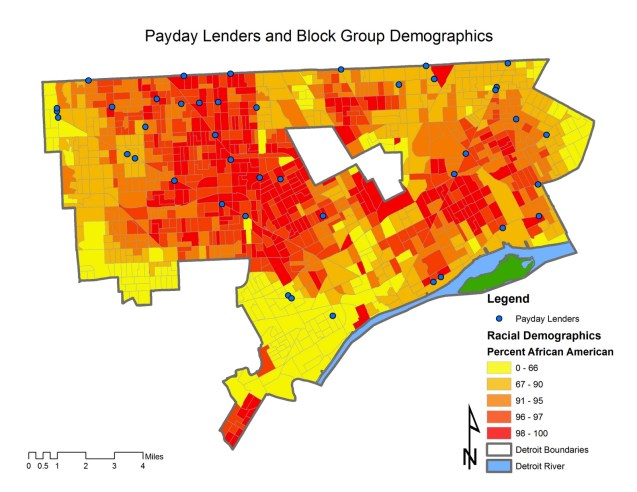
Rob Linn notes that “Nationally, payday lending customers get caught in a predatory cycle.” In his analysis he found that 12% of payday lenders in Detroit were unlicensed, claim false affiliation with FDIC, and almost always go unenforced and unpunished. Rob also found that these predatory lenders were concentrated in areas where a majority African American population lives.

“Given the Detroit City Council’s willingness to standup to other harmful businesses, it’s time to increase enforcement, if not regulation, of these lenders at the local level.  As it stands, the residents who can least afford these punishing rates are the ones facing the consequences. “

Open Spaces and Hantz Farm Map in Detroit

tumblr_mwhmy7mmp91rasnq9o1_1280

This is a fascinating visualization of Detroit based on satellite imagery of Detroit. The distinction of “open space” is interesting, especially when thinking about where Detroit current population resides. Population density is not focused in the center of Detroit as one might imagine from the “closed space” in black. The greater question is why Hantz chose those parcels when there are obviously more “open” spaces in the city?

Minimalist Map of the Detroit People Mover

peoplemoverminimal2

Image source

I came across this simplified Glasgow transit map and thought that would be an interesting idea to apply to Detroit’s ultra simple downtown “public transit” system. I choose some highlights of each station stop based on the station guides (no guarantees). The People Mover was constructed in 1987. Detroit was one of four cities selected to receive this “new” transit system as part of the “Downtown People Mover Program,” yet Detroit has one of the two remaining people movers from that program. Last year was the 25th anniversary of the Detroit People Mover.

EDIT: 12/03/13 Lafayette Coney Island added

Map of School Board Income Disparities 1970

bunge_school_board

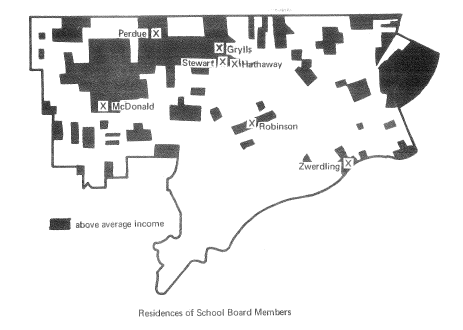
This map comes from the Detroit Geographical Expedition Institute (DGEI) in the Field Notes II paper. William Bunge and the DGEI had a particular focus on children and how social issues impacted children. Field Notes II was a compelling report that highlighted inadequacies and inequalities in the education system of Detroit. This map demonstrated the income inequality of representation on the school board.

Map: Detroit Construction and Demolition 2006 – 2009

detroit_demo_permit

Not much more needs to be explained here. These maps are good representations of Detroit’s future development especially as Dan Gilbert has been appointed by President Obama to lead the Blight Task Force and says he has plans to demolish every blighted property in the city. Even in 2009 these maps showed a number of building permits Downtown. Soon we will see Gilbert and the Cotton family make their mark on Detroit’s skyline with new skyscrapers. There are notable building permit clusters in the neighborhoods and it would be great to know what those represent. Hopefully, they represent building permits to renovate existing structures. There is a great need for many Detroit families to be able to retrofit their homes in order to improve the health and quality of Detroit’s aging housing stock, maybe there will be federal dollars in the future for such a program.

Detroit Maps at Whole Foods Market

wf_map2

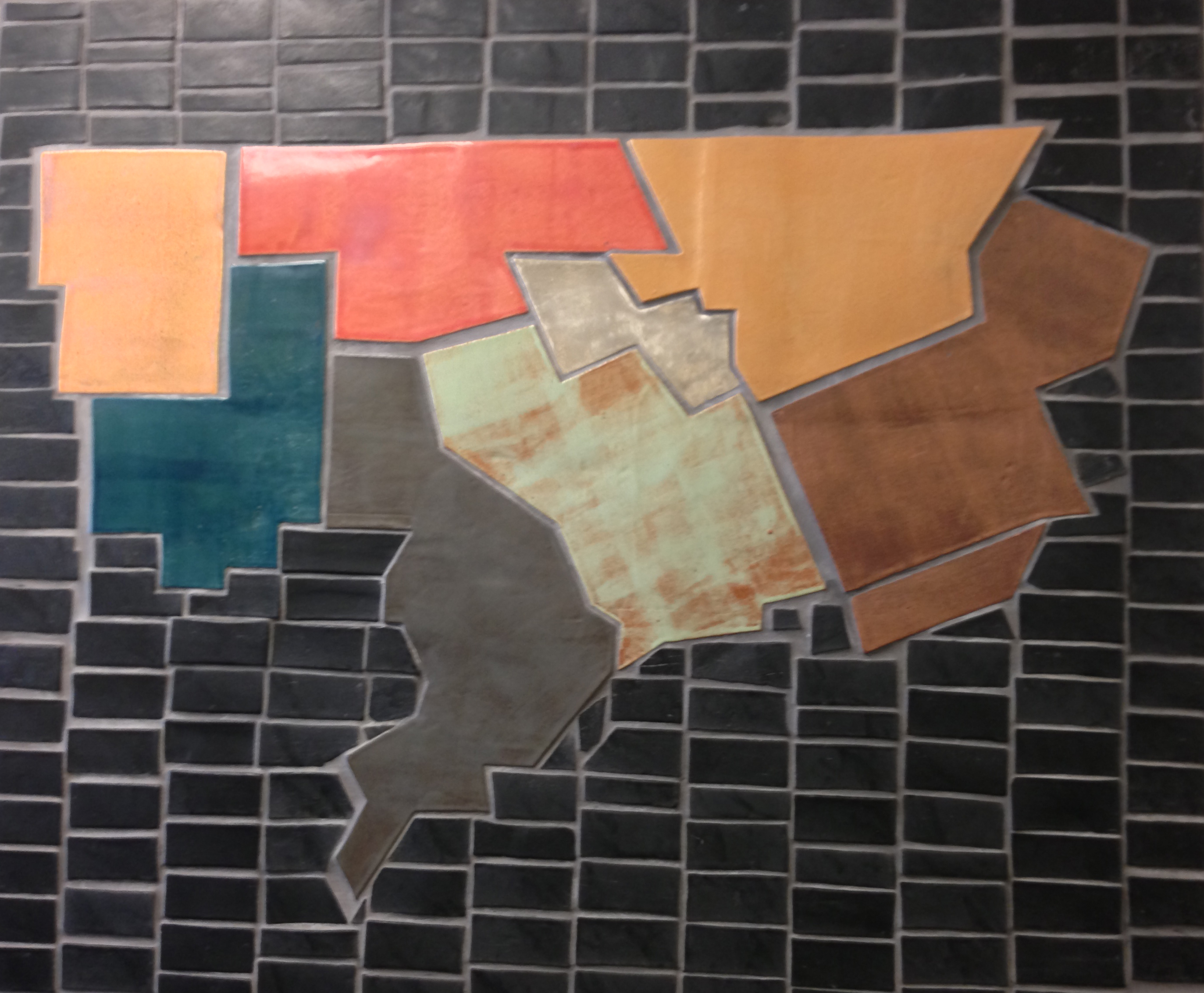
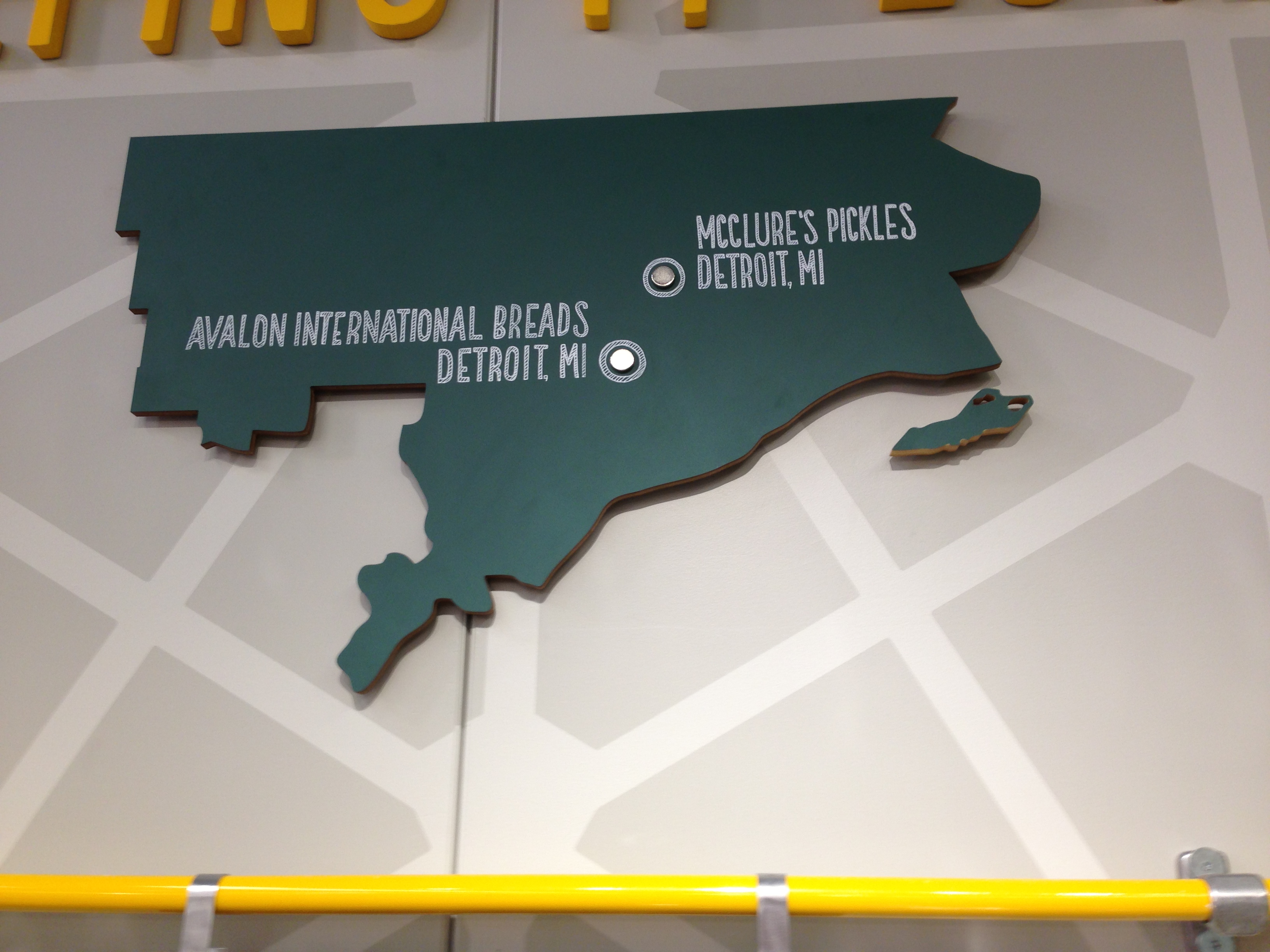
The new Whole Foods Market in Detroit has some fun maps! The mosaic map located upstairs by the community room appears to represent one of Data Driven Detroit’s proposals for the new city council districts. The map downstairs is less fun and more empty. For Whole Foods, it appears that Detroit is only represented by McClure’s Pickles and Avalon International Breads? Really? Maybe Whole Foods needs to support some other local food producers to help them enter the supply chain.

photo(1)