Map: Inferior Education in Detroit 1960

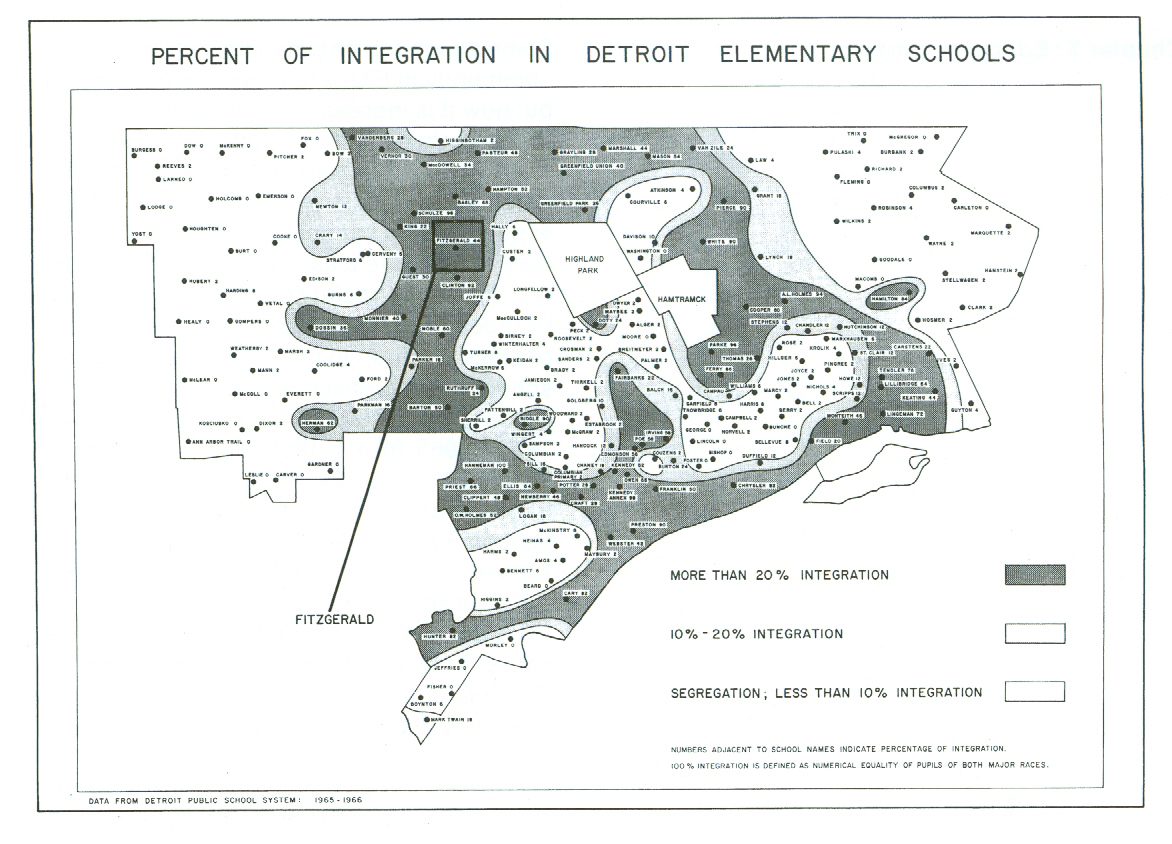
inferior-edThe Detroit Geographic and Expedition Institute (DGEI) spent much of their Field Notes II publication looking at the state of education in Detroit. This map, based on test scores, demonstrates the racial divide that matched the resources and education divide in the city.

Map of Inner-City Detroit 1999

Detroit_Map

This map comes by way of Suzanne Smith’s book, Dancing in the Street: Motown and the Cultural Politics of Detroit and was created by the University of Wisconsin Cartographic Laboratory. There are a few problems here namely the use of “inner-city” in its true urban planning context is good, but leaves out the reality of Detroit’s inner-city in the 90s. It could be argue that in the 90s there was a broader understanding of “inner-city” and this map does little to give anyone a geographic understanding of Detroit’s “cultural politics” past or present [the 90s].

Smith, Suzanne E. Dancing in the Street: Motown and the Cultural Politics of Detroit. Cambridge, Massachusetts: Harvard University Press, 1999.

Map: Detroit’s Sympathetic and Unsympathetic Ethnic Groups 1960

sympathetic-ethnic-groups

The city was fairly diverse in the 1960s, yet there were underlying tensions between different ethnic groups and their particular sympathies towards Detroit’s black population. In this map the Detroit Geographic and Expedition Institute (DGEI) mapped out those various relationships based on Census data.

Proposed Detroit City Council Districts and Neighborhoods Map

d3_districts

NOTE: These proposed districts were never adopted. They were one of many proposed district boundaries.

Data Driven Detroit created a map of their proposed plans for the new City Council Districts in 2011 along with the “neighborhoods” cataloged by Arthur Mullen of Cityscape in 2003. These are not the city council districts that were officially chosen, nor are the neighborhoods set in stone or widely agreed upon. This map is an important representation of how organizations and institutions with power and influence change and shape discussions about the city.

Does every area of Detroit need a name? Does it make more sense to talk about the city by District, neighborhood, school catchment area, or another distinction? Who decides these distinctions?

Map: Fitzgerald in Past, Present, and Future Detroit

fitzgerald_history

William Bunge wrote about urban geographies being very similar. In his book Fitzgerald: Geography of a Revolution, he discussed the changing nature of the Fitzgerald neighborhood from its existence in the Michigan wilderness in 1830 to becoming an affluent suburb in the 1920s. His question is whether the slums will continue to expand and include Fitzgerald, which at the time was considered a middle class neighborhood situated in between the suburbs and the slums.

I think the unfortunate answer to Bunge’s question is that Detroit continued to decline and the residents of Detroit continued to lose jobs and city services.

Map of Detroit on a Real Good Chair

1962587_701656849876835_147819032_n

Members of the AIGA Detroit Chapter created a design for the “Facing Forward: AIGA at 100” exhibition in New York. So awesome that they chose a map image design of the Detroit area for their Real Good Chair!

Design team: Rachael Beresh, Maria Bologna, Stephanie Luscombe, Chad Reichert, and Kelly Salchow-Macarthur.


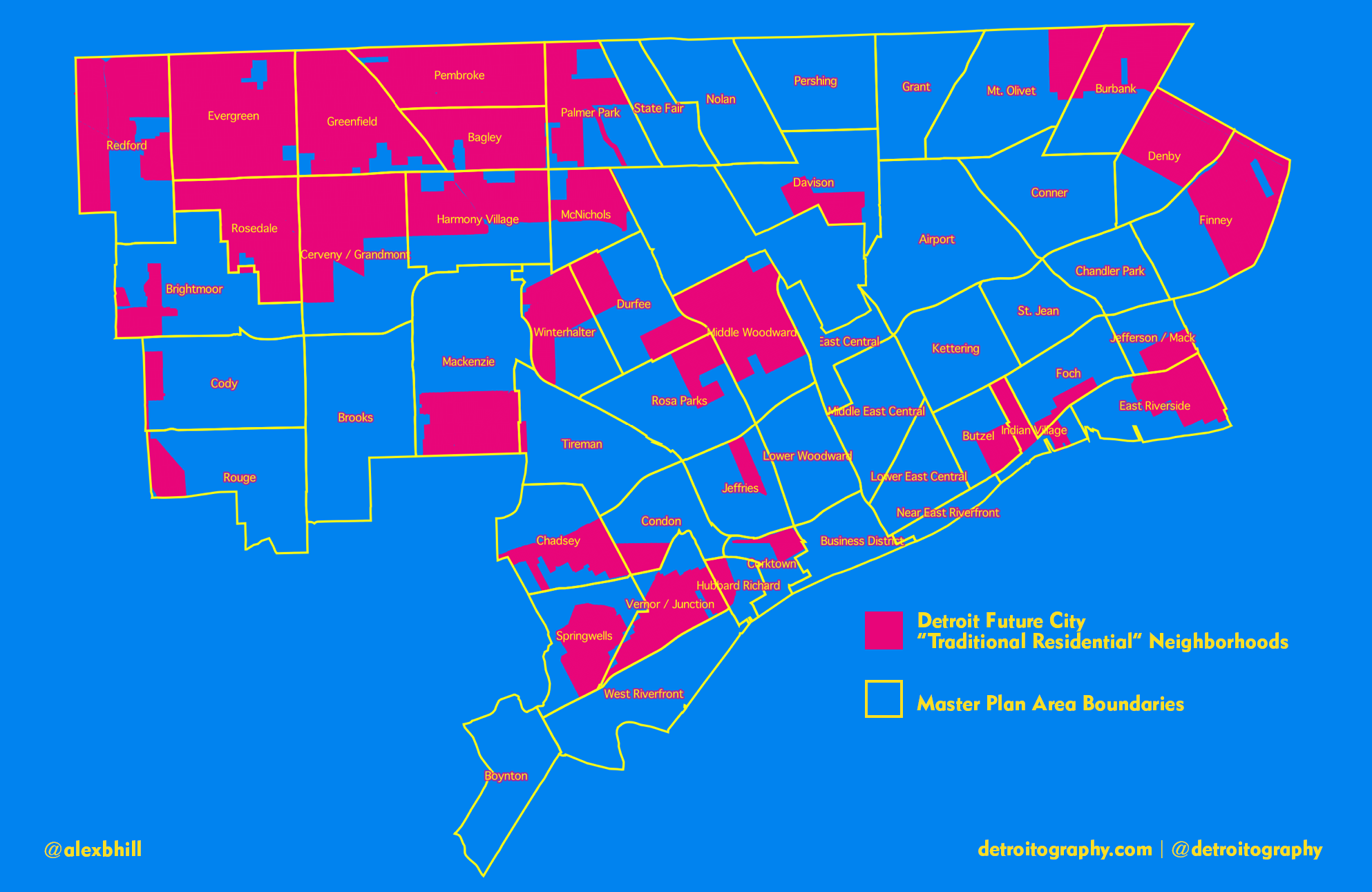
Detroit Future City “Neighborhoods” Map

dfc_nhoods

The ongoing debate about neighborhoods in Detroit have been troubled by the lack of clear definition in the Detroit Future City report. However, the report did define “traditional residential” neighborhoods, which were described as areas that would be maintained. The report states that with these neighborhoods have been hit by population loss, foreclosures, and lack of investment. The Midtown/ Downtown areas are given new labels in the report, so they do not appear in the “traditional neighborhoods” category. However, the report states that traditional neighborhoods:

“need improvements to their city systems and infrastructure to make them competitive with peer neighborhoods in the region.”

The color scheme for this map was chosen through inspiration from an article in Cartographic Perspectives: Expressive Map Design Based on Pop Art: Revisit of Semiology of Graphics? The article looks at using pop art graphic choices applied to map elements. This map is based on a Warhol example.

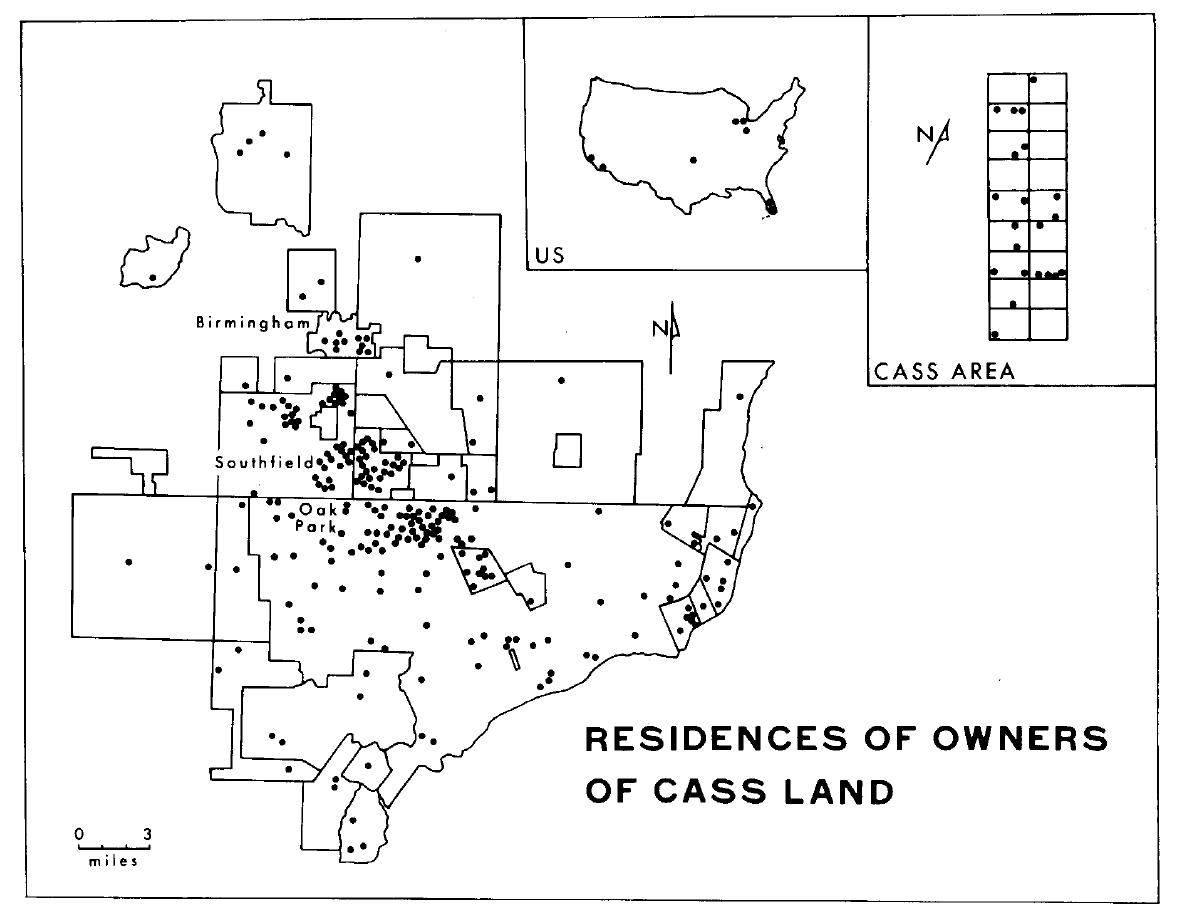
Map: Cass Corridor Land Owners 1971

cass land ownersThis map was published in Field Notes III of the Detroit Geographic Expedition and Institute (DGEI), which had a large focus on the 18-block area defined as the Cass Corridor. The report looked at demographics, assets, owner’s of land, etc. This is a very telling map as to the distribution of power and land in 1970s Detroit when Cass Corridor was not the best neighborhood to visit. It appears that Palmer Park, a wealthy, gated neighborhood to the North off of Woodward held much of the Cass Corridor land. Even as Midtown and Downtown see extensive development the legacy of Cass Corridor is seen in the poverty, homelessness, and social services. Time will tell how the new Arena District will impact the Cass Corridor and its history.

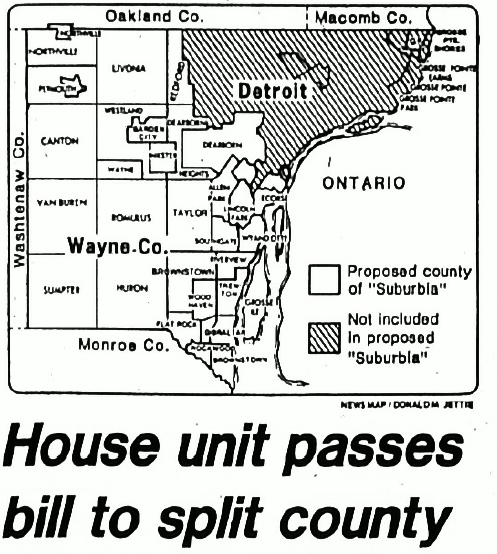
Map: Detroit vs. Suburbia County 1980

Suburbia-County

The saga of “Detroit vs. Everyone” has a host of racial, social, and economic factors – but who knew it included legislative action? The Metro Times was sent this map from a reader and dug up some interesting history.

“[…] an idea spawned by, it appears, then State Rep. Thomas Brown, a Democrat from Westland. Based on the map above, the plan would slice off everything besides Detroit and the Grosse Pointes. […] Then-Gov. William Milliken’s proposed solution was to reorganize the county under a structure that had a single top executive, but the county’s “36 independently elected commissioners and department heads do not want their political bailiwicks tampered with,” the Times reported […]”

The proposed plan passed in the Michigan House, but was sent to Committee to die. Can you imagine living in Metro Detroit where there was Suburbia County and everything Detroit and East? If anything this is an important representation of the municipal and legislative mentalities that have continued to push for this invisible line drawing.

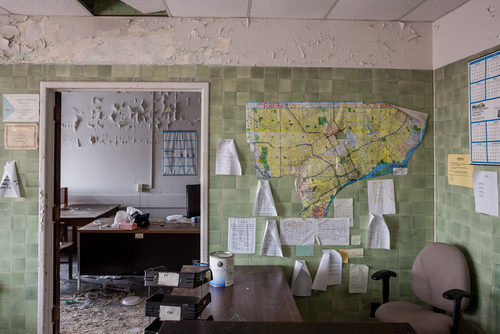
Map inside Herman Keifer complex

HermanKiefer-map

Curbed Detroit took a look inside the Herman Keifer main building. The complex is up for sale and looking for a developer. Could this be housing to anchor neighborhoods north of the Medical/ Education zones of Detroit? The main building, designed by Albert Kahn, was used for vaccination campaigns up until 2012.

Matt Clayson of the Detroit Creative Corridor Center (DC3) said in 2012:

Its location is prime and strategic – immediately behind Henry Ford Health systems and proximate to M-10 – and, as such, it could play a key role in connecting Boston Edison, Lasalle Gardens and Virginia Park to the greater downtown area.”

We aren’t sure what the map on the wall represents, maybe just a reference map for employees?

Map of Where to Recycle in Detroit

574502_446910325380797_1233297171_n

About to head out to the Recycle Here! Main Location, which has been a great recycling resource as the city works to improve city services all around. In late 2013, it was announced that there would be citywide curbside recycling. This announcement makes the future of sites like Recycle Here! uncertain and new business models like Detroit Greencycle obsolete?

Map of Downtown Detroit in the Guardian Building

7397504668_b10739698d_b

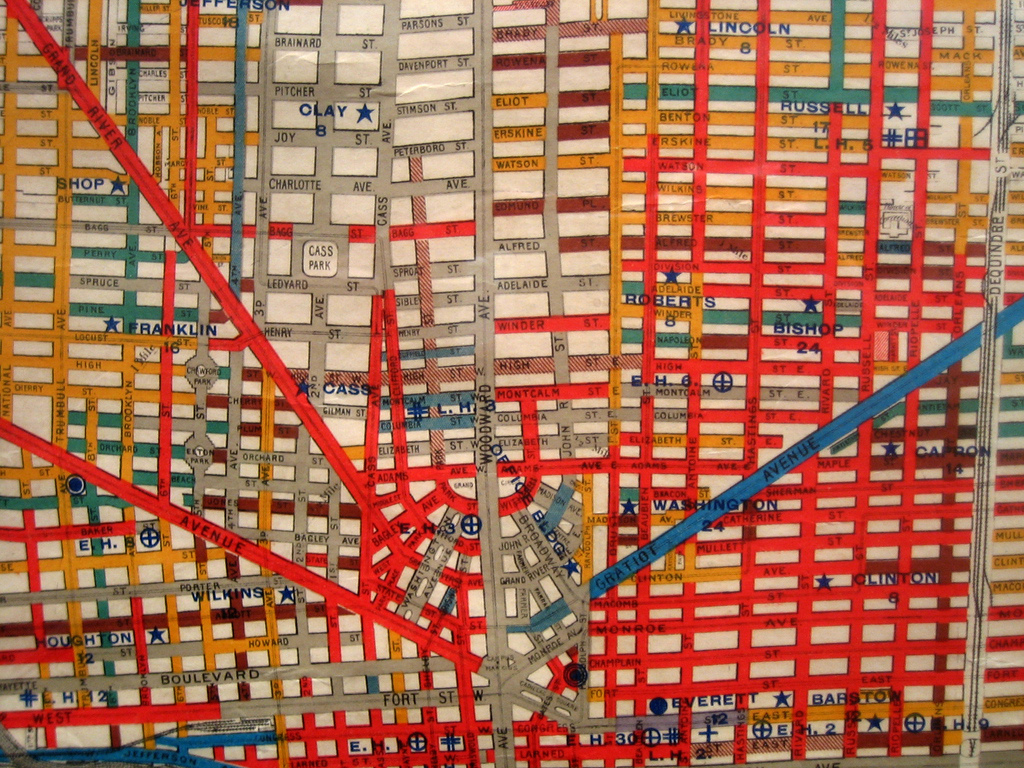
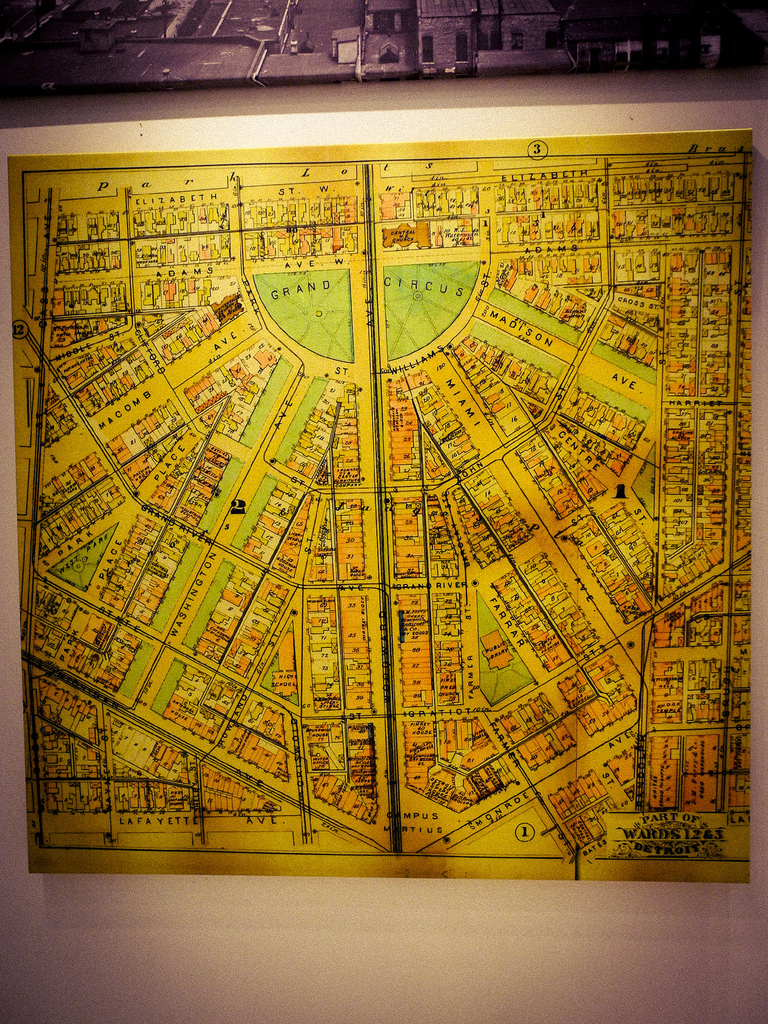
Just a beautiful map of Detroit (Necklace District area) inside the Guardian Building. The bottom corner reads that this is a map of Wards 1,2, & 3. Detroit is no longer broken into wards, which were based on the original ribbon farm boundaries, but recently voted to move to new Districts.

Detroit Metrorail Map

detroitmt

This Detroit transit fantasy map has absolutely no geographic accuracy, but is quite comprehensive in its scope and connectivity of the metro Detroit region. The rail lines reach all the way to Auburn Hills and  include Selfridge, Kensington, White Lake, and Ann Arbor.

“Detroit’s roads are lacking, urban sprawl is out of control, the inner city is fledgling, the state budget and Detroit budget are in crisis, pollution is still a concern, people spend hours in backups, and yet, politicians do nothing. Why? I’m not one to ask to speculate, but I am one to try to come up with a solution. Polls in recent years have said the same thing time and time again, the people of the Detroit region want better mass transit. Not only would it ease a clogged road system tied down to millions of spending for repair and upgrade, but it would also introduce more commerce to areas that only currently serve a majority of neighborhood residents. Just think about it, being able to go to the big game or show without leaving hours in advance due to traffic backups, having a more reliable way to work and be able to access new areas that weren’t open before to serious job inquiries. It’s time to stop dreaming and start doing.” – BT

Detroit Urbanization Expansion Map

Screen Shot 2014-02-22 at 6.44.03 PMFrom the 1970 “Master Plan for Ford Properties” the expansion of sprawl was predicted and mapped before it reached its full extent. Others have already talked about how the “center” of jobs has shifted from Wayne County to Oakland County, this map provides an interesting perspective on the process of “urbanization.”

Map: Radical railbanking for Detroit

Big-map1

I came across this alternative use of mapping/ GIS data and was surprised by what I found. Beyond the psychedelic visuals, I found the idea of “railbanking” to be quite interesting and not beyond what many others have attempted to do with projects like Rails-to-Trails and the Detroit Greenways. This representation of railbanking takes it to a whole new level.

“This project hijacks and radicalizes the tactics of railbanking by manipulating geodemography through the productive misuse of conventional GIS software. In doing so, the project attempts to locate a constructive position relative to the hegemony of market segmentation geodemography from which the architect can operate.”

Read more from author McClain Clutter (now at the University of Michigan). . .

legend4

Map: Tour De Hood cycles across Detroit

tdh

A disparagingly named series of bike rides originating in Grosse Pointe covered nearly the entire city. Rides were based on major roadways: following Grand River, Outer Drive, etc. You can see the common entry roadway was along E. Jefferson Ave and routes are more dense Downtown where the rides would stop for food and drinks. The organizer, Arthur Miller, spent a good amount of time taking picture to document the various areas of Detroit. His photos have captured some excellent Detroit painted typography as well as massive pot holes.

Now there are a plethora of organized bike rides around the city: Critical Mass, Criterium, Tour de Troit, Slow Roll, Bike Detroit, Wheelhouse Detroit, etc.

Map: Six Growth Corridors in Detroit 1970

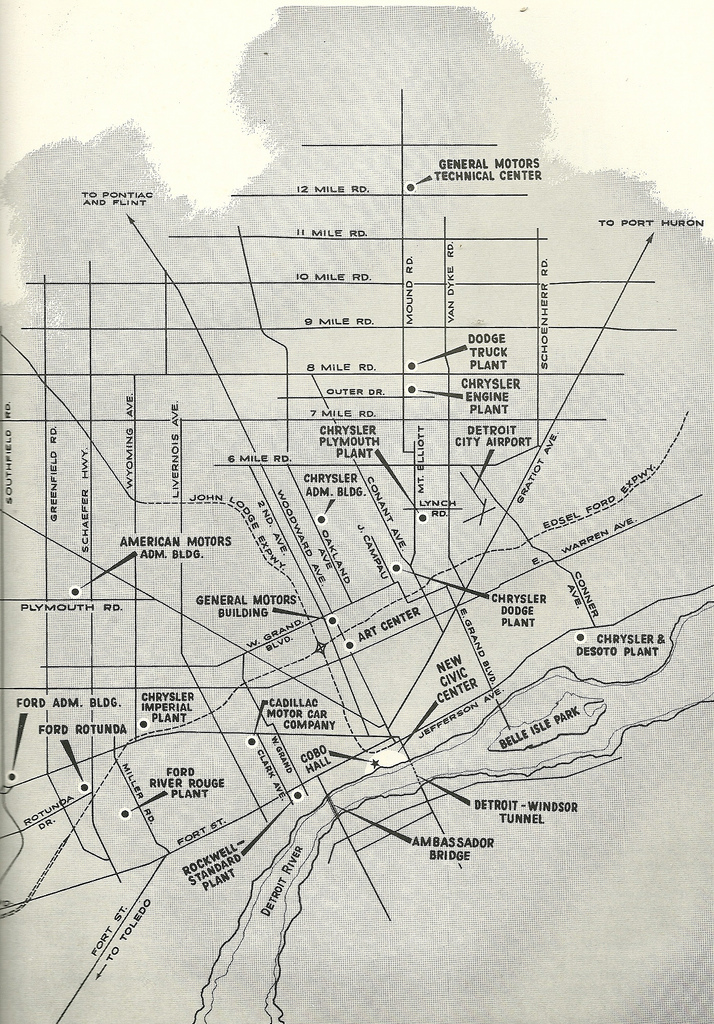
Screen Shot 2014-02-22 at 6.35.44 PMThis map also comes from the “Master Plan for Ford Properties” created in 1970. Ford recognized the importance of Detroit as a hub for goods and the need to adequate transportation. Here is an explanatory excerpt:

Historically, Detroit owes its existence and its importance to water transport and a plentiful supply of natural resources. Its modern growth has been largely dependent upon manufacturing, especially manufacturing associated with many different means of transportation.

The Pullman car works were first established there and continued in operation until 1893. The first freight car works were established in 1853. In 1902 these two industries employed employed 7,200 men.

Detroit’s geographical situation led to the construction of small and large vessels for lake traffic, which commenced in 1852 and has continued to the present day. […]

Detroit’s Logical Grid Map: One Square Miles

logical-grid-detroit


Mayoral candidate Benny Napolean, former Police Chief of Detroit, developed a “one square mile” plan for improving Detroit. His campaign tagline was “Together, transforming every neighborhood, one square mile at a time.” Although Napolean did not win, the idea wasn’t bad: bringing a community focused effort that defined the Detroit mayoral race. This map was created to demonstrate how his plan could work for better community policing.

Looks a little similar to the Microhoods used in the recent parcel survey, Motor City Mapping project.

How logical do you think these grids are?