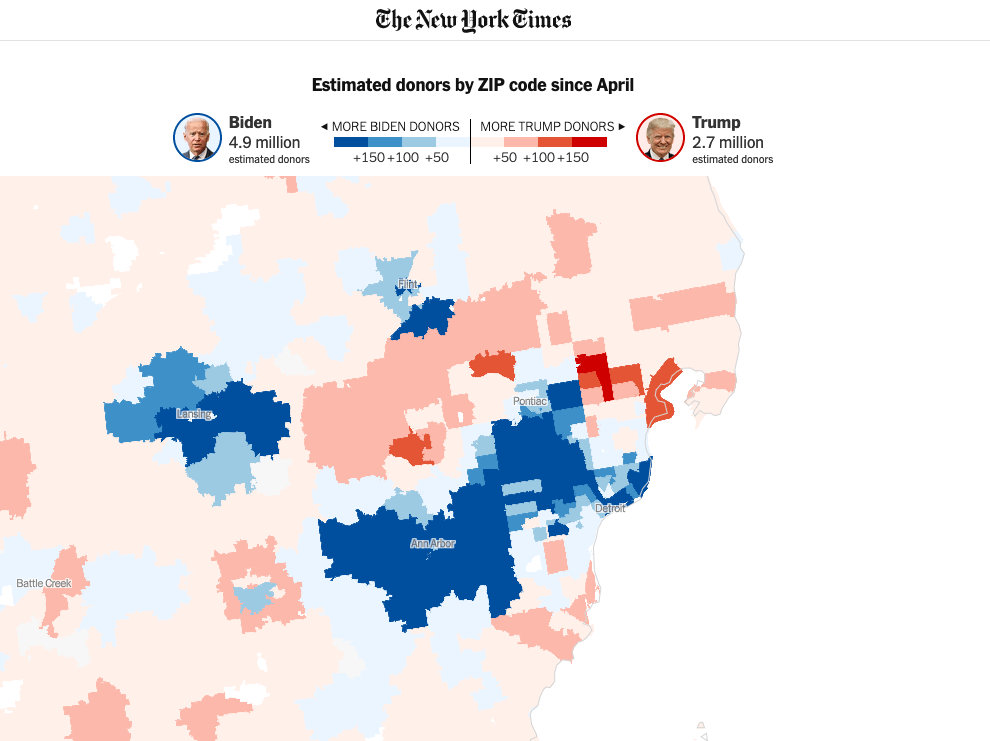
No real surprises here, you can pick out the largest cities in Southeast Michigan based on more Democratic candidate donations. The New York Times and many other groups have visualized pubic data from the Federal Election Commission (FEC) campaign donation records.
Bill McGraw is a household name if you are interested in city history, street naming, or maps! A veteran of the Detroit Free Press and co-founder of Deadline Detroit, Bill still writes freelance for local publications.
What is your map? (Title, Year, etc.)
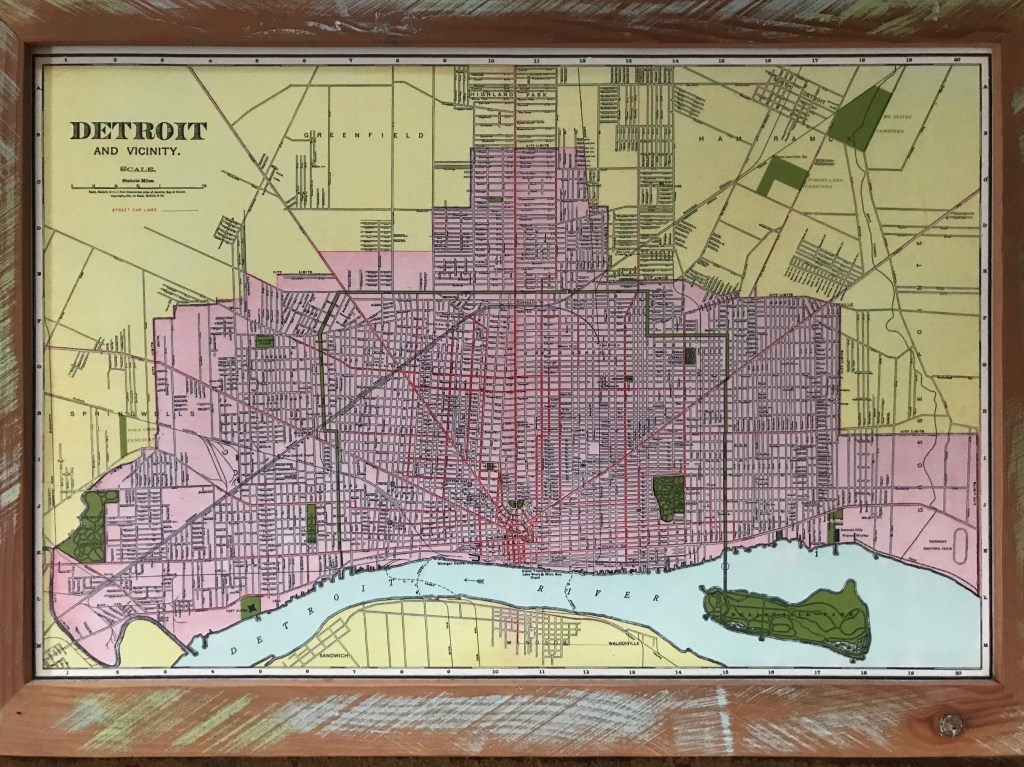
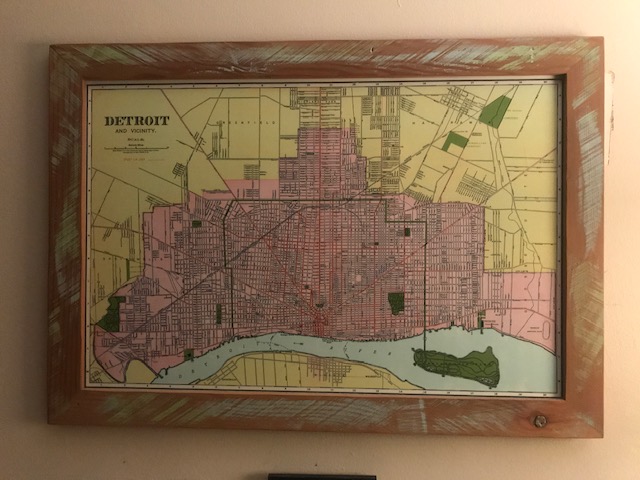
It is a 1911 map of Detroit from Rand McNally Co. from the New Commercial Atlas of America and it’s framed in my living room.
Where did you acquire your map?
I really don’t remember
What made you hang it on your wall? What stood out to you? What details do you enjoy about the map?
It’s pretty and the colors really pop. Detroit is purplish surrounded by yellow with parks in green and roads in red. This was 1911 moving right into the decade where Detroit doubles its population in just 10 years from about 460,000 in 1911 to one million.
It’s interesting because the roads in Grosse Pointe are platted, but not real yet. Leesville is included at Harper and Gratiot and North Detroit is on the map too. I’m fascinated by the street names outside of Detroit. After Detroit annexed them the roads stayed, but the names have changed.
Warren Avenue stops at the city limits at Hurlburt, Mack Avenue goes all the way through, and Connors Creek Road goes all the way from Jefferson up past Mt. Elliott cemetery. The creek isn’t yet covered either. Right at Jefferson and Lenox there is the Detroit Driving Club where in 1901 Henry Ford raced his car and started to get attention.
Reddit AMA from December 2017 via @freep
What in your background has drawn you to maps?
Well, in 2007 I drove the entire city for the “Driving Detroit” series. My Dad worked for Detroit Edison and used the drive around the city everyday. He worked at the little Detroit Edison stores around the city that offered free light bulbs, fridges, and things. We lived on the Eastside and you could give him a location and he would immediately know the major cross streets.
While my Dad was working for Detroit Edison they brought in a Greek guy named Doxiadis who created an extensive plan for the metro region and told Detroit Edison what they wanted to hear with population only growing in the region. My Dad used to bring home all those documents and maps in big tubes and as a kid I got hooked.
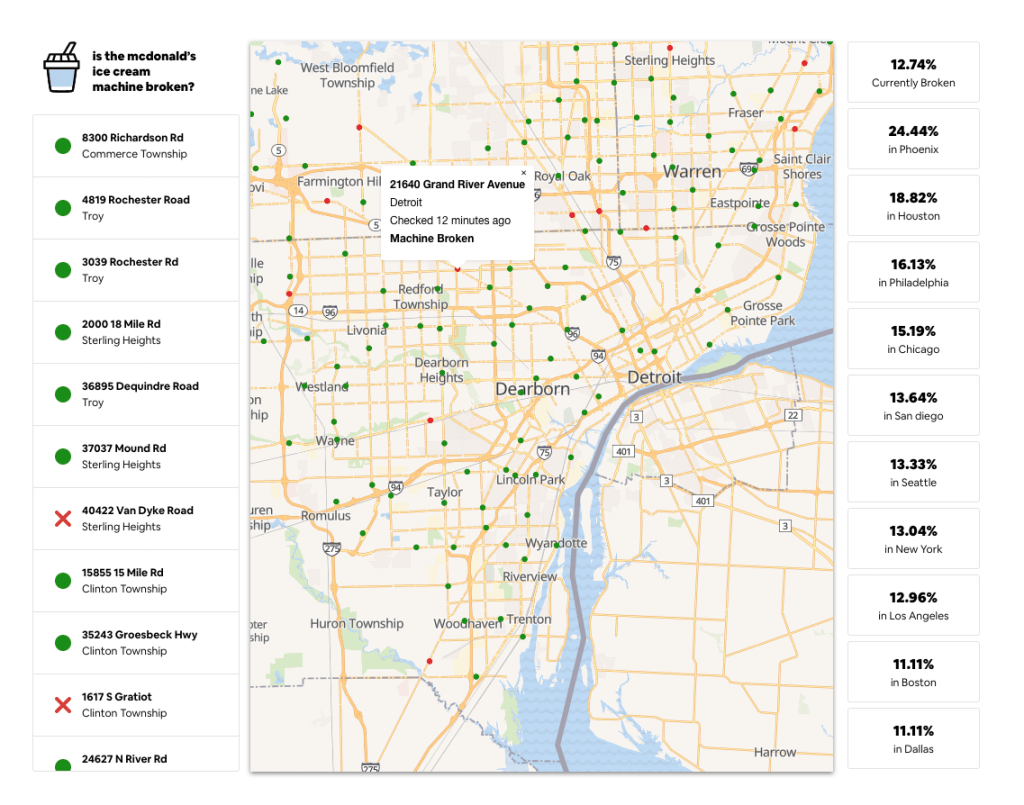
As of Monday (10/26/2020), Detroit McDonald’s locations only had one broken ice cream machine in Northwest Detroit. There seem to be more broken McFlurry machines in the suburbs – another wonderful reason to visit Detroit?
Rashiq Zahid built the Mcbroken app to map the status of ice cream machines, which oddly are centrally tracked by the McDonald’s corporation. The map and data have a wild story:
I reverse engineered mcdonald's internal api and I'm currently placing an order worth $18,752 every minute at every mcdonald's in the US to figure out which locations have a broken ice cream machine https://t.co/2KsRwAdrMd
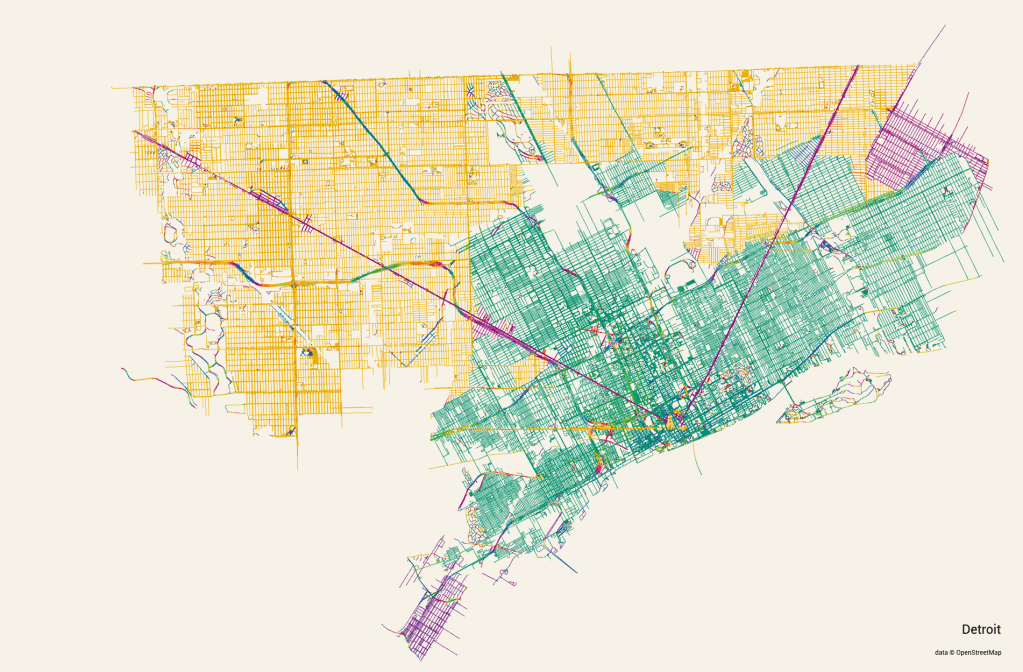
Andrei Kashcha developed an app that pulls all street data from Open Street Map and color codes it by the cardinal direction orientation of the roadway.
The resulting map presents a beautiful reminder that Detroit has a diverging urban planning history from spoke streets (based on trails of indigenous peoples?), street grid based on river access and ribbon farms, to the modern Jeffersonian grid.
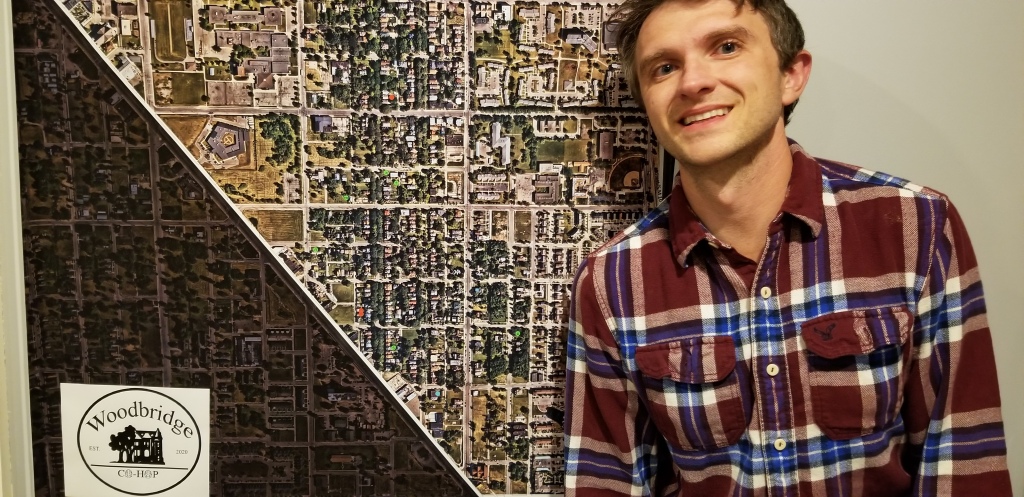
Mark Jones, GIS Analyst at SEMCOG, shares the wall map that he made for his personal project called Woodbridge Co-Hop. He recruited 13 growers with 150 hop plants to create the “Woodbridge Wet Hop Pale Ale” with Brew Detroit.
What is your map? (Title, Year, etc.)
Woodbridge Co-hop planting status. In January 2020, I started a program where hop growers throughout Woodbridge combine their yearly yields and give them to Brew Detroit to brew a neighborhood beer. Yearly we will have a Woodbridge Wet Hop Pale Ale release party, with the first one occurring this Saturday.
The map itself is the Co-hop’s boundaries. I put green stickers on the properties that are involved. I had to put red stickers on the three properties that tested high in lead and we did not use them for the beer. On each green sticker, the number of hops planted is written. In the future, we will be adding more growers and there will be more stickers.
I am a GIS Analyst at SEMCOG, so when I started the Woodbdrige Co-hop it seemed natural to print a huge map of the project’s boundaries in order to keep track where the hops are being planted and where the soil tests are coming back with high lead.
What made you hang it on your wall? What stood out to you? What details do you enjoy about the map?
The details on it change throughout the year. From the project’s conception in January to June we were gathering orders for hop plants. Then we got the soil test results in August and finally we are having new people wanting to join for next year. Plotting these locations on a map makes it easier to organize watering duties, create a walking tour, and plan out harvest day.
What in your background has drawn you to maps?
I went to graduate school for City Planning, but the spatial analyst aspect has really stuck with me. Since leaving MSU, I have focused on trying to visualize my environment and storytelling with maps.
Map of Detroit and Vicinity, 1897, Rand McNally & Co.
Where did you acquire your map?
I got this map when I moved back to Detroit from Los Angeles. Every time I’m in a thrift store I have to look at the old maps. I really can’t remember where I got this map, but maybe one of the very early Detroit Urban Craft Fairs.
What made you hang it on your wall? What stood out to you? What details do you enjoy about the map?
It’s history, I love it. The map is before automobiles were in the city, a very different time. I can look at Gratiot Avenue on this map and it’s a horse-pulled trolley route. It’s really fascinating. On this map there is no Delaware Street – I’m not sure why or what changed.
The big parks are fascinating too. They are still there today. The park in Boston Edison really stands out since that was basically the northern border of the city at the time.
In this map, Detroit is an itty bitty town with a Downtown and railroad connections. I can look at Milwaukee Junction and really understand why it was named that – three rail lines intersect right there.
What in your background has drawn you to maps?
My father had an amazing sense of direction. He would take me around the city as a boy on his housecalls. He was a radio TV repairman. He would tell me all the stories about the street names and their meanings.
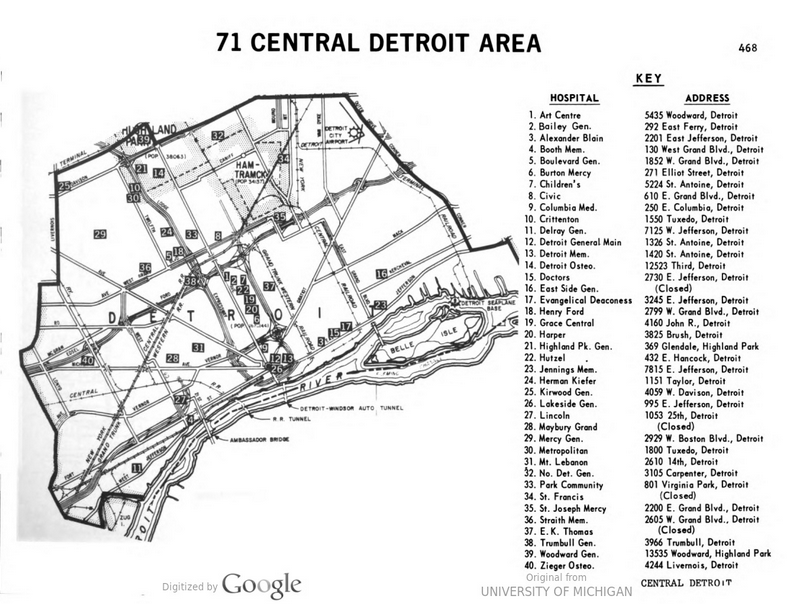
During the coronavirus pandemic hospital allocation and resources have been a major question that has led to greater coordination by the State of Michigan to ensure there are enough beds and staff have enough personal protective equipment (PPE).
In the late 1960s, many community hospitals were still in operation. Just in Northwest Detroit there was Mt. Carmel Mercy next to Sinai Hospital with both across the Lodge from Grace Hospital Northwest.
This map of the “Central Detroit” hospital planning region is where present day hospitals on concentrated with DMC and Henry Ford, but in the late 1960s had an even greater density of hospital locations. At this time “Detroit General” run by the Health Department which later became “Detroit Receiving Hospital” was still located Downtown rather than where it is today. The Art Centre hospital building is still in use on WSU’s campus although the building is half condemned.
A friend’s parents’ gave it to me! A lot of times people hear “urban planning” and think to send maps my way, which I actually love.
What made you hang it on your wall? What stood out to you? What details do you enjoy about the map?
I placed the map here because it definitely fits the urbanist aesthetic I wanted on this shelf. My favorite thing about it is the fact that it shows all the connections and lost streets the city has leveled over the years for “urban renewal,” freeways, and other things. It’s nice to have a tangible reminder of how connected and comprehensive the city’s urban fabric once was.
What in your background has drawn you to maps?
When I was a kid I spent hours drawing up fictitious maps for cities, so in a way I’ve always been drawn to them. Recently I’ve become more interested both in the artistic notes found in older maps and all the ways maps can tell very different stories of the same places.
This map is part of the Port Forward initiative. The report notes that funds will be used to conduct land use planning, study potential rail developments, assess the infrastructure in the area, complete environmental assessments. Detroit/Wayne County Port Authority (DWCPA) is looking to work with more property owners that are within the Port District.
We’re starting a new series of posts that feature, YOU! and your “maps at home.” Let us know if you have a cool map of Detroit hanging up (or not hanging) that you’ve collected and really enjoy. Thanks to Francis for kicking us off!
What is your map at home (title, year, etc.)
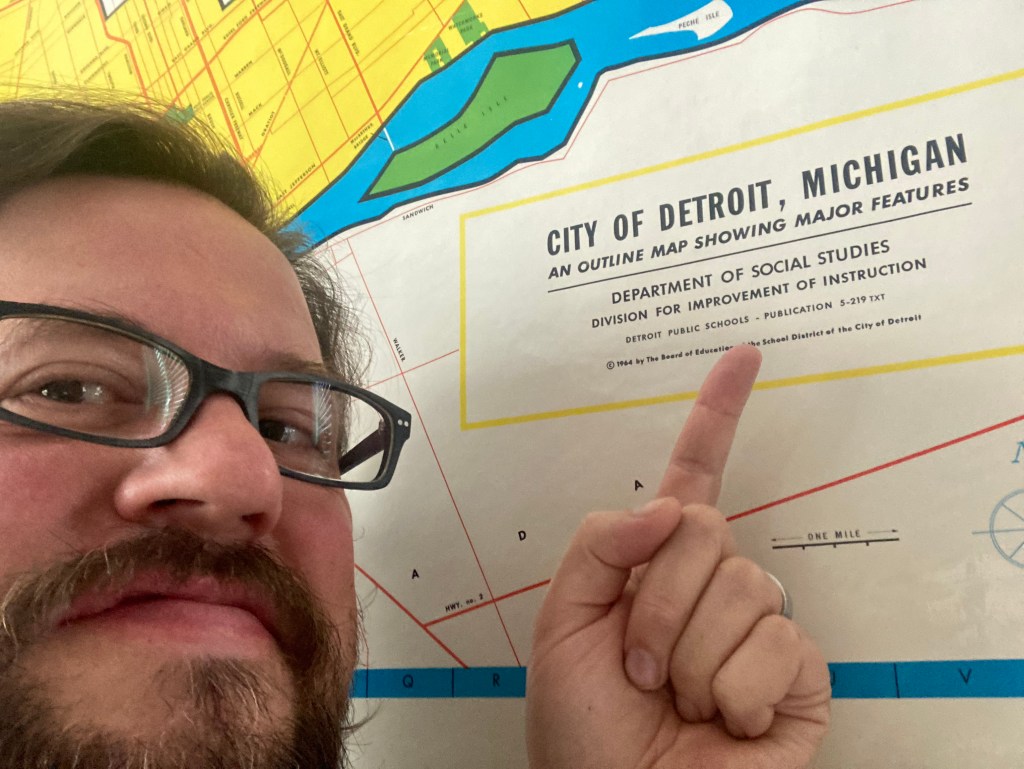
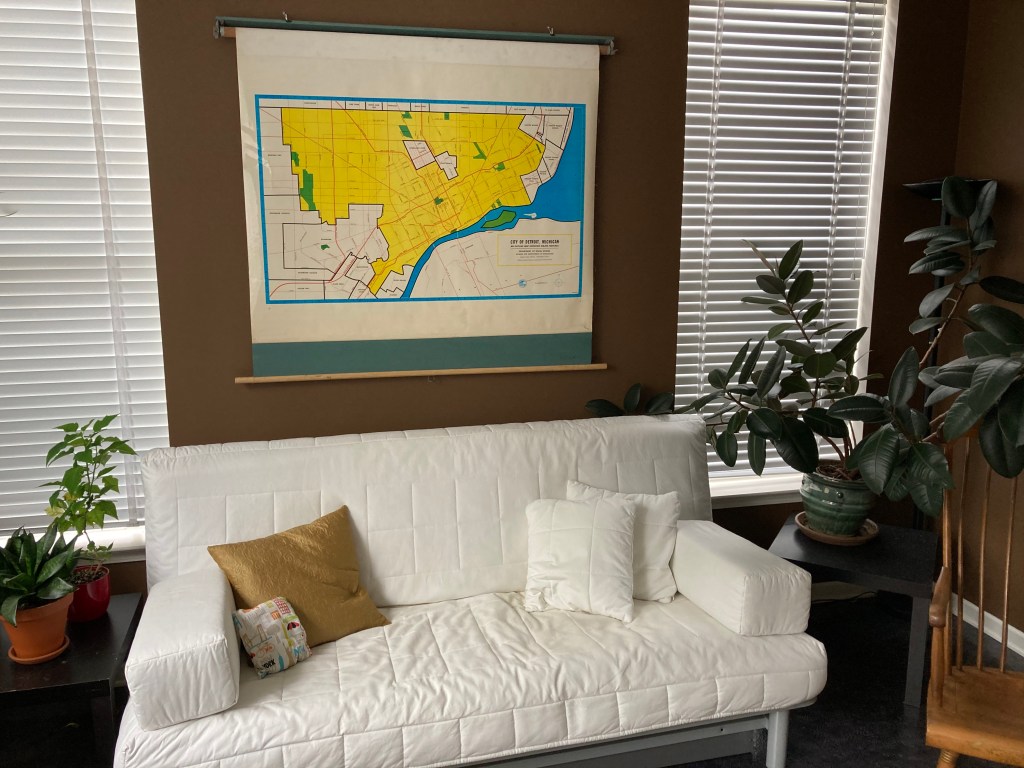
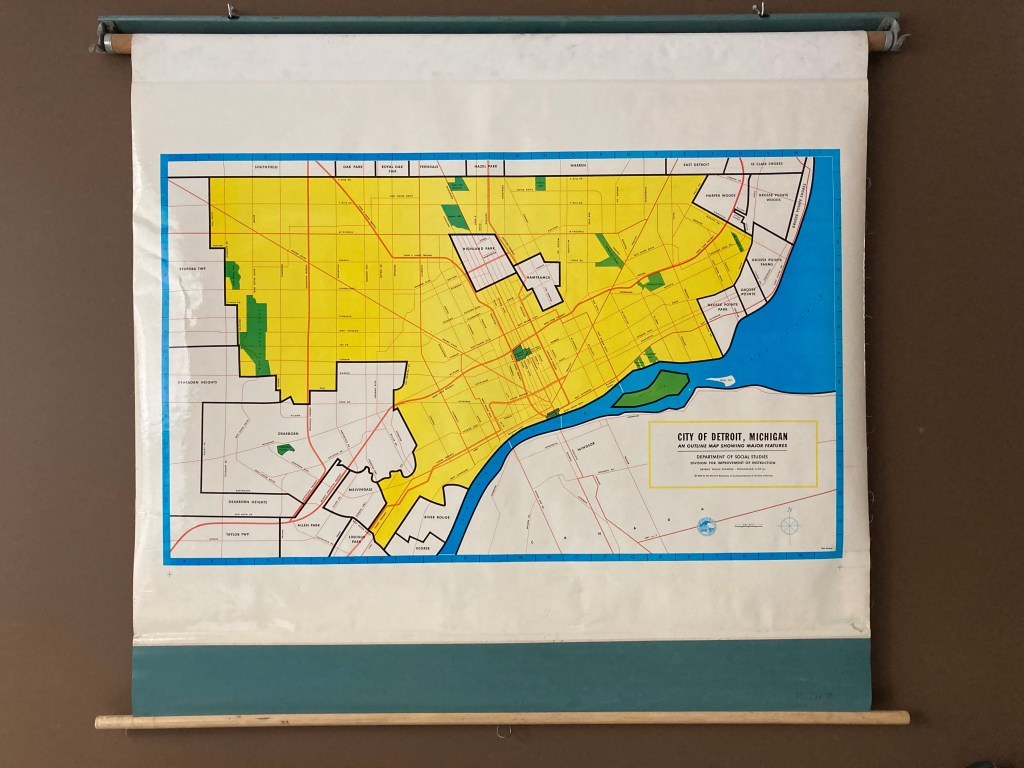
City of Detroit, Michigan An Outline Map Showing Major Features. Detroit Public Schools, 1964
Where did you find/acquire the map?
This map was gifted to me by someone who had access to a Detroit Public Schools warehouse and knew that they were getting rid of it.
What made you hang it on your wall? What stood out to you? What details do you enjoy about the map?
This map of Detroit was made to hang on a wall! It is one of those old school spring loaded pull down maps. I love that it is still attached to the roller, but we never roll it up. I actually love that it is not very detailed. I think it might have been drawn as a basemap, to just show, as it says in the title, “mayor features.” So not a lot of streets. It’s limited to the mile roads and the more important North-South corridors. I like that it is fairly contemporary, but is old enough to predate certain things. Like it was made before the Jeffries Freeway and shows the Fisher Freeway under construction. Eastpointe is still East Detroit.
What in your background has drawn you to maps?
We have a lot of maps in our house, including a bunch of globes. As an urban planner in a previous life, I have loved maps for decades, and have a number of Detroit maps, including some old ones that show what materials streets were paved in. Unfortunately not enough of my Detroit maps are framed!
Planning a city is a big job, but is it too much to ask for a coordinated effort?
The number of disparate boundaries in Detroit is both fascinating and befuddling: police scout car areas, curbside trash pickup zones, fire hydrant company areas, and on and on.
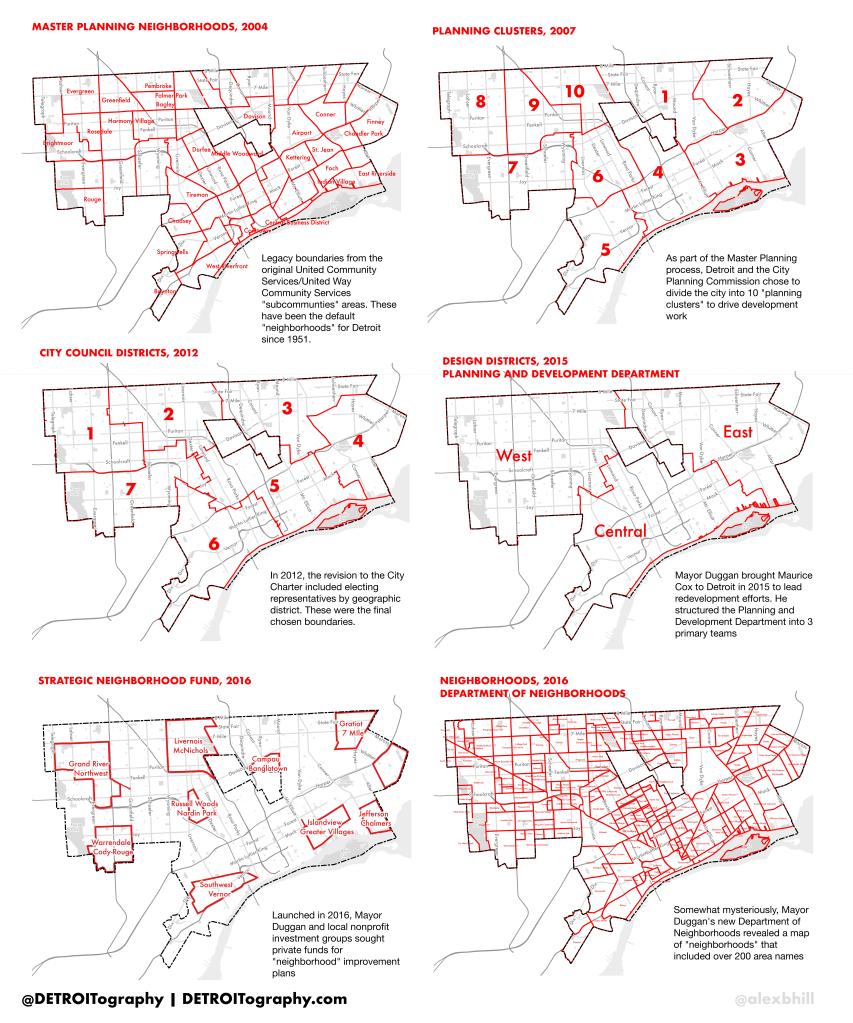
This post will focus on the various planning boundaries and what they mean for you. The boundaries will be discussed in chronological order, but all of these boundaries are actively used to plan the city’s future.
Master Plan Neighborhoods, 2004: These boundaries are the legacy of the United Community Services/United Way Community Services “subcommunities” first developed in 1951 and drawn along Census Tract boundaries so that Census data could be used to compare areas. These 54 areas have been the official “neighborhoods” since that time and remain so since the City’s Master Plan has not been updated since 2004.
Planning Clusters, 2007: The City Planning Commission decided to break the city up into 10 clusters based on the Master Plan Neighborhoods in order to focus development work. These clusters are still written into the official work of the Planning and Development Department.
City Council Districts, 2012: The City voted to elect representatives by geographic district as part of the City Charter revision. The final boundaries only align with Census Block boundaries making it difficult to match any demographic data to districts.
Design Districts, 2016: Mayor Duggan brought Maurice Cox (now planning director for Chicago) to the city to move his neighborhood work forward. As part of that effort Mr. Cox restructured the Planning and Development Department into 3 large “design districts” based on combining different City Council Districts.
Strategic Neighborhood Fund, 2016: Mayor Duggan creates a public-private fund to initiative “neighborhood” planning work in a few hand-picked areas. The Strategic Neighborhood Fund areas do not align with any other “neighborhood” boundaries. Hundreds of millions have been raised to support development work in this areas.
Neighborhoods, 2016: Mayor Duggan’s new Department of Neighborhoods (DON) adopts an interesting and controversial set of some 200+”neighborhood” boundaries largely based on the work of a local tech company and not based on community feedback.
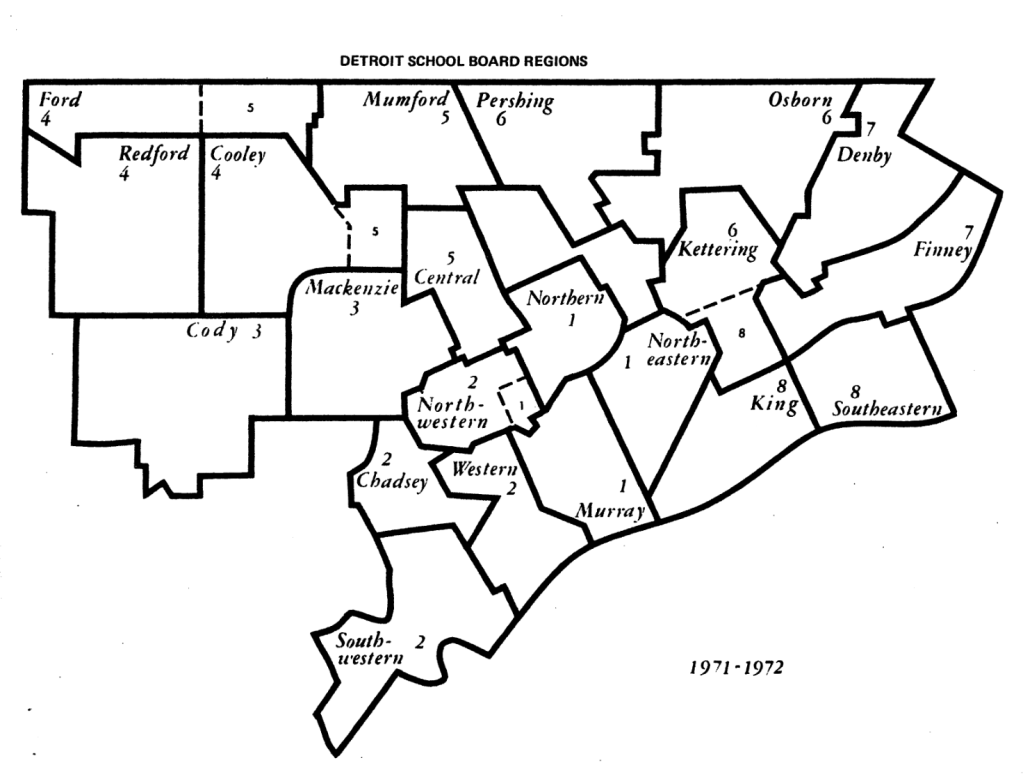
This map comes from the Toni Swanger Papers in the Reuther Library and Archives. The school board regions are no longer used and the membership is much smaller.
An active member of the Detroit women’s rights movement, journalist Toni Swanger worked with the Detroit Women’s Radio Workshop on programming for the Detroit public radio station WDET, and served in various roles for Detroit newspaper, Metro Times, including production manager and managing editor.
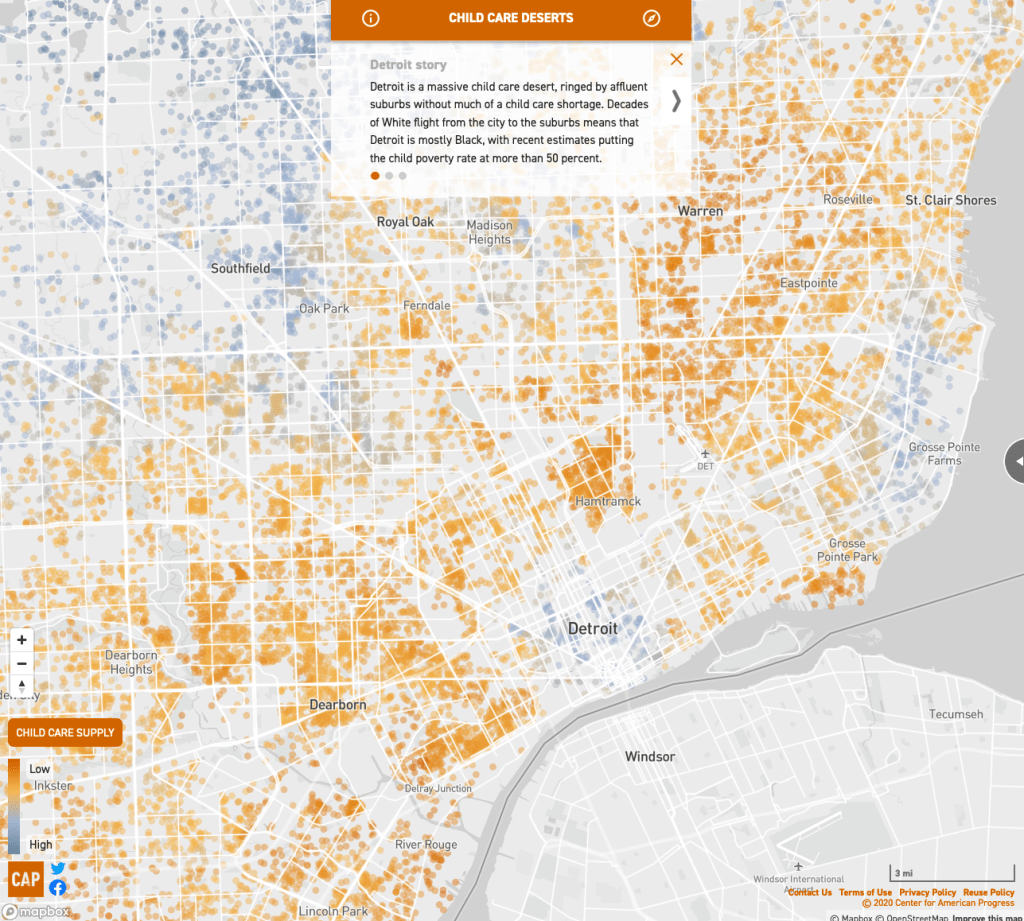
The “desert” metaphor is really overdone (and hardly accurate), but Detroit does have a significant gap in childcare opportunities. The Center for American Progress (CAP) and University of Minnesota developed a series of maps to drilldown on the issue with features for Milwaukee, San Jose, and Detroit.
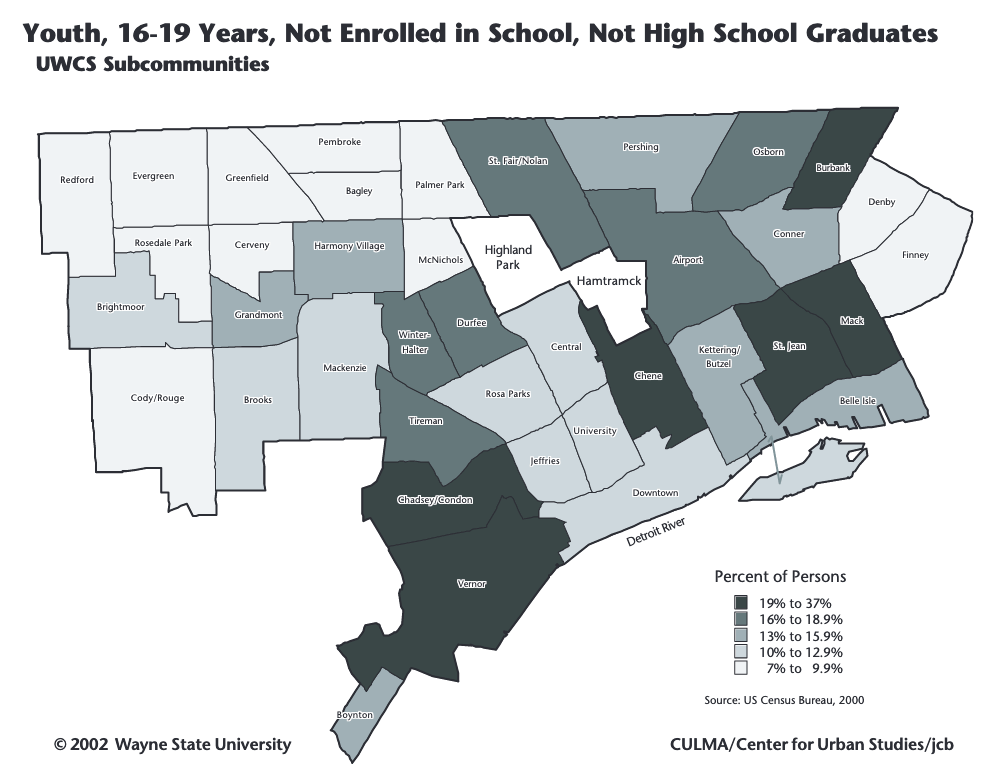
The current pandemic and school reopenings reminded me of an earlier map metric called “disconnected youth.” The WSU Center for Urban Studies mapped the metric in 2002 by “subcommunities” based on the 2000 Census. I expect the numbers will only get worse following 2020 and beyond.
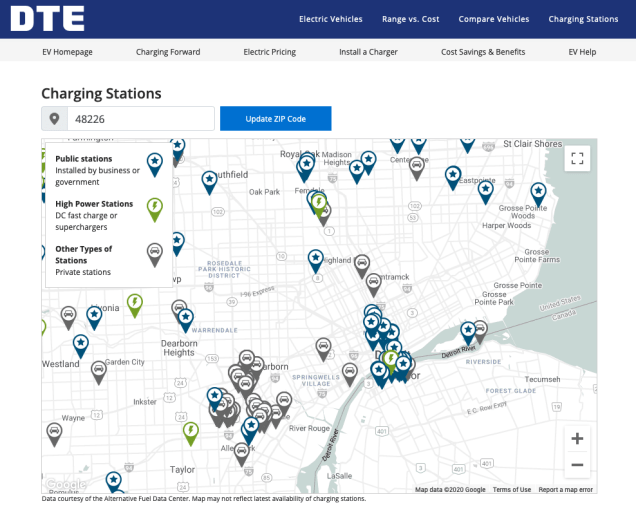
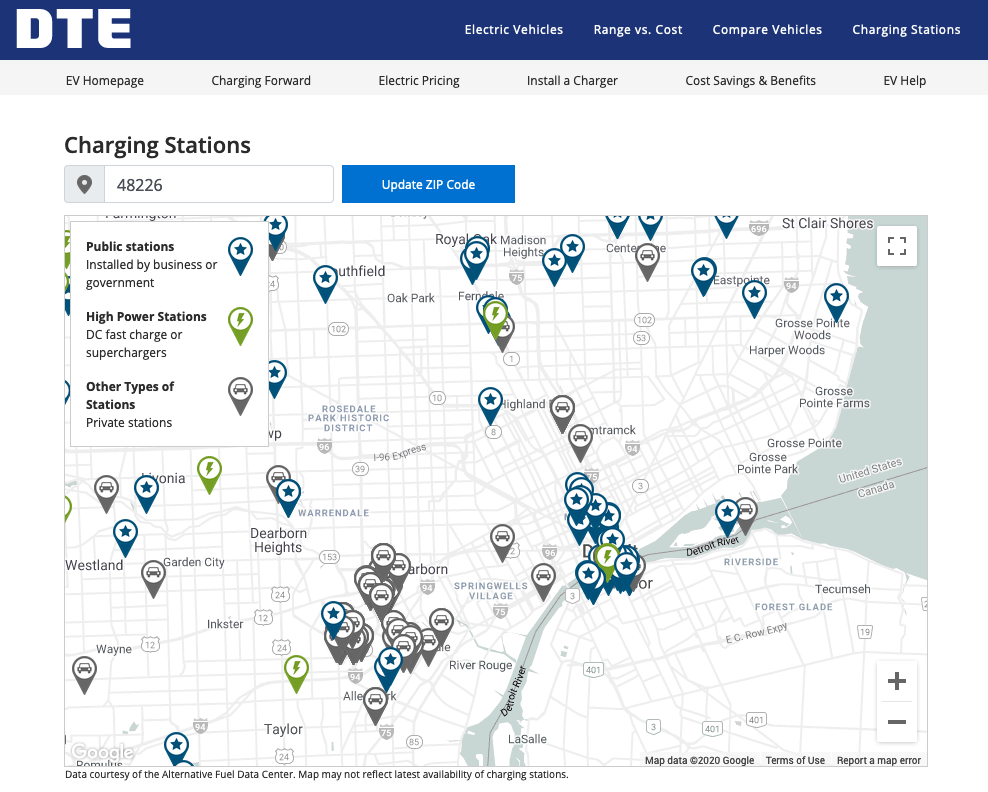
Map: Electric Vehicle Charging Stations in Detroit 2020
There aren’t many places to charge your electric vehicle outside of the 7.2 square miles of “Greater Downtown.” I’ve seen a few electric cars here and there charging at home garages across the city, but if you’re looking for infrastructure – good luck. DTE notes that data comes from Alternative Fuel Data Center, although many of the charging stations are the DTE corporate sites in Detroit.
These images stood out to me as stark contrasts from where a community vision wants to see development go compared to what the powers that be are capable of imagining.
The State Fairgrounds Development Coalition (SFDC) has a vibrant plan of mixed commerical/residential, a burgeoning alternative energy and tech center that connects to a high school and middle school, an extensive green park, all of which surround a new space to hold conventions and gatherings.
The currently proposed plan with City government, besides its immediate drab color choices and appearance, doesn’t show much beyond a warehouse and parking lot with a few pockets of undefined development. The primary draw is a new transit center that is quite limited and imagines no future multi-modal connections with nearby rail.
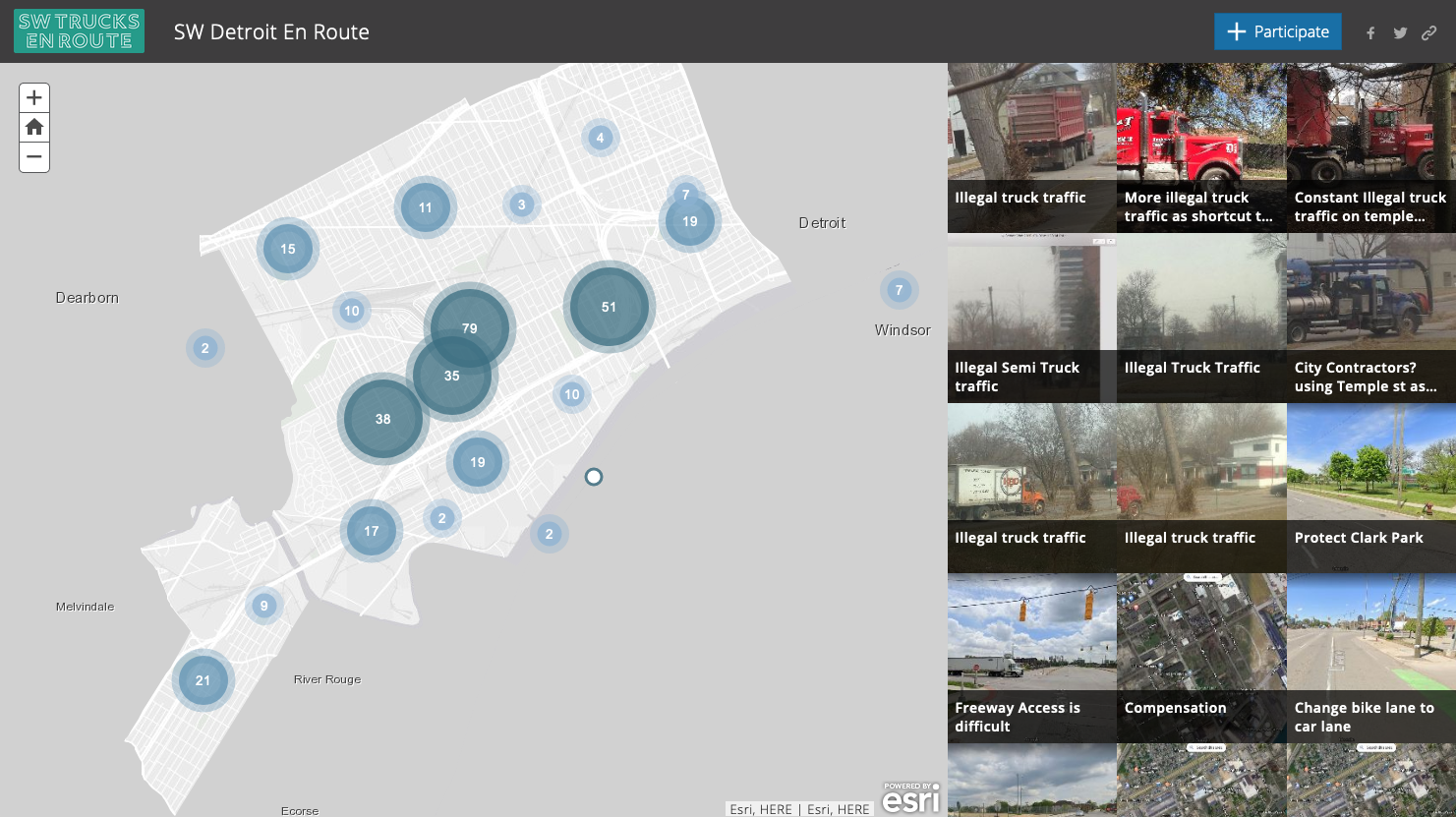
The City of Detroit DPW with Giffels-Webster has embarked on assessing truck routes, specifically within Southwest Detroit where truck traffic is heaviest due to transportation hubs and the current international bridge.









 DETROITography