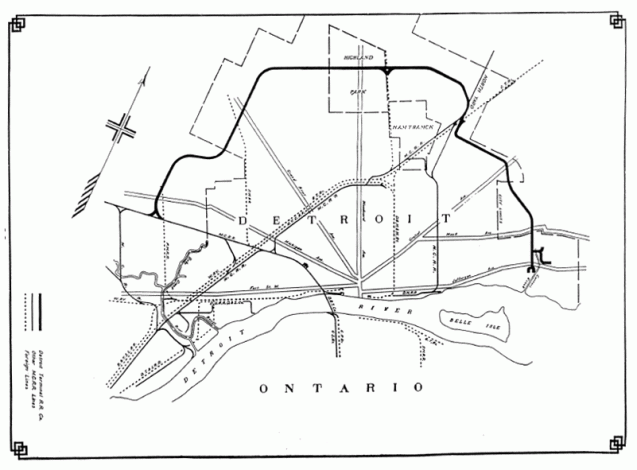
Map: Detroit Terminal Railroad 1916

DetroitTerminalRRCoMap1916

This map is from the New York Central Railroad Annual Report in 1916.

Detroit, like many major cities, had terminal (belt line) railroads to accommodate business. The Detroit Terminal Railroad (DTRR) was started in 1905 by local business owners in order to allow for expansion and access to rail. At the time (1905) all the good business locations were taken up along the major railroads. The construction of the railroad allowed for the continued expansion of industry into more “rural” areas.

Michigan Central Railroad, Grant Trunk, and Lake Shore & Michigan Southern Railway jointed purchased the DTRR after it was built. By 1914, the DTRR needed to add a second track to be able to handle the high level of industrial activity. The Chalmers Motor Company, Hudson Motor Company, Continential Motor Company, and the Ford Motor Company were the main industries on the rail line. Ford’s Highland Park plant was the largest user shipping out 100 freight cars with new automobiles every day.

The DTRR switched ownership many times and was operated by Conrail until 1981. Many of the vacant industrial areas of Detroit today would not have existed without the DTRR. Now the majority of the DTRR is being envisioned as an extension greenway loop that connects with the Dequindre Cut.

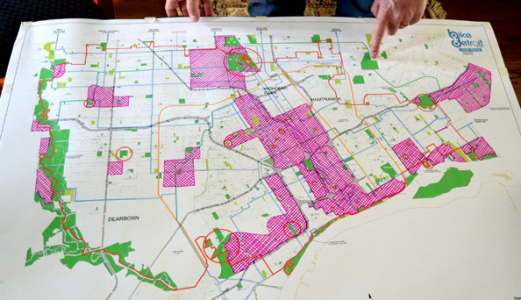
Map: Detroit Recommended Bike Routes 2010

BikeDetroitMap-521x300

Bike Detroit has a map of “recommended bike routes.” Even though there are far fewer cars in Detroit than during its peak, riding your bicycle on certain roads can be extremely dangerous. Check out their recommended routes to plan your commute or cycling workout.

The map was made in 2010 and now there are significantly more bike lanes. The routes still might be helpful for longer rides and the best cross town routes to choose (routes colored blue on the map).

See routes. . .

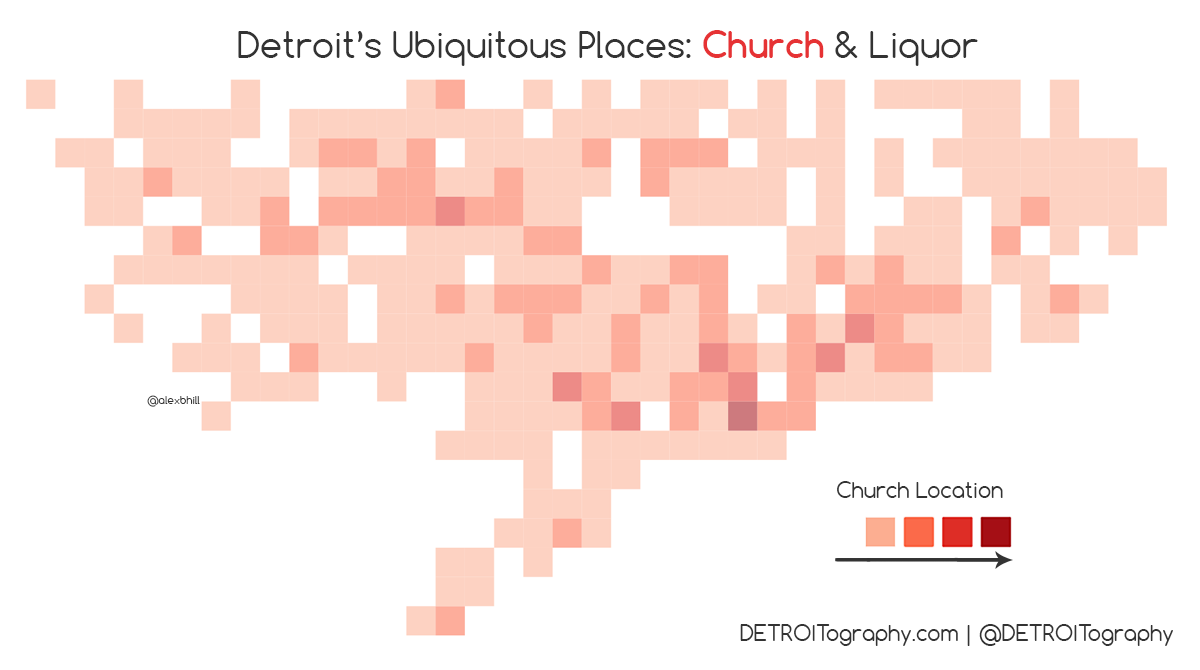
Map: Detroit’s Ubiquitous Places – Church and Liquor

Inspired by Nathan Yau’s work at FlowingData on pizza place geography and grocery store geography, I wanted to see how Detroit’s ubiquitous locations compared. Driving along Van Dyke where there was church after church (many abandoned) interspersed with liquor stores gave me the idea of examining which type of location dominated Detroit’s landscape.

church_liquor_dotIt takes forever to scrape the Michigan Liquor Control Commission (MLCC) website for active liquor licenses, so I relied on a 2012 dataset that I generated a while back. I then utilized data from Data Driven Detroit with Churches from 2011. The data is not perfect, but unless you have someone actively monitoring every liquor license and every church there is going to be significant change. Notably, the number of liquor licenses have been decreasing since 2009. The next step was to set up a grid that was generally half a square mile squares.

church_gridThere are a lot of churches in Detroit and they come in all shapes and sizes from mega churches that cover an entire block to converted storefront churches and the smattering of beautiful historic churches large and small.

grid_liquorThere is a strong concentration of liquor licenses Downtown, which isn’t surprising with the density of restaurants and bars. However there are other notable areas that dot the city with a high number of liquor licenses.

church_liquor_gridThe result of overlaying this data is interesting in that there appears to be a sort of “church belt” that stretches from Downtown to Northwest while liquor stores dominate the areas in between. Churches are more spread out across Detroit and liquor stores tend to be located closer together. It is safe to say that Detroit residents likely live closer to a church than a liquor store, but depending on where you live there may be a near equal amount of each type of location.

Event: #Maptime Detroit – QGIS Intro

QGis_Logo

WHEN: June 13th, 2015

WHERE: Grand River Workplace, 19120 Grand River

WHAT: Hey y’all, at this next #maptimedet we are going to get into QGIS (formerly known as Quantum GIS). QGIS is free, open-source, and highly capable GIS software. If you’ve ever been curious about QGIS and want to learn more, or never even heard of it, join us! We are going to go through some of the basics of using the QGIS software, including adding data, projecting data, symbolizing and map design, and geoprocessing.

If you’ve been using QGIS for years, come and lend your expertise to help others get started and answer questions.

Look for more information, including how to download the software, to be posted soon.

Beginners are encouraged, and be sure bring your laptop

View on Meetup

Map: Arabic Speakers in Metro Detroit

Arabic Detroit

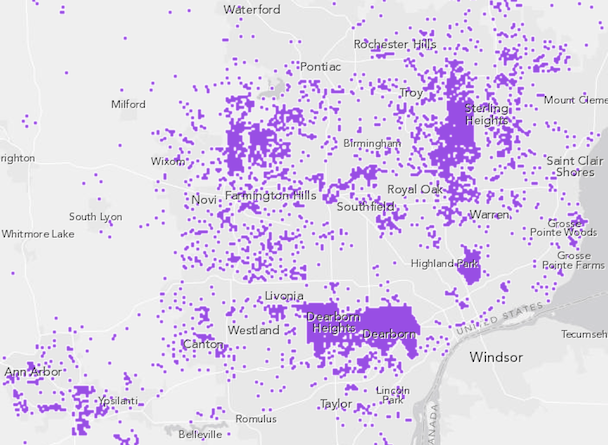
It is well known that Metro Detroit has one of the largest Arab-American populations in the country and is often said to have the largest concentration of Arab immigrants outside of the Middle East.

CityLab highlighted different language variations from the Census’ 2011 Language Mapper that builds on questions of “language spoken at home.”

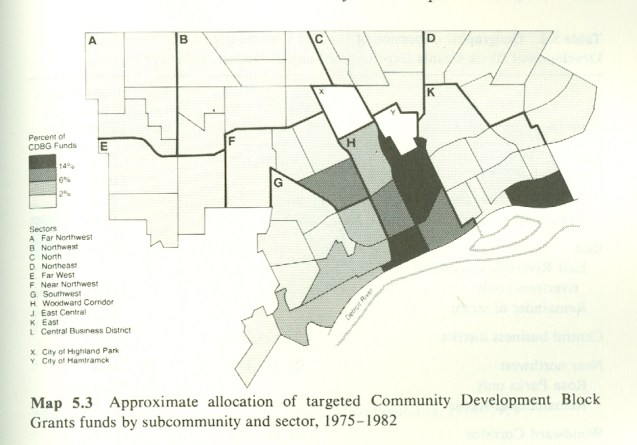
Map: Community Development Block Grant Allocations 1975 – 1982

cbg-map0001

This map was created and featured in “Race and Uneven Development” by Joe T. Darden, Richard C. Hill, June Thomas, and Richard Thomas.

“During the period from 1975 to 1982, funds the city spent in specific, identifiable areas constituted approximately 45 percent of all of the city’s CDBG [Community Development Block Grant] expenditures. […] As Map 5.3 illustrates, the city targeted many of the CDBG funds to the central business district, the riverfront, and the Central Functions area (Woodward Corridor), just as it proposed to do with economic development money.

If anything this map shows the long trajectory of development in Detroit. Since the 1970s funding was being allocated to the same areas that are seeing new changes and renewed focus today. History is a critical piece of understanding various issues in Detroit and most especially with development and funding.

Event: State of Detroit – Detroit’s Food Landscape

IMG_7920The team at the Chicago Design Museum approached me to contribute some maps and data visualizations to their upcoming “State of Detroit” exhibit. It grew into a collaboration that built off of my research focus on food access in Detroit while also addressing some of the “Detroit is Empty” misconceptions.

IMG_7919The installation has a cool sliding feature so you can view different map layers together.

Visit the exhibit from now until August 30th, 2015. More. . .

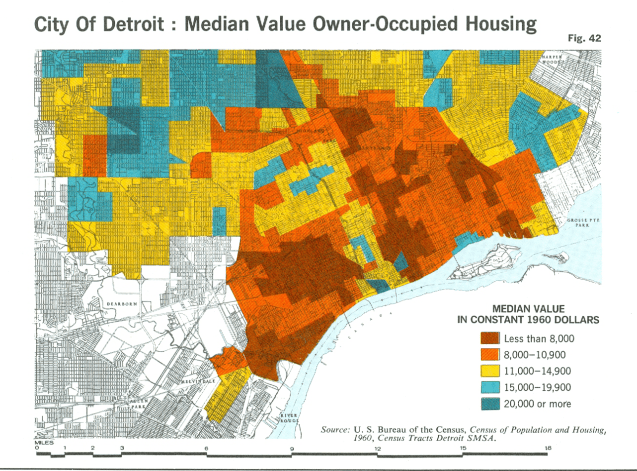
Map: Median Value of Owner-Occupied Housing 1960

dox-1960-home-value

From Doxiadis’ “Emergence and Growth of an Urban Region” Volume 2, this map utilized 1960s Census data.

The most important pattern to see in this map is the low value (and likely low quality) home values in what would have been Detroit’s minority neighborhoods in the “core city” area and Southwest, while the outer neighborhoods (notably Palmer Woods and Grandmont-Rosedale) were much more valuable and predominantly white.

Map: Detroit Tree Canopy Cover 2008

det-canopyThis map was part of the Detroit Environmental Agenda in 2013 from a team of partners working to improve the overall quality of life, health, and safety of Detroit’s environment and its people.

A few maps have focused on green space and crime reduction correlations. The Greening of Detroit is starting to share open data on where it completes tree plantings and recently the US Forest Service completed a comprehensive survey of all of Detroit’s street trees.

The Detroit Future City report calls for carbon forests around expressways, which I believe is beginning to be piloted, and the expansion of mixed use green space.

Map: City of Detroit Present and Future Blight 1960

dox-blight0001

From Doxiadis’ “Emergence and Growth of an Urban Region” Volume 2, this map utilized 1960s Census data.

“Of the 352,680 residential structures in the City of Detroit, about 50,000 are blighted. By 1975, when the city’s present renewal program will have been implemented, an additional 113,720 residential structures occupying 11,136 acres of land are expected to be blighted. By that time 238,000 more people will be living in blighted areas. Fig 44. indicates the extent of this problem in order to show the blighted and deteroriating neighborhoods in Detroit which are not presently affected by the city’s urban renewal program.”

A critical connection should be drawn between the above mapped areas and areas that were cataloged as blight in the 2009 Detroit Residential Property Survey (DRPS) and the 2013 Motor City Mapping (MCM).

Now we see many of these 1960 blighted areas, labeled blight and cleared, in the midst of redevelopment. Blight has a long trajectory that we cannot forget started somewhere. People have been mapping blight in Detroit for decades and blight has affected the development of the city for just as long.

Map: National Geographic Rethinks Detroit

Detroit_Desktop_mainmap_1x

National Geographic‘s recent three part coverage of Detroit titled “Taking Back Detroit” (who took it the first time? second time, third?) includes this map under Part 2: Rethinking Detroit. The map is a nice visual display of the city’s densely populated areas (dark brown/ maroon) vs. more vacant areas (green).

Follow the link for closer looks at: Sherwood Forest, Woodbridge, Burbank (?), Brightmoor, and NorHam neighborhoods.

natgeo-key

Many neighborhoods along Detroit’s perimeter are as densely populated as the city’s wealthier suburbs. This analysis at the block level shows the range from neighborhoods that are thriving to those that have more vacant lots—and to areas reverting to nature, known as “urban prairie.”

SOURCES: NOAH URBAN, DATA DRIVEN DETROIT; LOVELAND TECHNOLOGIES; DETROIT LAND BANK AUTHORITY; SOUTHEAST MICHIGAN COUNCIL OF GOVERNMENTS; COMMUNITY DEVELOPMENT ADVOCATES OF DETROIT; MOTOR CITY MAPPING; OPENSTREETMAP; U.S. CENSUS BUREAU; CITY OF DETROIT ASSESSMENT DIVISION AND PLANNING AND DEVELOPMENT DEPARTMENT; NOAA

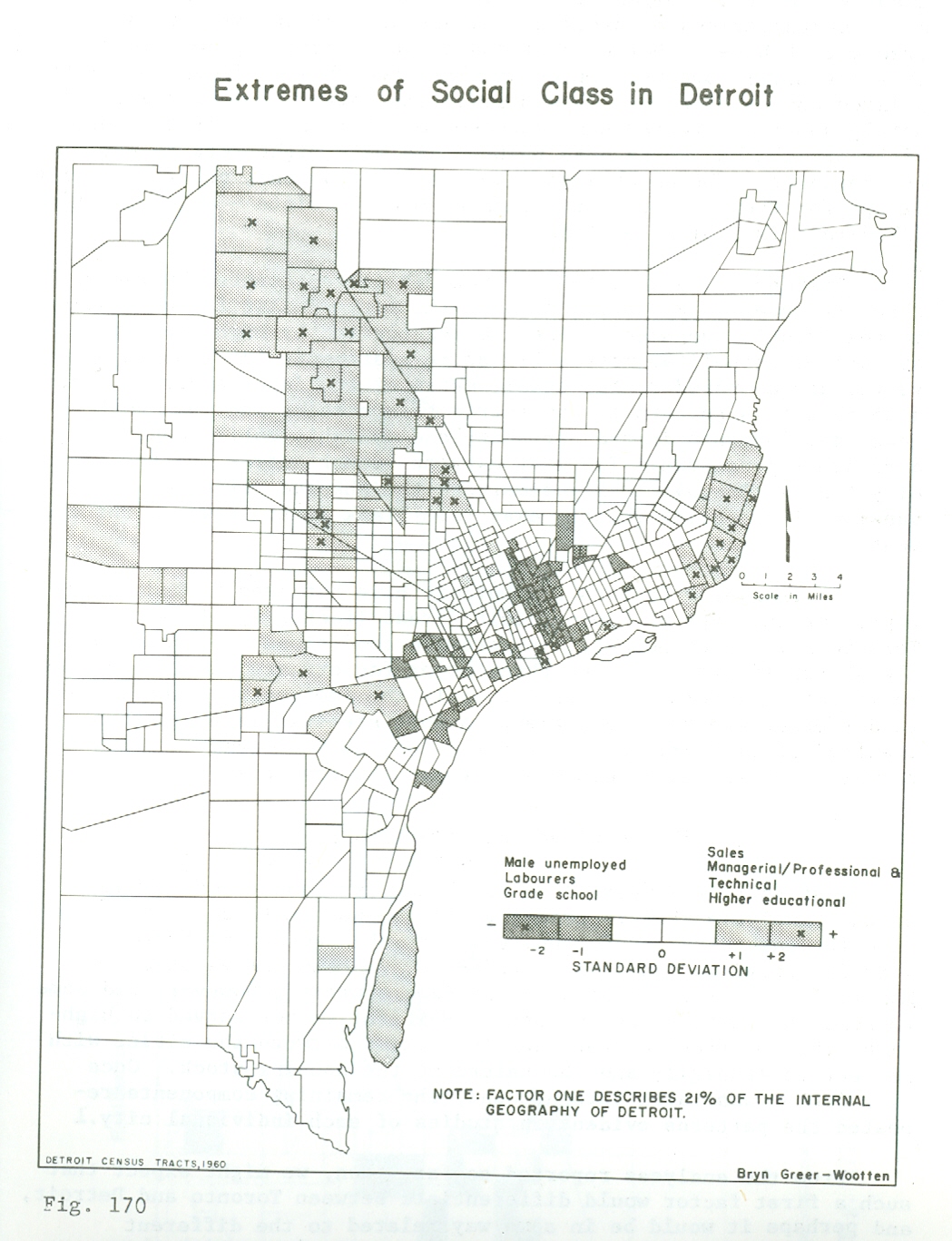
Map: Extremes of Social Class in Detroit 1960

bunge-social-class0001

This map is published in William Bunge’s book co-authored with R. Bordessa, “The Canadian Alternative: Survival, Expeditions, and Urban Change.”

The map author, Bryn Greer-Wootten, utilized the 1960 Census (employment, education, income) to look at what Richard Florida might describe today as the geography of the “creative class.” Greer-Wootten finds that the inner city versus Suburb divide is quite stark.

Map: Detroit Urban Streams Restoration

dwsd-streams-fig-8.10

Revisiting the potential for stream recovery, a map of historic and existing rivers and streams from Detroit Water and Sewage, CDM and the Urban Streams Restoration by Lars Gräbner published in March 2015, Mapping Detroit: Land, Community, and Shaping a City is available at the Wayne State University Press.

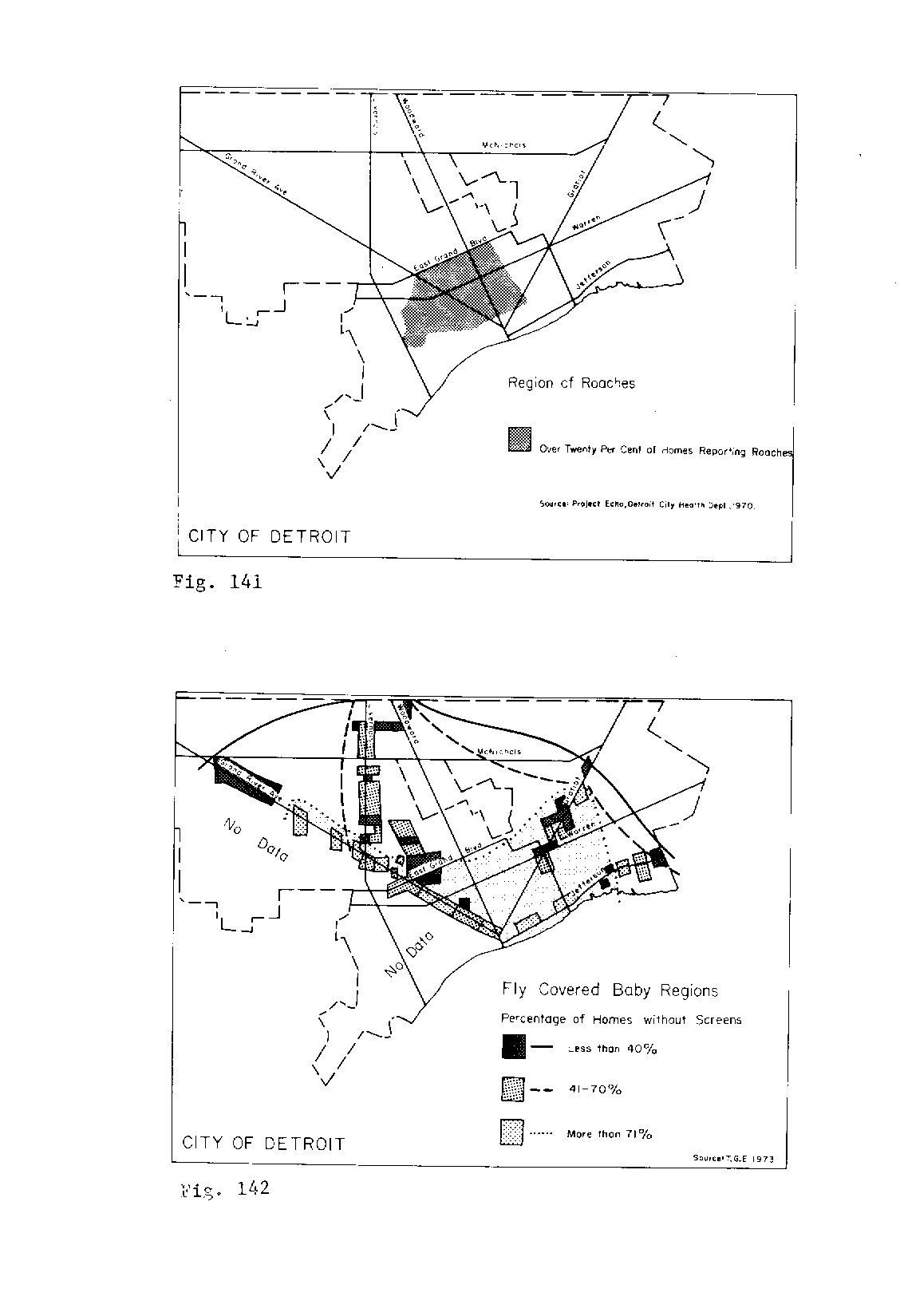
Map: Detroit Regions of Cockroaches and Flies 1970-73

det-roaches-flies

This map was part of William Bunge’s book co-authored with R. Bordessa, “The Canadian Alternative: Survival, Expeditions, and Urban Change.” These maps contribute to the authors’ display of the City of Death among their three distinctions which also include the City of Superfluity and the City of Need.

Map: Detroit Soil Analysis 2004-2013

Soil-Analysis-2004-2013

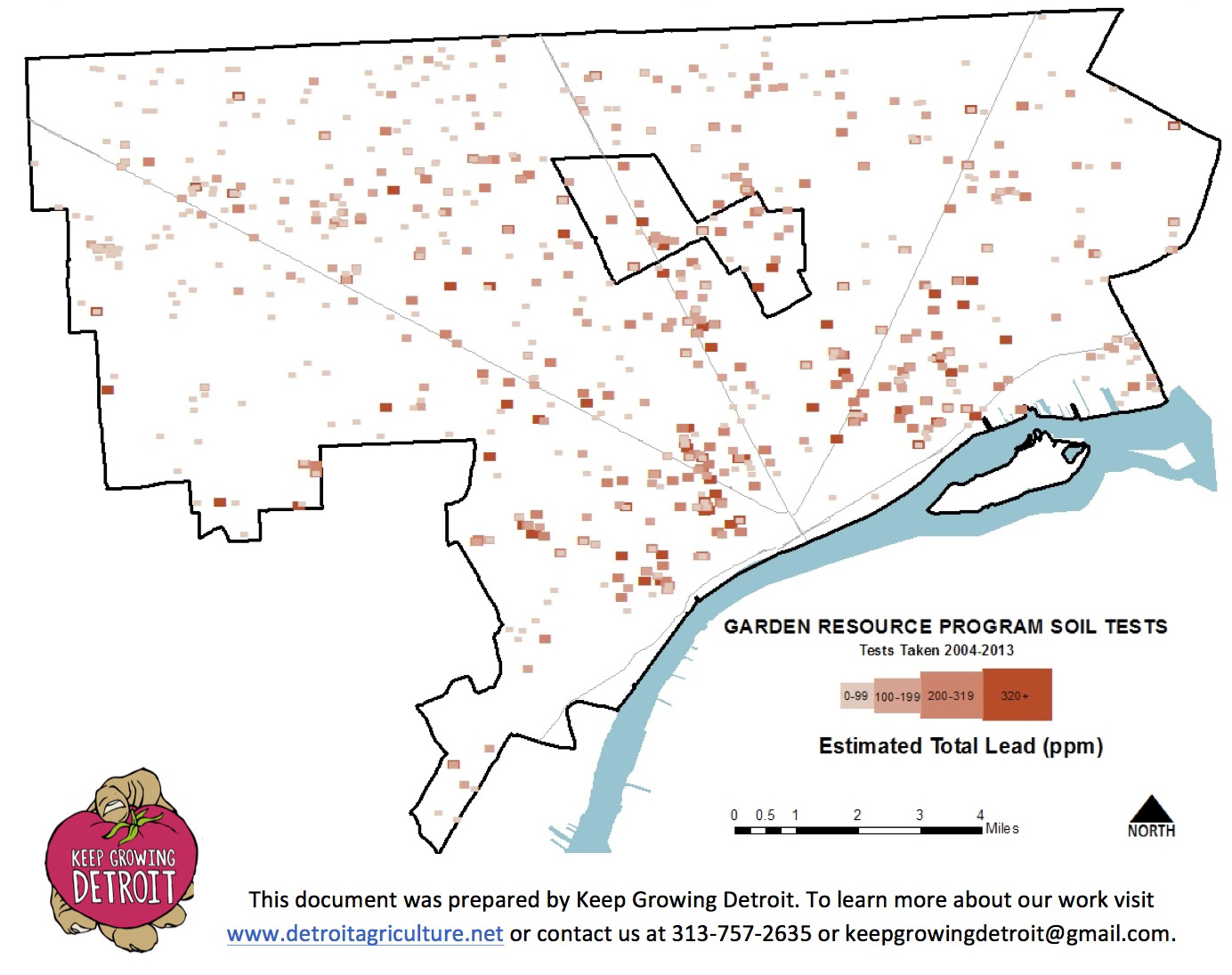
The quality of soil around Detroit is a regular concern with so much former industrial activity and current industrial activity. Much of South Southwest Detroit can’t even consider growing anything both because of the poor soil quality as well as the horrible air quality.

The Greening of Detroit/ Keep Growing Detroit (Garden Resource Program) completed 943 soil tests between 2004 and 2013. Out of all the tests 84% had lead levels below 320 parts per million, which is considered safe for gardening and consuming produce that is grown.  You can see on the map that sites with 320+ ppm test results are fairly scattered across the city, but mostly closer to the riverfront than outlying neighborhoods.

Map: Can Detroit Really Be Compared to Any Other City?

detroit-cities3

Can Detroit really be compared to any other city? No doubt everyone has tried comparing crime rates, economy, and poverty levels in Detroit with other troubled cities. A few groups have even tried fitting different city land areas into Detroit’s 139 square (land) miles. It always seems that Detroit has too much or too little of something for a city to city comparison to make much sense. Rob Linn had similar thoughts and instead of comparing land area or other commonly compared attributes he analyzed infrastructure density (feet of street per resident) as a method to debate the misguided “rightsizing” push. Rob found that Detroit had a high rate of “feet of street per resident” which caused some areas of the city to appear more vacant when in reality they had healthier infrastructure density.

The 2010 Census population for Detroit was 713,777, closer to San Francisco’s. Imagine San Francisco’s southern edge lined up with the river front and perhaps we would see what proponents of a “condensed” city envision. Should the city condense to its former 1913 borders and focus on making services work within that area before moving outwards or would that just be an exercise in discrimination and inequality? Still others have suggested part of Detroit’s downfall was that it stopped expanding its borders. Check out the “map of Detroit” as an amalgamated region.

detroitsizeI wondered what other cities would actually make sense to compare Detroit to as far as land area, population, and density. Manhattan, New York City is a wild comparison just because the land mass and density of people is so different from Detroit. Boston is interesting because of its area and population size, but San Francisco is more comparable because of its similar population size to Detroit and its smaller corresponding square-mile area.

State City Population Land (sq mi) Density (/sq mi)
NY New York 8,175,133 302.64 27,012.50
CA San Francisco 805,235 46.87 17,179.22
MA Boston 617,594 48.28 12,792.70
PA Philadelphia 1,526,006 134.1 11,379.50
DC Washington 601,723 61.05 9,856.50
MD Baltimore 620,961 80.94 7,671.50
MI Detroit 713,777 138.75 5,144.30
NV Las Vegas 583756 135.82 4,298.20
CO Denver 600,158 153 3,922.60
AZ Mesa 439,041 136.45 3,217.50
GA Atlanta 420,003 133.15 3,154.30
NC Charlotte 731424 297.68 2,457.10
TN Memphis 646,889 315.06 2,053.30
TX El Paso 649,121 255.24 2,543.20
OR Portland 583,776 133.43 4,375.20
WA Seattle 608,660 83.94 7,250.90
WI Milwaukee 594,833 96.12 6,188.30

I choose to compare Detroit in land mass, population density, and population size with 16 other cities. I first chose the common comparisons from the popular comparison map (Boston, New York City, Washington D.C., San Francisco), then chose similar population sizes (Charlotte, El Paso, Baltimore, Memphis), followed by similar population density (Seattle, Denver, Milwaukee, Las Vegas) and finally looked at similar land sizes (Philadelphia, Atlanta, Mesa, and Portland).

While there is still no great comparison city for Detroit, looking at how the city matches up with many of its comparison cities is an important exercise. There may not be any direct comparisons, but there are definitely specific policies and strategies that Detroit can utilize from cities that it is often compared to and vice versa. The details are where better comparisons can be made rather than the surface level comparisons of land area, population, and density.
Map: Gentrification is not simply Data

Screen Shot 2015-04-08 at 8.13.02 AM

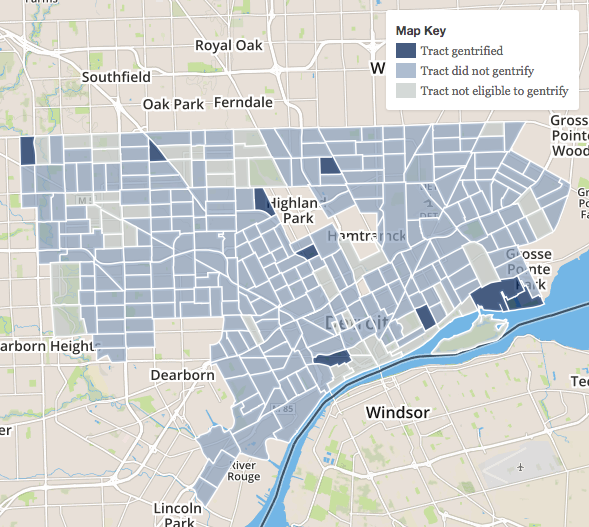
The map from Governing (1990-2000 above) should be an important reminder that data isn’t everything. Especially when it comes to discussions around gentrification we cannot limit ourselves to the hard data collected in the census because gentrification is a social and political phenomenon.

Governing utilized three data points in order to classify “neighborhoods” as gentrifying or not:

  • Median Home Value: Estimates are shown for owner-occupied housing units in 2013 dollars for recent data and 1999 dollars for 2000 Census data. Percentage changes in home values reflect adjustments for inflation.
  • Bachelor’s Degrees: The share of the population age 25 and older who report holding bachelor’s degrees.
  • Median Household Income: Values shown in 2013 dollars for recent data and 1999 dollars for 2000 Census data.

Indicators are important and these particular pieces of data do help to look at the issue of gentrification (rising prices, etc.), but the most important data to examine is the process of gentrification, not simply the outcome. What policies have contributed (i.e. redlining, reverse redlining), what political moves are making it more difficult (i.e. water shutoffs and foreclosure), and where are foundations, city government, and others focusing money for new investment.

I would argue that these maps don’t tell the story of gentrification at all, but rather the impact of further disinvestment of the neighborhoods where Detroit residents live. As census tracts/ neighborhoods lose population, those who are able to stay are more likely to have higher income, education, etc.

These maps and data again don’t account for the local nuance of issues with property and displacement:

“These numbers are meaningless. The area in Brightmoor is 70% vacant. How many data could you collect from that? So only 3 in every 10 houses is inhabited, there are no grocery stores, no banks, no high school, just burned out houses, vacant lots, potholed streets. Just another academic exercise that has no practical value for those of us who live there. There are no houses in that area.”

– Riet Schumack