Map: Michigan Avenue Community Organizations 1982

MACO-groups

Last year I was contacted by Maryanne Dunmire who had formerly been involved with the Michigan Avenue Community Organizations (MACO):

Back in the mid to late 1970s, I lived in southwest Detroit, in an area that identified itself as the Michigan Avenue Community Organization (MACO). During that period of time the organization developed a plan for the neighborhood and published a Revitalization Plan in 1982.

She shared a copy of  the 153 page report that includes numerous current community leaders and extensive surveying and analysis. Part of their effort was also to petition the city government to follow their new standard format for data sharing.

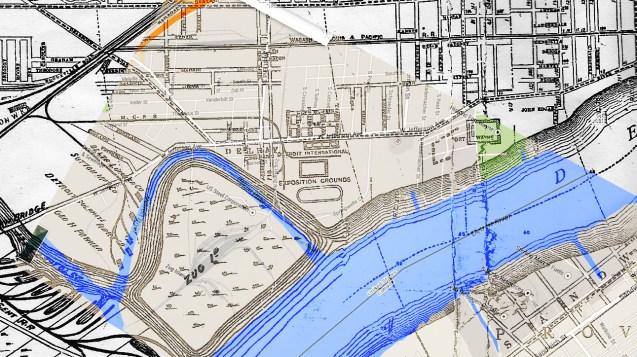
Map: Detroit International Exposition 1890

Delray-Maps-1890-2

This map overlay is from Digging Detroit‘s historical dive into Detroit’s own world fair of sorts. The city was at the forefront of many industries and products from Detroit were already being mass produced and widely distributed. In 1890, Detroit used 156 acres in Delray, south of Fort Wayne, as the Exposition Grounds.

From Digging Detroit:

Detroit was not only the largest producer of heating and cooking stoves, it was also on the forefront of ship building, rail car manufacturing, cigar production and development of cutting edge pharmaceuticals. Detroit was also on the verge of launching a bustling automotive industry but at this point factories were being constructed to design and build gasoline engines.


Map: New Center Master Plan 1978

Screen Shot 2017-05-24 at 7.28.55 AM

This map caught my eye in the “Preservation News, Volume 18, No. 11, 1 November 1978.” The effort seemed very similar to the recently announced project in Cody-Rouge with DTE, GM, and Quicken.

“General Motors Corporation announced in September a four-year, $20 million joint private and public effort to revitalize the six-block New Center neighborhood adjacent to its world headquarters building in Detroit. […] The balance of the $2.6 million needed to purchase 125 houses and 175 apartments will come from 15 other Detroit firms.

The houses will be renovated for approximately $23,500 each and sold for $40,000–about half the price of a similar sized house in the suburbs. The original owners will have the first option to repurchase their homes. […]”


Braille Map of Detroit

Screen Shot 2017-05-19 at 7.21.03 AM

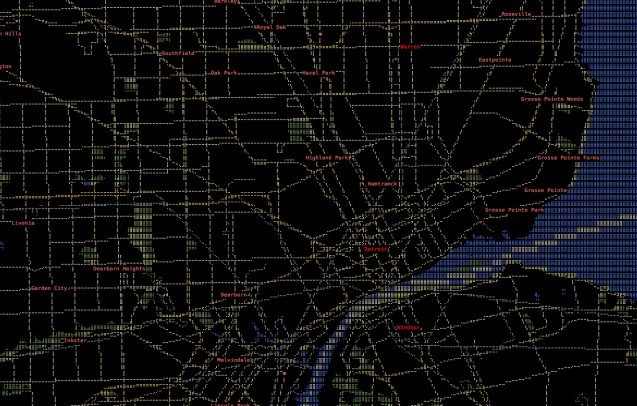
If you’re familiar with ASCII, Michael Straßburger created the geographic implementation this year. The result is a fully navigable text-based map of the world that could be printed as raised characters.

MapSCII is a Braille & ASCII map renderer for your console – enter => telnet mapscii.me <= on Mac and Linux, connect with PuTTY if you’re using Windows.

Map: Medically Underserved Areas of Detroit

MUAP-map

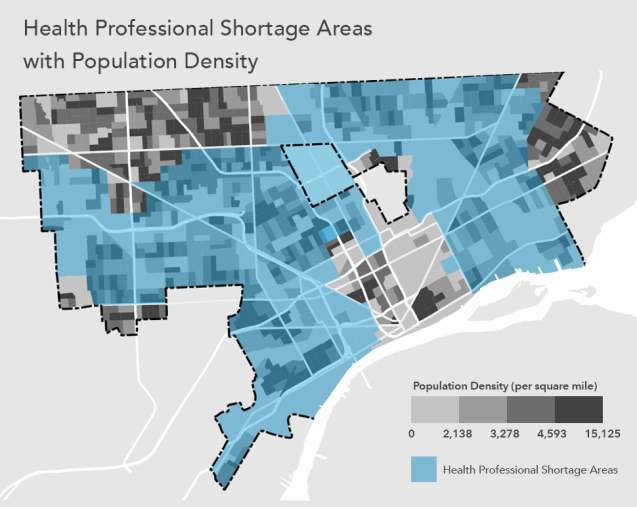
The Medically Underserved Areas/Populations (MUA/P) designations are based on the Index of Medical Underservice (IMU) from the Health Resources and Services Administration (HRSA). IMU is calculated based on four criteria:

  • Population to provider ratio;
  • Percent of the population below the federal poverty level;
  • Percent of the population over age 65; and
  • Infant mortality rate.

Most licensed physicians in Detroit are located at one of the three major health system hospitals which leaves an absence of primary care and family doctors in nearly all of Detroit’s neighborhoods. Areas well covered by hospitals also highlight due to high infant mortality rates such as 48201 (Detroit Medical Center) and 48202 (Henry Ford Hospital).

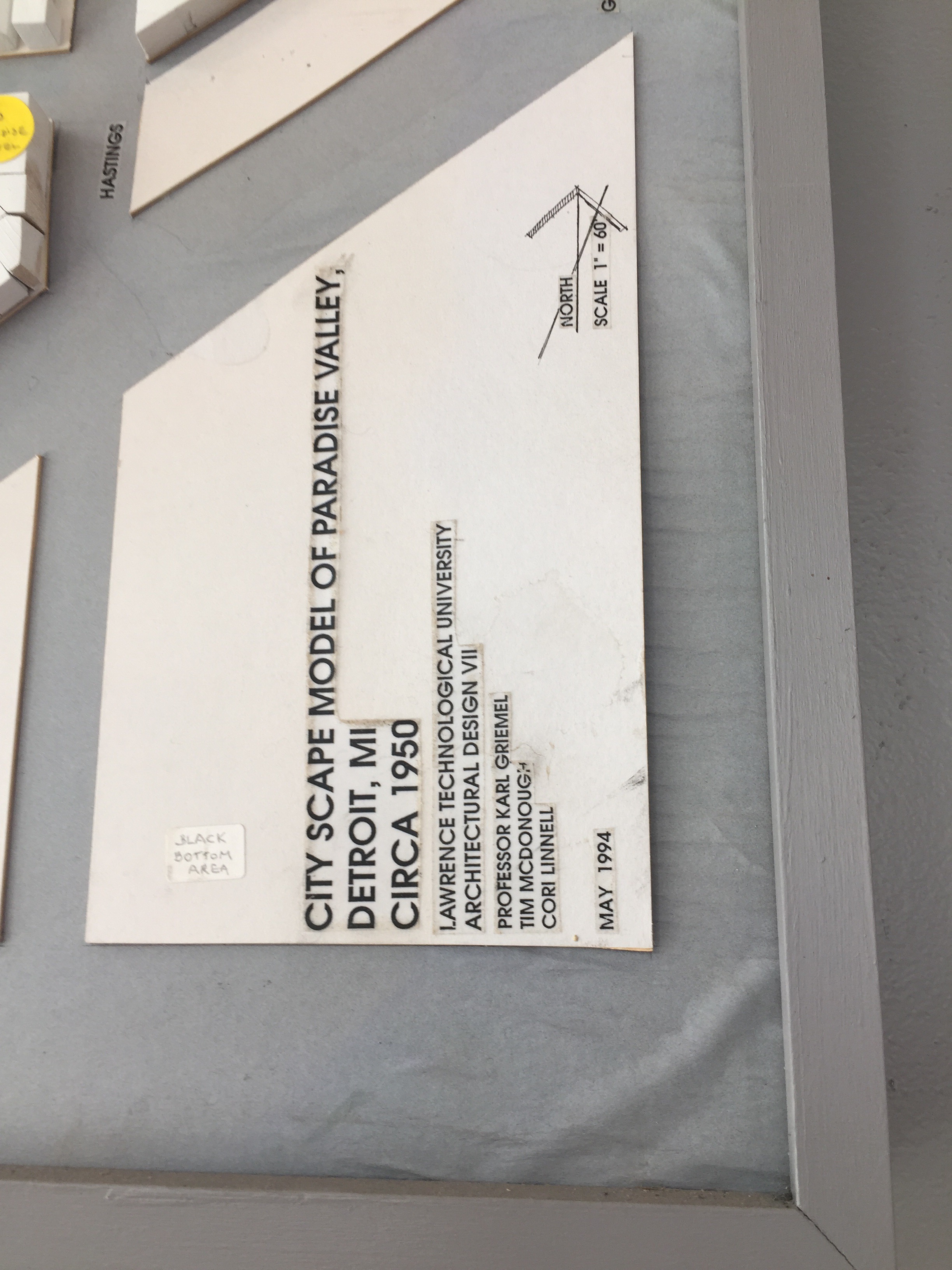
Map: Cityscape Model of Paradise Valley 1950

I happened to visit Dilla’s Delights for a quick coffee refuel while Downtown and was pleasantly surprised to have a historical streetscape popping out of the wall. The model is credited to an architectural design course at Lawrence Technological University in 1994.

The model marks important venues in 1950s Paradise Valley although it should be noted that historically, Paradise Valley reached further north up to Kirby Street.

Map: New Rainbow Street Sweeping Strategy 2017

sweeping-map

In this year’s State of the City, Mayor Duggan announced the purchase of new street sweepers when there had been none operating in the last 7 years. DPW has announced the start of cleaning for the city’s 2,000 miles of streets.

It would seem that a sequential color scheme would work best since the colors are meant to convey street-sweeping over time, moving from the East of the city to the West. Lightest color gets swept first, darkest gets swept last within the 2 week cycle.

remake-sweeping-map

Map: Detroit Dog Parks Size Comparison 2016

Screen Shot 2017-05-06 at 5.38.31 PM

A helpful little map comparison of the available parks for dogs and how big they are. This comparison was included in the Detroit Parks and Recreation Department (DPRD) and General Services Department (GSD) “2016 Parks and Recreation Improvement Plan.”

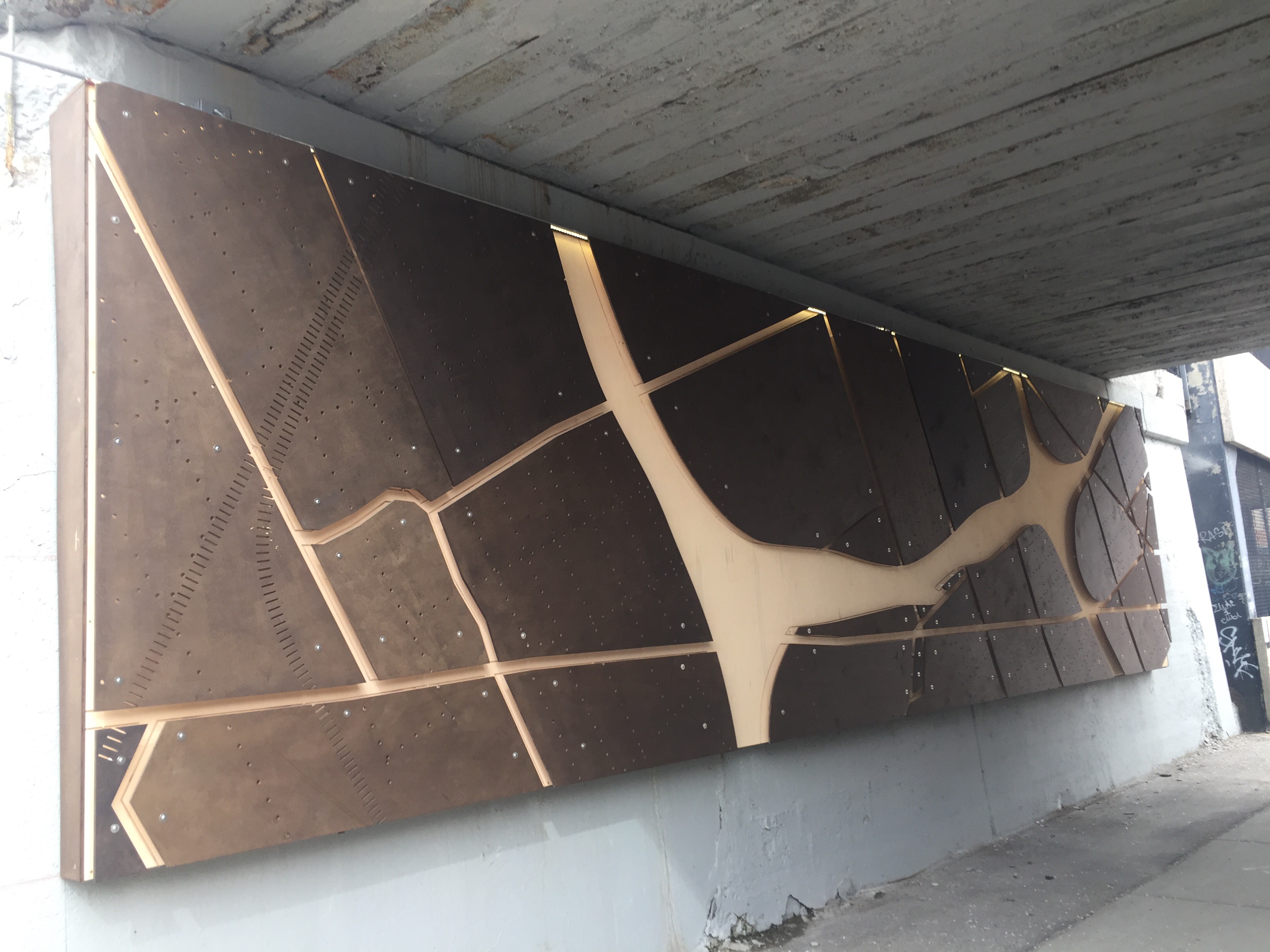
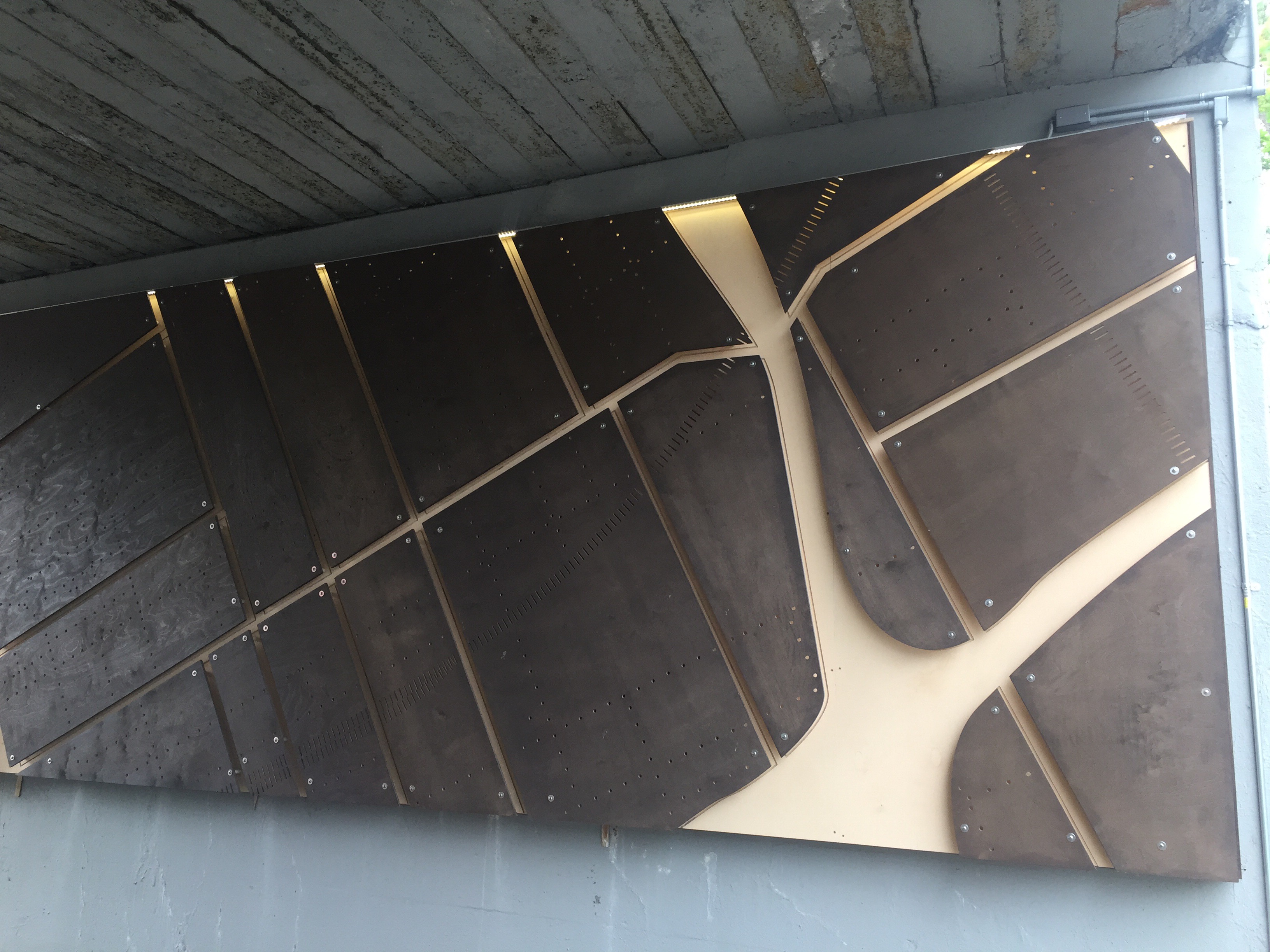
Map: “Point of Origin” Viaduct Installation

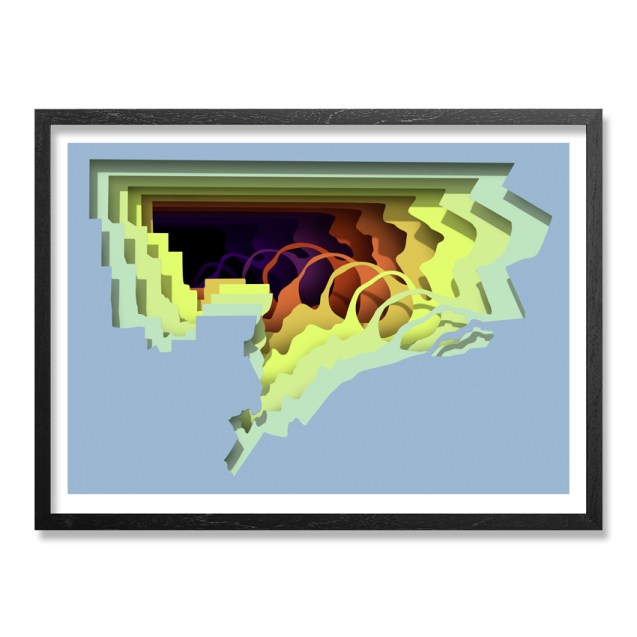
The Detroit-based agency, Mindfield, was selected by Midtown Detroit Inc. to fill this empty spot below the Second Avenue viaduct. The piece is called “Point of Origin” and appears to be a series of metal cutouts that look like maps of Detroit, however Detroit’s true “point of origin” is not depicted on any of the panels. The expressways seem to be the most easily recognizable feature.

There is some interesting back lighting that is still in progress.

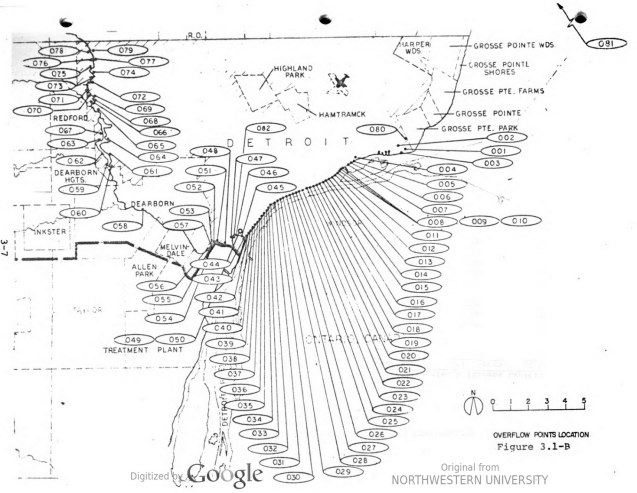
Map: Detroit Water Pollution Overflow Points Location 1978

Screen Shot 2017-04-06 at 8.38.43 AM.png

This map was generated to aid in future sewer pollution control planning from the report “Detroit water pollution control system segmented facilities: environmental impact statement.

I just thought the map design was a bit wild when there are so many opportunities along the Detroit River for pollution overflow on the way to the waste treatment plant.

Map: Wayne State Campus Master Plan 2020

Screen Shot 2017-04-27 at 8.18.23 AM.png

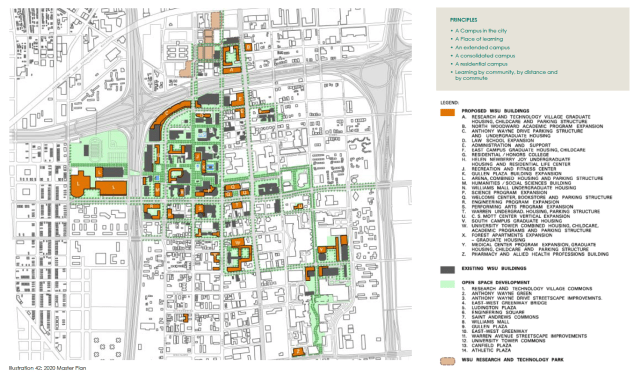
In 1998, Albert Kahn Associates conducted surveys and assessments to develop a Master Plan for what Wayne State University could look like in 2020.

Some of the main takeaways were focused on a more consolidated campus by developing existing spaces already owned by WSU. Notable proposed buildings are the parking structure/housing structure that curve with the expressways, new housing attached to the medical school parking structure, and massive multi-building arena complex on Warren Ave.

Extending the campus to include a brand new School of Business nearly all the way to the edge of Downtown was not in the Master Plan.


Map: Detroit Tuberculosis Deaths 1939 – 1940

Screen Shot 2017-04-26 at 7.32.35 AM.png

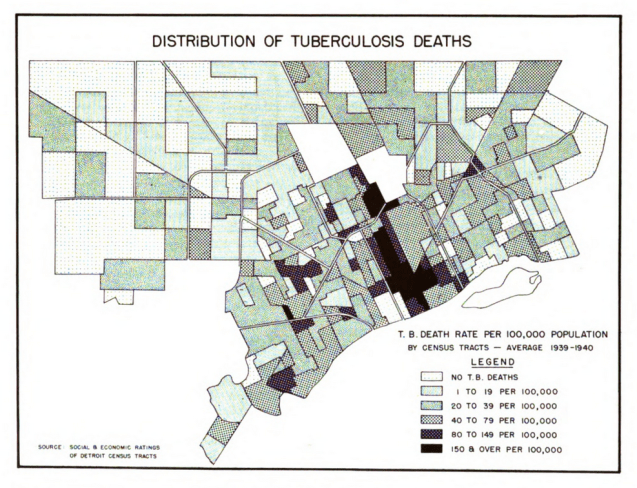
This map from the Detroit City Plan Commission’s report titled: “The People of Detroit” brings the city’s health into focus. Much of Detroit’s public health infrastructure was built to address tuberculosis. The now empty and redeveloping Herman Kiefer Hospital was constructed in 1911 for the express purpose of eliminating tuberculosis in Detroit.

“The highest incidence of venereal disease is among Negro males. Mortality due to tuberculosis and pneumonia is highest in the area within the Boulevard, and lowest in the newly developing areas on the outskirts of the city. Insofar as the rates are the result of living conditions in deteriorating and blighted areas, remedial action to be applied would need to be more far-reaching than wider extension of medical care.”

Map: Detroit’s Belle Isle Master Plan 2005

belle isle master plan 5-15-01

Who couldn’t love a updated “hand drawn” style map of Detroit’s largest park?

From the Belle Isle Master Plan:

The Belle Isle Park Master Plan was prepared over a two-year period from 1996-1997. In 1998 the plan was reviewed and presented to the Detroit City Council. In 1999, City Council members took the plan to the community by holding public discussions at neighborhood recreation centers throughout the City to acquaint citizens with the plan and solicit more input. The final report was compiled in 2000; it is presented in two parts, the Comprehensive Renovation Plan and a Technical Assessment Report.  In 2005, the Master Plan was updated to reflect ongoing improvements and an updated cost estimate.

Map: Detroit’s Changing Coffee Landscape 2017

coffeedensity2017map

The recent announcement of Cafe con Leche’s second closing is bittersweet for many as new coffee ventures are brewing. El Club is looking to expand with a cafe space, Cake Ambition won Motor City Match funding, MACC is working on a cafe laundromat space, and Stef-N-Ty plan to add a coffee shop next door to their store in the Northend.

In my 2015 analysis of coffee places in Detroit, Highland Park, and Hamtramck I identified some 54 coffee shops in Detroit. Considerably more than the 21 count that has been floating around. However, due to the nature of Detroit’s economic and retail recovery, many national chains chose to locate inside the safe walls of existing venues. Out of 9 Starbucks locations in Detroit only 2 are stand-alone shops. Biggby and Tim Hortons are often located inside other buildings as well although there are many more stand-alone Tim Hortons and Dunkin Donuts locations.

Since 2015, I’ve seen 6 coffee shops close, 2 or 3 changed ownership but remained in operation, and 20 new coffee spots open. The new grand total comes to 67 coffee shops within Detroit’s outer border. Only New Center and “Sherwood Forest” saw losses of coffee shops that were not filled by new ones. Interestingly, Midtown only gained one coffee shop while Downtown added 4 new coffee shops.


Map: Detroit Region Areas of Population Growth 1950 – 1961

Screen Shot 2017-03-26 at 11.33.14 PM.png

This map helps demonstrate the early loss of population from the City of Detroit into adjacent suburbs. From the “Report on Metropolitan Environmental Study: Sewerage and Drainage Problems” this map accompanied a report looking ahead to plan for 1970 needs. In large part the report found that the areas that had the greatest population growth also had the most inadequate systems for sewerage and drainage.

Map: Detroit Rental Value 1940

Screen Shot 2017-04-21 at 8.56.50 AM

This map is included in the Detroit City Plan Commission’s 1946 report titled: “The People of Detroit.”

In regards to rent, the report reads:

“The average monthly rent is a good index of the present economic level of given geographic areas in relation to others. In spite of distortions which may be introduced by a scarcity or abundance of homes, or transportation facilities of distance from work, it is a fair indication of family income. While the average contract or estimated monthly rent for the city was $35.88 at the time of the census in 1940, average rents by census tracts ranged from $18.00 per month in the tracts near the central business district to $120.00 per month in Palmer Woods.”


Map: Where is the Heart of Detroit?

The “heart of Detroit” is a common marketing shtick attempting to show the importance and purported hip-ness of a given location. Sometimes that location is a new development and other times it is a historic place marker.

heart-of-detroit-headlines

Thanks to Aaron Foley’s 2012 Mlive article on this very topic and some more recent google searches, there is nice list of locations assumed to be the “heart of Detroit” and with wide geographic variation.

“My inner cartographer wants the “heart” of the city to be the Dexter/Davison/Linwood near Central High School, which is, uh, central to almost everywhere in the city.” – Aaron Foley

heart-detroit-locations

Heart of Detroit:

  • Midtown
  • Downtown
  • Capital Park
  • Barry Subdivision
  • Belle Isle
  • Central High School
  • W. Grand Blvd.
  • Linwood and Gladstone
  • Diack Park/Playground
  • New Center
  • Corktown
  • Brush Park
  • Woodbridge

Anyone can claim the “heart of Detroit,” but how can we determine the true “heart” or center? Mathematically we can calculate the geographic center of Detroit.

heart-detroit-geocenter.png

Media mentions are nice and the geographic center is helpful, but it is no mystery that Detroit is a very large area with random clusters of population. Using more math we can calculate the mean “center of population” for Detroit. It seems that Aaron Foley’s “inner cartographer” is spot on!

heart-detroit-popcenter.png

Map: Proposed Play Space in Gratiot-Mack Neighborhood Improvement Plan 1955

Screen Shot 2017-04-06 at 8.20.47 AM


This map is included in the “Summary progress report. Detroit Committee for Neighborhood Conservation and Improved Housing.” The broad goal of the Neighborhood Conservation Committee was a “blight-free” Detroit. The Gratiot-Mack area was the original pilot “neighborhood” where adding new greenspace was seen as a positive for neighborhood stability.

In the Google Maps snapshot below, you can see much of the proposed playgrounds and greenspaces actually did come to fruition, however blight prevention did not have a lasting, long-term effect in the 50 years following 1955.

gmap-mack-gratiot.png

Map: Rouge River Basin in Detroit

IMG_1526

This beautifully designed map comes from none other than a meta-study of flooodplains and flood hazards in the 4 county Detroit region. It’s a very telling analysis when thinking about our current flooding and water drainage challenges.

The map needed a small edit in the legend, so an old school cut and paste method was utilized.