Detroit voters went to the polls (and ballot boxes) last Tuesday to decide on multiple ballot propositions and candidates for November’s general election. The unofficial results published by the city have the current turnout at 15.8% of registered voters, which matches primary turnout in past years.
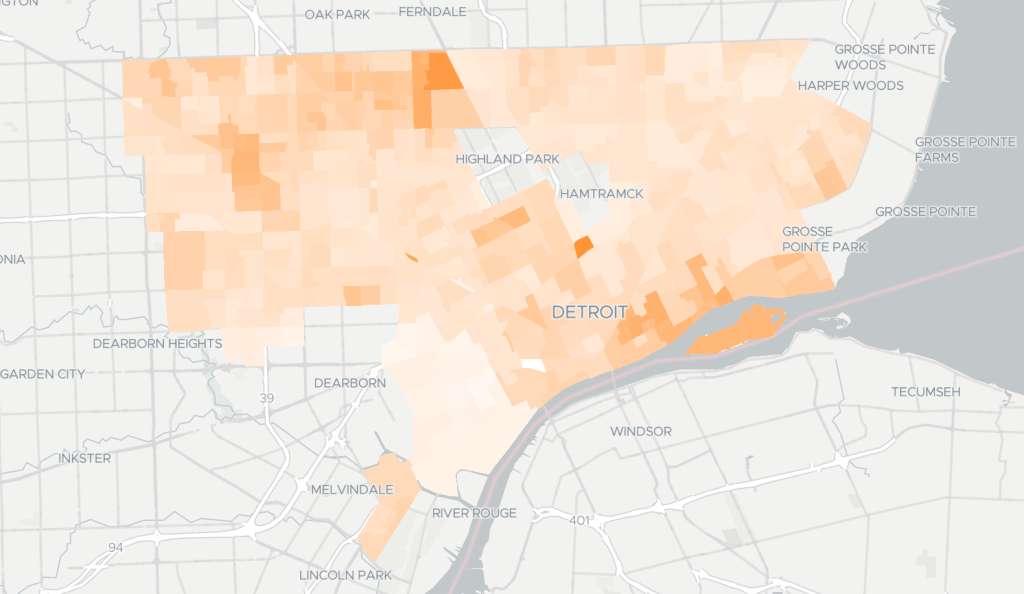
This map includes Detroit precinct results for all races on Detroit ballots, but doesn’t include results for any precincts outside of the city. While incumbents and favored candidates generally won their elections, there’s some variation across neighborhoods for some of the more contested races including Democratic Senate and 13th District House Representatives.
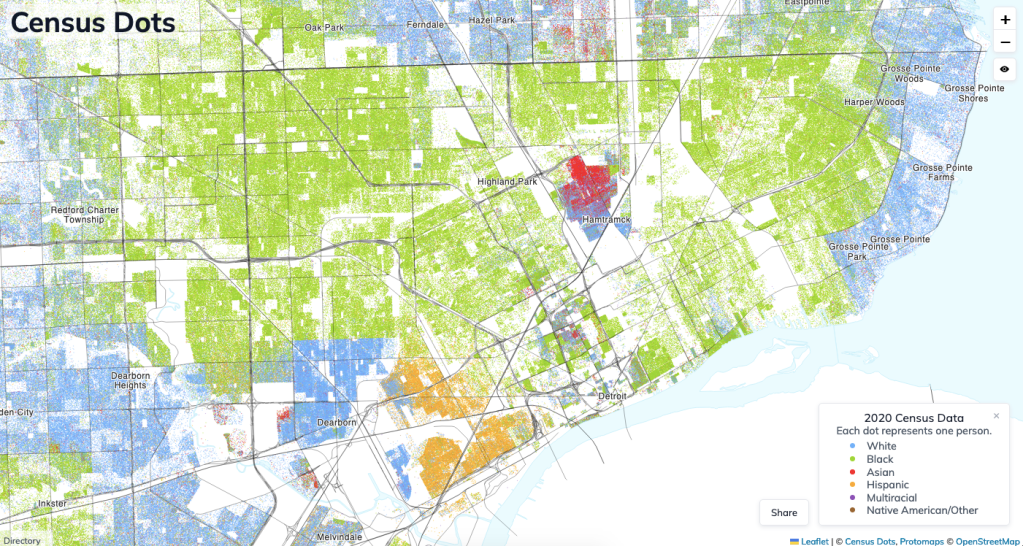
As a map nerd, I had loved Dustin Cable’s 2010 Racial Dot Map which he had created at UVA. I was saddened when this map left the internet, so as a way to get more comfortable using Census data and to learn some exciting new web map technologies, I decided to create an updated racial dot map using 2020 Census data.
Similar to previous dot maps, this map was created by combining two census data sources: the population counts published in the State Redistricting Data and the Shapefiles defining the census’s geographies. The decennial census provides population counts down to the census block level – an area roughly the size of a city block – enabling a fairly high degree of geographic accuracy. Dots are color coded based on the racial categories defined by the census. The dots within a given census block are placed randomly, which is why you might find some dots in unlikely places like parking lots or bodies of water.
The data comes together to create an extremely visually compelling map, both when viewed at the national scale and at the scale of individual regions like Metro Detroit. It often illustrates the stark divides that persist across much of the country.
The fictional Detroit Transit Authority rapid mass transit system consists of six (6) color-coded heavy rail rapid transit lines and 126 station stops that form a network of commuter routes connecting major points of interest in the city of Detroit with terminals in some nearby inner-ring suburbs and DTW airport. The majority of the system runs on two-track elevated concrete structures in the outer neighborhoods of Detroit with third rail power. In the more densely populated areas, commercial districts, downtown, and near major landmarks or freeway interchanges the routes descend into subway tunnels to bypass and avoid these things.
The DTA Rail System most closely resembles the newest parts of the Chicago ‘L’ both above and below ground. Resources from the Chicago Transit Authority (CTA) will be referenced in this brief. The track configuration expands from two tracks to three, four, or five tracks in some areas where routes run concurrently (to allow for bypassing), in areas where there is an extra siding track (for layups), and in the case of the Woodward subway, a fifth center track to provision for one-way peak direction express service. Switches are strategically located and periodically spaced to allow trains to change tracks.
The DTA Rail System is built completely independently of the existing transportation systems in Detroit: the People Mover and the M1 light rail system. The Detroit Transit Authority is a new state independent government agency established to succeed DDOT, unify Detroit’s transportation, and operate the flagship new rail system. It is largely subsidized by the state and Wayne County (but notably not Oakland or Macomb counties). DPM and M1 Rail come under this umbrella as does the DDOT bus system. The existing DDOT bus system routes are adjusted to better intersect the DTA Rail System and align with its departure schedules to make connections easy for riders. Bus Rapid Transit (BRT) lanes and stations will be added to Michigan, Grand River, and Gratiot where easy connections exist with the DTA Rail System like at Gratiot/Warren and Michigan Central. Some transfers exist between subway and elevated lines like at the Woodward/Warren station. The terminals are designed to be multi-modal with suburban SMART bus connections and provisions to connect to a future regional rail network.
Near the Yellow Line Terminal at Fairlane Dearborn. I imagine this 3-track terminal station making use of the vast property around Fairlane Town Center and adjacent to a park and ride lot. Maybe you see the mall or the old Hyatt in the background.
Where the Red and Blue Lines run concurrently in Southwest Detroit. This is a four-track elevated structure that runs just off of Fort St (along the north side of I-75). This view could include the Ambassador Bridge in the background. Junction is a transfer station with a double island platform arrangement. Clark and West Grand have single island platforms.
The Woodward Subway. I think it would be cool to show one or more underground stations on the Woodward Subway like District, Campus Martius, or Hart Plaza. Another view could include what the ground-level subway entrances on Woodward look like. Will have to discuss the platform arrangement at the transfer stations – perhaps they are double island or stacked side platforms.
Woodward/Warren area. The Red and Green lines run underground here and the Yellow Line runs above ground, making for an interesting view of the elevated-to-subway transfer. Maybe even a cutaway view. Notable Midtown buildings could be shown in the background here.
Outer Green Line. These views could present what the DTA system looks like running through a typical residential neighborhood. The curve between Dexter Linwood and McNichols could be cool to show. Another cool view could be the elevated structure passing over Oakman Blvd.
Alter Road Green and Pink Line Terminal. Right before this station on the Detroit side is one of the major rail yards which could be included in the view. This is another view where you could see what the system looks like traveling through a typical residential neighborhood.
This map imagines what a connected future of shared mobility and universal access could look like for Metro Detroit. It sets aside traditional assumptions and our current short-sighted approach to regional development and embraces a shift to a more sustainable, shared allocation of resources for transportation. It is lightly based on an earlier map I produced calling for a reduction in Detroit’s freeway system.
Paul Jones III is a Detroit native and graduate of University of Michigan’s Taubman College of Architecture & Urban Planning. He currently lives in Cambridge, MA where he works as a Community Planner for the U.S. DOT Volpe Center specializing in program development and capacity building. The ideas and views expressed are his own and reflect his ongoing passion for the intersection of history, urbanism, and transportation justice in Detroit.
I made this is fantasy transit map for Metro Detroit with a few goals in mind. My first step was to create a map that would both revolutionize transit in Metro Detroit while also being as realistic as possible given our state and region’s lack of investment and what current right-of-ways exist. This map is an attempt at a compromise between fantasy and realism. It also tries to challenge the idea that Detroit is too decentralized to have good regional transit by showing that a good system can be achieved by going through the heart of Detroit.
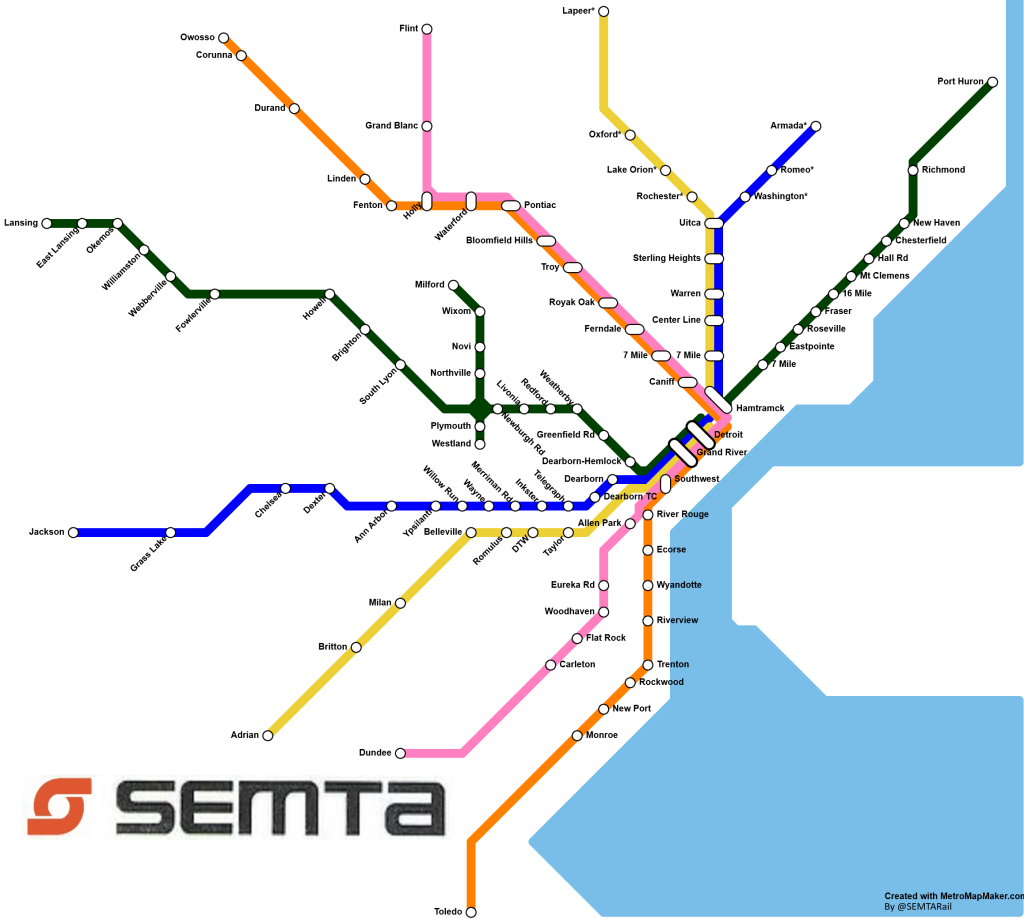
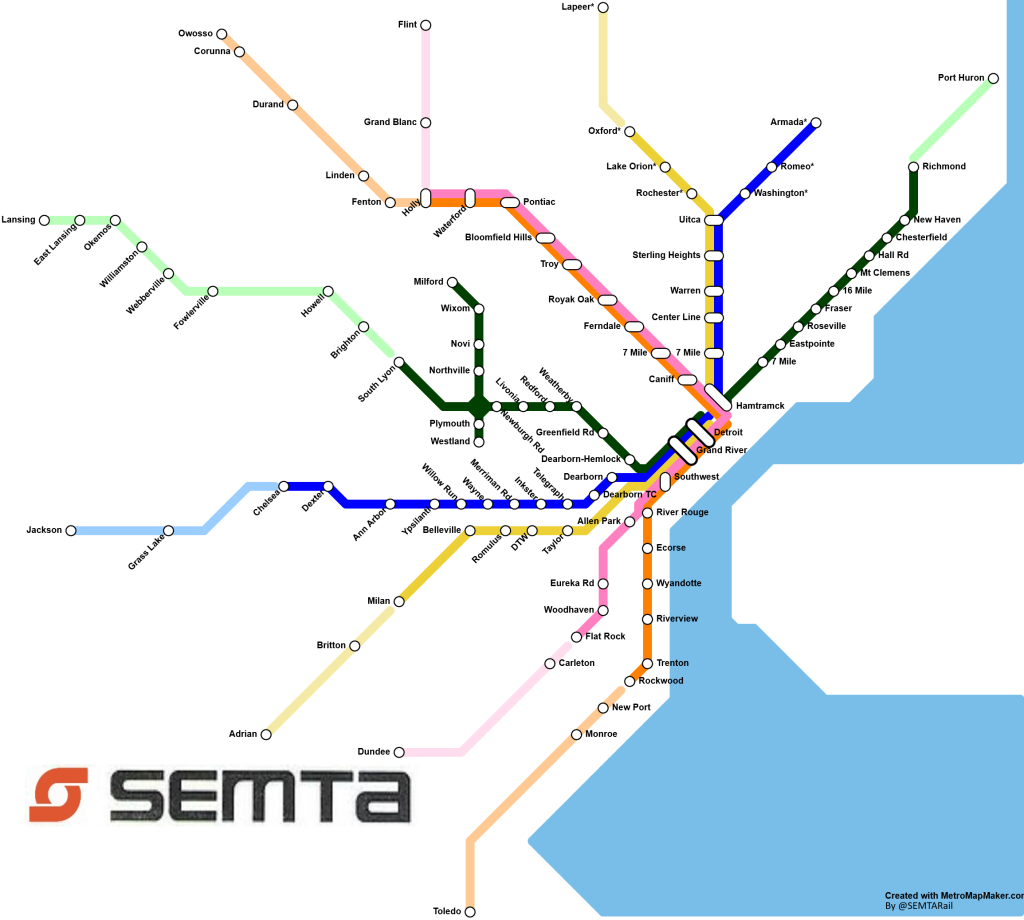
This map imagines the birth of the SEMTA Regional Rail, a callback to Detroit’s last regional rail service, the SEMTA commuter rail, which ran peak direction trains between Pontiac and a station outside the Renaissance Center. With the SEMTA Regional Rail above there were a couple goals. First and most notably, this map is based on existing infrastructure. Except for the stations marked with an asterisk (*), of which there are 7, in track alone these lines currently exist. Some of that track is either too old, disused, or single track and thus low capacity. But the fact that the right of way and much of the track for this project currently exists means that relative to other regional rail projects or ideas this project would be cheap to build.
This map also emphasizes cross region trips with large transfer stations in the city. This map attempts to answer the problem that Detroit is “too spread out” for regional transit. All the lines are on average as direct as they can be, and they all go through the heart of the city. While it may be faster to drive from each end of a line to the other, this directness makes the train competitive, especially when there is traffic or routes without a freeway. I also have noticed that many Detroit regional rail fantasy maps have trains dead ending in the city which in the modern era is more and more of an outdated use pattern. This map tries to emphasize regional trips while maintaining the same focus on Detroit.
The above version of the SEMTA map shows the same system but the lines are lighter when the system leaves RTA territory. RTA is the current 4-county regional transit authority, and if we wanted to fund this system without state help this is what that system would likely look like. The big thing this version of the map lacks is larger anchor cities on the ends of lines that would likely be drivers of ridership.
My hope with this post is to help people dream of a modern transit system for Detroit that would both serve the region well and feel realistic to dream about. I believe the system I have mapped is a realistic system to dream of given our region’s stubbornness with building regional transit. Future improvements could be:
Tunneling under downtown to move the transfer stations down from New Center
Expanding the Green Line branch to be its own line going from Flint to Monroe
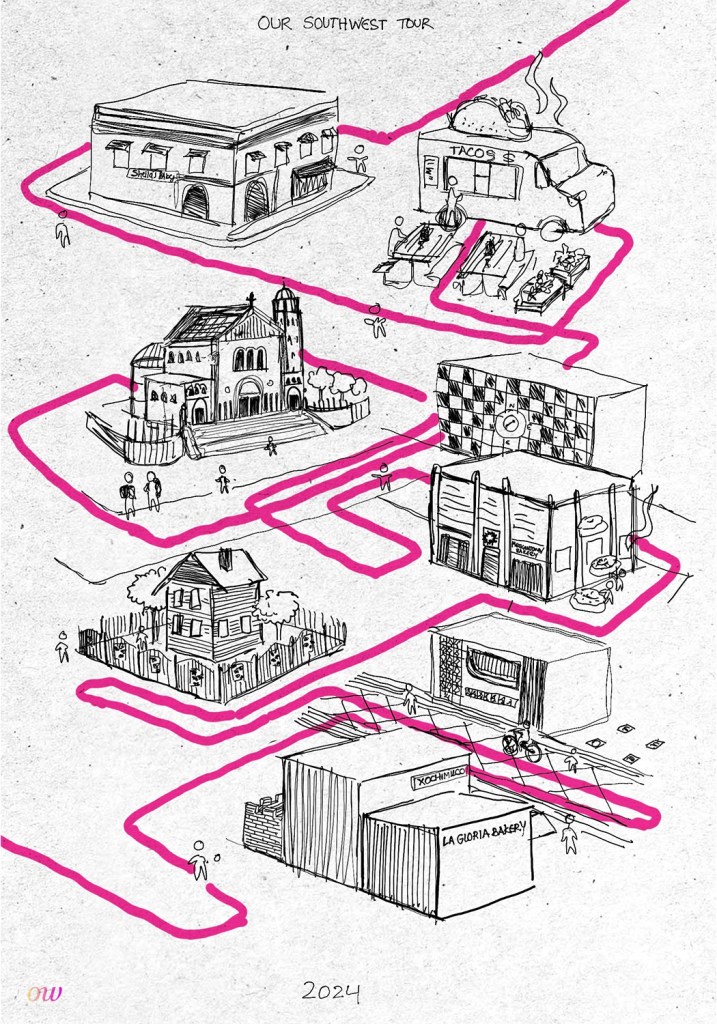
‘Our Southwest Tour’ map was initially created to explore new forms of graphic representation, but quickly turned into a piece that we incorporated into one of our current Southwest Detroit projects, a boba tea shop. As we began the process, we wanted to be intentional about how we blended the history of boba tea into the history of Southwest. In order to enrich our research and gather information to use in future projects, we spent a day on what we call, “Our Southwest Tour.”
This tour was done by other work designers Tian Li and Lauren Forgacs, and the map was digitally hand-drawn and created by Lauren. To begin our tour, we focused on some areas that we intentionally wanted to explore; Bagley, Vernor, and Springwells, in that order. We spent a day taking our time walking through each area, and noted architectural details and specific spots that really stood out to us. We paid attention to repetitive color schemes, murals, patterns, and constructional details. We took lots of photos of each area, and now have a large library of images from Southwest.
Concerning the details of the map itself, the pink line is loosely our path through the spots. Starting from the bottom, there is the Bagley Area. You can see where Lauren drew the pedestrian oriented streetscape, La Gloria Bakery, Xochimilco, and the building across the street that had notable ironwork in the window and on the wall. On the bottom left, there is a house depicted in the neighborhood on Bagley, and it has some of the ornate floral details we saw within the ironwork on the fences in that location. Moving further up the map is the Vernor area. You can see MexicanTown Bakery, and above that the mural with a compass is pointing to South West. On the right, there is Most Holy Redeemer Church, and some students coming out of class. Moving further up, you can see El Imperio taco truck, where Tian and Lauren enjoyed some delicious Birria tacos. To finish the map, on the top left is Sheila’s Bakery, which marked the last area Tian and Lauren explored.
by: Gene Estrada, Detroit River Story Lab, University of Michigan
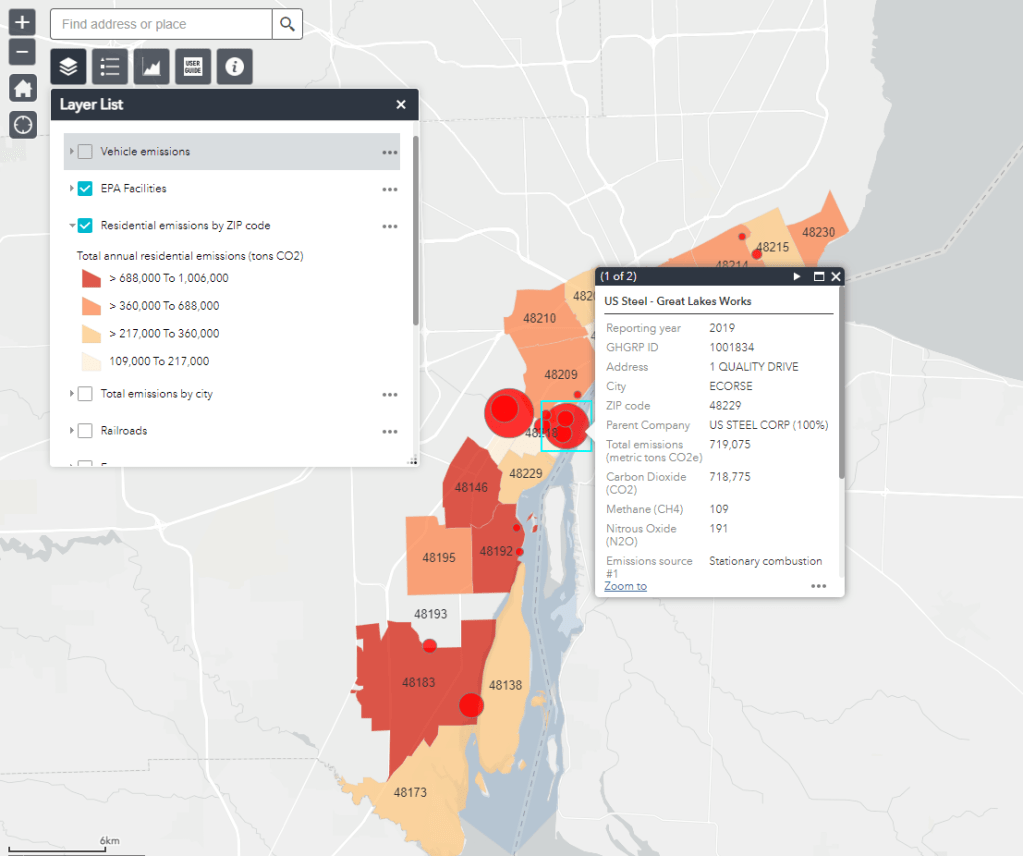
This map was created by the Detroit River Story Lab at the University of Michigan, Ann Arbor. Our goal is to estimate the total amount of greenhouse gas emissions (i.e., create an emissions inventory) for the Detroit River Corridor. We created this online, interactive map as an accessible tool for anyone interested in understanding carbon emissions at a local level. We are currently working with local educators in Detroit-area schools to include the use of this tool in school curricula.
To create this map, we collected carbon emissions data from a multitude of sources, including the U.S. Environmental Protection Agency’s Greenhouse Gas Reporting Program, the Database of Road Transportation Emissions, the U.S. Army Corp of Engineers, and more. Each carbon emissions source (facilities, vehicles, river cargo shipping, etc.) is displayed as its own map layer, which users can toggle on and off, and contains detailed information available the carbon and other greenhouse gas emissions associated with that layer and components within the layer. A full list of data sources, with links, used to create this map, and a summary of the approach we used to construct the map, can be found in the About tab.
We implore users to explore the map layers and look for patterns in the spatial distribution of emissions. We also provide layers showing major freeways, railroads, and U.S. Census data to encourage users to look for associations between infrastructure, demographics, and carbon emissions in the Detroit River area.
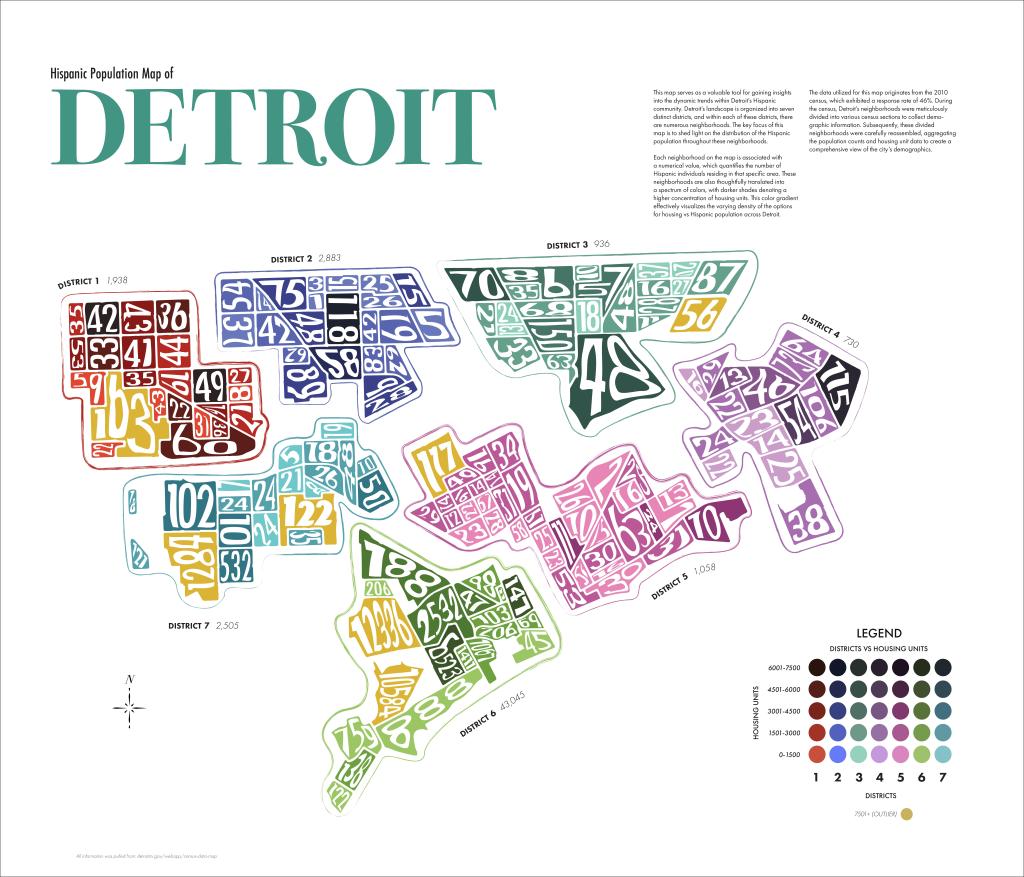
Embarking on this project has been a fascinating journey for me. As a Hispanic male from California, relocating has somewhat severed my connection to my roots. In my California days, I was surrounded by a community that shared my heritage, but in my new home, it’s a different story—Taco Bell and the occasional Hispanic food truck provide a glimpse of familiarity. This endeavor became an opportunity for me to delve into the intersection of my heritage and my current city. Opting for a minimalistic aesthetic was a conscious decision—I wanted the focus to remain on the data without overshadowing it. Navigating the color scheme posed its own challenge; I aimed for distinct colors to ensure each district stands out unmistakably. It’s been a project that not only explores demographics but also pushes my creative boundaries in unexpected ways.
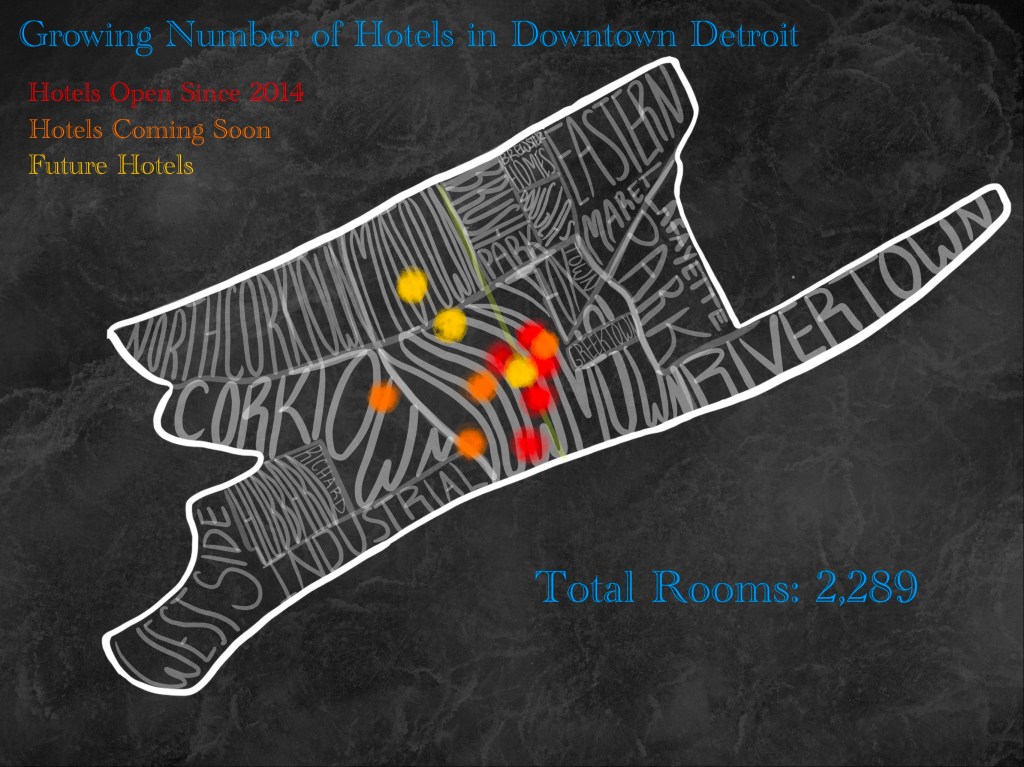
I chose this specific data since it can directly represent the growth the city of Detroit has gained through multiple factors, such as popular events, sights, food, and history. Detroit has so much character and has come a long way in just a matter of a decade. This data puts a smile to my face knowing people are visiting to appreciate the city just as much as we all do.
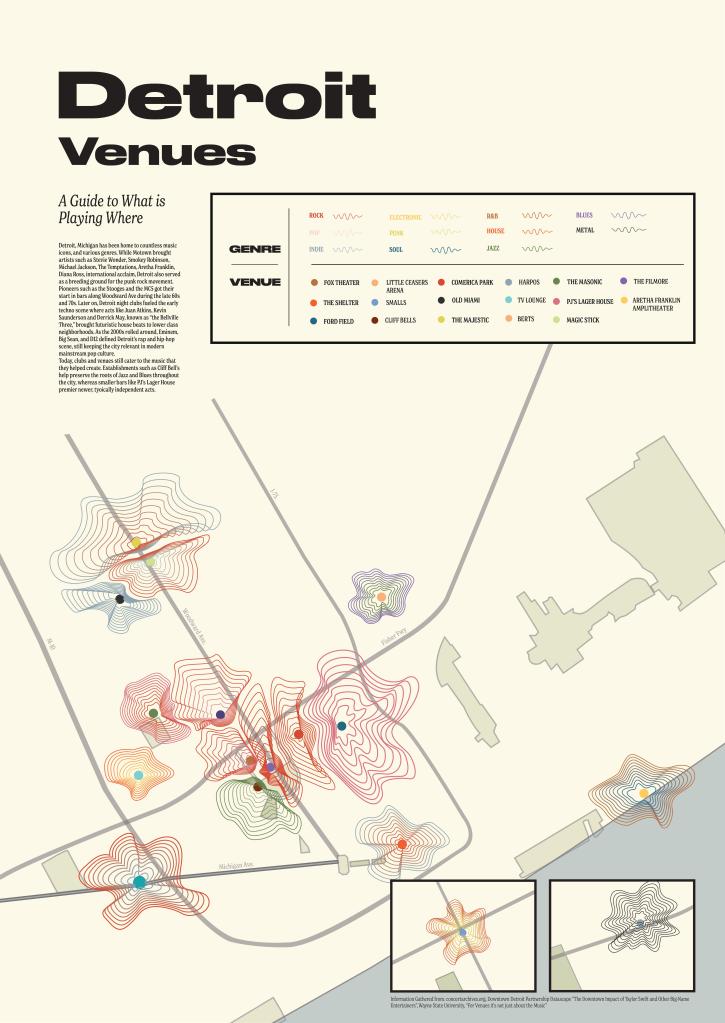
I was inspired to show the spread and growth of Detroit’s music scene. Detroit is home to countless music icons, and various genres. While Motown brought artists such as Stevie Wonder, Smokey Robinson, Michael Jackson, The Temptations, Aretha Franklin, and Diana Ross, international acclaim, Detroit also served as a breeding ground for the punk rock movement. Pioneers such as the Stooges and the MC5 got their start in bars along Woodward Ave during the late 60s and 70s. Later on, Detroit night clubs fueled the early techno scene where acts like Juan Atkins, Kevin Saunderson, and Derrick May, known as “the Bellville Three” brought futuristic house beats to lower-class neighborhoods. As the 2000s rolled around, Eminem, Big Sean, and D12 defined Detroit’s rap and hip-hop scene, still keeping the city relevant in modern mainstream pop culture. Today, clubs and venues still cater to the music that they helped create. Establishments such as Cliff Bell’s help preserve the roots of the Jazz and Blues throughout the city, whereas smaller bars like PJ’s Lager House premier newer, typically independent acts. I feel it is important to show the history and innovation that music has played in the city of Detroit. I wanted to show this movement of music through sound waves. These sound waves spread over the city to communicate how many shows play at each venue and what genre of music.
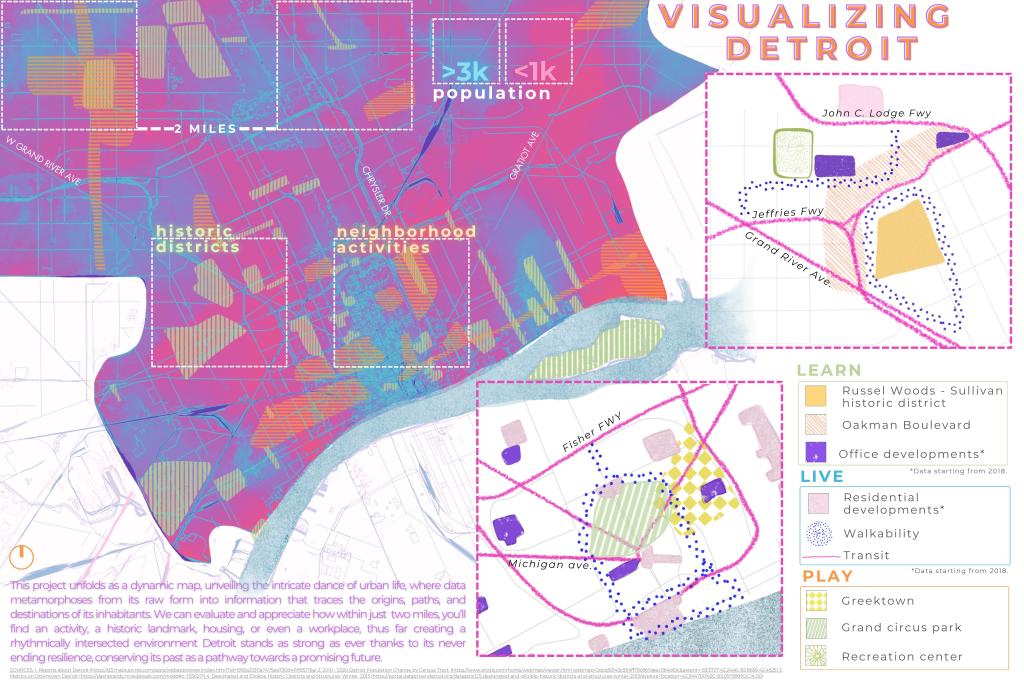
Exploring Detroit’s data set whilst taking into account its fascinating historical narrative, I knew I wanted to take these concepts hand in hand and present a project that had a compelling message. But there’s a crucial step in between—making sense of the data. This transformation is not just about presenting numbers and figures; it’s about crafting visual metaphors that resonate with our collective understanding. I delved into the dataset with a guided vision of how cities work, how and where its population tends to flourish, where essential services and parks thrive, and how these elements intertwine to impact the quality of life. These themes were carefully chosen to serve as the compass for my exploration of the data.
WORK: In this city, work and life are interwoven in a tapestry that celebrates and embraces diversity within its myriad activities, ultimately enhancing the quality of life.
PLAY: The city’s heartbeat pulses through the various activities that grace its streets, offering an insightful glimpse into its vibrant soul.
LEARN: By charting the historical districts, we embrace the past as a guide toward our future. A city’s strength etched by persevering its historical landmarks, parks, and constant evolution.
LIVE: Our lives are inextricably intertwined with the myriad offerings of this city, creating a rhythmic symphony of experiences and opportunities.
This project unfolds as a dynamic map, unveiling the intricate dance of urban life, where data metamorphoses from its raw form into information that traces the origins, paths, and destinations of its inhabitants. For urban planners and city leaders, these insights can reveal hidden structures, eventually finding a tool to shape and improve their communities. Some elements may remain open to interpretation, but therein lies the beauty and potential of art itself. In conclusion, data serves as the cornerstone upon which we construct our understanding of the world, a bridge between history and the present, a canvas for our artistic expressions, and a compass guiding us toward a brighter, more informed future.
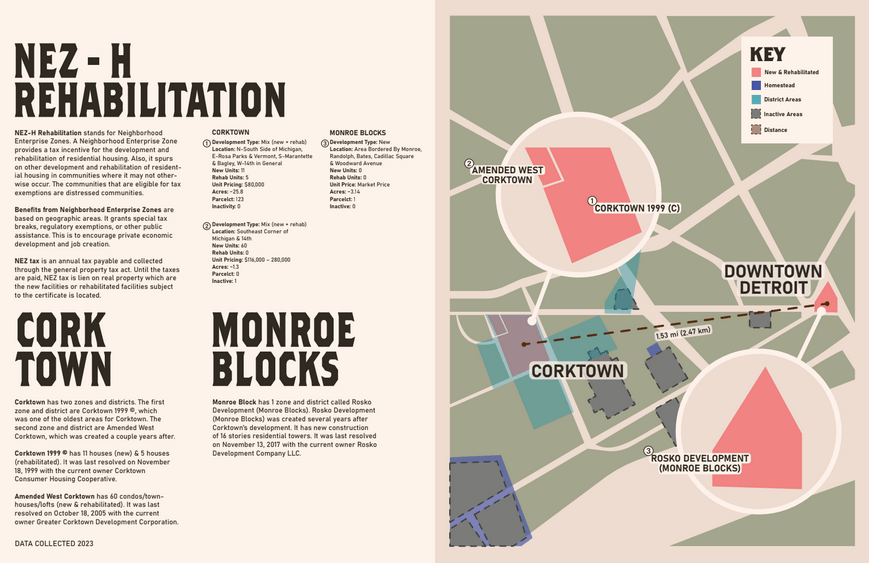
The dataset chosen was from the NEZ-H Rehabilitation and Homestead, specifically zones from Corktown and Monroe Blocks. Most younger people are not aware as to what neighborhood enterprise zones are in Michigan. This map is to educate the younger audience and anyone else who does not know what these zones are for. I compared an slightly older zone, old zone, and a zone more recent. I provided information from the City of Detroit Open Data Portal in the boundaries section of datasets. The illustrations are created by me with a help of the maps via Google. The colors are used to give a neutral setting with some pop of color depending on the importance of the map. The elements in my visual is to indicate any information provided about the tax property, borders, and more.
One of my biggest complaints about navigating Detroit is how disconnected the streets are. On foot, by bike, or in a car, getting around the city can be unnecessarily confusing because of the division caused by the freeways, the mash-up of different grid systems, and the inconsistent development patterns.
In addition to my personal experience, a lot of the inspiration for this project comes from Paul Sewick’s “Detroit Urbanism” blog and his series on the Woodward Plan, in particular. It was this blog that made me realize how incomplete the Woodward Plan really is. Much of the confusion of downtown is due to the inelegant way that the Woodward Plan is cut off and forced into a rectilinear plan west of Cass, east of Brush, and below Michigan and Monroe.
To visualize a more connected Detroit, I created two sets of maps that include road networks, transit networks, and zoning. There is one set of maps for downtown and one set of maps for a generic square mile of greater Detroit. I like to imagine that these two sets of maps could be used as templates to create a master plan of the city to redevelop its transportation system. In this fantasy master plan, downtown anchors the city while the square mile grid is repeated to the city limits, making occasional adjustments for spoke roads, freeways, railways, parks, and changing grid orientation. The goal is to have an easily navigable city with plenty of greenery, good public transit, and regularly spaced thoroughfares that don’t end abruptly.
Road Network
Downtown
To create my idealized map of downtown, I started by laying out the centerlines of the Woodward Plan in Fusion 360. I adjusted the plan so that the upper section is complete but the section below Michigan and Monroe is largely the same as it is currently. I also added a half mile to the West, North, and East to provide context of how downtown would fit into the larger city grid. I then used Inkscape to widen these centerlines to specific widths and color coded them by street type.
There are several major changes between this idealized map and what exists currently. One major change is that I have re-aligned a few of the spoke roads (and added a new one) to connect more directly with Campus Martius. Bagley and Grand River have been shifted to meet Michigan and 2nd Ave at a large roundabout. Similarly, Gratiot and Madison have been shifted and Mound Rd has been extended to meet Monroe and St Antoine at a large roundabout. These roundabouts are intended to provide park space as well as a safe intersection for the 7-way crossing. They are similar in size to Dupont and Logan circles in Washington, D.C. I also re-oriented Campus Martius to be more intuitive to navigate in the surrounding grid.
I applied road hierarchy concepts to further develop the grid. The 120ft avenues function as arterials, the collectors connect local streets to the avenues, and alleys provide service access to lots without clogging up traffic. To simplify intersections, local streets are converted to pedestrian streets where they meet 120ft avenues and at intersections with more than four legs. The 100ft avenues function somewhere between an arterial and a collector. Except for Woodward, tram lines are spaced roughly every mile.
Map by Dan Seiderman
Greater Detroit
The logic behind the rectilinear sections of the downtown network can be seen more easily in the square mile grid:
120ft Avenues are spaced every ½ mile.
Tram lines are spaced every mile.
Stops are spaced every ¼ mile.
90ft Collectors are spaced every ¼ mile.
60ft Local Streets are spaced every:
⅛ mile from west to east.
⅟16 mile from north to south.
60ft Pedestrian Streets are implemented where local streets meet avenues.
20ft Alleys only connect to local streets.
This setup ensures that a thoroughfare exists every ¼ mile. Additionally, these thoroughfares (90ft and wider) should all include dedicated bike lanes to provide a robust cycling network. Regarding the pedestrian streets, they allow permeability for pedestrians and cyclists while encouraging motor traffic to move through the city via the collectors and avenues. This incentivizes drivers to use local streets only for local traffic. It also provides pedestrians with an unbroken path along avenues for multiple blocks and gives corner businesses space for outdoor dining.
Map by Dan Seiderman
Subway Network
Downtown
Though Detroit’s population continues to decline, a future, thriving version of the city would need a robust public transit system. In addition to tram lines, my idealized plan calls for a subway system to fill this need. The spoke roads make an obvious starting point for a subway network since they radiate out from downtown and reach far into the suburbs. By adding a secondary grid network on top of this, an interwoven and well-connected system forms. Stops are spaced approximately every ½ mile for local service and every mile for express service.
With so many transit lines leading to Campus Martius, it would naturally make a great transit hub. In this plan, there are: five subway lines (Michigan, Grand River, Woodward, Mound, and Monroe) and 2 tram lines (Fort and Woodward) that all converge on the park. All this connectivity would make it a great location to add commuter and intercity rail. By branching off from existing rail lines around Fort St and Rosa Parks Blvd, a new line could be buried along Fort to bring these services to Campus Martius. Another line could branch off on the east side and connect to Campus Martius to form a passenger rail loop around downtown. The plots on both sides of the park could be used as stations, with the west station serving as a terminus for trips to the south and west and the east station serving as a terminus for trips to the north and east. Platforms for through-running tracks could be placed on a level below the terminus tracks to make this rail hub a real powerhouse.
In addition to many other intercity and regional rail connections, a link could be made between DTW Airport and Campus Martius that would take only 15-20 minutes. From Campus Martius, commuters and tourists could reach destinations such as:
The Fisher Building
Time: 10 minutes
Route: Woodward Express up to Grand Blvd then a 5-minute walk
The DIA
Time: 5 minutes
Route: Woodward Express to Warren then a short walk
Eastern Market
Time: 10 minutes
Route: Mound Local to Temple
The Renaissance Center
Time: 10-15 minutes
Route: Walk
Jefferson North Assembly Plant
Time: 15 minutes
Route: 5-minute walk to Hart Plaza then 10 minutes on Jefferson Express
Map by Dan Seiderman
Greater Detroit
Outside of downtown, subway lines are spaced every mile, alternating with tram lines so that there is rail transit every ½ mile. Local stops are spaced every ½ mile; express stops are spaced every mile.
Map by Dan Seiderman
Zoning
Downtown
With these idealized road and transit networks, a zoning pattern is needed to bring the streets to life so that people have destinations in this more connected city. To encourage a lively city with an easily repeatable development pattern, I created the following scheme:
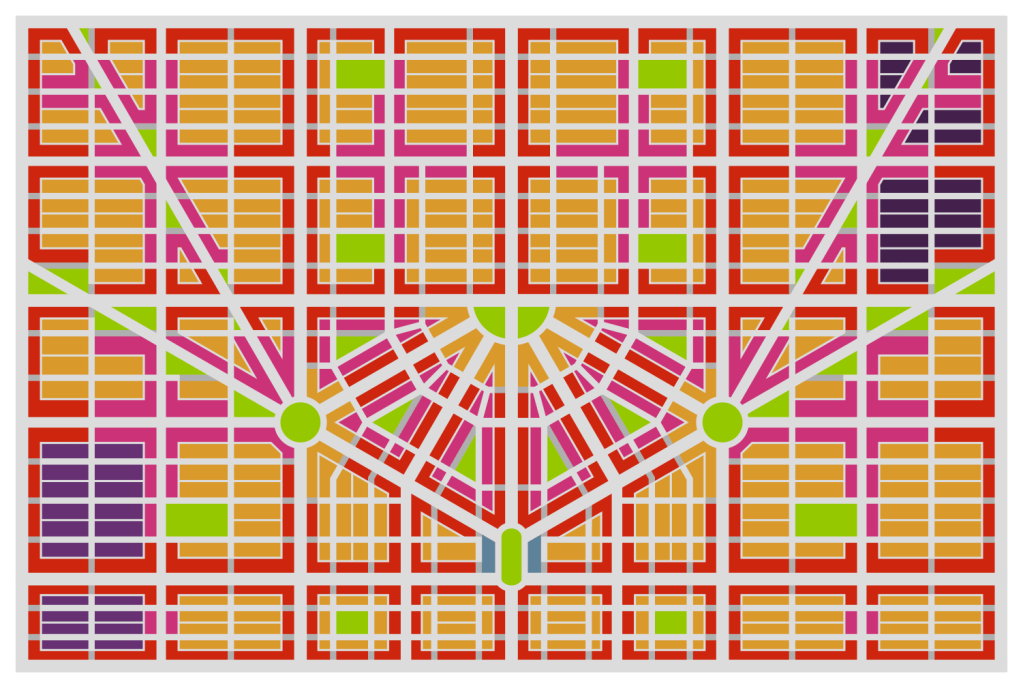
Avenues are zoned for commercial.
Collectors are zoned for mixed use.
Local Streets are zoned for residential.
Small and oddly shaped blocks are zoned as parks.
Additional parks are spaced so that the closest one is no more than a five-minute walk away.
Local streets can also be zoned for industrial such as in Eastern Market and Corktown. This would create a similar environment to the business parks in the suburbs in the sense that industrial centers would be isolated from residential areas and through traffic would be restricted. Since they are surrounded by commercial along their thoroughfares, it would help to maintain a safe and friendly environment for pedestrians and cyclists even in an otherwise industrial area.
Map by Dan Seiderman
Greater Detroit
The zoning scheme can be more easily observed in the generic one-mile square grid outside of downtown. Pockets of housing are surrounded by commercial corridors and occasionally broken up by large parks.
Map by Dan Seiderman
Conclusion
To attract people to the city, redevelop empty blocks, and remove excessive surface parking from downtown, Detroit needs a solid transportation network that gives people options to easily navigate the many opportunities that the city provides. While rebuilding the city exactly according to these maps may be impossible, many of the concepts are relatively easy to apply. Concepts like multi-modal streets, mixed-use zoning, plenty of park space, and regularly spaced thoroughfares all lead to a more connected city.
A more connected city is one full of opportunities. A city with a coherent network of roads is one that makes it easy to develop public transit routes. A city with good public transit is one where people of all means can easily get around without sitting in traffic. A city where people spend less time sitting in traffic is one where people are happier and more productive. A more connected Detroit is a thriving Detroit.
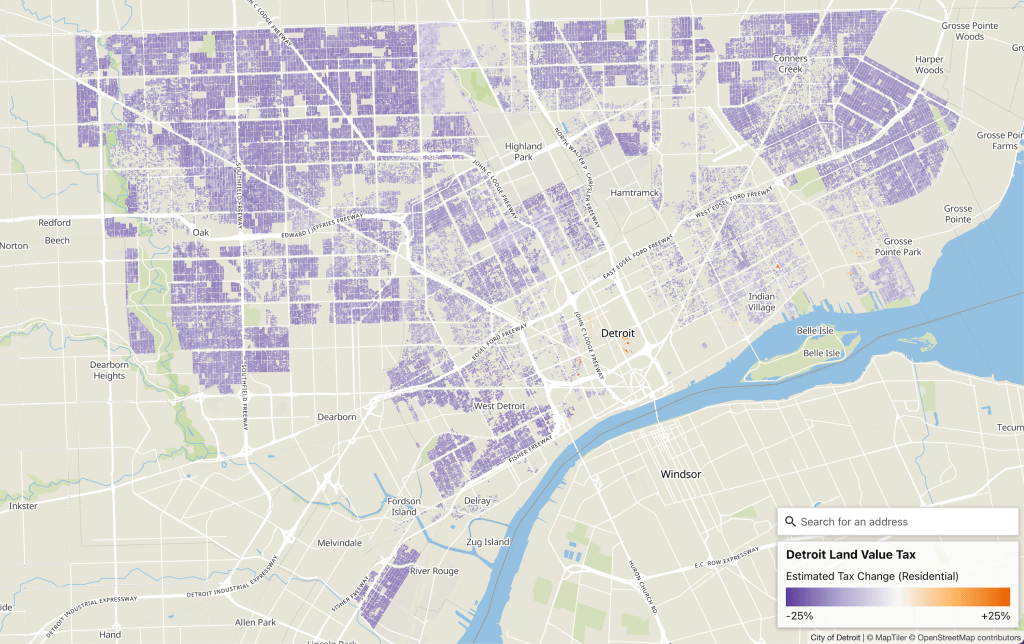
The current data includes estimates of what residential parcels would have seen on their 2023 tax bill under the proposed plan, but makes it possible to see trends across the city, with the majority expected to receive at least some reduction in taxes. Vacant parcels on average would see a slight property tax increase with improved properties seeing a decrease according to the estimates, with downtown parcels seeing the steepest increases with or without improvements.
When zoomed out, some parcels may be combined with others nearby with their average percentage change estimate used to determine their color.
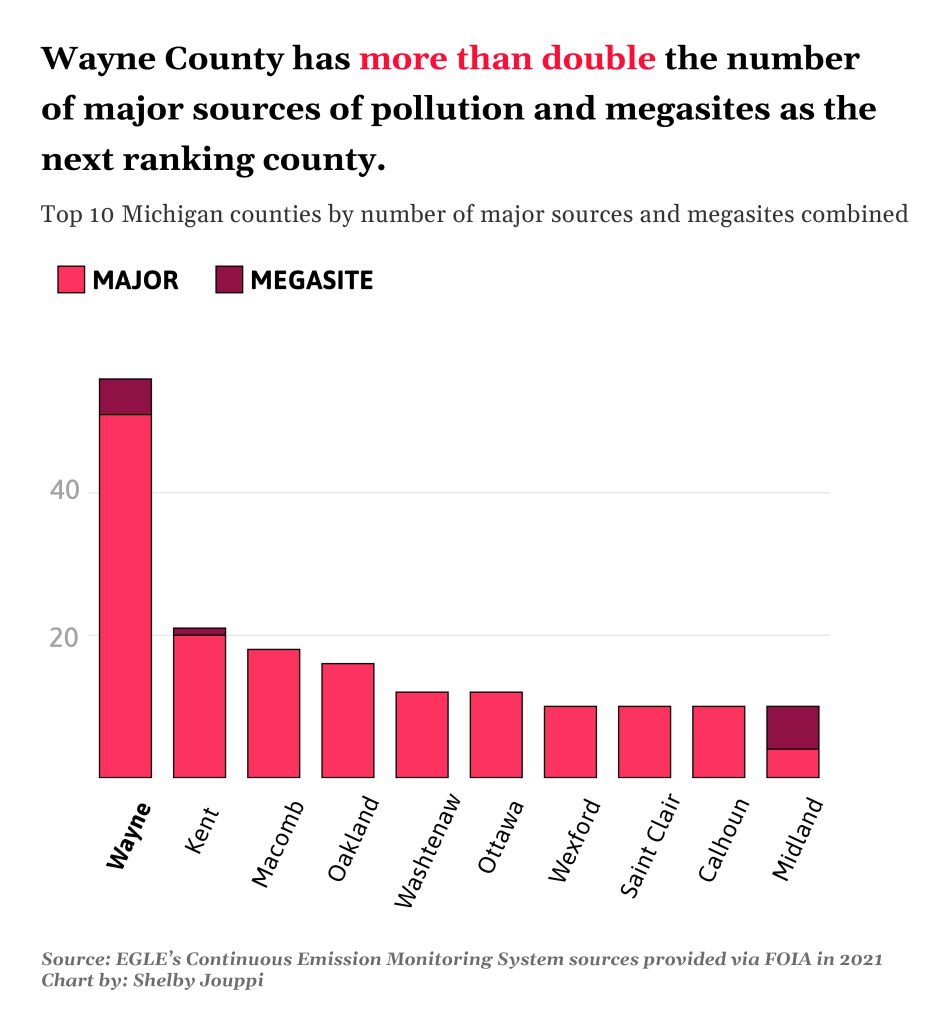
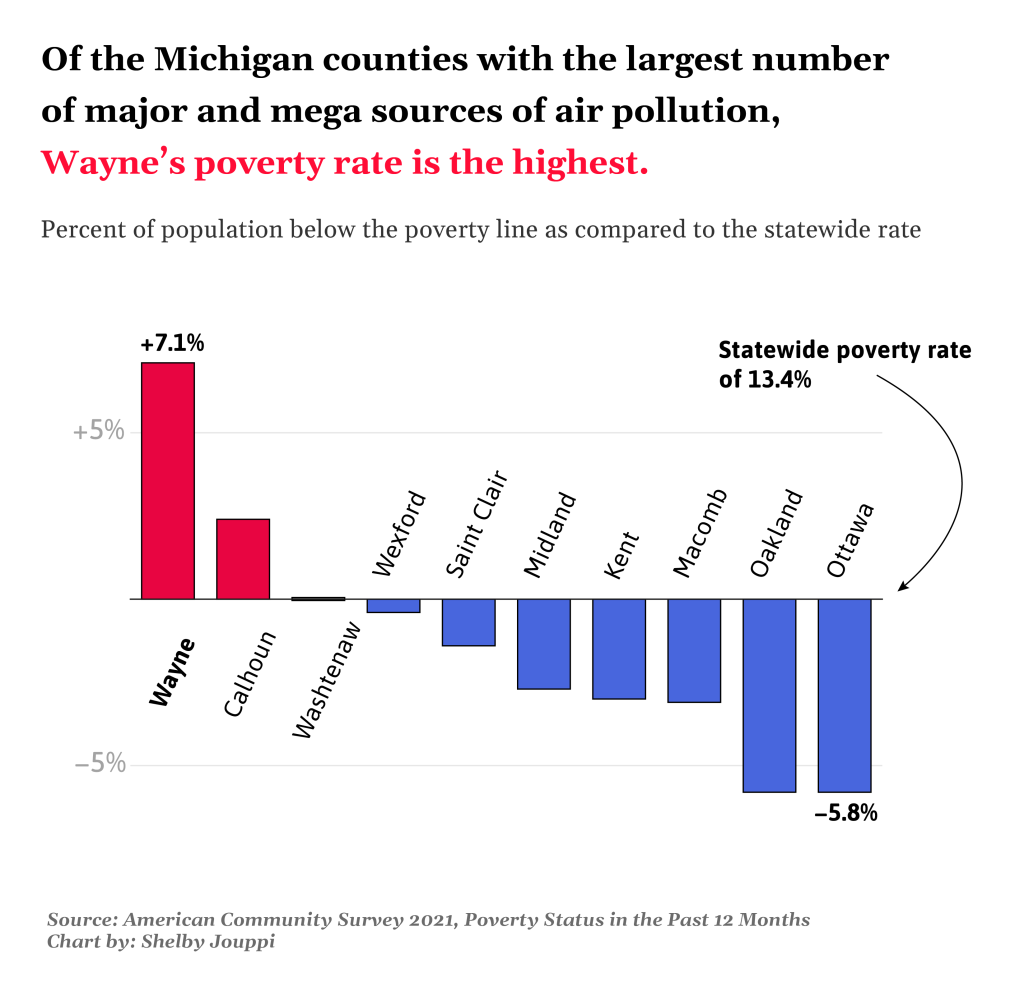
Detroit and Wayne County are home to a disproportionately large number of significant sources of air pollution. These facilities are required to have a permit to pollute, and the Michigan Department of Environment, Great Lakes and Energy (EGLE) that routinely inspects them and responds to complaints will issue a violation notice if the facility breaks that permit.
About half of the major and mega sources of air pollution in Wayne County have received multiple violation notices since 2018.These companies have exceeded their allowed pollutant levels, failed to keep accurate records of their emissions, or disturbed the neighborhoods around their facilities with offensive odors or potentially dangerous fallout.
Much of this goes on behind the scenes, and a new tool from Planet Detroit and myself makes it easier to keep track of these violations. The Michigan Air Permit Violation Dashboard updates every day with the newest violation notices issued by EGLE and includes an interactive map where users can explore each facility’s violation history.
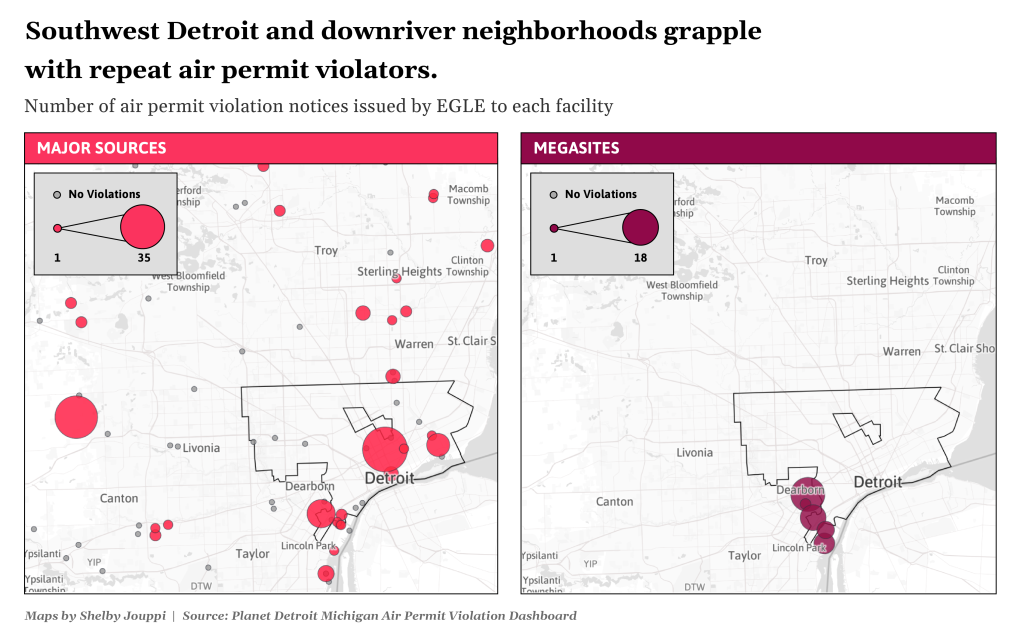
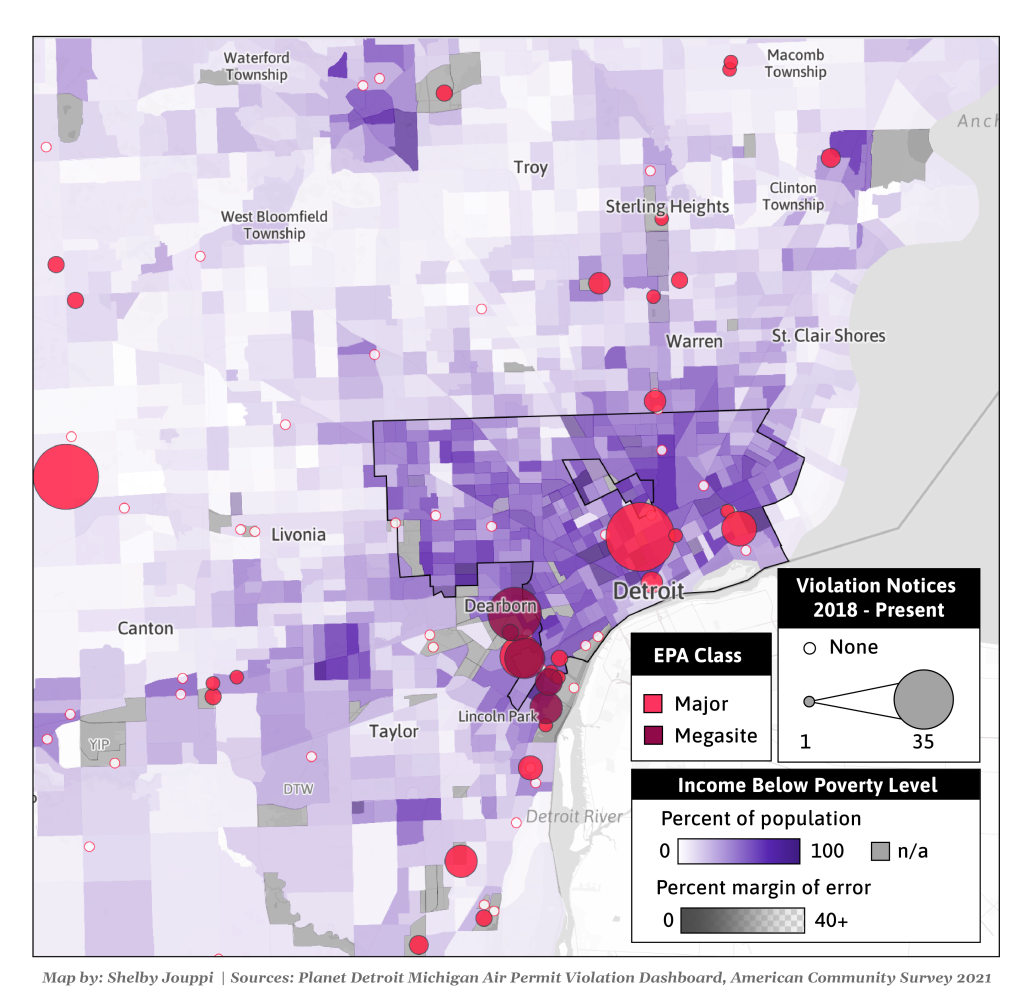
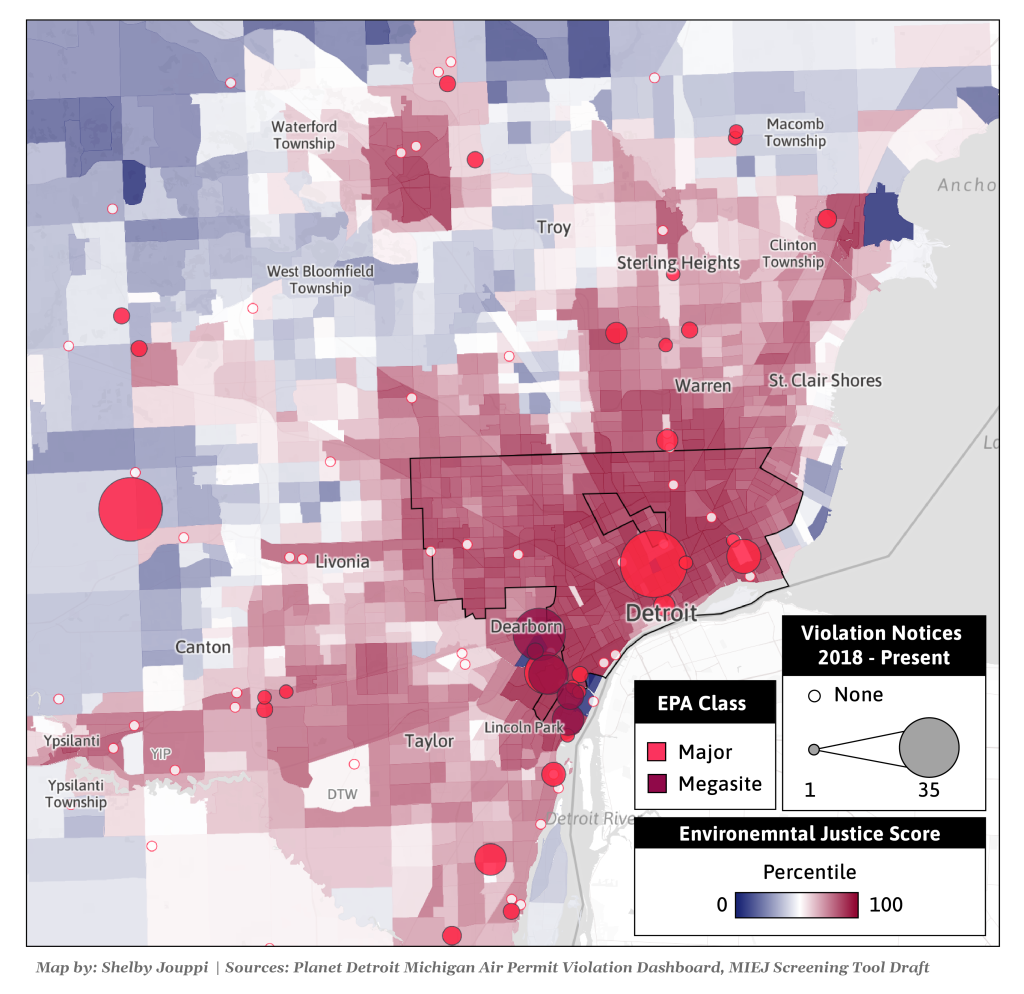
Data from this project shows that Detroit and downriver neighborhoods are battling a high concentration of large sources of air pollution that chronically break their permits.
Three major polluters in the industrial corridor around the Ford River Rouge Complex have violated their permits more than 10 times in the past six years. Take Cleveland Cliffs, for example, a steel manufacturing megasite on the border of Dearborn and Detroit. It has received 18 violation notices, most recently for failing to test for mercury emissions, emitting dark smoke into the air and releasing slag pit and sulfur odors into the community.
When overlayed with income data from the 2022 American Community survey, it’s clear that poorer census tracts in and around Detroit are affected by the large concentration of significant air pollution sources that keep violating their permits.
The Michigan Office of the Environmental Justice Public Advocate published an environmental justice screening tool last year to shed light on areas of the state that experience high levels of pollution exposure as well as poorer health and socioeconomic conditions. The data show that environmental justice is an issue for the entire metro Detroit region.
Shelby Jouppi is a freelance data journalist who covers public health. Before recently completing her master’s in data journalism at Columbia University, she was a reporter for WDET 101.9 FM, a news app designer and a podcast producer.
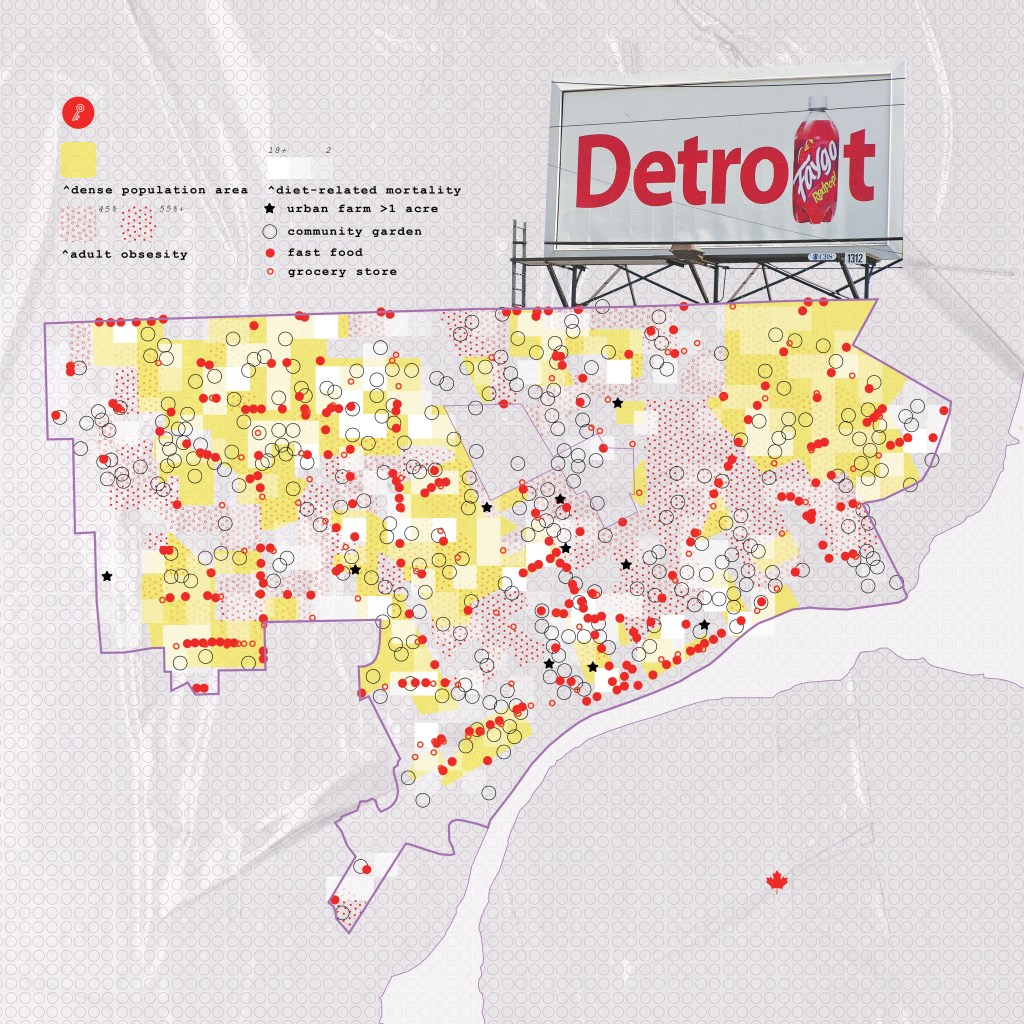
For Graduate Architectural Thesis, 95 ASB : Radical Exclusivity in the Food Commons
The thesis lives within and adapts the urban fabric of Metro-Detroit, bolstering and promoting the emergence of the Food Commons. This thesis is anti-tabula rasa, acknowledging the systematic injustice present in policies and organizations as well as the current intentional and community-driven efforts to promote food sovereignty in situ.
The constellation of actors and emotions that Food includes provides both extremely prescribed architectural modes and thinking, as well as immense human creativity, spatial adaptation, cultural expression, and feeling. The work takes advantage of the intense tactility and breadth of intimacies innate to Food and Food spaces, presenting a new exuberant and empathetic mode of architectural design, one that enables the persons and producers within the urban fabric to maximize its usage and atmosphere.
The project operates on a variety of scales, from the creation of urban-adapting exclusive furnitures, to larger zoning and planning schema taking advantage of existing convivial Food experience in Metro-Detroit, such as urban farms, food trucks, etc. The scales and tactile nature of the work evoke the relation between a family meal and the larger infrastructural systems that govern relationships and understandings of Food, consequently blurring the lines in order to dismantle preconceived notions, provoke systematic change, and spark joy and engagement of each producer within the Food commons.
The thesis works with each producer of the urban Food fabric and enables their own radical exclusivity to promote connectivity, exposure, and collective work.
Jordan Zuael is an architect/designer, most recently graduating with a Masters of Architecture degree from the University of Michigan Taubman College. My great-grandparents immigrated from Italy to Detroit, and my family has lived and worked there ever since – with my architectural thesis, I naturally followed suit. The city, food, and design have been my greatest passions, and I continue to be inspired by the rich history, tenacity, and passion in the Detroit community.
This map was created as a piece of research into the Indian Village neighborhood. We wanted to examine how the viewsheds became restricted by the dense number of homes in 1951 and then opened back up after blight took parts of the city out. As a part of a course that required us to design a response to a Detroit neighborhood that had experienced major demolitions, we felt it was important to examine how it changed spatially over time.
The images were produced using a Grasshopper visual script in a Rhino model of the neighborhood. Firstly, my team and I created maps of the neighborhood in 1910 and 1951 using Sanborn map database. Then we created a 3D model with the Elk plugin, which used Open Street Map data to create the building masses. Once we had the model, we used the Isovist component to create our viewsheds. The component starts at a selected point (designated by the “plus” signs on the map) and draws bursts that connect to the closest points of each geometry near it.
This process allowed us to look at how different homes on the site were connected by view, and when we got down to ground level, we could compare how it felt to be in the neighborhood at its most dense and at its most sparse. Honoring the dignity of the residents was important in the design process, so our response needed to take into account the experience of the street.
Maggie is a student interested in observing life at all scales through varied mediums. Currently studying at Lawrence Technological University, she is pursuing a dual-degree in civil engineering and architecture with the eventual goal of studying urban design in postgraduate work.
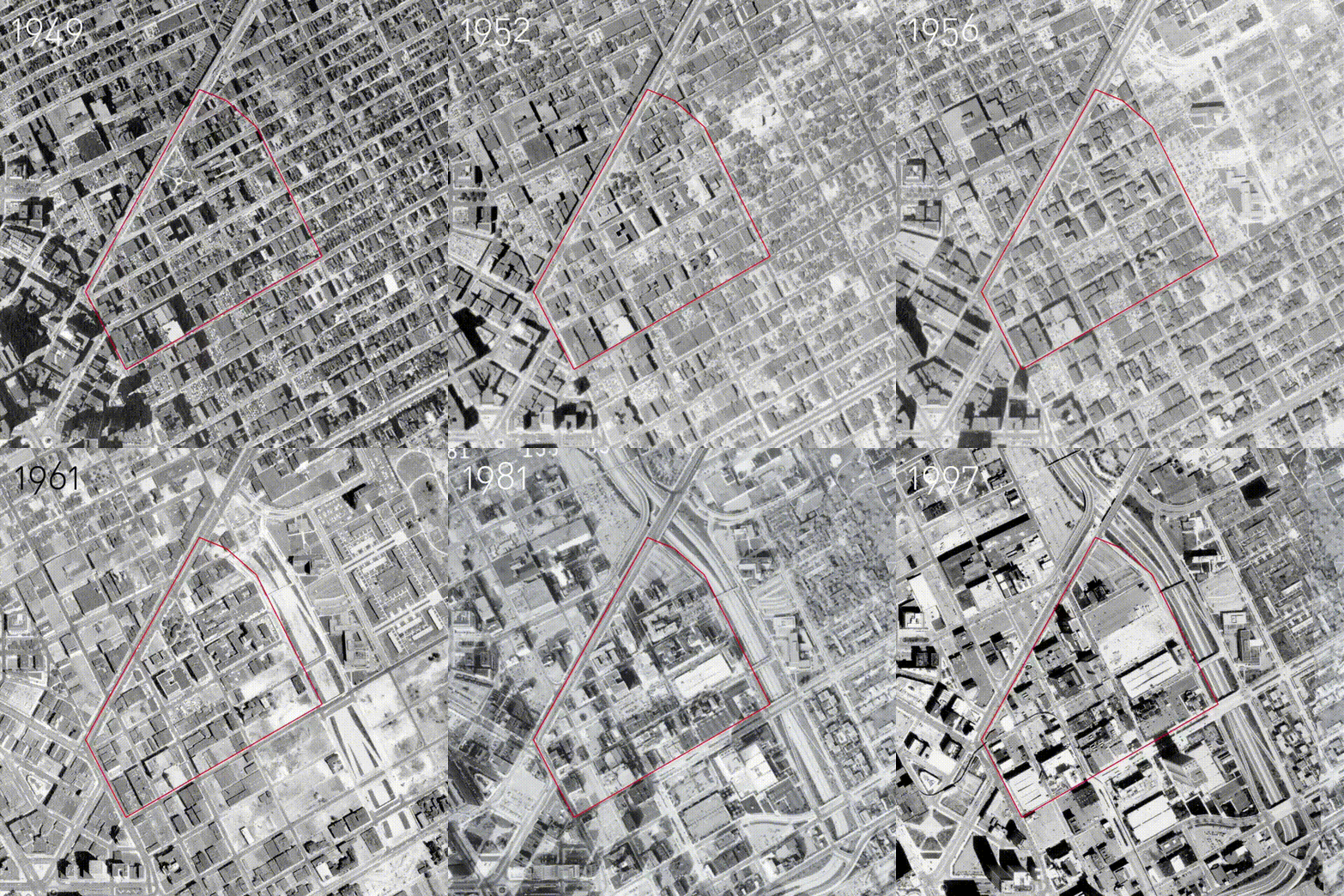
This series of aerial images was research produced as part of the Greektown Neighborhood Framework Vision. This series of aerial photographs from the DTE Aerial Photo Collection held by Wayne State University are superimposed to help tell a jarring story of priorities and the detrimental urban planning which spanned several decades in Detroit.
From the destruction of Black Bottom along Hastings Street for the creation of I-375 to the demolition of the historical Victorian fabric of the city in favor of parking garages and lots, Greektown has been reduced to “Greekblock” but yet still reveals that persistent community engagement is our only key to salvaging that which has been lost in the name of speed and technology. These maps helped influence the plan by reintroducing “Clinton Park” which existed in the city for a century before it was destroyed by the construction of the Frank Murphy Hall of Justice. With some political support the park may one day find its place back in Greektown.
JonathanHanna is the Design Principle of HBB Design Collaborative and Adjunct Faculty at Lawrence Technological University College of Architecture and Design
Detroit has an incredible opportunity to reduce the impact of highways on our urban fabric.
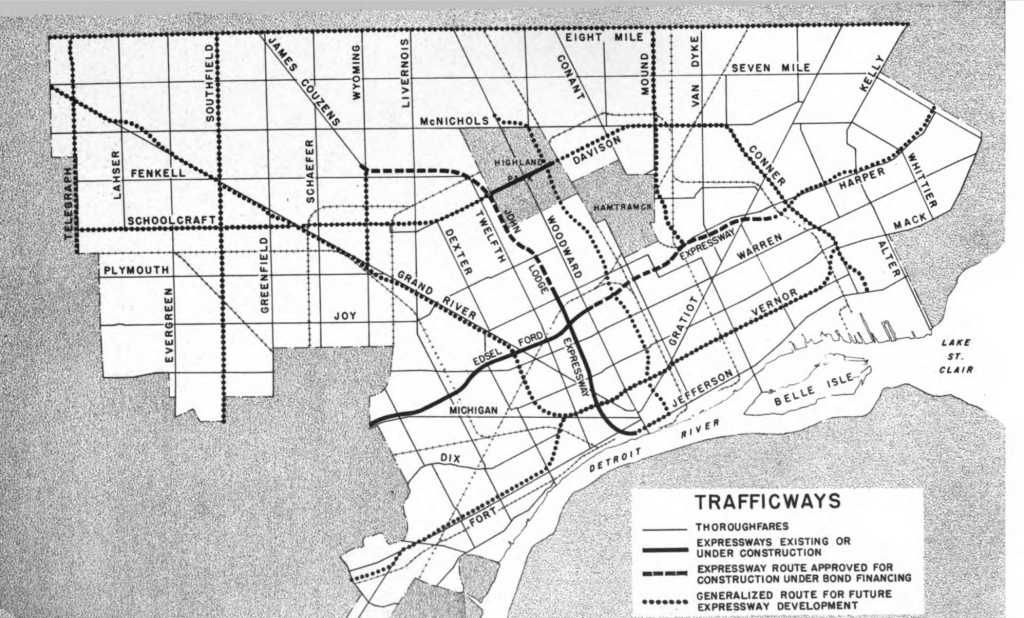
Our highways are some of the worst examples in the nation of racist, mid-century urban planning practices, and removing them has been a topic of interest in transportation, planning, and racial justice circles for decades. As more cities start to make decisions that recognize the relationship between transportation policy, quality of life, and equity, embracing a bold plan to undo the damage of urban highways and restore the city’s walkable grid over time could help Detroit truly take the lead in redefining urban mobility and addressing past harms.
Each highway’s construction undermined density and walkability in the city center and displaced thousands of residents. These displacements targeted Black communities on the east side of downtown and thriving Chinese and Mexican immigrant communities on downtown’s western flank. The pollution, noise, and severed connections from our freeway craze continue to impact quality of life for Detroiters. Freeways have degraded the delicate connections that once held our neighborhoods together. They funnel more cars on our downtown streets than they should handle, and our attempts to design around this have enabled destructive widening projects and minimized the potential for vitality citywide. Our streets are overall wider than our shrinking population justifies and this is especially true downtown. Some of our busiest crossings are dangerous by design for pedestrians. The parking demands associated with freeway access to downtown have cost us countless landmarks and historic structures that have been replaced with surface lots. Our downtown is now tightly surrounded by several lanes of highway and dotted by enormous interchanges, limiting the spread of development. The surface street connections we’ve lost make it difficult to link areas of strength in a way that could really encourage the type of infill development the city needs. Reducing Detroit’s freeway system will address all these concerns and mend the damage highways have done to Black Detroiters and the urban vitality over the last 80 years.
I-375
Most local discussion about freeway removal centers on I-375. The less than 1 mile stretch destroyed the city’s thriving Black Bottom neighborhood and contributed to the displacement of 130,000 mostly Black residents on the east side of Downtown. The stretch has come to the end of its useful life and plans to replace it with a surface-level boulevard by 2027 have been inked by the Michigan Department of Transportation (MDOT). Though the prospect of reversing one of the city’s biggest urban planning mistakes seems promising, the preferred alternative selected by MDOT would be nothing more than a continuation of the harm imposed by car-centric design in Detroit. MDOT’s proposed boulevard looks more like Hall Road than anything that belongs downtown and the design would expose people walking and biking to more danger than the existing freeway configuration. Additionally, without a full acknowledgement of past harms and a reparative plan for restoring ownership and honoring the legacy of Black Bottom, the project will fail to be impactful. Limiting the scope of downtown freeway removal to I-375 misses the much bigger transformation that could take place in Detroit, and MDOT has demonstrated an inability to design appropriately for urban areas. To fully leverage this opportunity, Detroit should reimagine more of its highway system and focus on reestablishing historic street connections.
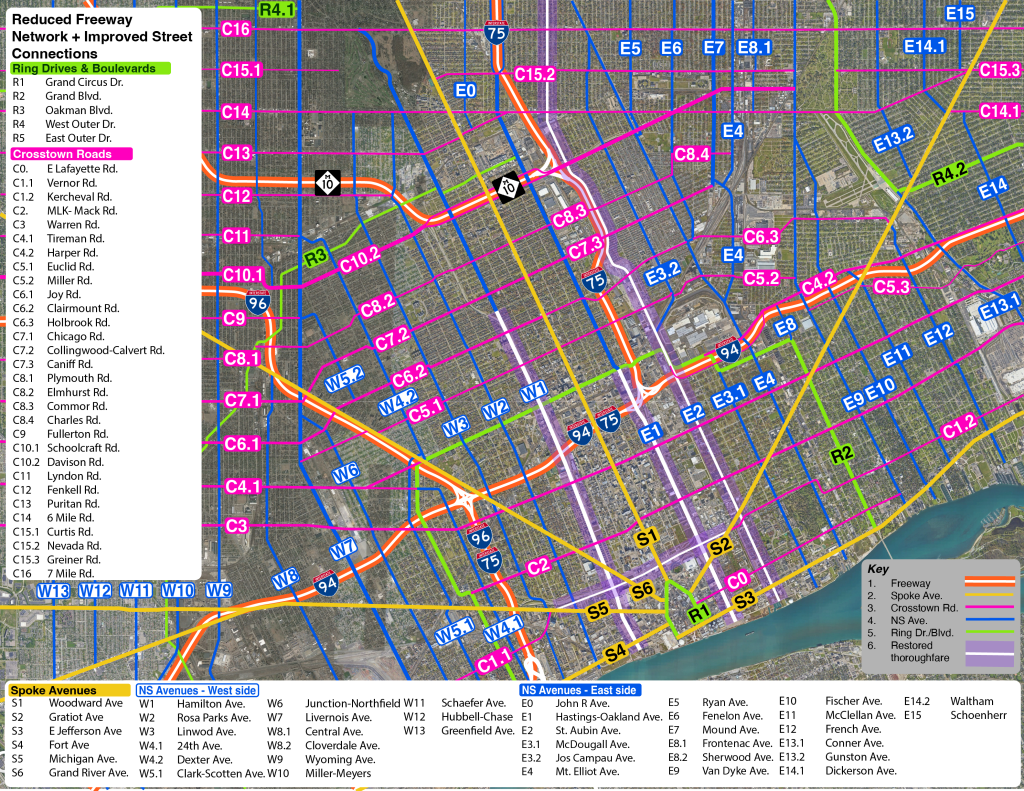
A bold plan to reduce the city’s freeway system offers a clear opportunity to create a walkable, connected city that could set the stage for the kind of urban vitality city leaders claim to want. In three steps, I’ll explain a proposal for freeway removal in Detroit by removing duplicative sections of the system, replacing them with city-appropriate streets that prioritize people and high quality city blocks over cars and restoring the the city’s urban fabric to promote a balanced transportation system with enough safe space for people walking, biking, and public transit.
Map by Paul Jones III
Step 1: Removing Duplicative Freeways
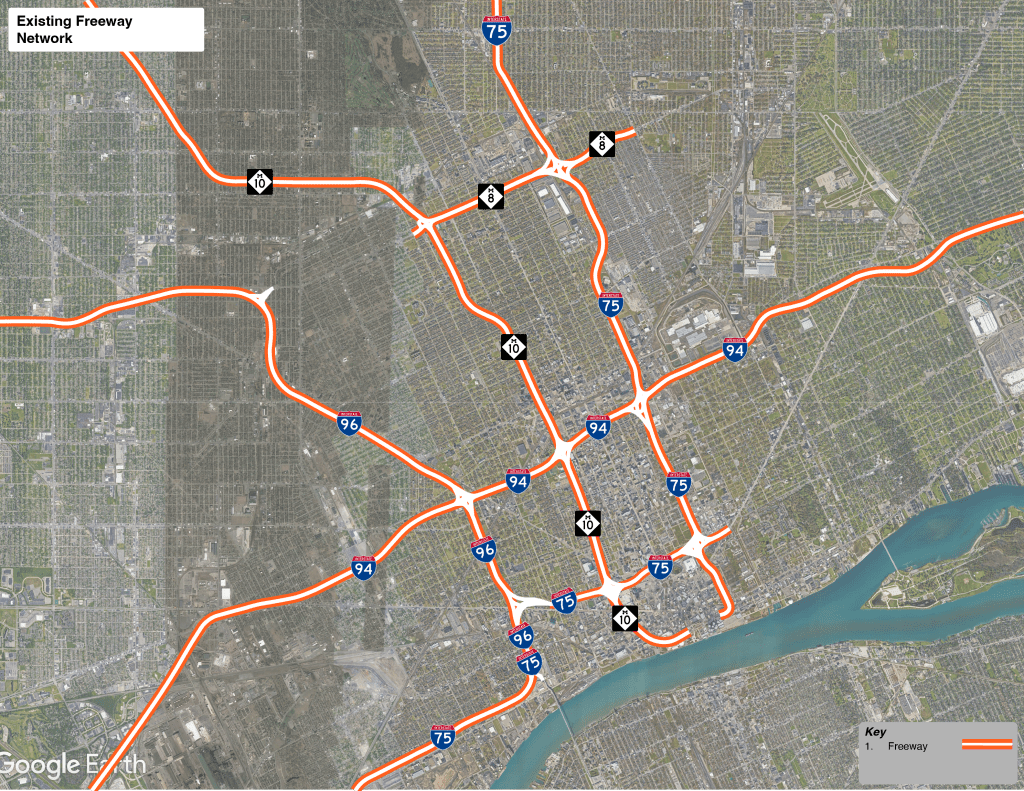
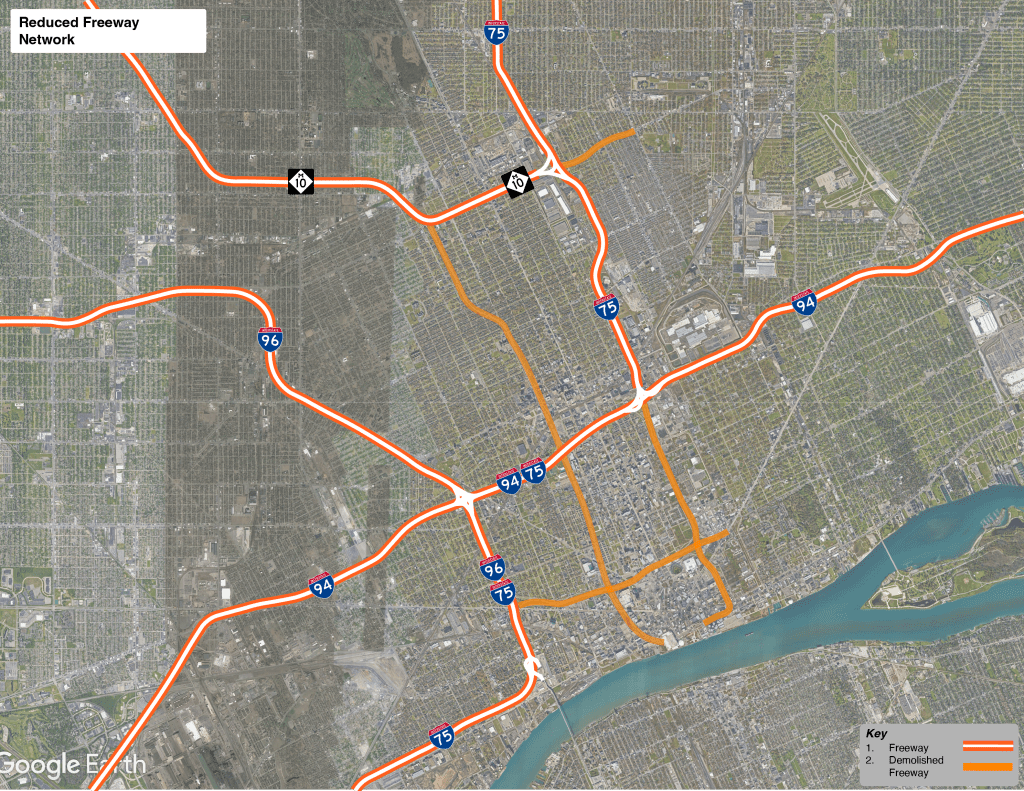
Three of our major freeways, I-96, M-10, and I-75 run parallel to one another as they approach downtown. These stretches are bisected by I-94 and again near downtown by the Fisher Freeway stretch of I-75. From here, I-375 continues to join Jefferson Ave. while M-10, The Lodge, does the same on the west side of Downtown. This redundancy offers the opportunity to consolidate auto access and limit the impact of highways to the periphery of downtown.
Under this proposal:
I-96 (Jeffries) would remain the same with its I-75 concurrency extended north to I-94
I-94 (Ford) would remain the same with its I-96 to I-75 stretch becoming a concurrent route for I-75
M-10 (Lodge) would be reconfigured to turn into the M-8 (Davison) right of way at the current M-10/M-8 interchange and terminate at the present day M-8/I-75 interchange. The existing Lodge freeway south of the Davison would be completely demolished.
I-75 South at the I-94 interchange would follow the I-94 (Ford Freeway) right of way west and I-96 (Jeffries Freeway) east to rejoin the existing I-75 south designation near the Ambassador Bridge
I-75 North would follow the I-96 west (Jeffries Freeway) right of way and turn east at the I-94 (Ford Freeway) interchange to rejoin the existing I-75 North Chrysler Freeway stretch
Map by Paul Jones III
Removing these stretches would free up thousands of acres of developable land adjacent to Greater Downtown, Midtown, and the near west side while lowering the fiscal burden of maintaining overbuilt freeway infrastructure. Extending freeway removal beyond I-375 also offers the City the opportunity to take more reparative action that addresses the damage done by the destruction of Black Bottom, Paradise Valley, Chinatown, and other communities on the near west side. This could take the form of housing built along the reimagined corridors and the development of a Black arts & culture district that celebrates the rich culture and history that urban renewal sought to erase.
Step 2: Replacing Freeways with City-Appropriate Streets
Hamilton Ave
Currently, Hamilton becomes the Lodge service drive south of Chicago Blvd. With the freeway eliminated south of the Davison Freeway, Hamilton Ave. can be extended as a complete street that follows the historic path of 6th Ave. through New Center, Midtown, and south to Jefferson. This transformation should be complemented with improved public transit along the corridor and a park and ride center at the street’s intersection with the Lodge to help facilitate downtown trips and relieve parking demands.This street would restore connections between Palmer Park, Highland Park, Boston Edison, Virginia Park, New Center, Wayne State, Midtown, Corktown, Huntington Center and the Riverfront.
Hastings Ave
Hastings Avenue would replace I-75 South of the existing interchange with I-94. This complete street would be a nod to the historic, storied Hastings St. that was razed to build the freeway that stands today. Hastings Ave. would connect to Oakland Ave., the 3 block stretch of Hastings St. that still exists between Grand Blvd. and Harper Ave. and extend south, roughly following the now demolished I-75 right of way to Jefferson, and Schweizers Pl to Atwater. This restored street would connect the North End, the Cultural Center, DMC, Brewster-Douglass Site, Eastern Market, Ford Field, Lafayette Park, Greektown, and the Riverwalk along a complete thoroughfare.
Vernor Hwy.
With the Fisher Freeway demolished, Vernor Hwy can be restored as a surface street that traverses downtown. The new Vernor Hwy would connect the existing East and West Vernor Highways while creating a central, signature crosstown corridor for Downtown Detroit that would rival Woodward in destinations and make the journey from Corktown to the Eastern Market an easy walk. Southwest Detroit, Michigan Central Station, new developments around the Tiger Stadium site, new development parcels located in the footprint of the defunct I-75/ M-10 interchange, MGM Grand, Cass Tech, Little Caesars Arena, Foxtown, Comerica Park, Ford Field, Brush Park, The Eastern Market, Lafayette Park, and the Dequindre Cut would all be served by this restored street.
Map by Paul Jones III
Step 3: Restoring The City’s Urban Fabric to Promote Citywide Mobility
Before freeways, Detroit was a dense, walkable city with a strong grid of connected, tree lined blocks. By prioritizing speeding traffic going directly to the city center, we’ve undermined our ability to build a working transportation network. Although the introduction of freeways tore through and disoriented neighborhoods that were once well-connected to one another and downtown, we have the opportunity to use what’s left to rebuild an even stronger transportation system than the city had at its population and economic peak. Detroiters deserve a safe, thoughtful transportation network that allows residents to travel with dignity even if they don’t own a car. We deserve transportation investments that breathe life into our communities instead of exposing them to more pollution in the name of faster car commutes. A strong vision of freeway removal will be a key element of building that future.
Paul Jones III (@PaulTheUrbanist) is a native Detroiter and recent graduate of the University of Michigan Master in Urban and Regional Planning program. Paul is passionate about the intersection of history, urbanism, and social justice in Detroit and is interested in empowering communities with a working understanding of how the built environment impacts daily life.
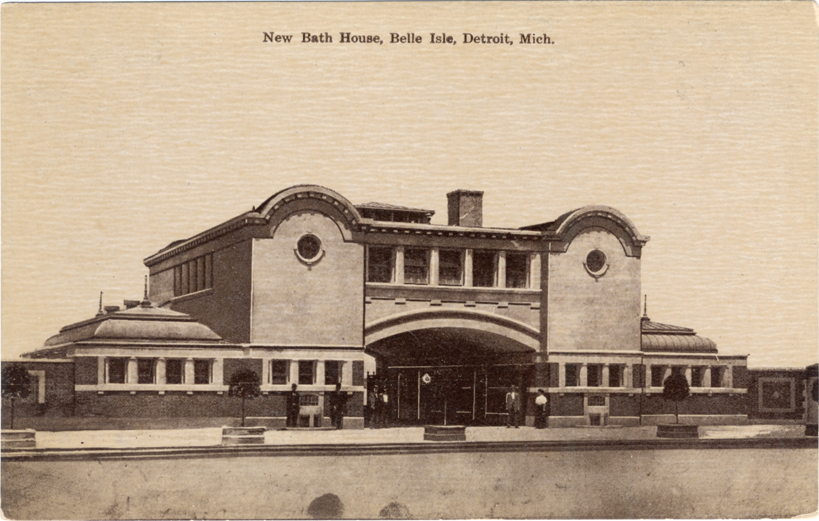
Belle Isle is undoubtedly Detroit’s most beloved park. The city’s island getaway is regularly flooded with people on warm days, and welcomed 5.2 million visitors to its beaches, picnic groves, and lakesides last year alone. Detroiters love Belle Isle and have for generations. It has played a significant role in the city’s history since its development in the 1880s. More personally, Detroiters have made childhood memories, gone on dates, proposed, held birthday parties, family reunions, and intimate gatherings with families and friends in the park. This underscores the significance Belle Isle holds in the minds of Detroiters and highlights how important it is to maintain it as a world-class, functional public space. While the island is a place of respite, relaxation, and enjoyment for Detroiters, it is also obvious that the park experience continues to be degraded by disinvestment, mismanagement, and environmental neglect that have characterized decision making for decades.
With the disruptive use of the Island for the annual Grand Prix coming to an end, new grant dollars coming from the U.S. Department of Interior, and more opportunities, a number of changes are poised to take place. This should be an exciting time for Detroiters to imagine a park that more accurately reflects the special place Belle Isle is. By sharing this vision, I hope to inspire those who care about Belle Isle and public space in Detroit to challenge themselves to imagine the brightest future possible for the places we love so much. This vision is a compilation of ideas for Belle Isle that have been gleaned from historical documents, some unbuilt proposals, and elements of my own. Below, the new park is observed from the perspective of someone riding the new shuttle loop.
STOP 0: Belle Isle Transit
Visitors to the improved park are greeted by a new monumental ‘Belle Isle Park’ sign and entry plaza at Jefferson and Grand Boulevard. Because it’s a busy weekend day, people driving are directed to park in a structure located at the former uniroyal site and use the Belle Isle Transit Center to access the island. This center’s design is a nod to the original Belle Isle tram stop that was demolished in 1980 and gives visitors access to bike share, bike rentals, and wagon rentals for hauling outdoor gear without a car. Most importantly, it is Stop 0 on the Sunset and Sunrise shuttle loops that give car-free access to all the park’s destinations. Visitors board the shuttles here and are whisked across the bridge to the island.
STOP 1: Remick Amphitheater
A roundabout at the approach now enables park goers to travel both directions on the park drive. Stop 1 is just east of the park drive’s intersection with the bridge. This stop gives visitors access to the Remick Amphitheater, and the Detroit Boat Club on the other side of the park drive. The bandshell has been relocated from its site on Loiter Way, and is now complemented by seating and a lawn that gives spectators sweeping stage views against the backdrop of the Detroit skyline. The northernmost portion of the park’s picnic grove surrounds the amphitheater and has 5 shelters in various sizes.
Remick Band Shell, built in 1950 for the Detroit Symphony Orchestra
STOP 2: Central Ave
At the intersection with Inselruhe, the shuttle loops diverge with the Sunset loop turning to service the western part of the island and the Sunrise loop continuing east. The Sunset loop goes on to Stop 2, called Central Quad for its position on the Island. Just past the restored pedestrian promenade at Central Avenue, visitors use this stop to get to the Inselruhe pier that looks over the beach and Detroit River, the Belle Isle History Museum occupying the old Belle Isle Police Station, the Kid’s Row play area, giant slide, and new dog park. The comfort station at Central & Inselruhe has been restored to service the northeast section of the picnic grove with 3 shelters. The centerpiece of the quad is a pedestrian plaza that surrounds the restored equestrian monument honoring Union General Alpheus Williams. Kid’s Row provides unique play experiences for the park’s youngest guests and thoughtful accommodations for entire families. The Sunset loop continues forward, turning right at the portion of park drive formerly signed as Loiter Way.
A historic photo of Belle Isle’s Central Avenue (loc.gov)
Whitcomb Conservatory from the Oudolf Garden
STOP 3: Inselruhe Cultural Center
Occupying the structure originally built as coach stop 7, stop 3 is a key station that services the Inselruhe Cultural Center, a collection of historic and newly built institutions and gardens celebrating Detroit’s cultural and natural heritage in one place. The Aquarium and Dossin Museum still anchor the eastern end of the center while the newly formed Belle Isle Botanical Gardens encompasses the Conservatory and Nancy Brown Peace Carillon. A new conservatory has been built south of the gardens surrounding Marshall Frederick’s Barbour Fountain, a Japanese lake garden now stands between the Picnic Way bridge and Carillon, and a Children’s garden complements the Oudolf Garden. The Botanical Gardens’ Conifer Collection provides a year-round green oasis for park visitors and leads to the Flynn Pavilion further west. Another new addition to the Cultural Center is the Belle Isle Arts Gallery next to the Dossin Museum, a unique riverfront gallery space on the island.
On the other side of Inselruhe, Greenhouses provide space for Detroiters to learn about local horticulture and the historic horse stables have been repurposed to house a craft center. Inside, groups and individuals can take on Belle Isle inspired arts and crafts projects while a weekly open air crafts and vintage market happens outside. Belle Isle’s historic Sawmill and the White House on Inselruhe that predates the park are also serviced by this station.
STOP 4: Lake Tacoma
Lake Tacoma is located near Stop 4 and gives this station its name. This area is anchored by the Flynn Pavilion which offers a snack bar, pedal boat rental, and pontoon tours of the park’s canals in the summer and is the center of winter activities for the park. This portion of Lake Tacoma is lowered and frozen in the winter to offer ice skating and is complemented by the park’s holiday tree on the Muse Rd pedestrian mall. A sledding hill with spectacular views of the park and city rises just in front of Flynn Pavilion where there used to be a parking lot. The main picnic grove is just across the park drive.
STOP 5: Fountain Way
Moving along, the shuttle approaches Stop 5 at Fountain Way. This gives riders access to the iconic Scott Memorial Fountain and the surrounding esplanades of maple, oak, and bright cherry blossoms. Many of these were donated from Detroit’s Japanese sister city Toyota. Using this stop, visitors can also head to the Belle Isle Casino for special events or catch concerts, plays, and other shows year round at the new Fine Arts Theater. New walkways, canal connections, and bridges have transformed this portion of the park and offer a more fitting centerpiece of Belle Isle’s west end. These enhancements are loosely based on Cass Gilbert’s 1917 drawings for the Scott Fountain and surrounding grounds.
1917 Drawings from Cass Gilbert showing the Scott Fountain, Casino, and other proposed improvements.
STOP 6: Sunset Point
Sunset Point is Stop 6 on the sunset loop. Once adorned with simple pathways and scattered benches, this area is now a cohesive, monumental space celebrating Detroit’s beautiful sunsets. The centerpiece of this destination is the sunset rotunda which rises behind a small lagoon where a simple brick comfort station once stood. The rotunda is flanked on either side by a comfort station and a bistro that are connected by a colonnade. These are popular destinations for evening walks and have patios where Detroiters can sit and socialize freely. From this complex, a pedestrian walk continues towards the river and connects visitors to the park’s new observation tower. Here, park goers can climb to 100 feet by stair or elevator for a panoramic view of Detroit’s International Riverfront.
STOP 7: Welcome Center
Stop 7 is home to the Welcome Center and Grand Lawn. After the demolition of the Grand Prix paddock, the Grand Lawn was built as a reinforced natural grass landscape optimized for large events and heavy foot traffic. The Casino overlooks the lawn from the south and the Welcome Center mirrors the Casino’s architectural style in a smaller, modern format on the north side. At the welcome center, visitors can get information about attractions and events in the park, find groups to walk or exercise with, sign up for tours, and shop at the Island’s souvenir shop. Behind the Welcome Center on the banks of the Loop Canal is the park’s main canoe and kayak rental shelter. The location near the beginning of the canal system facilitates more full enjoyment of the park’s waterways. The main offices of the park are located on the small peninsula created by the Loop Canal and Detroit River. From here, the shuttle’s sunset loop will cross the MacArthur bridge to return to the Belle Isle Transit Center at Jefferson.
To reach the eastern end of the island by shuttle, park goers should use the Sunrise Loop. Instead of turning right at Inselruhe after Stop 1, the Sunrise Loop Continues forward to service stops 8-14 before rejoining the Sunset Loop at Stop 3.
Example of inspiration for sunset rotunda structure and colonnade.
STOP 8: Riverbank Beach
Stop 8 is home to Riverbank Beach and its accompanying beach house, pools, and boardwalk. The windowless beach house that once served the beach has been replaced with a larger facility that offers locker rooms and showers for the beach area as well as an indoor/ outdoor pool deck that can be used year round. This deck is flanked by risers that allow space for sunbathing and relaxation or spectating during competitive events.
The Oakway Comfort station provides support facilities on the other side of the park drive and invites people from this stop and the beach to explore the Belle Isle Flatwoods.
View of original Belle Isle Beach House, demolished in 1970
STOP 9: Lake Muskoday
Stop 9 is at the western tip of Lake Muskoday and entrance to the Detroit Yacht Club. This stop gives visitors access to the boat launch at Lake Muskoday, the eastern end of the beach and a trailhead for the Belle Isle Flatwoods.
STOP 10: Muskoday East
Stop 10 is on the eastern shore of Lake Muskoday. Here, park goers can access a comfort station, the fishing area at the Detroit River, as well as exhibitions for the two water intake cribs at Belle Isle and the razed Waterworks Park that once existed sat across the river. As part of long-term initiatives to improve the system of waterways on Belle Isle, Lake Muskoday’s connection to the Detroit River has been restored as well as a part of the lake that was once filled in north of the park drive.
STOP 11: Blue Heron Lagoon
The view of Blue Heron Lagoon opens up to the left, and is Stop 11’s namesake. The new overnight campground on the shores of Lake Muskoday is reached from this stop. Just south of Camp Muskoday, efforts to protect and restore the park’s tree cover are aided by a full-service permaculture center and tree nursery at the former site of the nature zoo on the eastern end of the forest. Here, Belle Isle trees are propagated, raised, and studied to enhance and protect the park’s ecosystem for future generations. Blue Heron Lodge, which offers a cafe, accommodations for swimming nearby, and event space, now occupies the site of the relocated golf range. A beach has been built on the northern shore of Blue Heron Lagoon, and sand paths lead to other swimming areas along Hippie Channel.
STOP 12: Lighthouse Point
Next up, shuttle riders are taken to Lighthouse Point, Stop 12. A new comfort station complements the Iron-Belle Trailhead, a parking grove, and 2 picnic shelters can also be found here. Continuing towards the lighthouse, visitors will now find rolling meadows of native shrubs, flowers, and grasses which add dynamic color and depth to this section of the park and create bright pathways towards the Livingstone Lighthouse. Beyond the lighthouse, the grove of trees and shoreline overlooking Lake St. Clair offers the best place in the park to greet the morning sun. Here, fitness and meditative meetups happen and give space for the city’s early risers to build community.
STOP 13: The Strand
Stop 13 gives visitors access to the area of the park known as The Strand. A portion of the southern beach shoreline has been restored, and beach goers can access showers, restrooms, and other amenities at The Strand Beach House. The park’s southern fishing pier is also accessible from this stop. From the beach and fishing pier, visitors can cross the park drive to walk the Lake Okanaka shore and islands on a raised boardwalk that connects this area to the Flatwoods and Iron-Belle trailhead. On this side, the
Woodside comfort station has been restored and offers services and amenities at the southern entrance of the woodlands.
Belle Isle Athletic Shelter originally constructed as the Bicycle Pavilion
STOP 14: Athletic Park
Stop 14 houses the Belle Isle Athletic Park and the park’s historic Wet-Mesic Flatwoods. The historic Athletic Shelter, originally built in 1898 as a bicycle pavilion, now houses a museum celebrating the history of bikes in Detroit and event spaces for the athletic park. The athletic park includes a set of basketball courts, a multi-purpose stadium that can house a range of competitive activities, 2 baseball fields, and a connected indoor field house and fitness center. This complex has a number of practice fields that can be reserved or used for pick up play. Near the riverfront is the park’s golf range in a smaller footprint than its former site on Blue Heron Lagoon. Closer to Inselruhe, 3 large picnic shelters support team gatherings near the athletic park. Tennis courts have been moved further south and two sand volleyball courts stand between the athletic park and The Strand Beach.
The woodlands at the center of Belle Isle have been extended to occupy their historic footprint, and A new nature center for the flatwoods now stands in a clearing that used to be the site of the park’s handball courts welcoming park goers into the woodlands. To facilitate the restoration of the park’s wetland forest, most paths are on raised boardwalks that allow water to flow freely beneath. Highlights of the flatwoods are demonstrations of the impact of Emerald Ash Borer and Oak Wilt on Detroit’s trees, the performance of the wetland forests during flooding, and the unique ecosystem found in the park and Detroit River. A large arch has been built at Central Avenue’s entrance to the flatwoods, and an adventure park with canopy walks, high ropes, climbing and other activities occupies the woodlands where the children’s zoo once sat.
After Stop 14, the Sunrise loop rejoins the Sunset loop to service stations 3-7 and head back to the Belle Isle Transit Center.
Paul Jones III (@PaulTheUrbanist) is a native Detroiter and recent graduate of the University of Michigan Master in Urban and Regional Planning program. Paul is passionate about the intersection of history, urbanism, and social justice in Detroit and is interested in empowering communities with a working understanding of how the built environment impacts daily life.
I started making hip-hop themed maps because there are tons of geographic references in rap music to map: emcees often call out to streets and neighborhoods they’re from, as well as the places they go. The Detroit map came out of homesickness; I recently relocated to Texas and was missing home. Also, I had never done a city map; my maps prior focused on one artist or one song.
I set the goal to try to find unique geographic references from Detroit emcees: one place for each artist. I studied the lyrics of songs from artists I grew up listening to (Blade Icewood, D-12, Slum Village), Detroit’s new class of emcees (Kash Doll, Payroll Giovanni, Sada Baby), and everyone in between. I went to websites like The Original Hip-Hop Lyrics Archive and Genius for a little help, but for the most part I listened to the music and deconstructed the lyrics myself. All in all I found a total of 37 unique references from 36 emcees: 16 streets/highways, 17 places, and 4 neighborhoods. I added Saint Andrews Hall/The Shelter because of its history as one of the premiere venues for rap battles in the 90s.
I built the map using shapefiles downloaded from the City of Detroit’s data portal as a foundation, and created the place features from scratch. To add extra sauce to the symbology I used colors from Detroit sports teams: Honolulu blue streets (Lions), teal neighborhoods (90s Pistons), red places (Red Wings). I found little tidbits of information along the way, like the fact everyone is from 7 Mile Road, EVERYONE. 7 Mile was the most mentioned street by far across all emcees. Blade Icewood, Royce da 5’9”, Guilty Simpson, D-12, Esham, Black Milk and more all talk about 7 Mile. This was a fun project, I revisited favorite songs and discovered new hits to add to my playlists.
Contact
Submit a map or just get in touch. Thanks for following!








/cdn.vox-cdn.com/uploads/chorus_image/image/65497640/Remick_3.0.jpg)




 DETROITography