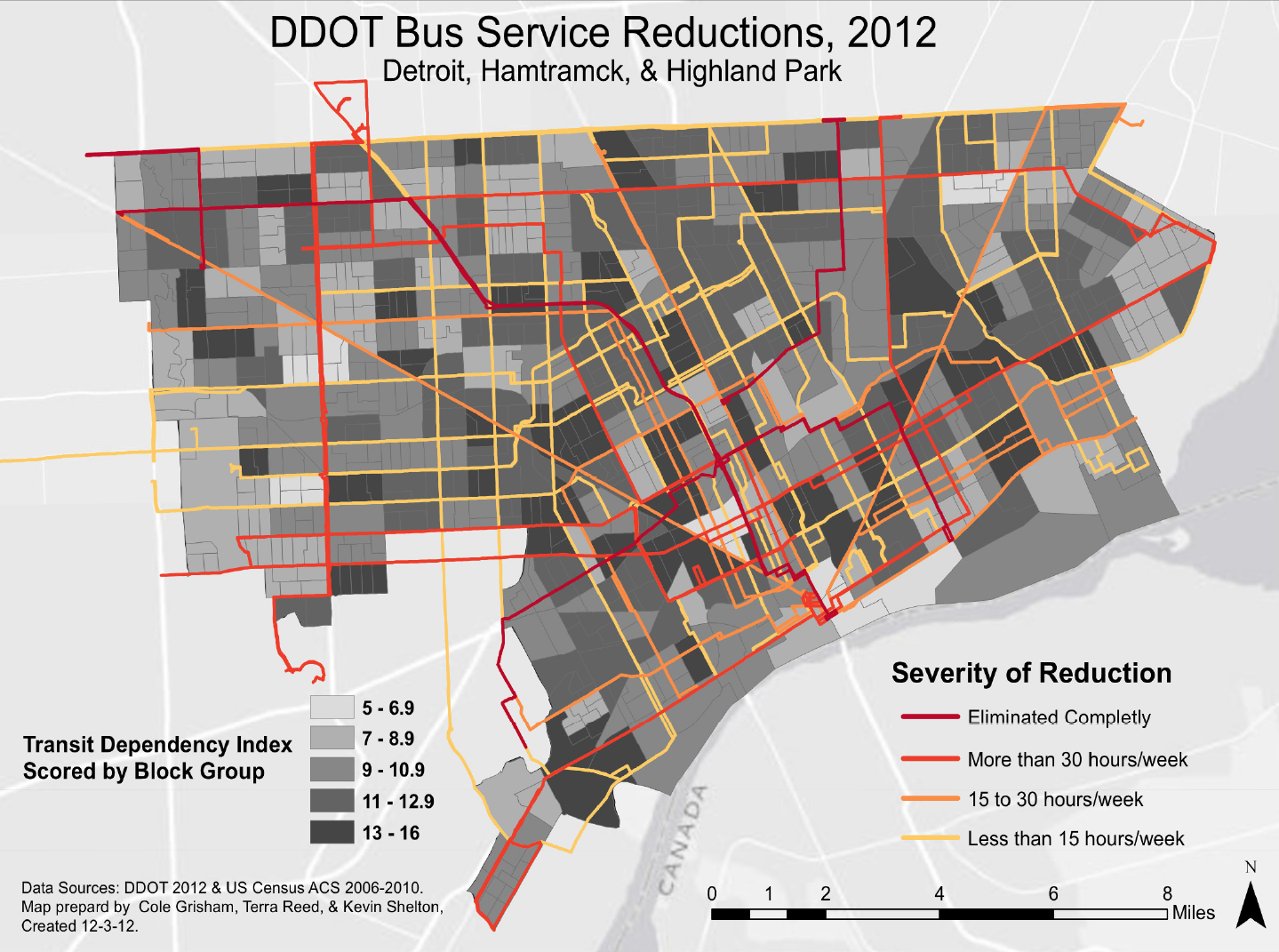
Map: Social Justice Impacts of Transit Reductions in Detroit

transit reductions

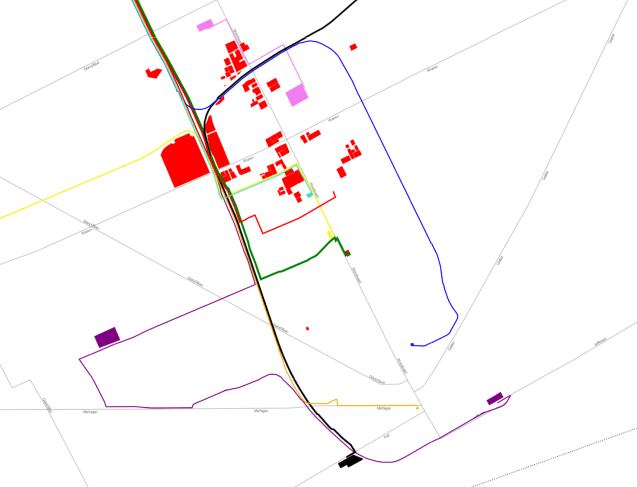
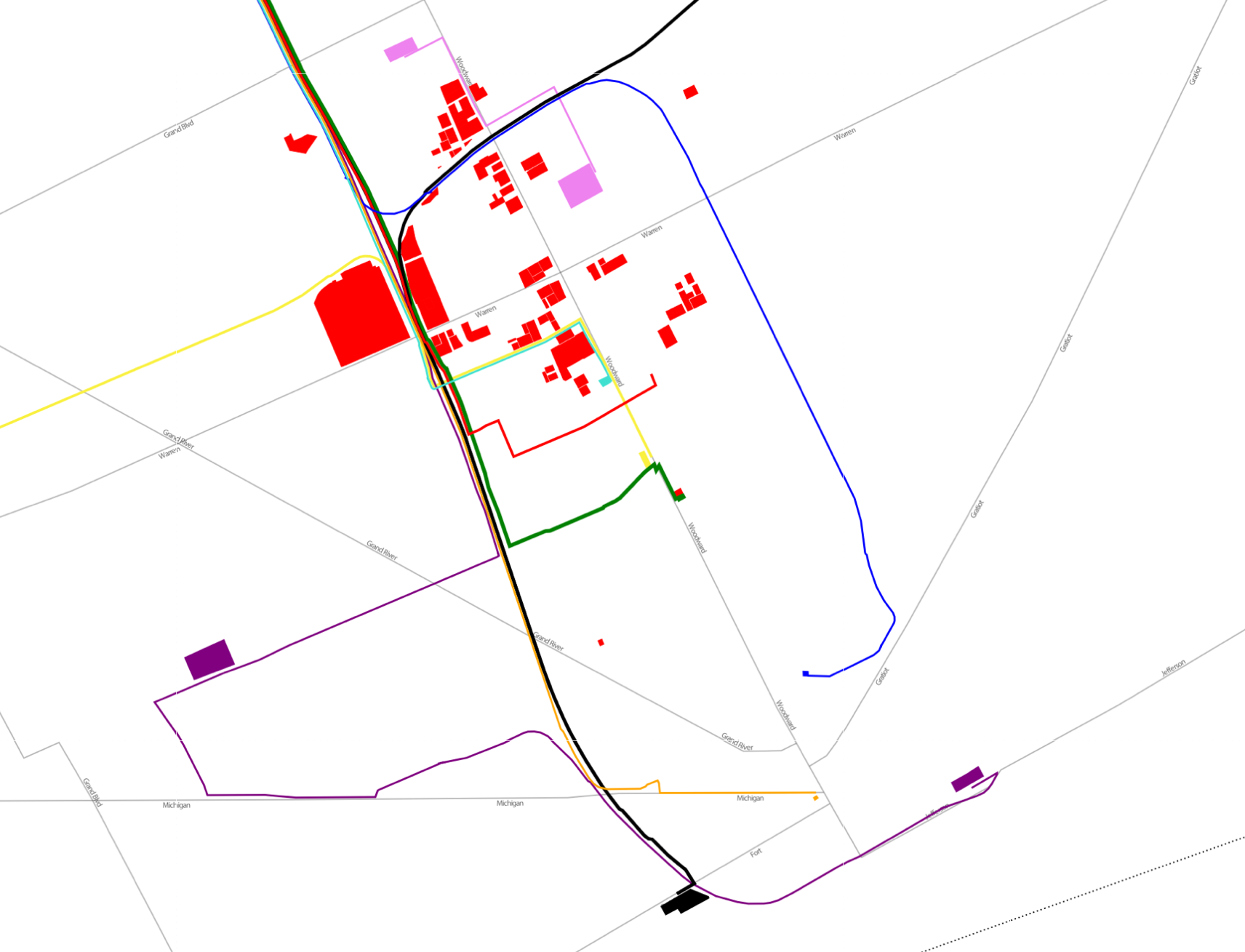
University of Michigan graduate students Nicholas Grisham, Terra Reed, and Kevin Shelton found that the 2012 reductions in DDOT bus service affected almost all routes whether it was a reduction of hours, days, or the entire route. They also found that transit dependency was spread out across the city. They developed a Transit Dependency Index (TDI) based on Census data of: vehicle ownership, elderly population, youth population, and median household income.

Their question was whether bus reductions disproportionately affected transit dependent residents more than others. The answer was yes, but the impact also reached across the city.

Find the entire presentation HERE

Data: 6,600 Detroit Gardens in 1932

thrift_gardens

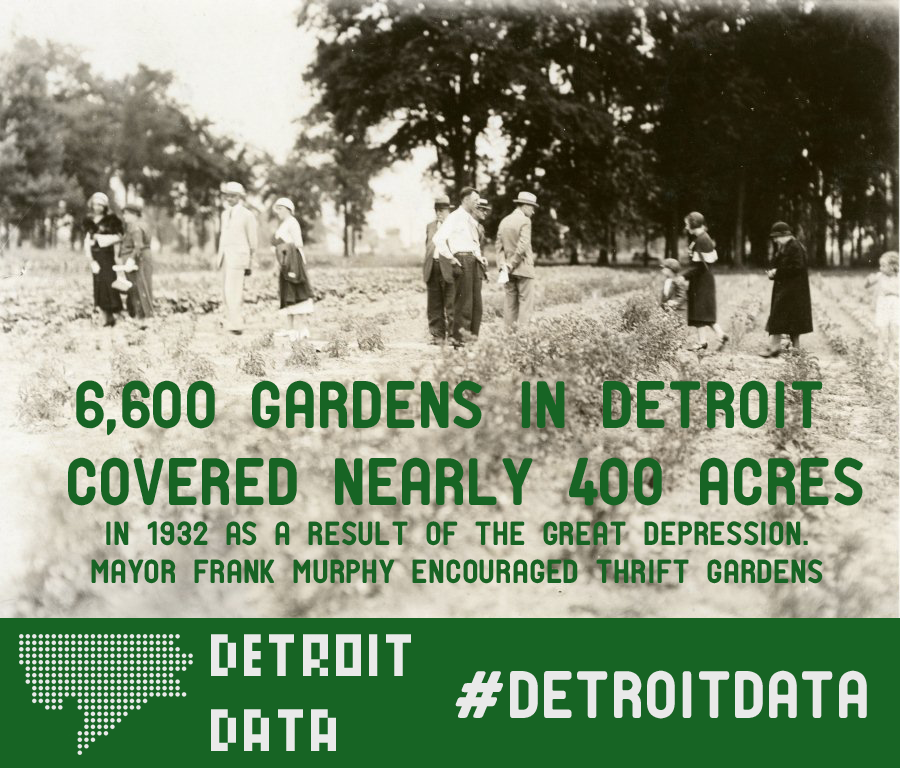
When the Great Depression hit, Detroit’s auto industry production fell by 75% between 1929 and 1932. Many were left without work or an income to pay for food, housing, etc.

Anyone know where we might be able to find some info on where these gardens were located? Where were vacant lots turned into farms and gardens?

Source:

Map: Residential Density & Walkable Schools in Detroit

detroitps-map-a-final

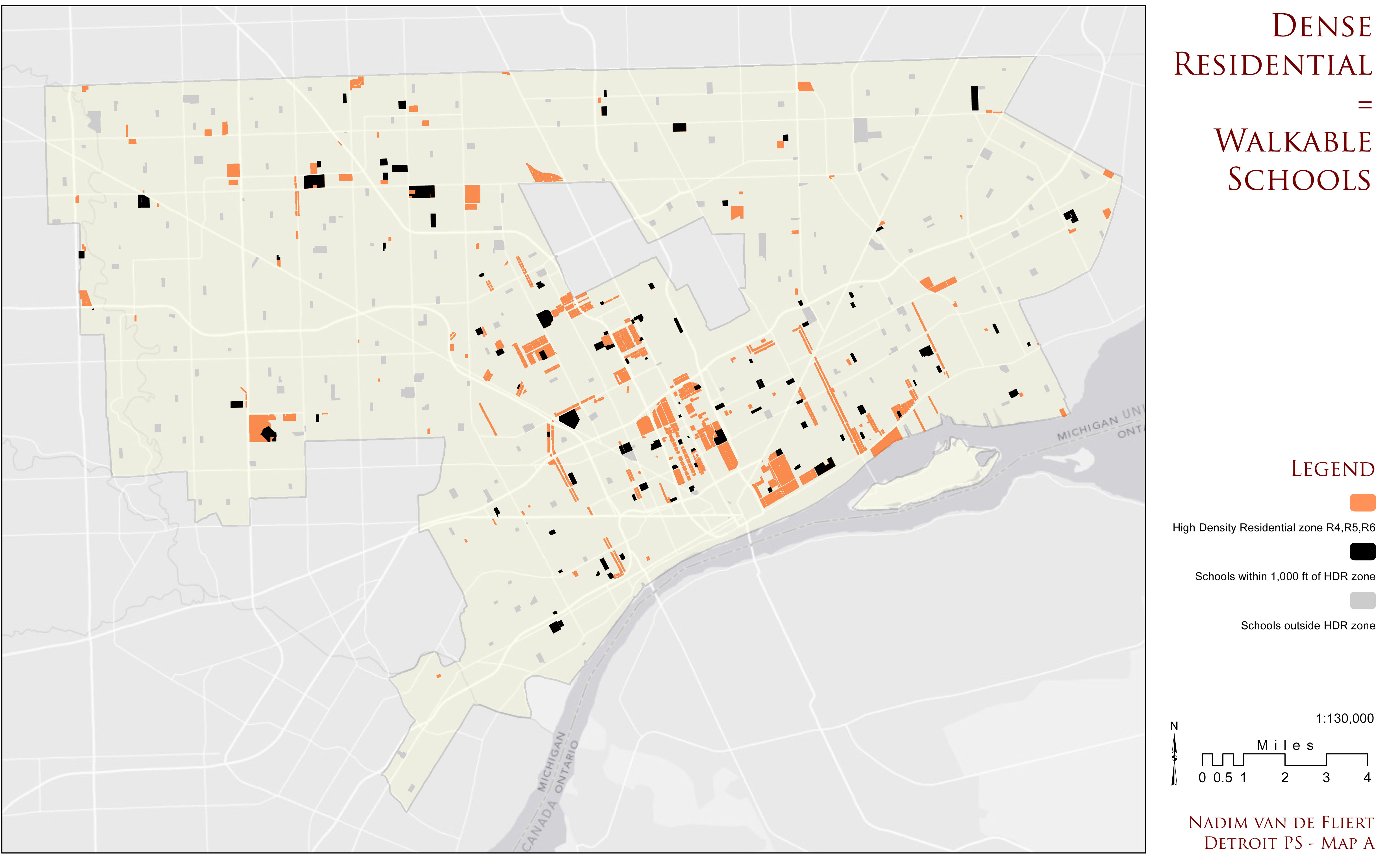
U of M student Nadim Van De Fliert created this map to demonstrate the need for more dense residential development as a way to support better, community-centered schools. More from the author:

Map A reveals the residential zones classified as R4, R5, and R6 – the highest density residential (HDR) zones in the city.  Those schools within 1,000 feet of the high density residential zones are highlighted in black.  1,000 feet was chosen to roughly estimate the east-west distance of a standard New York City block.  Imagine turning the corner on a nice leisurely stroll to school with your classmates and seeing your destination just a few hundred paces further ahead.  At this point, it’s a dead sprint – racing to be the first at the front door.  This is an ideal for which to strive, perhaps.

What’s missing:

  1. Data sources
  2. 1000 foot radius around schools? Where do the ideas converge?
  3. Don’t use the equal sign for a hypothesis (dense residential = walkable schools)

M1 Rail Map on Downtown Detroit Window

photo (11)

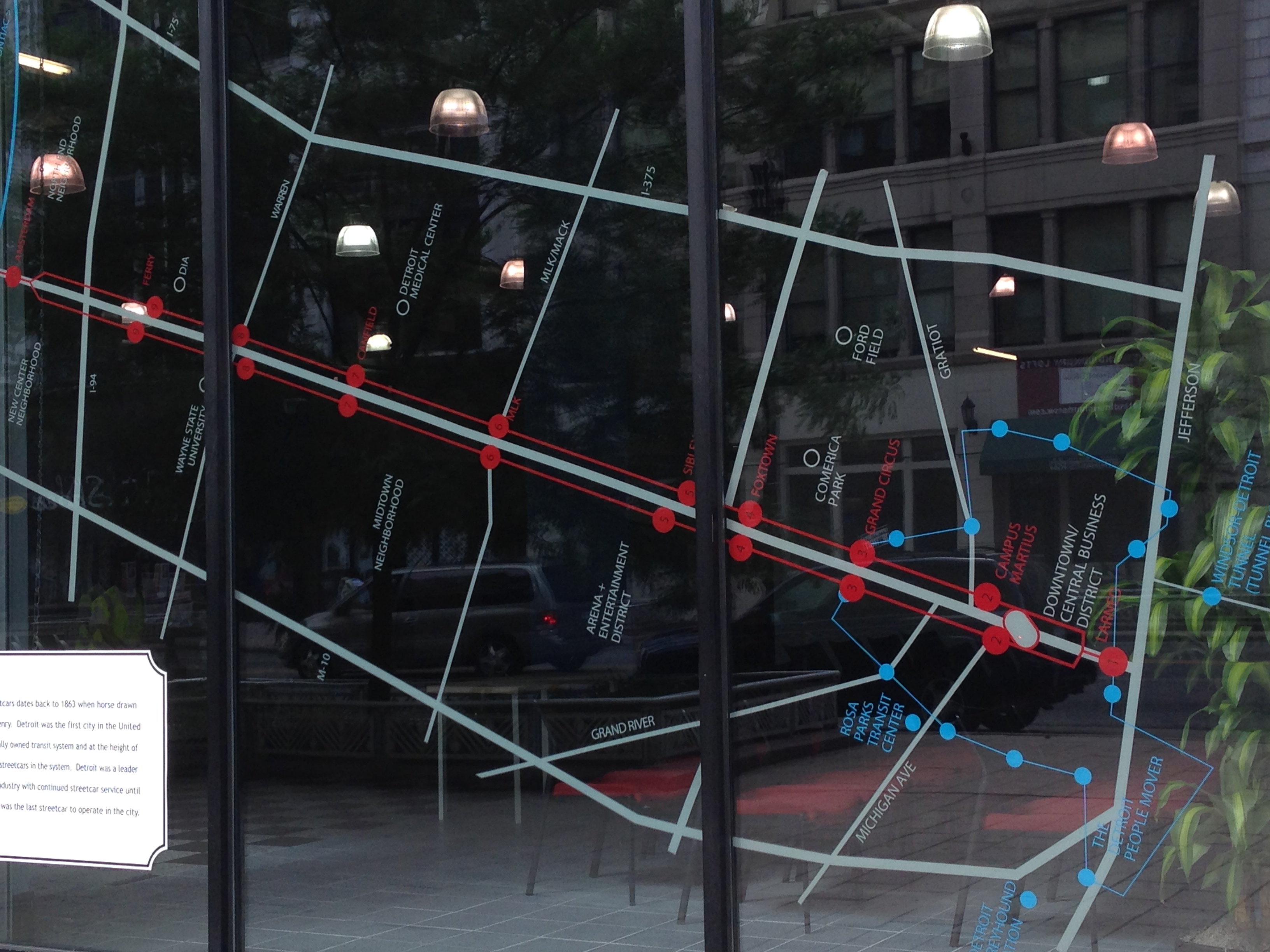
Spotted along Woodward, this window map stood out on a walk Downtown. After months of slow prep work being completed underneath Woodward Ave., the M1 Rail now has an official breaking ground date: July 28th. This also means that Woodward Ave. will be closed from Adams St. to Campus Martius for about 3 months. Be sure to attend one of the two upcoming community meetings.

Visit: http://m1rail.com for more details.

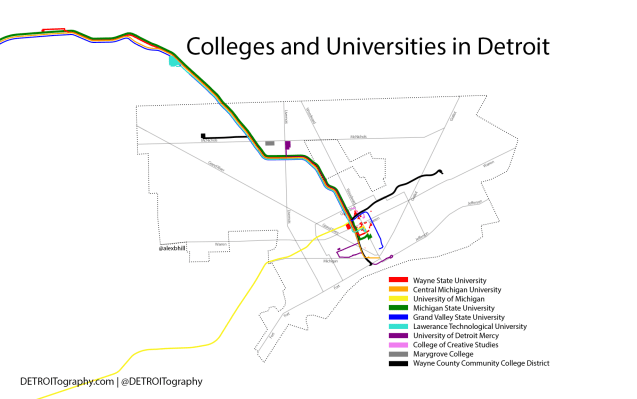
Map: Colleges and Universities in Detroit

college_univ2

In recent years Detroit has seen an influx of college and university satellite sites. Notably, the University of Michigan (UM) Detroit Center opened in 2005 while the Michigan State University (MSU) Detroit Center opened in 2009. Detroit has been host to a number of colleges and universities from its founding. As Michigan’s largest city and former state capitol, Detroit held the greatest number of highly educated individuals. In 1817, Justice Woodward wrote up plans for the University of Michigania (Catholepistemiad) with 13 departments. The building was constructed at Bates and Congress, but due to disagreements over educational ideas, controversy with the land, and general mismanagement, the university never really took off. Land that had been previously earmarked for a new Michigan state capitol soon became the new University of Michigan in Ann Arbor under the leadership of Henry Tappan in 1837. UM’s proximity to Detroit has afforded many “urban research” opportunities for faculty, staff, and students.

Central Michigan University (CMU) and Grand Valley State University (GVSU) have both set up satellite locations in the last few years. Lawrence Technological University (LTU) is moving its Detroit Studio from New Center to a new building under-construction at Woodward and Willis.

Wayne State University (WSU) in one form or another has been educating student since 1868. It began as the Detroit Medical College. The iconic “Old Main” building was constructed for Central High School in 1896, but then became the Detroit Junior College and then the College of the City of Detroit. In 1934, a handful of small colleges were combined to create Wayne University. The Law School, School of Social Work, and School of Business were added and in 1956 it was constitutionally established (Michigan) as a public institution by the name Wayne State University. Additionally, WSU has an Oakland satellite campus just northeast of the city limits.

Marygrove College (MG) moved to Detroit in 1927, it had previously been known as St. Mary’s College. The college was a women’s only institution until 1970. The college prides itself on Catholic social teachings and actions. The fenced in campus off of W. McNichols has an Oxford University appearance with its grand buildings and architecture.

University of Detroit Mercy (UDM) was founded by the Jesuits (Society of Jesus) as Detroit College in 1877 and expanded to the University of Detroit in 1926. The Mercy College of Detroit was established in 1941 and was then consolidated with the University of Detroit in 1990 to form the University of Detroit Mercy. UDM is best known for its Dentistry program and growing Law program.

Wayne County Community College District (WCCCD) was founded in 1967 downtown Detroit. Currently with six separate campuses across the county (3 within Detroit) with an emphasis on career programs plus traditional college programs, such as Liberal Arts.

The College of Creative Studies (CCS) was formed in 1906 from the Art School of the Detroit Society for Arts and Crafts. Over a two decades of slow expansion, the college began offering one of the first arts and crafts 4 year degrees in 1926. It was known as the Center for Creative Studies—College of Art and Design until it was renamed in 2001 as the College of Creative Studies.

Timeline of Detroit Higher Education:

  • 1817 University of Michigania (UM)
  • 1837 University of Michigania leaves Detroit (UM)
  • 1868 Detroit Medical College (WSU)
  • 1877 Detroit College (UDM)
  • 1906 Art School of the Detroit Society for Arts and Crafts (CCS)
  • 1926 University of Detroit (UDM) & Center for Creative Studies—College of Art and Design (CCS)
  • 1927 St. Mary’s College moves to Detroit as Marygrove College (MG)
  • 1934 Wayne University (WSU)
  • 1941 Mercy College of Detroit (UDM)
  • 1956 Wayne State University (WSU)
  • 1967 Wayne County Community College (WCCCD)
  • 1990 University of Detroit Mercy (UDM)
  • 1999 Lawrence Technological University Detroit Studio (LTU)
  • 2001 College of Creative Studies (CCS)
  • 2005 UM Detroit Center (UM)
  • 2009 MSU Detroit Center (MSU)


det_univ_downtown

Downtown/ Midtown are the obvious focal point for the majority of colleges and universities located within the city. The Lodge Freeway and Woodward Avenue are popular thoroughfares for getting around to educational institutions.
Screen Shot 2014-07-02 at 8.11.49 AM


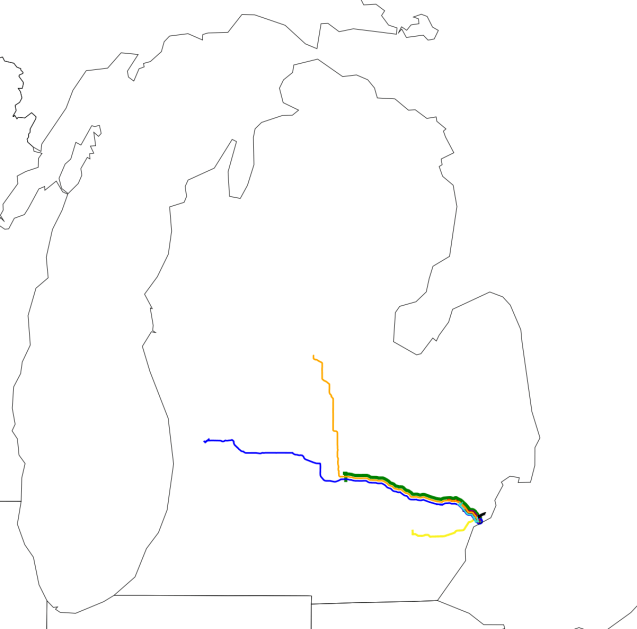
GVSU members have the longest to travel at 169 miles to get to their Detroit location. My theory is the GVSU building is mainly a marketing piece with its prime name display location behind Comerica Park. CMU comes in second at 154 miles while MSU is 81.2 miles. UM members travel half that distance at 42.3 miles. This all just goes to show the influence of Detroit as both a regional and statewide center for knowledge.
Map: Detroit Regional Population Cartogram 1970

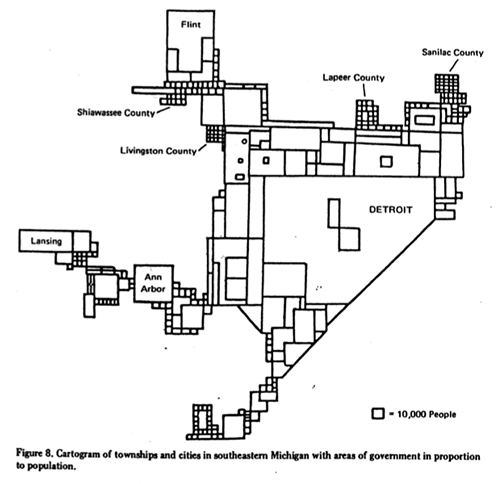
detroit_cartogramThis is a classic William Bunge map/ cartogram showing the population sizes of various southeastern Michigan municipalities reaching up to Flint and as far over as Lansing. When this was made in 1970, Detroit dominated the population charts. The city still dominates in regards to population size compared to its neighbors despite the recent population losses.

Data: Water Shutoffs and Delinquent Accounts in Detroit

dwsd_water

The worst offender of the delinquent water accounts and overdue bills is the City of Detroit, in particular the parks. Palmer Park alone has an outstanding bill of $422,295.40. Many of the residential properties with outstanding bills are abandoned homes that haven’t been lived in for many years.

The fire hydrant pictured flowed for a full 6 days even while 4 separate nearby employees made 5 different calls to report it to the Detroit Water and Sewage Department (DWSD). The hydrant was not shut off until a tweet was sent to the Mayor with the estimated water wasted = 1.5 million gallons (if PSI = 1). The week before a hydrant behind Detroit Receiving flowed for a full 7 days before getting shut off.

Water bills in Detroit are twice the national average of $40 and the City Council approved a 8.7% bill hike just last month along with controversial plans to privatize DWSD. For many Detroit residents already struggling to make ends meet, this is another burden when a delinquent water bill might represent 20% of their income.

Water is a human right and there should never be a need to take basic needs away from people. Catarina de Albuquerque, expert on the human right to water and sanitation, from the United Nations Office of the High Commission on Human Rights (UNOHCR) responded to an appeal about the water shut offs, saying:

“Disconnections due to non-payment are only permissible if it can be shown that the resident is able to pay but is not paying. In other words, when there is genuine inability to pay, human rights simply forbids disconnections,” said Catarina de Albuquerque, the expert on the human right to water and sanitation.

My hope is that Mayor Duggan will take a lesson from Mayor Frank Murphy who, during the Great Depression, chose to feed the hungry and turn empty factories into boarding houses for the poor. Balancing the books doesn’t have to come at the expense of Detroit residents already facing economic difficulty.

“no one in this great city of plenty…must be allowed to go hungry, or cold, or unhoused, or unclothed.” – Frank Murphy

Data:

Source:

detroitdata_get

Map: Jewish Migration in Detroit 1840 – 1965

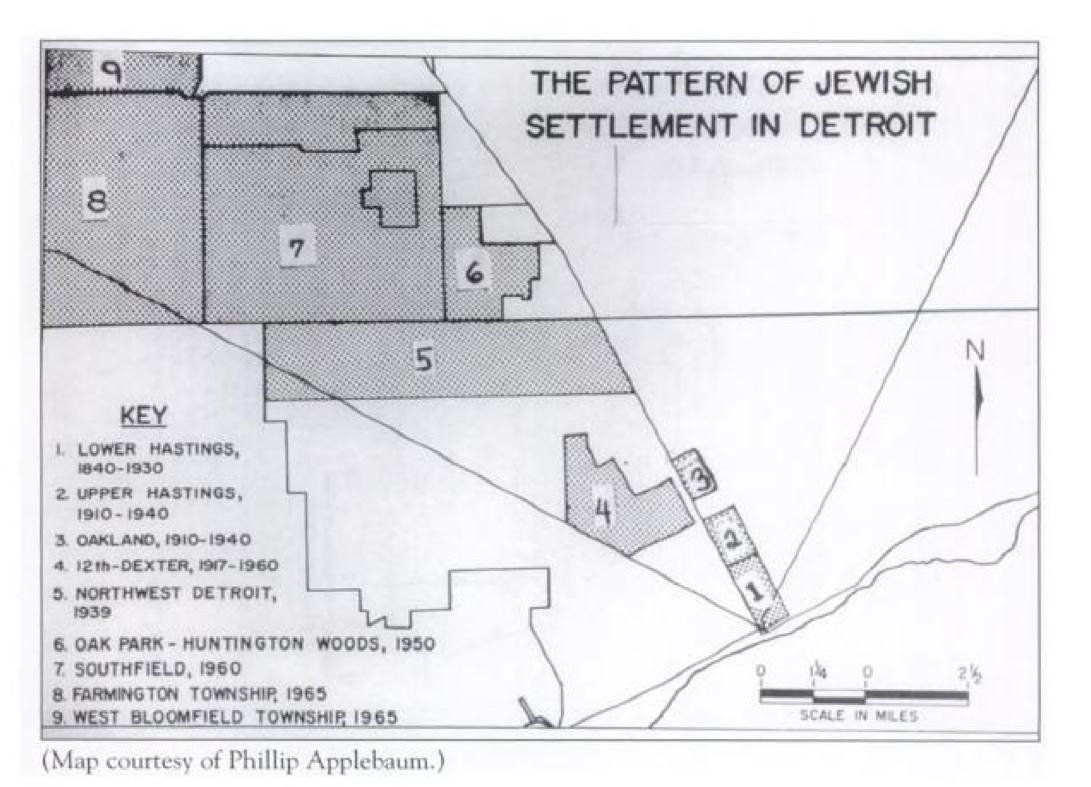
Screen Shot 2014-06-20 at 10.05.12 PMThis map appears in the book by Irwin J. Cohen titled “Jewish Detroit.” In the introduction he writes that he was able to complete the book by spending many hours in the Burton Historical Collections at the Detroit Public Library. Cohen covers the history of Jewish settlement in Detroit from the first Jewish resident in 1762 to the burgeoning congregation of Beth El Temple before Detroit’s Jewish population began its Northwestern migration to what are now Detroit’s affluent suburbs.

The Jewish community was more open and welcoming than others to the Black community and many of these areas became historic neighborhoods of Detroit’s Black community as the Jewish community migrated Northwest.


Map: the Smells of Detroit’s Midtown Loop

smells_midtown_loop

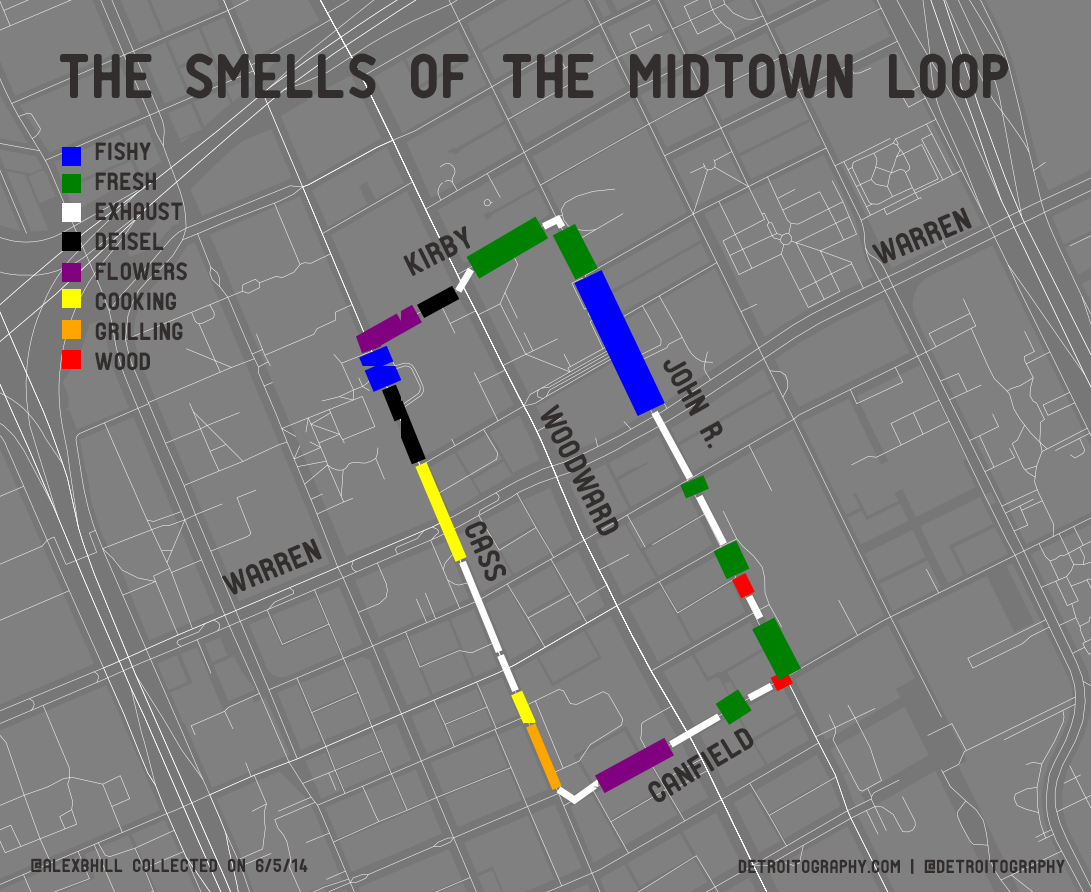
I’ve really wanted to do some psychogeography and while this is not the best example it did allow me to be more present in my walk around the Midtown Loop, a 2 mile placemaking project to improve the walkability of Detroit’s cultural institutions. Instead of doing the straight and scientific geography lines of the route I decided to record the smells that I experienced. Not all of them very pleasant.

My walk started at Hancock and John R. and moved counter clockwise. After crossing Warren and immediately at the Michigan Science Center the strong smell of fish hit me. It lasted quite a while and I assume is an issue with the sewers. The corner at Kirby and John R. is where the College of Creative Studies (CCS) and the Detroit Institute of Arts (DIA) have well manicured lawns. After crossing Woodward I took in the smells of exhaust and some strong diesel before being greeted by nice floral scents along the Detroit Public Library (DPL). The fishy smell came back after rounding the corner and I wondered if the smells were related. Some big construction and contractor trucks passed by and brought more diesel. Upon reaching La Pita Fresh the strong smell of cooking followed and then again in front of Shangri-La with some grilling near the frat house on Cass. Fresh flowers dominated my nostrils at the corner where Go Sy Thai now sits. La Palma was undergoing renovations and freshly cut wood could be detected. Lawn crews were taking care of the VA Hospital lawn as well as putting down some new wood chips. Throughout my 2 mile loop I most commonly interacted with the smell of exhaust. These roads are all fairly busy and well traveled roads and it makes sense that they would have high car traffic. Since this is supposed to be one of Detroit’s shining examples of walkability maybe they could put some time into ideas to reduce car use.


Data: Detroit Homicide Reporting Doesn’t Add Up 2009 – 2013

homicide_data

I’ve been actively engaged in tracking homicides in Detroit for a few years now thanks to the efforts of Cham Green and the independent Detroit Crime and Homicide Group, which has spent the last years combing news articles, Detroit Police Department (DPD) major crime reports, and checking these against FOIA requested homicide numbers. There is no other comprehensive or working system to keep track of crime and homicide in the City of Detroit.

The Detroit Free Press requested homicides in 2011 as part of a FOIA. The data they obtained went back to 2008 with about a dozen cases from 1970 and 1980s. Needless to say, the FOIA made it evident that the City of Detroit was seriously lacking in its ability to keep track of crimes and report them in an accurate and timely manner. I can’t say that I’m surprised with the regular cost cutting within the DPD and the constant shifting of both officers and precincts, but there has to be a better solution.

I checked the data from the independent Detroit Crime and Homicide Group against the FOIA and it did not match up with the official reported Detroit Police Department (DPD) homicides (2012 Crime Statistical Information, Detroit Police Department) or with the numbers reported by DPD to the FBI’s Uniform Crime Reporting (UCR) system. Technically, DPD isn’t required to report “justifiable homicides” to the FBI UCR. However, the DPD has a documented history of under-reporting homicides (LeDuff & Esparza, 2009) and other major cities have been cited for categorizing more “justifiable homicides” in order to decrease their homicide rates and appear to be safer. In many cases the reporting police officer may deem a homicide “justifiable” simply based on their own prerogative. In 2011, justifiable homicide was up by 79% (Madison & Duell, 2012) while 2012 marked the highest year for homicides since 2007 (Damron, 2013).

The City of Detroit has been utilizing the CrimeMapping.com site to aggregate and display its crime data for the past few years, but there are glaring issues with data accuracy and availability. Just yesterday the site displayed that there had been a single (1) homicide in Detroit between January 1, 2014 – June 22, 2014, when it is well documented in the news and the DPD that the numbers are just over 120 homicides in the 2014 calendar year. This demonstrates not only a serious lack of innovative thinking, but also a disregard for accurate data sharing with the public. In March 2014, the DPD put a full stop on publishing the 24 hour major crime report and now sticks to reporting drug busts, weapons confiscations, and successful arrests. It is nearly the end of June 2014 and the DPD website has still not posted any crime statistics update since the end of May 2014.

The City of Detroit, Detroit Police Department, and other city agencies need to adopt true open data policies. Data that affects the public on a daily basis has no business being kept behind closed doors or contracted out to those who will not be good stewards.

Data:

*FBI UCR data isn’t yet available for 2013 (only for Jan-Jun) and the DPD website has stopped publishing crime statistics.

Sources:

  • Detroit Crime and Homicide Group
  • Detroit Police Department
  • Detroit Free Press

homicides_1960detroitdata_get


Map: Detroit Urban Renewal Projects 1963

Detroit-Urban-Renewal-Plans-e1397015133573

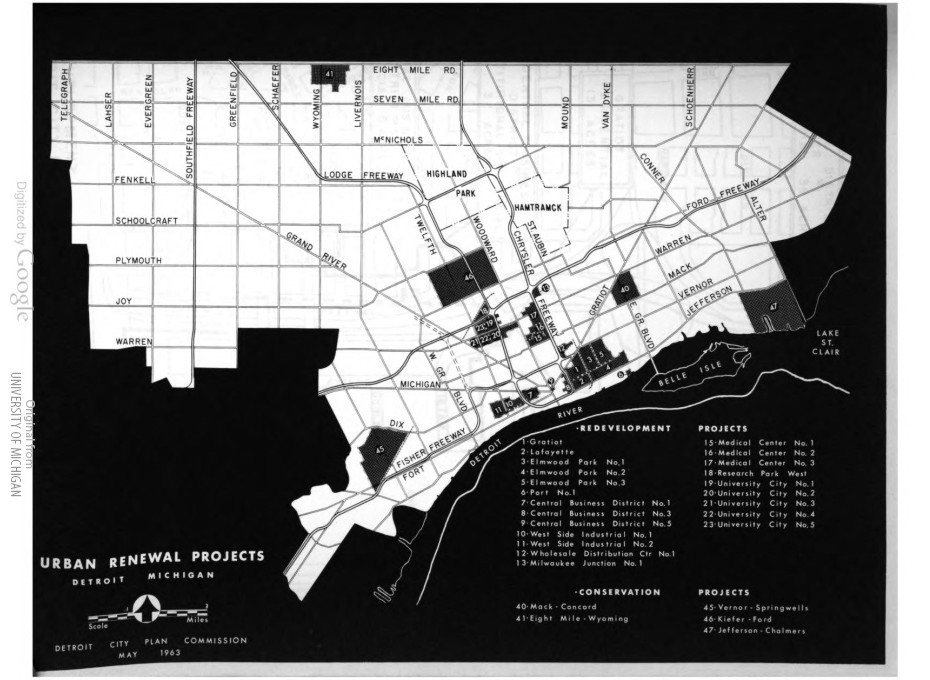
Many of these urban renewal project failed to generate any forward momentum for Detroit when it was heading in its worst direction. I imagine that the remnants of some of these projects have allowed current developments to succeed, namely the development of “University City” areas at Wayne State University which has become a critical anchor for the city. I wonder how much the West Side Industrial projects have allowed Corktown to rapidly gentrify, Wholesale Distribution at Eastern Market, “Elmwood” projects fostering Lafayette Park area, and not to be forgotten the series of projects at “Medical Center” the other major anchor in what the Mayor’s Office and Brookings Institution are calling an “Innovation District.”

Renaissance, renewal, innovation – will this current era of Detroit development generate sustained change? and for whom?

Data: Marchers with Martin Luther King Jr. in Detroit 1963

detroit_mlk

On June 23, 1963, Martin Luther King Jr., hosted by the Detroit Council for Human Rights, marched with 125,000 people down Woodward Avenue. Inside Cobo Hall, he gave his speech “Walk to Freedom” which would be the basis for the now historic “I Have a Dream” speech during the March on Washington.

“I have a dream this afternoon, that one day, right here in Detroit, Negroes will be able to buy a house or rent a house anywhere that their money will carry them, and they will be able to get a job.”

On the 50th anniversary last year (2013) of King’s march in Detroit, thousands marched down Woodward with the theme “Jobs, Peace, and Justice.” Detroit and the US have come a long way since King visited in 1963, but there is still a long way to go.

Anyone have estimate of number of marchers from 2013?

Sources:

Map: Military staging during the 1967 Detroit Riots

detroit_riotplanning_1966

This appears to be a map used during the 1967 rebellion/ riots to help the military and police stage various armed units related to areas of conflict. The Fairgrounds had become a landing zone for paratroopers, the City airport was a main base, and in all 17,000 men were brought to quell the discontent of Detroit residents.

More on the rebellion/riots. . .

.

Map: The Geography of A Detroit Anthology

DETanthology

I read through every single memory, story, poem, and even photograph from the early release of A Detroit Anthology. I was excited by some of the author names and even more excited to read the stories of authors I had never known before. The poignant, perceptive, and powerful writing that comes out of this compilation of Detroit stories is important, but not all encompassing. A Detroit Anthology doesn’t try to be the one stop shop for all of Detroit’s stories and hopefully more projects like this can collect the histories and memories of Detroiters.

As this site is geo-focused, I highlighted all geographic mentions in the book. This took some time, but wound up being well worth it. The collective stories of Detroit are hardly bound by the city limits. Many residents are unable to travel much further than their block and some teenagers have never seen the West side, but the stories of Detroit reach across the country and around the globe. I picked out the top ten mentions inside the city and outside to give a picture of the breadth of the Detroit experience.

I found a cluster of locations in the Downtown/ Midtown zone, but this is largely because of the long historic significance of the area represented by Jewish immigration (Lower Hastings), Greek immigration (Greektown), Irish immigration (Corktown), post-prohibition entertainment [legal] boom (Paradise Valley), African-American migrations (Black Bottom/ Paradise Valley/ Hastings), largest open air produce market (Eastern Market), the land of Lewis Cass (Cass Corridor), urban renewal (Lafayette Park), new entertainment developments (Arena District), and places like Hart Plaza, the River Walk, Cobo Hall, and Joe Louis Arena. All of these areas overlap, overtake one another, and compliment each other. They show a storied, often troubled past, as well as a difficult, but not impossible future.

Map: Detroit’s Coworking Landscape

cowork_landscape

Just about every month there is a new “coworking” location added to Detroit’s aspiring technology and innovation community. One coworking space has finally not located Downtown, WorkPlace in Grandmont Rosedale. WorkBuild HQ is the most recent addition right Downtown. The map isn’t even able to properly display all of the locations because there is such a high density Downtown.

The Voronni tesselation is based on the costs associated with becoming a coworking member at particular locations. These were determined by available information – a number of locations make it very difficult to get their information if you don’t apply and get vetted (dark green). There are also a fair number of coworking locations that are very community focused and some offer free space and services.

Please send along any updated information if you know more about particular coworking spaces. Thanks!


Map: Detroit Public Schools Near Industrial Zones

det-schools-industrial-zones


This map accompanies the map on “air qualities around schools,” which was noted to have many issues. In this map it would make sense that you would want schools to have a certain buffer zone from industrial sites. This maps is potentially more methodologically sound than analyzing air qualities based on geography, but the problem is that there is no explanation of methods used.

  1. What is the measure of walkability? 0.5 or 1 mile?
  2. Are we sure some of these schools are even still open?
  3. What industries still exist and operate in the “industrial zones” or are they just dormant buildings?

What may be more interesting here is if it was possible to conduct health screenings at schools and determine if dormant or active industrial zones contribute to the poor health or students, which could also potentially be linked to in school performance.

Map: Most Common Country of Origin in Detroit

DETforeign_born

At first glance, this map is a mess to look. However, I made an artistic choice to keep all of the colors because I thought it gave a nice impression of Detroit as a colorful quilt of different countries, people, and backgrounds. The idea came from Slate‘s series of maps on “most common country of origin” by States. I pulled Census data for all census tracts within the City of Detroit and manually went through selecting the dominant country of origin (n=49) for each tract (n=323).

The dominant country of origin was by far Mexico with 19,327 residents across 40 census tracts. Bangladesh was represented by the second highest number of residents, but they were very concentrated in just 3 tracts. Jamacia came in second, dominating 29 tracts. Canada (19 tracts) and Nigeria (17 tracts) followed. Canada could also be found all across the city from Westside to Downtown to edges of the Eastside.

There is an obvious Mexico cluster in Southwest Detroit (Mexicantown), which has seen immigrants from Mexico since the 1960s. Iraq shows up in 2 main clusters. One in “Chaldean Town” just below 8 Mile and East of Woodward Ave as well as just North of Dearborn (bottom left). Yemen and Bangladesh are clustered around Hamtramck. Jamacia and Canada are interestingly clustered in the West side. China and India seem to be most concentrated near Midtown/ Downtown and I wonder what influence Wayne State University has on this population. European countries were the most represented with 13 countries, but never a significant number of residents.

World Map Legend: 49 countries, 37,084 residents

DETcountry_world

Map: Distribution of Races in Cass Corridor 1971

dist-of-races

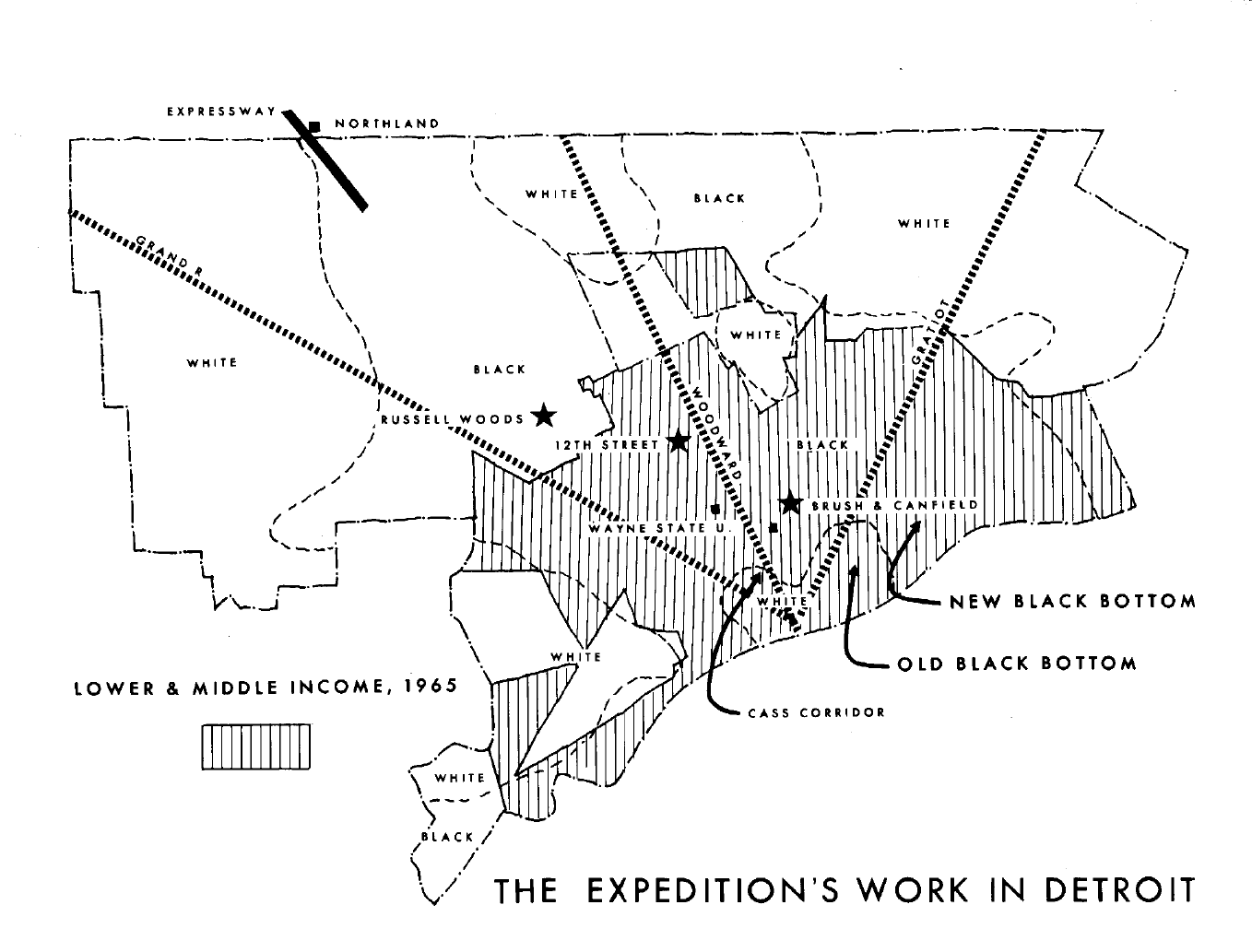
This map comes from Field Notes III of the Detroit Geographic Expedition & Institute (DGEI) which had a series of maps and features on the Cass Corridor. The last Cass Corridor map noted the racial differences in Cass Corridor. This map illustrates the racial divide where Black population rarely crossed 3rd Avenue to reside within the Cass Corridor.

The Cass Corridor was considered a “society” neighborhood in the 1860s – 1900s as Lewis Cass sold his farm land and the wealthy began building large Victorian homes there. In the 1960s – 1970s it was considered one of the pockets of White population in the city.

From DGEI’s Field Notes III publication:

“But, physical proximity has done little to bring the white Appalachians of the corridor any closer to blacks socially. Their dislike for each other has a long history, which stretches back to the days when they were both poor in the South. Poor whites and blacks have always had to compete with each other for jobs. An “outsider” may be able to see their mutual hatred as a trick played to keep them from uniting. To them, it is a deeply rooted cultural feeling.”

Map of Detroit in 1796

1796detroit

Although Detroit was formally established by the French (Antoine de la Mothe Cadillac) in 1701 and the Fort was called Fort Pontchartrain du Detroit, the British took over in 1760 after their victory in the ‘French and Indian War.” The British renamed the fort as simply ‘Fort Detroit” and began confiscating weapons from the Frenchmen. The British had constant difficulty keeping colonists and Native Americans happy with their rule and attempted to keep them satisfied by ending tax collection, granting land, etc.

You can tell this is a British map before handing over to American control since there is a section of land dedicated to the British Governor as well as King’s Wharf on the Detroit River. This map represents the plan for Fort Lernoult, which was constructed by the British in 1778 due to its better vantage point on higher ground instead of the former Fort Detroit location right along the riverfront. This Fort Detroit once stood near where the corner of Fort St. and Shelby St. meet in present day Downtown Detroit.

Fort Detroit (Lernoult) didn’t change hands again until July 11, 1796 when the post was handed over to the Americans as part of the Jay Treaty. The Fort wasn’t officially renamed to Fort Detroit until 1805. It was recaptured by the British in the War of 1812

Historical Events Rundown:

  • 1701 – Fort Pontchartrain du Detroit established along riverfront
  • 1706 – Ottawa attack Fort Pontchartrain
  • 1760 – British gain control after French and Indian War, renamed Fort Detroit
  • 1763 – Siege of Fort Detroit by Chief Pontiac of the Ottawa
  • 1778 – Fort Lernoult constructed on higher ground than former Fort Detroit
  • 1796 – Fort Detroit and Fort Lernoult handed over to Americans as part of Jay Treaty
  • 1805 – Fort Lernoult renamed Fort Detroit due to former Fort Detroit existing as the town area
  • 1812 – British recapture Fort Detroit in War of 1812
  • 1813 – Battle of Lake Erie caused British retreat, renamed to Fort Shelby to honor of Isaac Shelby who helped regain control of fort
  • 1826 – Congress gives Fort Shelby to the City of Detroit
  • 1827 – Fort Shelby demolished
  • 1961 – Fort Shelby excavation