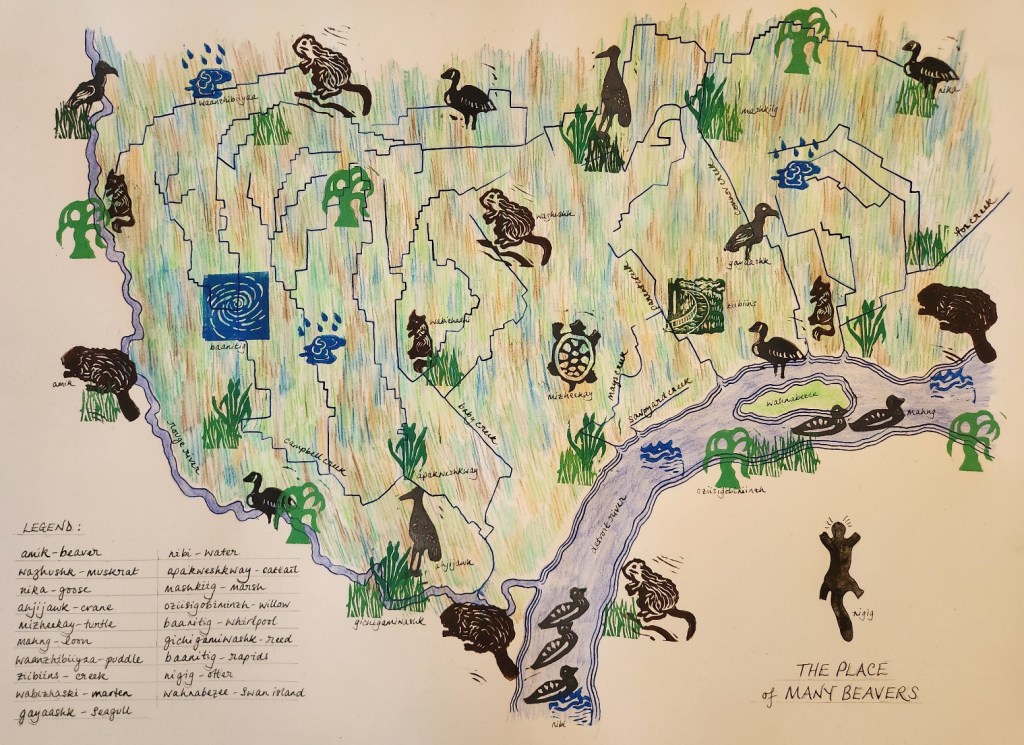
This map is one of my first explorations of how I might interpret the data I researched and collected on Detroit’s buried waterways to share visualizations of the city. I am very convinced that the way we talk about a place impacts our relationship with it. I created this map to learn the Ojibwe names of some of the Indigenous plants and animals of Teuchash Grondie (The Place of Many Beavers) / Waawiyaataanong / Karontaen / Motown / Midnight / Motorcity / Detroit.
Following two Michigan Supreme Court rulings, Rafaeli v. Oakland County in 2020 and Schaeffer v. Kent County in 2024, Michigan residents who experienced property tax foreclosure between 2015 and 2020 were granted the right to retroactively claim surplus proceeds from their homes being auctioned for more than the tax debt owed. For example, if a homeowner hadn’t paid their $1,000 annual property tax for two years and lost their home to foreclosure, and the county later auctioned the property for $20,000, the homeowner would now be owed $18,000. This practice of retaining surplus proceeds resulted in Wayne County reportedly collecting $92 million between 2005-2015.
Based on data provided by Alex Alsup (link), it became clear that, among Wayne County’s 41 cities, Detroit residents were disproportionately impacted, effectively sacrificing their homes to keep the county financially afloat. Filtering out commercial properties and speculators, Alsup and Outlier Media identified approximately 2,700 former Detroit homeowners who qualified to claim surplus proceeds, with an average amount of $8,000 each.
Outlier Media became aware of this in late 2024 (link)(link), resulting in a very short window to identify and notify affected residents before the March 31, 2024 claim submission deadline mandated by Michigan statute. Starting in late January 2024, Outlier began hosting phone banking events (link). Initially, we only had the address and the name on the deed at the time of foreclosure, making it difficult for volunteers to locate phone numbers. As a workaround, many phone bankers had to rely on Google searches to identify current contact information.
Outlier partnered with the Detroit Justice Center (DJC) to gain access to public records via LexisNexis. From there, Detroit Documenters and DJC volunteers began looking up both contact information and whether the former homeowners were still living. If deceased, volunteers were asked to identify likely next of kin or potential beneficiaries. Tragically, 40% of the former homeowners were found to be deceased. With limited clarity from the Wayne County Treasurer’s office, Outlier operated under the assumption that it was best to submit claims by the deadline, even if no probate cases or estates had been opened. After searching for contact information, more phone banking events were held where unlike the first sessions, these later events had a noticeably higher contact rate as volunteers were actually reaching people.
I was hired on a three-month contract as project manager in the first week of February after contributing as a Documenter, helping look up contact information, and attending a pilot phone bank in January. Recognizing the scale of the outreach, I bought a cheap flip phone to keep communications organized, as I was responsible for dozens of follow-up calls after each phone bank.
In the two months leading up to the deadline, we made 4,321 calls, resulting in 481 successful contacts. We estimate these efforts could lead to $5,882,473 potentially being returned to impacted former homeowners and their families. Out of those 481 contacts, I personally responded to 200 follow-up calls, which I tracked individually. Fortunately, the Detroit Housing Network’s call center stepped in to assist with additional follow-up efforts.
On March 29, just days before the deadline and after our final phone bank, I attended the workshop “Mapping Your Local Environment” led by CJ Knoble and presented by Detroit Documenters, Planet Detroit, DetroitData, Urban Data Response, and Rooted Futures Lab. We learned how to use Felt for mapping and were encouraged to create one ourselves. The day before, I had organized a one-stop claim submission event at the Joseph Walker Williams Recreation Center where free notary services were provided, and the City of Detroit’s Department of Revitalization collected claim forms to deliver to the Treasurer’s office. As I helped people complete their paperwork, I realized I had previously been in contact with many of them. Inspired, I created a map at the workshop to explore whether the residents I’d reached represented the broader geographic spread of the windfall profits owed, and whether some areas saw more concentrated profits than others.
Data Layers Included:
The boundary of Wayne County
The boundary of Detroit
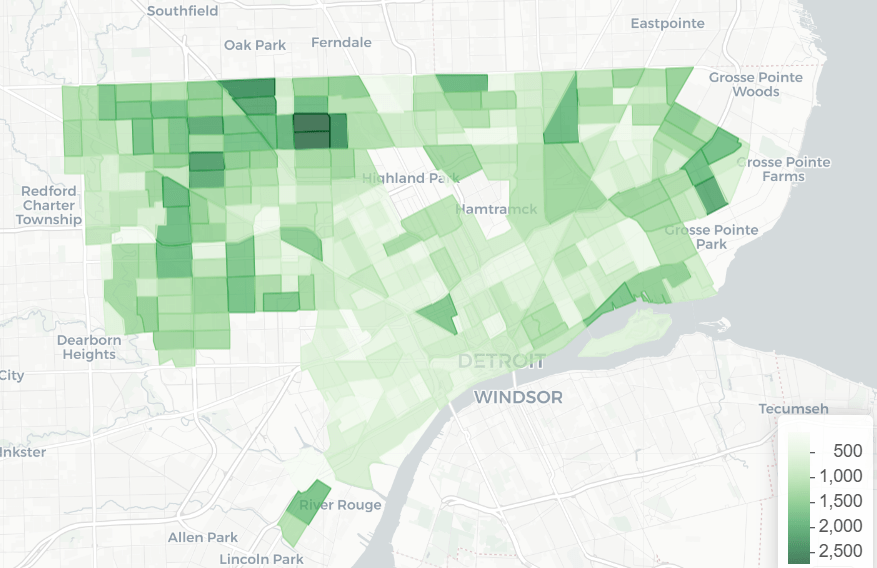
A heatmap of addresses eligible for surplus proceeds, released by the Wayne County Treasurer’s office
📲 Emojis from my claimant follow-up spreadsheet, each representing a home I personally consulted
Observations:
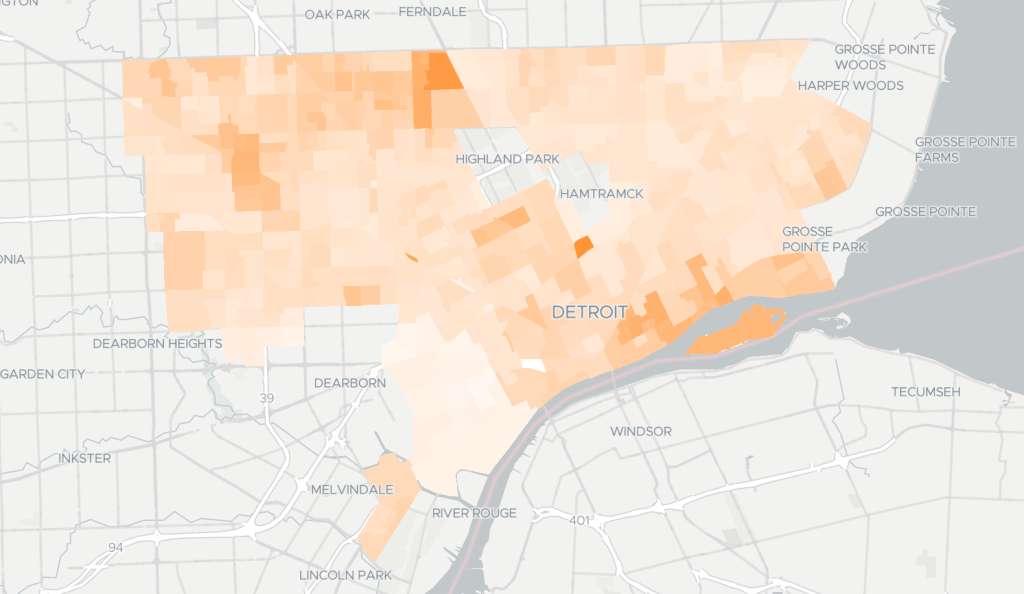
To visualize areas with higher concentrations of qualifying foreclosures, I converted the list of eligible addresses into a heatmap. The results are likely not surprising to most Detroiters: the issue was widespread across the city except in areas such as Wayne State University/Cass Corridor/Midtown, the riverfront, and neighborhoods near Ferndale and Grosse Pointe. Although there were pockets that were less impacted by property tax foreclosure between 2015-2020, it was painful to see how prevalent they were in Detroit compared to the other cities in Wayne county as depicted in the heat map.
The distribution of the 📲 symbols, representing homes I personally contacted, was wide but I could see that I lacked strong outreach in some heavily impacted neighborhoods. I was especially disappointed that I didn’t assist more residents in Southwest Detroit, where I live, and where the heatmap showed many eligible properties. Given that Southwest is a predominantly Spanish speaking community, they may have routed their follow up calls to our partner there, Bridging Communities or other organizations. Although there are gaps on my personal outreach map, I presume that a map of total calls to 2,163 out of nearly 2,700 impacted former homeowners that were placed during phonebanking events would fill those pockets. If there had been more time it would have been great to map earlier on to track the distribution and build more localized partnerships.
Next Steps:
Michigan statute requires that claimants receive a response from the Wayne County Treasurer’s Office by July 1st 2025. It is the second week of June and I am getting calls from anxious claimants who still have not heard back. I am able to relay that no one has received their letter as of yet, and their calls assure me that I will know when they do arrive. The expected letter from Treasurer Sabree is supposed to confirm the amount that is owed and instruct the claimant on next steps. I expect that a large portion of claimants will be disappointed to find that there is another step, which is to file a motion in court. This might be particularly intimidating for those who claimed interest as heirs or beneficiaries. We do not know how WCTO will be responding to claimants who didn’t have a probate open when they submitted the initial form March 31st. Detroit Justice Center is contracting experienced probate attorney Deborah Choly to assist heirs with filing. I am back at Outlier as of last week for this second phase and will be organizing workshops where claimants can be guided through filing as well as receive specialized support and resources for the process. I will be keeping track of who reaches back out in this phase and hope to map again to compare and contrast my outreach in each phase.
Shiva Shahmir holds a BA in Fine Arts from the University of British Columbia, with a concentration in architectural theory and environmental design, and an MPS in Arts and Cultural Management from Pratt Institute. Since 2017, she has voluntarily managed Spread Art, a nonprofit, community-programmed cultural space, as President of the Board. In 2023, Shiva joined Wayne State University as part-time faculty in the Music Department, where she lectures on studio recording and music technology. In 2024, she became an active Detroit Documenter with Outlier Media, where she is now contracted as a Project Manager. Shiva is also an artist and a proud FCC-licensed amateur radio technician.
When I started the Mapping Detroit’s Buried Waterways project in 2022, I had no idea I would still be trying to complete it 3 years and 283 miles later.
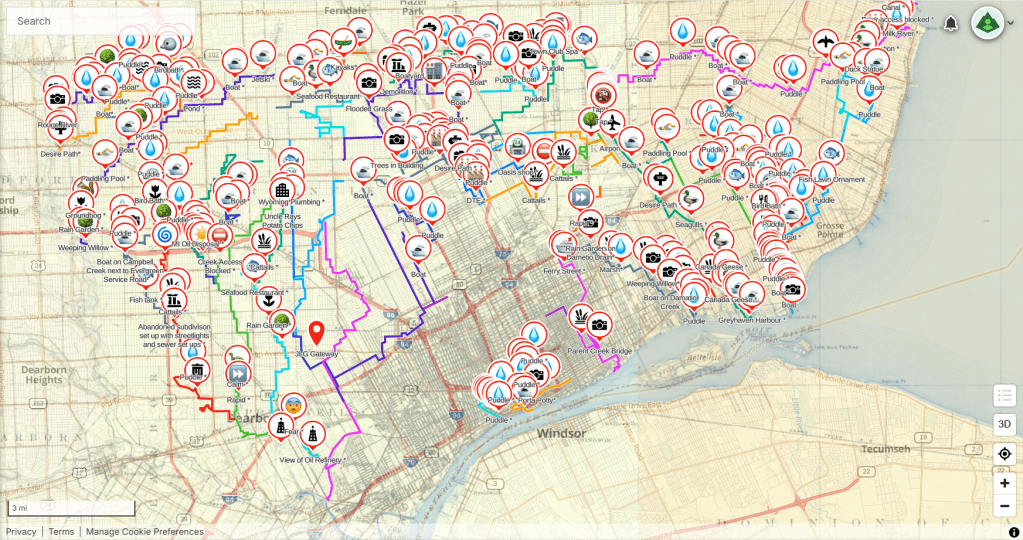
This map is a screenshot of the current state of the project from my GAIA account, which I use to record tracks as I follow the routes of the buried waterways as closely as I can in real time on today’s streetscape. The base map is the current Open Street Map with the U.S. Geological Survey (USGS) 1905 1:62,500 series map and my tracks and waypoints (GPS coordinates of points of interest) layered on top. I started the project by following Baby Creek and its tributaries because it is the closest buried waterway to my house. To begin with I simply recorded the track as I followed the creek on my bike. As I moved west to Campbell Creek, I began marking waypoints of things I noticed that related to, or reminded me of, water. There are now more than 500 waypoints on the map representing everything from puddles, rain gardens and marshes, to boats, paddling pools and desire paths, to fish lawn ornaments, Canada Geese and Weeping Willow trees. Around summer 2023, when I headed over to the Eastside to map the channels of Fox Creek, I started adding photos (represented by the camera icon) to the map.
I love looking at this map. I love that it documents the evolution of the project and the profusion of the mess of waypoints and the memories they bring back of visiting different areas of the city.
Voter Mobilization efforts should focus on a simple equation that indicates the potential available voters in each U.S. census block. The Voter Participation Rate (VPR) as defined as the Voter Totals / Voting Age Citizens located in each block indicates the untapped quantity of voters available in each tract.
Using reliable data sets for each of the key variables, VPR indicates the highest potential for tracts for voter mobilization activists in the city. The analysis below suggests that these groups should prioritize the following 5 Census Tracts:
Census Tract
VPR
Census Tract 5240.01
14.30%
Census Tract 5242
14.40%
Census Tract 5241.01
17.60%
Census Tract 5173
20.30%
Census Tract 5234
20.70%
Data Sets:
The data used in this analysis is pulled from two sources. The first is a very interesting data set available from Michael Bryan and the Harvard Dataverse where they aggregated precinct level voting totals from 2020 and projected them onto U.S. Census geometries. This allows the analysis to by past known issues with exit polling and use actual voting totals in the calculations. Although this data is reported in a partisan fashion in terms of votes for the president, uses the aggregate total votes across a Census Tract for targeting non-partisan voter registration efforts.
The second data set used is data published by the Census on the count of Voting Age Citizens in a given Census Tract as calculated by the 2022 5-Year estimates which is the most recent data available for this type of estimate and geography.
These data sets provide information on the participation of voters in elections, specifically, the last presidential election as well as the overall available number of voters in a given area, in this case, a Census Tract. Census geometries are useful in that they can also provide various demographics and other data that is not available for precinct areas.
Calculating VPR
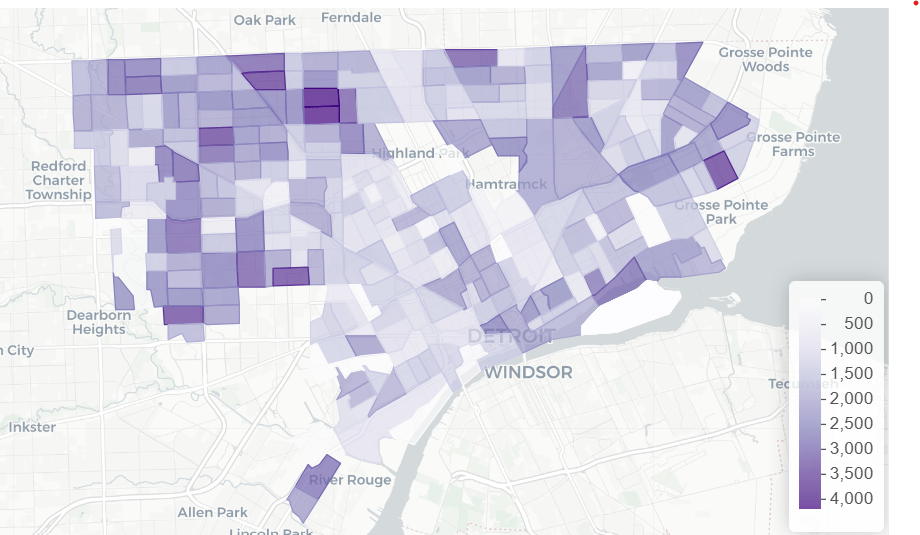
The Vote Totals by Census Tract are shown below:
This data shows that the Bagley neighborhood (Census Tracts 5385 and 5386) seems to have the highest counts, while Southwest Detroit shows less voting overall.
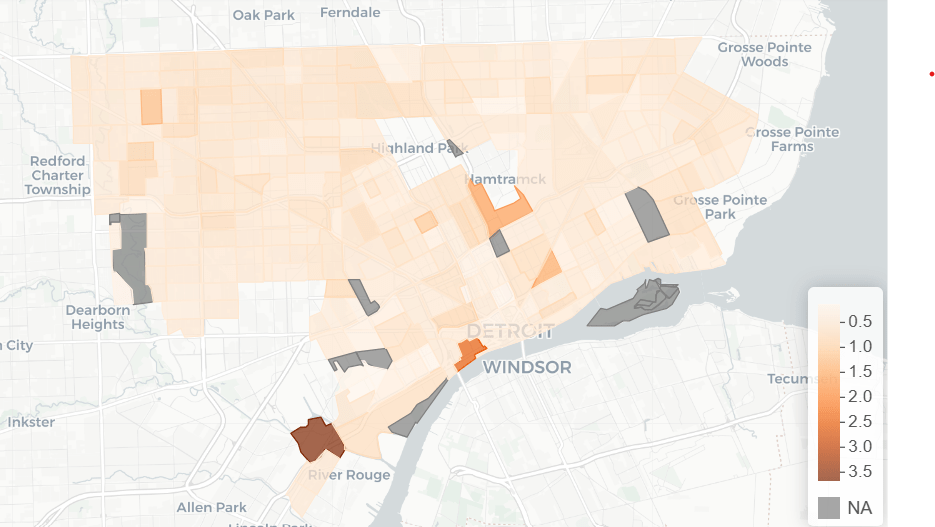
Figure 2 shows the counts of Voting Age Citizens from the 2022 ACS data:
There are several items to note from this plot. The first is that populations of Census Tracts vary widely across the city. Most notably, there are several (Belle Isle, the Stellantis Plan on the east side, Rouge Park on the west side, etc.) where the estimated population is 0. These Tracts must be taken into account differently as they cause issues with the analysis.
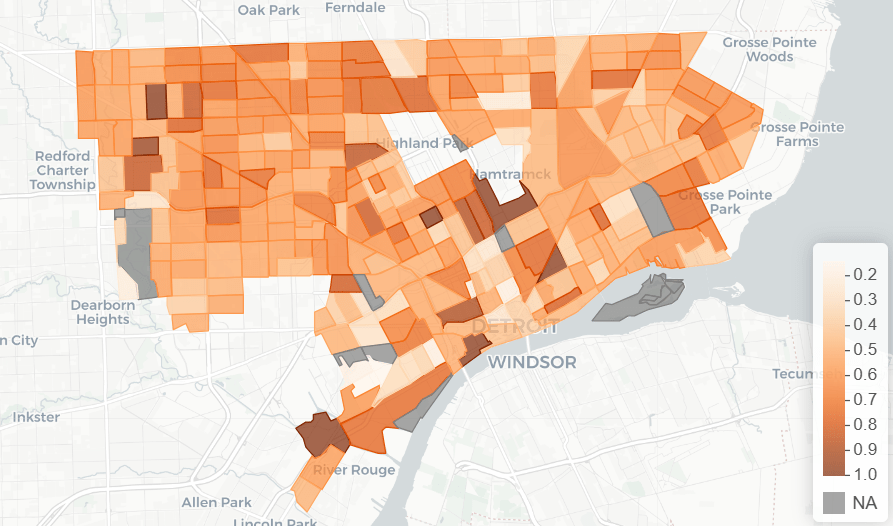
Using these values, the Voter Participation Ratio (Vote Totals per Census Tract/ Estimated population of Voting Age Citizens per Census Tract) can be calculated:
This plot shows greyed out Census Tracts where no Voting Age Citizens are estimated to live, these are marked as “NA”. Additionally, there are several tracts where the projections exceed the estimates from the Census generating a ratio above one. One possibility is that these are tracts where there was significant decrease in population from 2020 to 2022. Another possibility is that the precinct population from which the projections were drawn is geographically heterogeneous and the projections don’t do a great job for these particular areas. This is likely true for highly industrialized Census Tract 5245, which shows a ratio of 3.7. The Census only estimates that 36 Citizens of Voting Age live in this tract.
If the ratios are capped at 1 by using the Voter Totals as the estimates where the ratio exceeds 1, the plot shows a better looking and more useful chart:
Interestingly, although the prevailing belief is that Detroiters don’t vote, most Tracts have relatively high participation with two thirds of Tracts showing over 50% VPR. Overall, Detroit has a VPR of 56%. Using this data, a list of Census Tracts to target for voter registration and outreach can be generated, including some of the lowest participation Tracts like 5240 (14%), 5242 (14%), 5173 (20%), etc. If voter outreach were to bring these 5 lowest Census Tracts up to the average VPR of 56%, it would boost turnout by 3200 votes in the city.
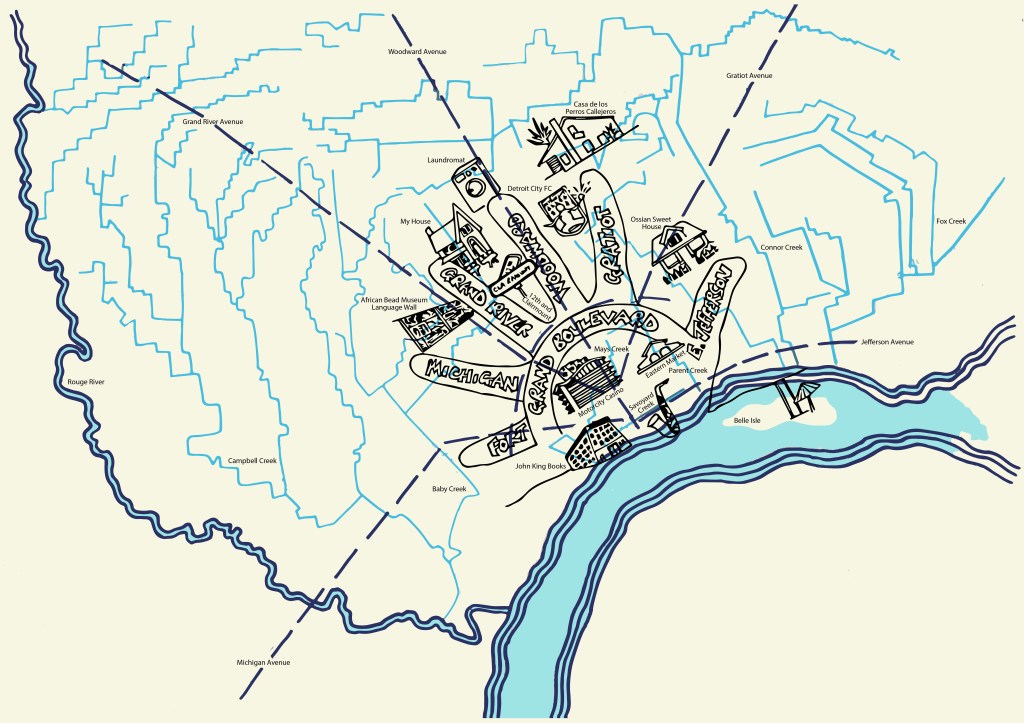
This map combines the classic Detroit hand map with an outline of Detroit’s buried creeks – sketched from tracks recorded while following the creek routes on my bike – to share my relationship with Detroit.
The hand map is the first map I created of Detroit after attending a DETROITography event in 2017. The map focuses on places that were and mostly still are important to my life in the city. My house, the African Bead Museum, and Belle Isle Beach are all places I still go regularly. Thankfully I have a washer and dryer now so my visits to the laundromat are not as frequent.
The outline map of Detroit’s Buried Waterways represents how learning to navigate the city from the perspective of water, rather than concrete, has expanded my relationship with Detroit. Following the creeks on my bike has taken me to neighborhoods all over the city and introduced me to thriving communities, emergent marshes, and resilient people and nature.
by: Neel Marathe, University of Michigan urban technology student completing a GIS internship
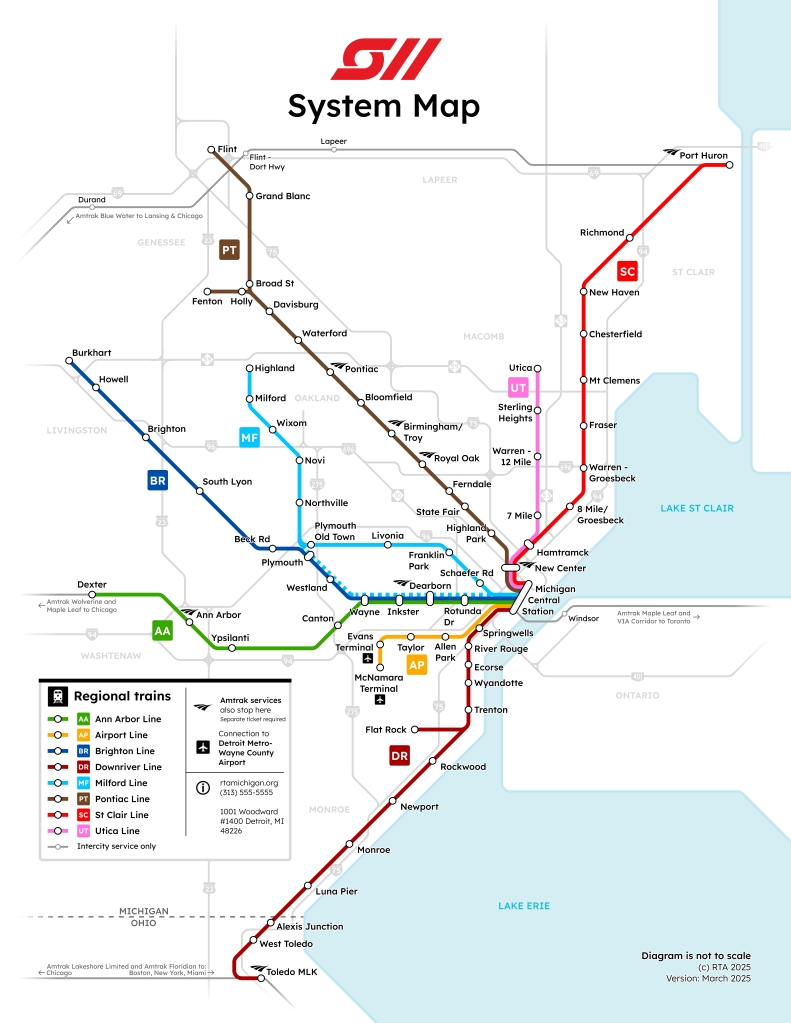
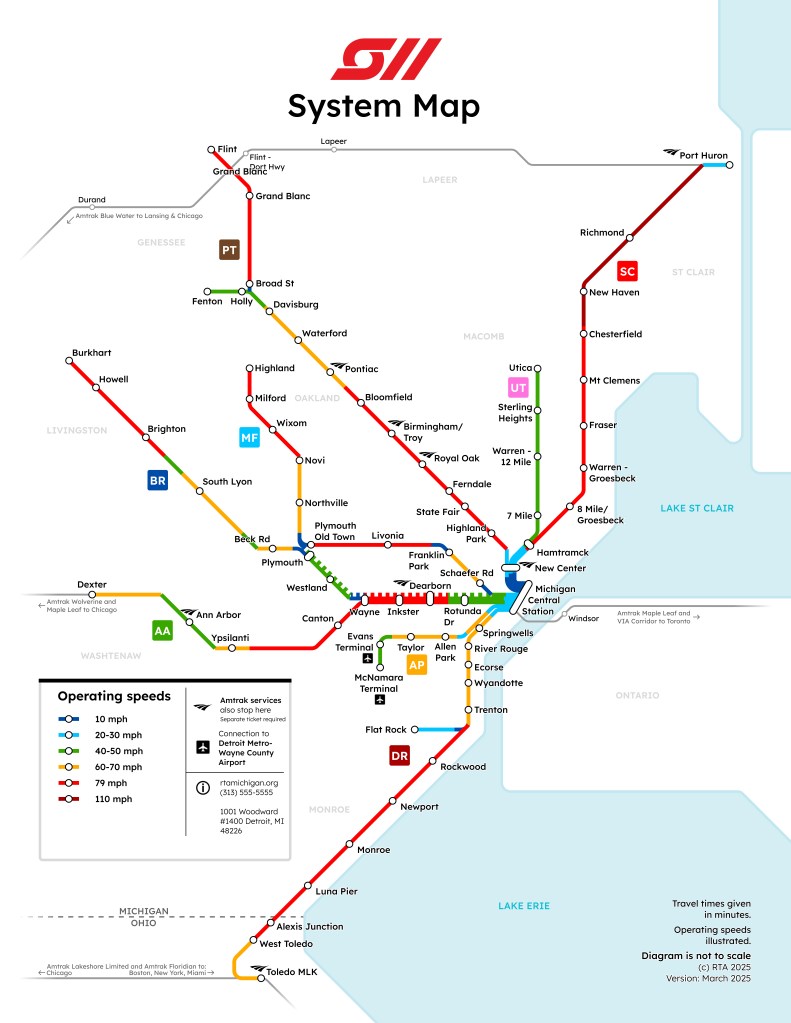
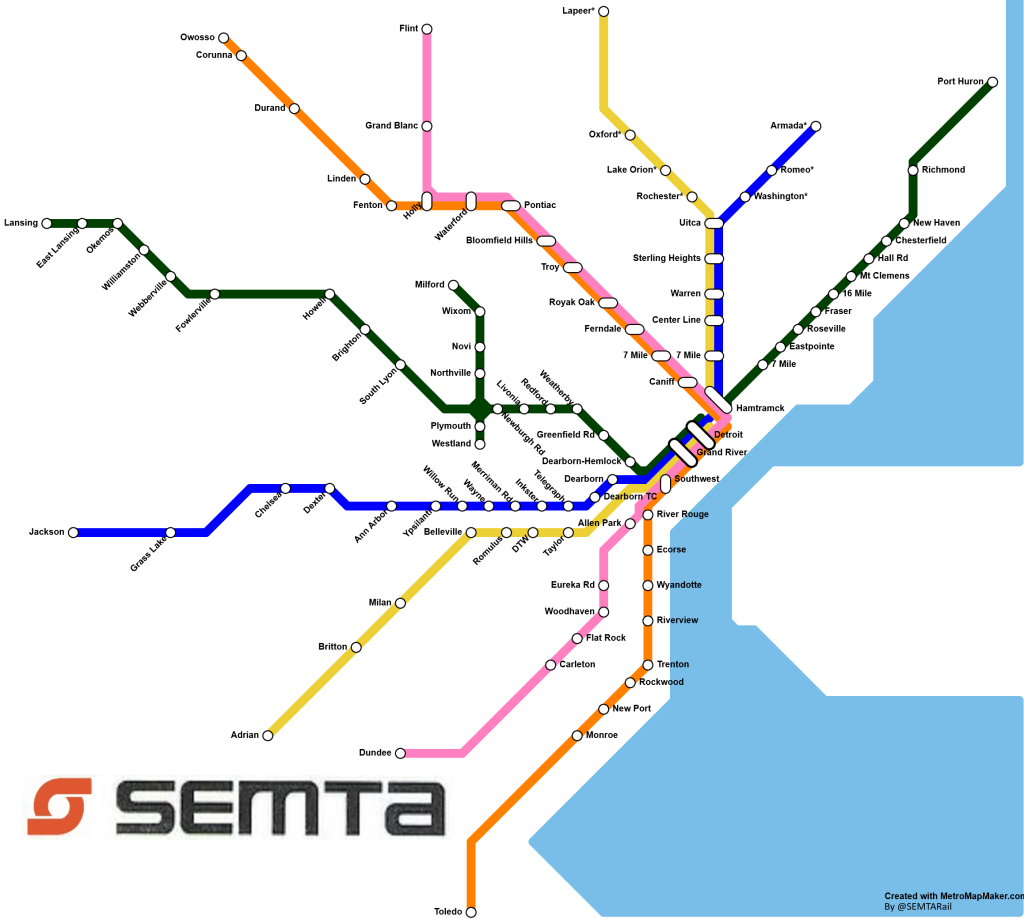
What if SEMTA, the one-line commuter rail from the 70s, grew instead of dying out? Inspired heavily by Metra and GO Transit, this project that I worked on over spring break imagines that Detroit had a regional/commuter rail system that matured through the ages (not like a brand new proposal). This system entirely uses existing tracks owned by many different freight companies, but imagines that they’re improved a lot for passenger use.
Perhaps interestingly, I imagine that what I’ve depicted as the Downriver line is actually an electrified former interurban once operated by the Detroit United Railway—very similar to the South Shore Line in Chicago/Indiana. Even Henry Ford attempted to run an unconventional electrified freight railway on this corridor (didn’t go well). This being electrified would’ve made it easy to also create an electrified airport line, which features the only non-existing right of way in the map. The rest of the lines would probably run with diesel trains.
I’m also in the process of making fictional timetables for all these lines, with service patterns based on a commuting habit analysis sourced from this handy SEMCOG map (the patterns are present there).
Tools: ArcGIS Pro to start & make the shapefiles, Figma for everything visual.
Why no ring line? Why do they all terminate at MCS?
I wanted this map not to be perfect, but somewhat realistic to the imagined continuation of SEMTA’s operation. Thus it looks very similar to Metra’s and GO’s systems. I was especially inspired by GO, who run a great regional bus service that complements their rail network with non-radial lines along major freeways, and fills in the unserved corridors with lower capacity, higher frequency service.
As many pointed out, Detroit isn’t the center of Detroit—there’s much more demand here to go to other job centers: edge cities like Troy, and the unique case of Ann Arbor. I think a radial rail line would be great, and ridership would make sense too, considering the decentralized nature of traffic patterns in our metro area.
Why no western access to the airport?
There are a number of ways to imagine this system—this one is not great for that use. There’s definitely rail routings that’d make transit from the western metro to the airport more possible. For mine, I wanted to imagine that an electrified interurban down to Toledo would be the basis for an electrified, high frequency airport line that also serves some other downriver communities that the main lines would miss out on.
Why no service to Southfield, Farmington, etc?
I wanted to stick to using current existing rail right-of-ways to remain realistic; there are no rail lines that go to those communities. This is also somewhere I imagine that a complementary bus service would fill the gaps, by providing connections to stations or directly into town and other peripheral destinations. I imagine that the current SMART buses would be very useful for this—travel from the Troy/Birmingham station into the business district, for instance.
by: Kelsey Maas, Wayne State University (Intro to GIS, Fall 2024)
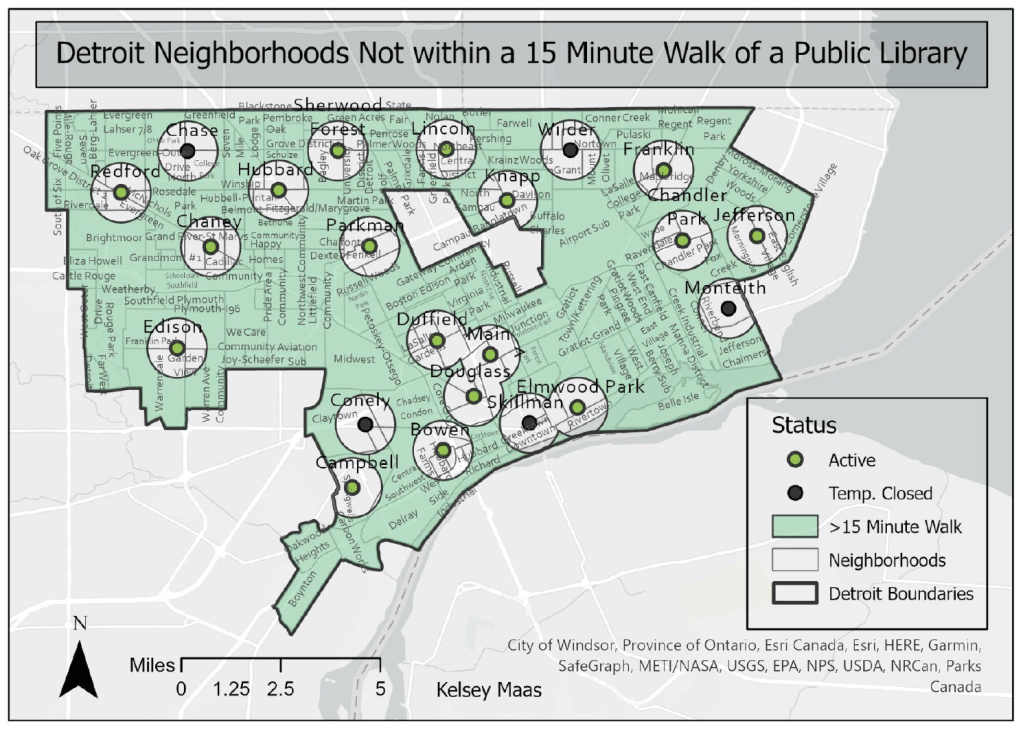
Public libraries have long served the people of Detroit. The first public library opened in 1865 in the Old Capitol building. Due to extensive population growth, the City constructed its first library branches to meet need. Eventually, eight more branches were created from funds from the American Industrialist Andrew Carnegie with the last Carnegie branch approved by the City Council in 1917. More branches continued to be built to serve the growing city well into the twentieth century. Eventually, the appearance of new branches ceased as the population shrank in the mid-twentieth century.
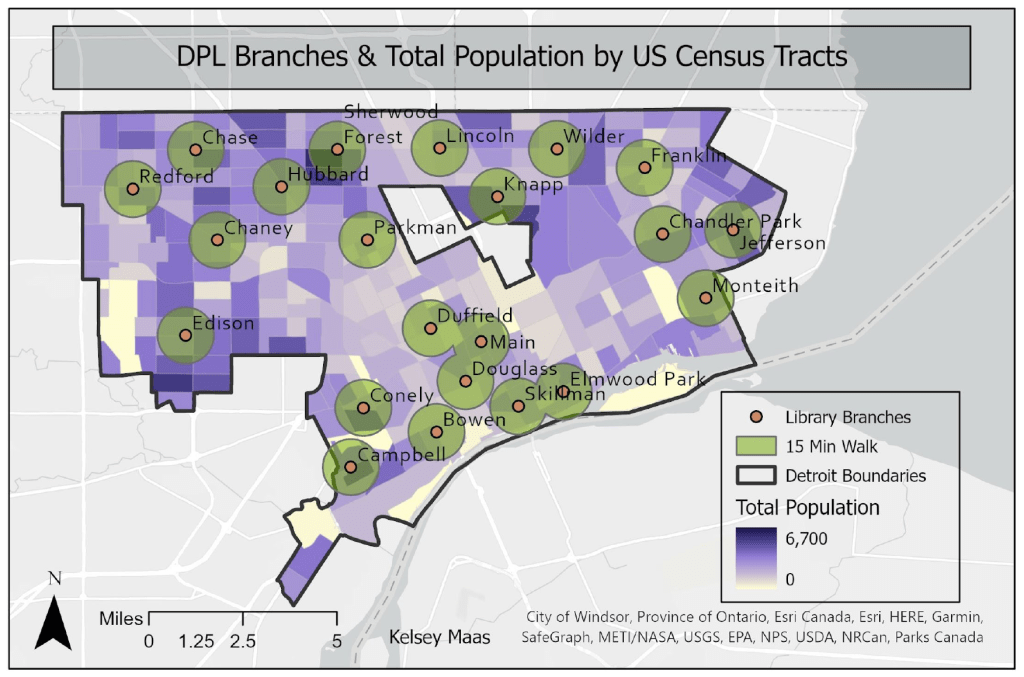
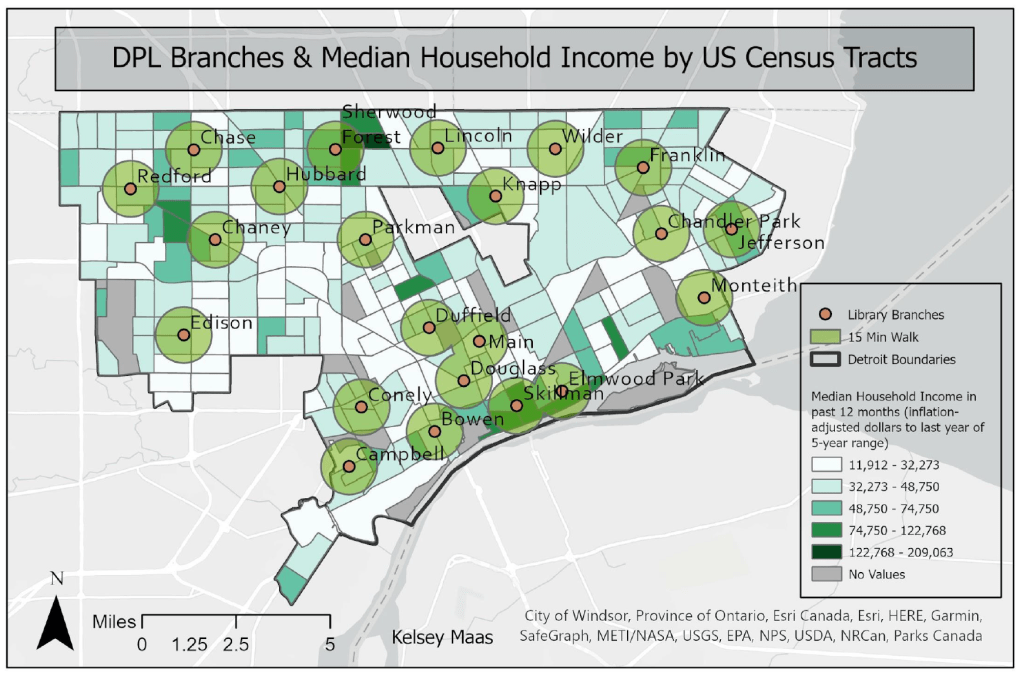
More recently, public and community resources (library branches, public schools, etc) have reduced due to the loss of Detroit residents and disinvestment. As Detroit is geographically large (143 mi), this means residents must travel further to access public amenities. Additionally, limited public transportation options and frequency, further adds to access issues. This project aims to examine who can walk to Detroit Public Libraries and who is left out through a spatial lens. The boundaries are the City of Detroit’s borders. It will highlight the neighborhoods served and underserved by Detroit Public Libraries.
The concept of the 15 Minute City helps to frame walkability. The term was coined by urbanist Carlos Moreno and remains a popular framework for evaluating the livability of cities. The 15 Minute City is an ideal urban environment that is structured at a human scale where residents can get to their everyday needs within a 15 minute walkable or cyclable travel radius. Community benefits from a 15 Minute City design consist of socioeconomic equity (residents are not limited if they do not have a car), less vehicle dependence (reduces carbon emissions), increased walking and biking (better health), and increased standards of living (conveniently located services).
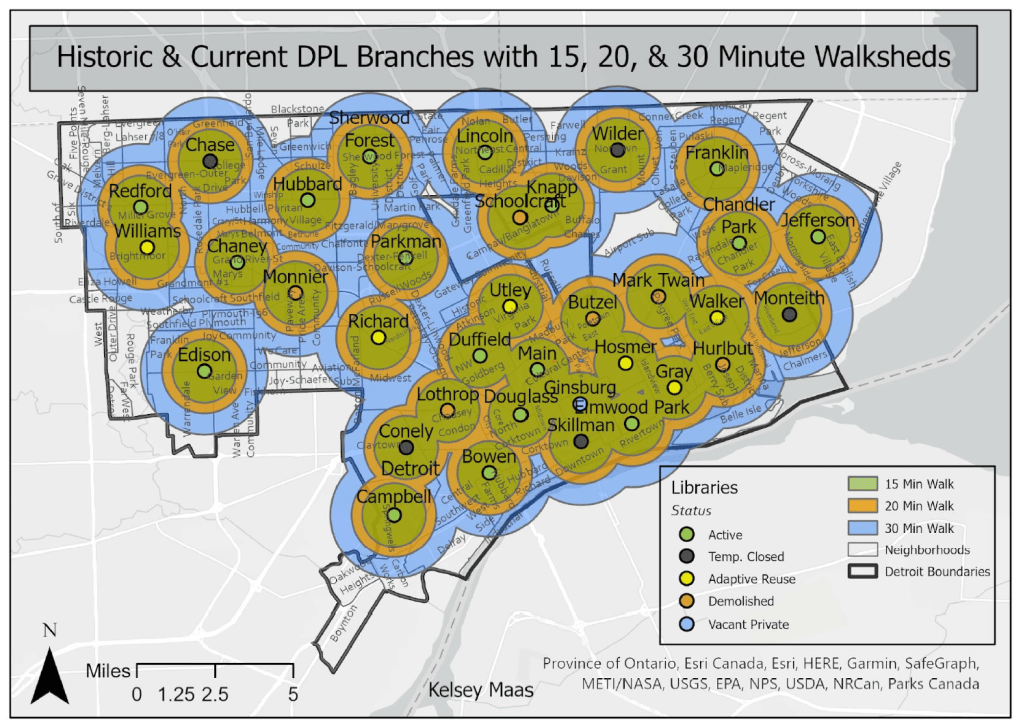
The Detroit Public Library system currently has 22 physical locations. Of these branches, five are temporarily closed. The first set of maps illustrates which Detroit neighborhoods are serviced within a 15 minute (0.75 mile), 20 minute (1 mile), and 30 minute (1.5 mile) walk of a library branch. The map’s buffer distance was calculated per the 15 Minute City framework and methodology.
The maps include both the active and temporarily closed branches with the understanding that the five temporarily closed branches will reopen in the coming years.
by: Andrew Chiles, Wayne State University (Intro to GIS, Fall 2024)
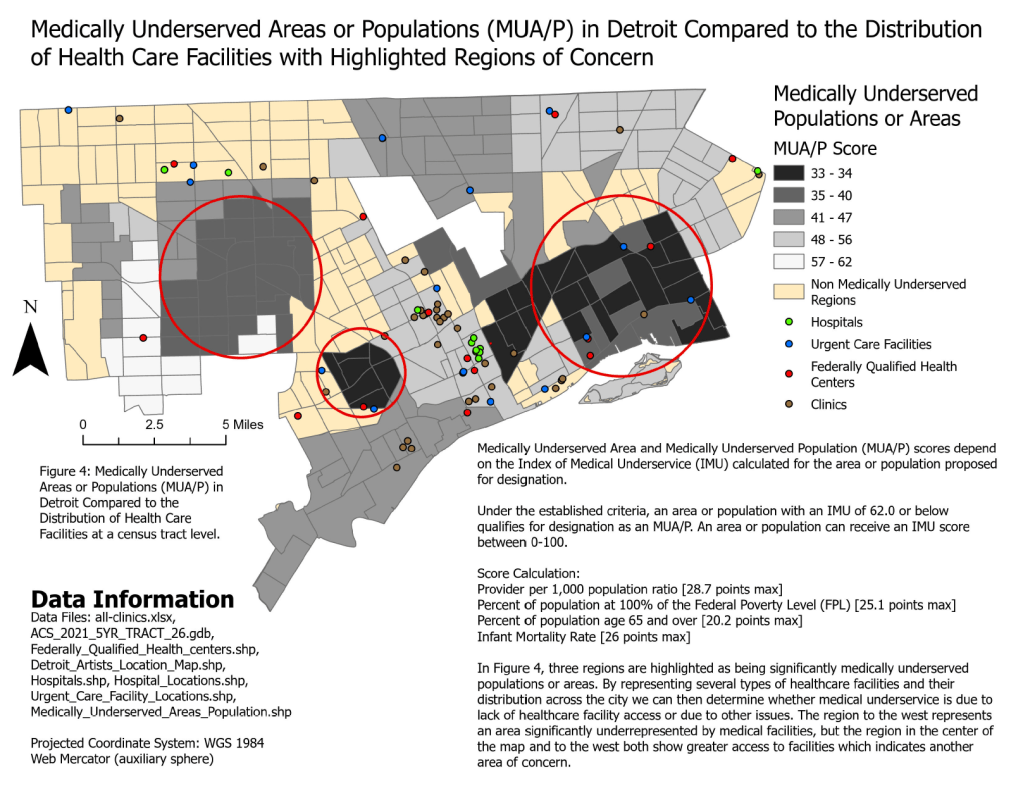
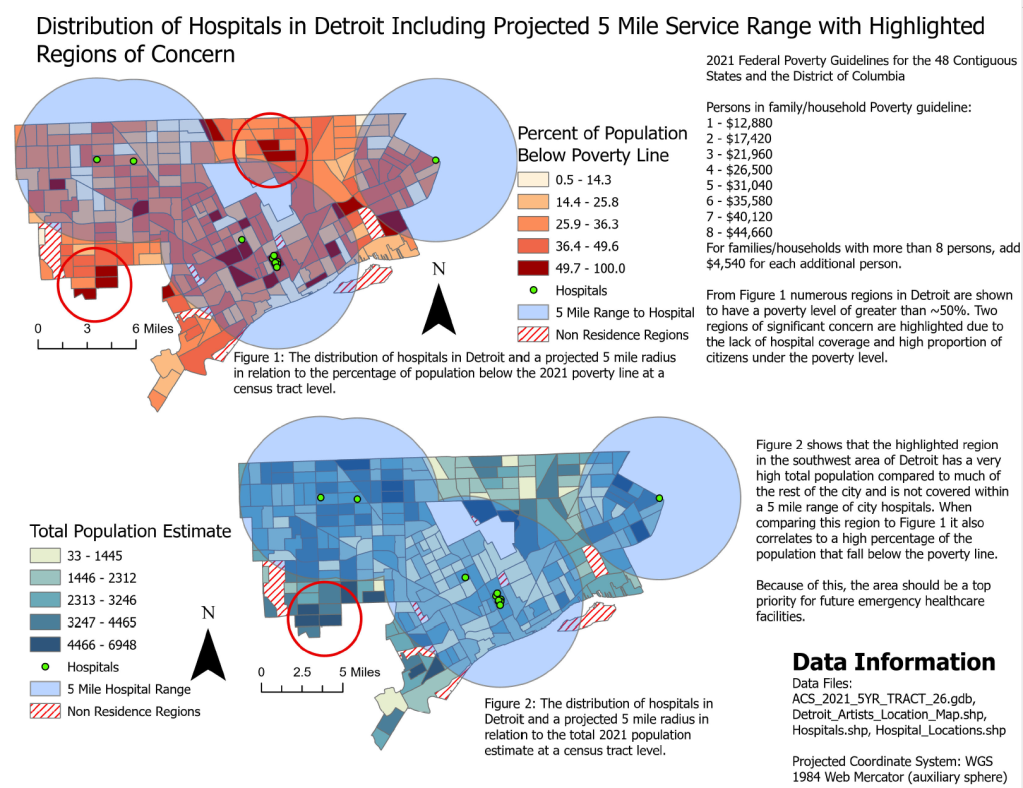
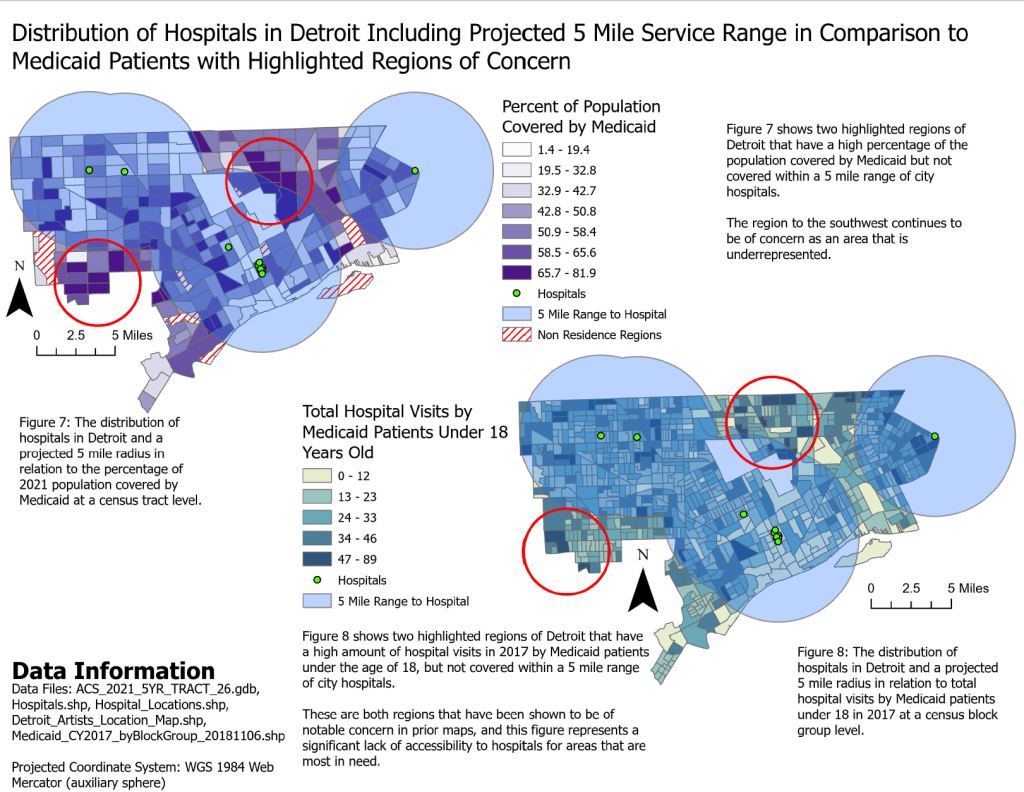
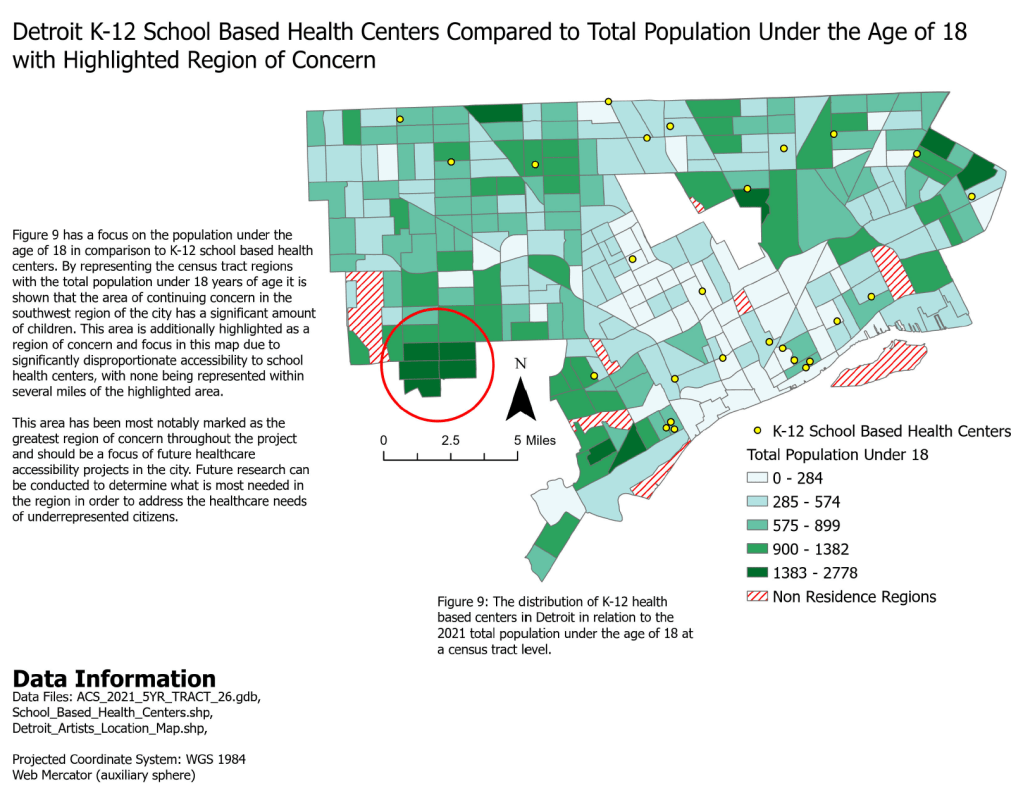
Access to healthcare is a crucial aspect of public health outcomes, even more so in urban areas such as Detroit, where socioeconomic disparities can influence who receives adequate medical care. This project will focus on examining access to healthcare facilities across Detroit, through the use of geospatial data analysis. Specifically, I would be seeking to answer how the spatial distribution of healthcare facilities in Detroit corresponds to varying demographic dynamics within the city, and what gaps exist in terms of healthcare accessibility.
By examining the geographic placement of hospitals, clinics, and other healthcare facilities in Detroit and overlying the data with population metrics and health outcomes, we can identify areas that are underserved by healthcare services and/or disproportionately affected by preventable or manageable diseases and health issues.
This topic is significant in regard to discussions on health equity and urban health disparities. Detroit has been deeply affected by systemic racism in the past and continues to have the lingering effects. This research may help to showcase how it is rooted within public health. The results of which can inform public health initiatives aimed at improving healthcare accessibility and reducing illness prevalence in vulnerable communities.
The geographic focus of the project is the entire city of Detroit, with a detailed analysis at the neighborhood or census-tract level. Detroit is characterized by it’s extremely diverse neighborhoods and communities, many have been shaped by historical patterns of disparities and economic disadvantages. By focusing on the entire city, we are able to capture the spatial variations in healthcare access and diseases to explore how they differ across different parts of the city. Neighborhoods of specific interest or concern will be highlighted and focused on to showcase these disparities across the city.
The data used in the project is from DetroitData and Data Driven Detroit (D3), catalogues of opensource data for the Detroit community, as well as the 2021 TIGER/Line Demographic and Economic Data and 2020 TIGER/Line zip code tabulation areas from the US Census Bureau. Additional reference material comes from the US Department of Health and Human Services – Office of the Assistant Secretary for Planning and Evaluation (ASPE) and the Health Resources & Services Administration (HRSA).
by: Yanyun Li, Jered Dean, Houjon Ding, Raven Wright – City of Detroit
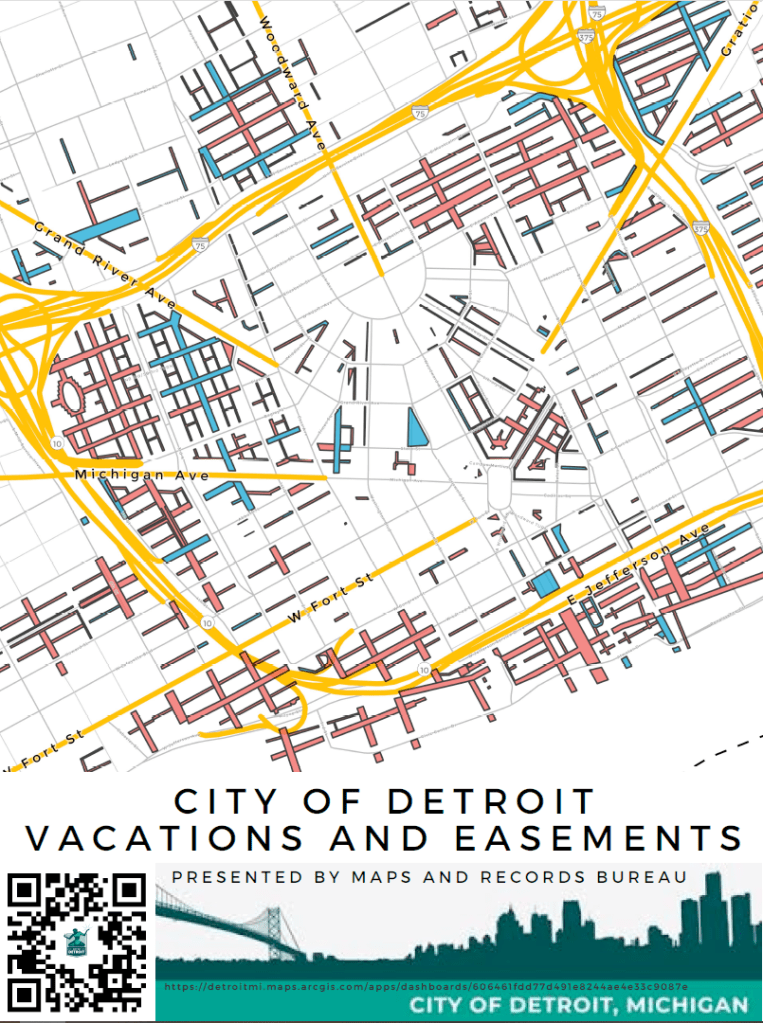
This layer indicates all streets and alleys vacated ‘Outright’ and vacated with conversion to utility easement in the City of Detroit. This layer is updated regularly.
by: Steven Wiltse, Martin Denicolo, Zachary Manning, Kevin Zhang, Tess Parr – City of Detroit
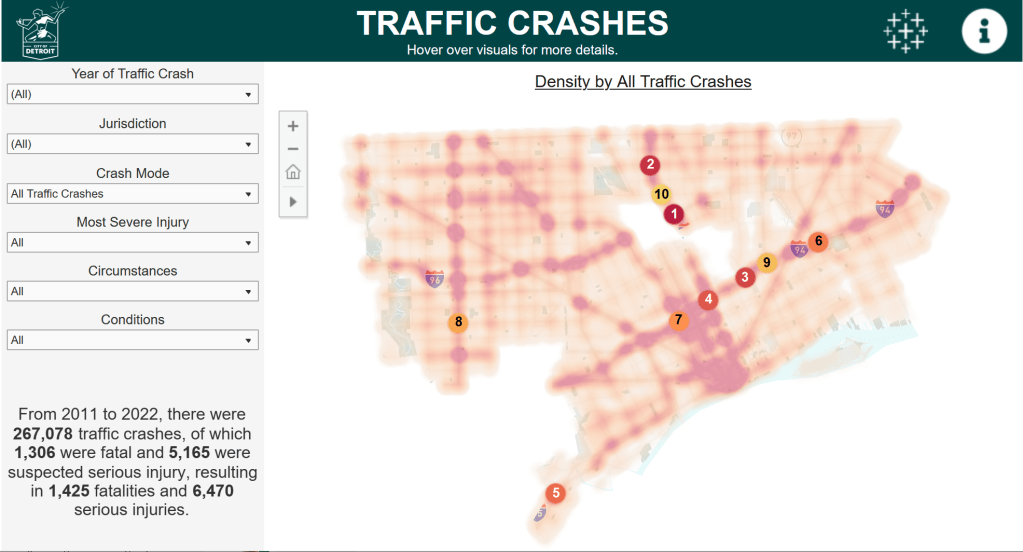
The City of Detroit has launched its Open Data Portal Analytics initiative in order to increase public access and understanding to valuable data and information that is posted on the Open Data Portal as raw datasets.To that end, the Traffic Crashes dashboard was built to visualize 267,078 traffic crashes that occurred in the city of Detroit from 2011 to 2022. The dashboard’s visual elements include a heatmap of traffic crashes with top 10 intersections, a highlight table of crashes by time and day of the week, and a histogram of crashes by type.Users can apply filters on the dashboard to explore deeper trends in the data. Drill-downs include the road jurisdiction, modes involved (e.g. automobile, pedestrian, bicycle, etc.), most severe injury to occur, circumstances involved in the crash (alcohol/drug use, red light running, speeding, etc.), and conditions at the time of the crash (rain/wet, snow/ice, dark-unlighted, etc.). The filters dynamically change all the elements on the dashboard, including written descriptions.The Traffic Crashes dashboard was built in Tableau Desktop and embedded in an ArcGIS Experience Builder application.
by Kelsey Maas & Megha Bamola – City of Detroit, Historic Designation Advisory Board (HDAB)
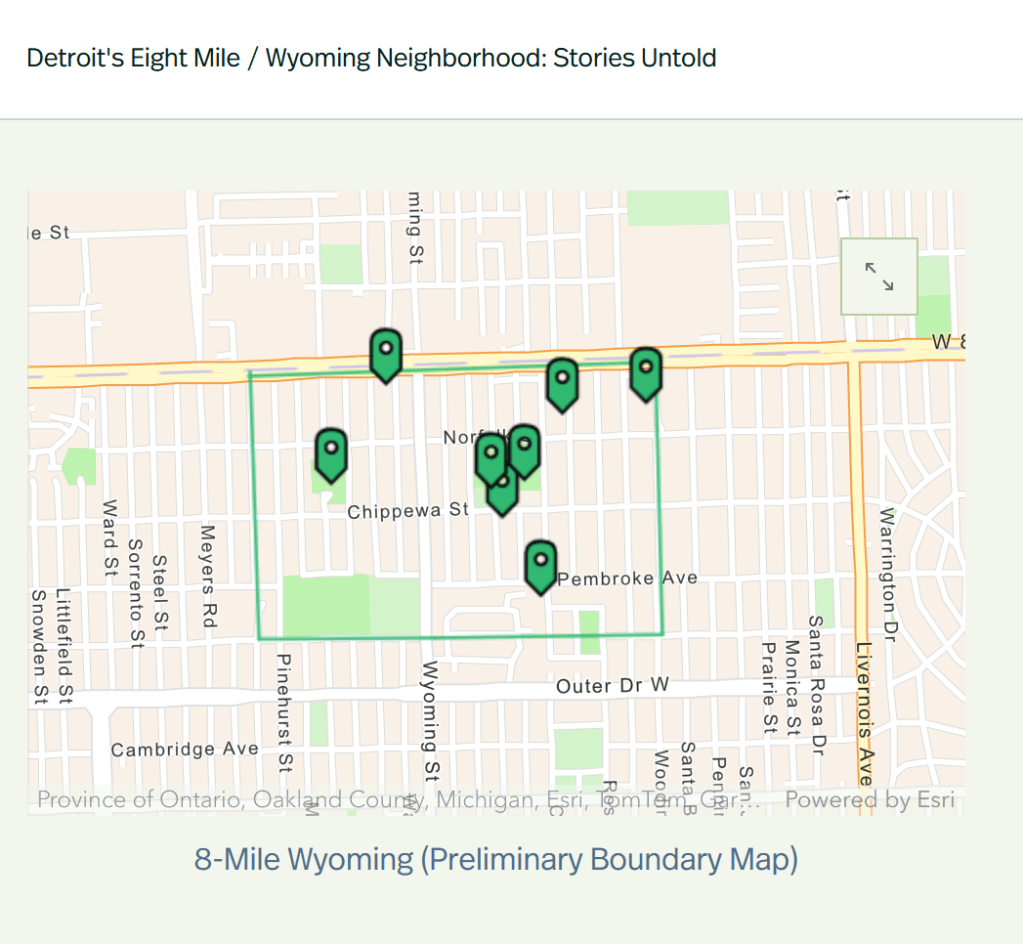
Detroit’s Eight Mile-Wyoming neighborhood is the oldest Black neighborhood in Northwest Detroit. The neighborhood signified a starting point for many working-class Black Detroiters; one of homeownership, hopeful revitalization, and a sense of community. Numerous resources remain in the community that highlight significant moments in African American and Civil Rights history. We invite you to explore these sites with us and learn more about the people and places of Eight Mile-Wyoming! This Story Map was a part of the Eight Mile-Wyoming Intensive-Level Survey project and was supported in part by an Underrepresented Communities grant from the Historic Preservation Fund administered by the National Park Service.
by: Yanyun Li – City of Detroit, Department of Public Works (DPW)
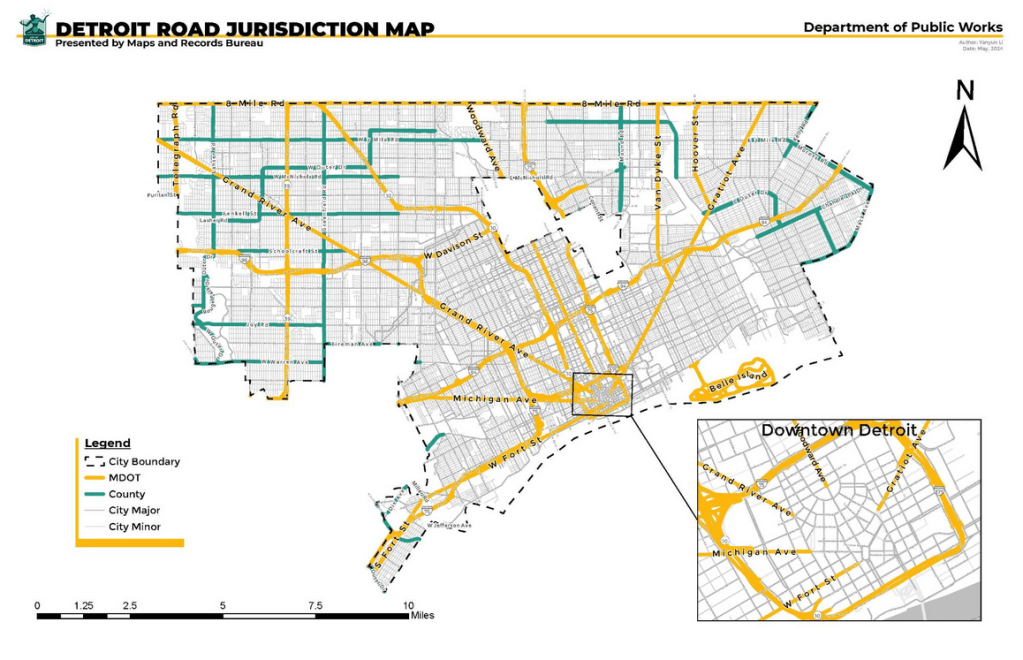
The jurisdiction map of Detroit delineates city, county, and MDOT territories. City-owned roads include city minor and city major. MDOT’s highways serve as vital conduits linking Detroit to broader networks. This map will serve as a valuable tool for promoting efficient city right-of-way governance, fostering collaboration, and guiding urban development.
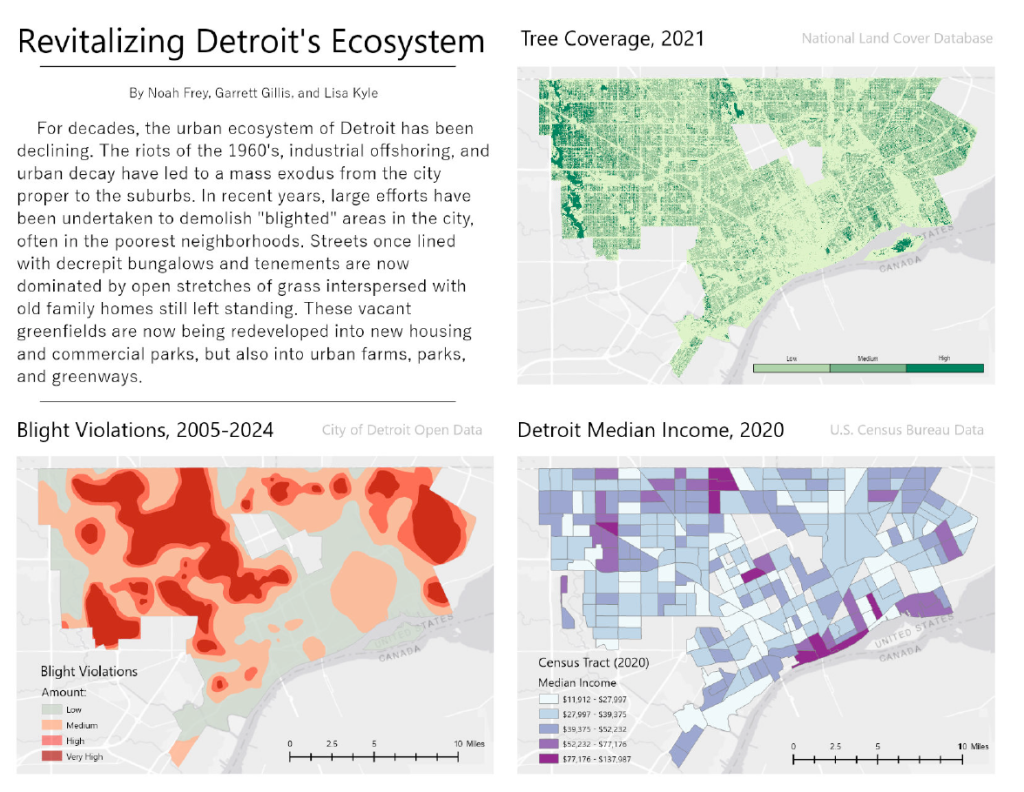
by: Lisa Kyle, Garrett Gillis, Noah Frey (Wayne State University)
We chose to focus on the present development of Detroit because, in our view, the city is at a crucial precipice. The latter half of the 20th century was not kind to our city — but recent blight removal projects give us a unique opportunity. That opportunity is, of course, to rebuild the city with modern values and sustainability in mind.
In terms of visual presentation, this project contains three maps representing different aspects of Detroit’s urban environment. We wanted the layout of the poster to be colorful, yet sleek and organized. Each map is laid out in an array so as to provide easy reference to the others. No dataset exists in a closed environment; trends, history, and real world knowledge can be obtained from a close look.
Other Research: – U.S. Census Data (2020) – Tree cover, National Land Cover Database (2021) – Detroit Daffodil Map – Bees in the D Map – City of Detroit Riverfront Trail Network Map
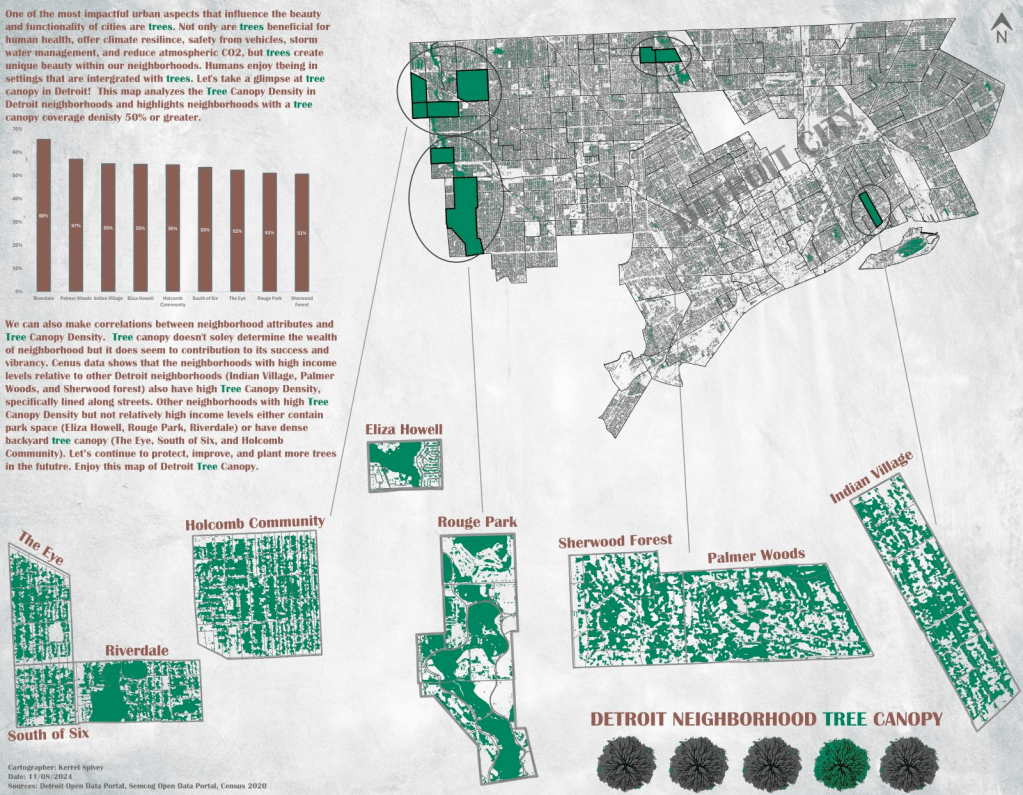
Detroit, once known as a tree-filled city before its urban decline starting in the 50s and the emerald ash borer invasion beginning in 2002, has experienced landscape change over the decades. Neighborhoods within a city can be defined by their people, setting, and character. Trees influence all three of these by improving the mood of residents, beautifying the landscape, and creating unique features. This map looks at neighborhoods with the highest tree canopy density (greater than or equal to 50%) and what we can learn about those areas because of their higher density.
Whether high tree density is lined on the streets of a neighborhood, occupy park space, or fill large backyards these areas can experience numerous benefits. From healthier environments to thermal control and from community cohesion to economic stability it is important for any urban environment to maintain and grow trees. Traveling in a neighborhood filled with sprawling sycamores and large oaks brings a feeling of tranquility and inspiration. Its clear the benefits of looming tree canopy in an area are extremely valuable. Let’s increase of tree planting efforts in Detroit for current and future generations to enjoy.
Detroit voters went to the polls (and ballot boxes) last Tuesday to decide on multiple ballot propositions and candidates for November’s general election. The unofficial results published by the city have the current turnout at 15.8% of registered voters, which matches primary turnout in past years.
This map includes Detroit precinct results for all races on Detroit ballots, but doesn’t include results for any precincts outside of the city. While incumbents and favored candidates generally won their elections, there’s some variation across neighborhoods for some of the more contested races including Democratic Senate and 13th District House Representatives.
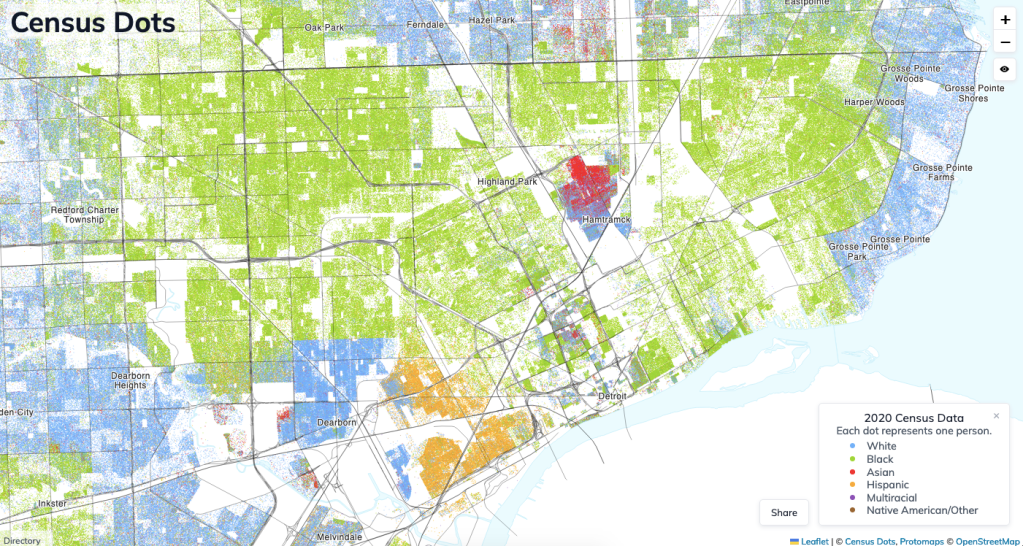
As a map nerd, I had loved Dustin Cable’s 2010 Racial Dot Map which he had created at UVA. I was saddened when this map left the internet, so as a way to get more comfortable using Census data and to learn some exciting new web map technologies, I decided to create an updated racial dot map using 2020 Census data.
Similar to previous dot maps, this map was created by combining two census data sources: the population counts published in the State Redistricting Data and the Shapefiles defining the census’s geographies. The decennial census provides population counts down to the census block level – an area roughly the size of a city block – enabling a fairly high degree of geographic accuracy. Dots are color coded based on the racial categories defined by the census. The dots within a given census block are placed randomly, which is why you might find some dots in unlikely places like parking lots or bodies of water.
The data comes together to create an extremely visually compelling map, both when viewed at the national scale and at the scale of individual regions like Metro Detroit. It often illustrates the stark divides that persist across much of the country.
The fictional Detroit Transit Authority rapid mass transit system consists of six (6) color-coded heavy rail rapid transit lines and 126 station stops that form a network of commuter routes connecting major points of interest in the city of Detroit with terminals in some nearby inner-ring suburbs and DTW airport. The majority of the system runs on two-track elevated concrete structures in the outer neighborhoods of Detroit with third rail power. In the more densely populated areas, commercial districts, downtown, and near major landmarks or freeway interchanges the routes descend into subway tunnels to bypass and avoid these things.
The DTA Rail System most closely resembles the newest parts of the Chicago ‘L’ both above and below ground. Resources from the Chicago Transit Authority (CTA) will be referenced in this brief. The track configuration expands from two tracks to three, four, or five tracks in some areas where routes run concurrently (to allow for bypassing), in areas where there is an extra siding track (for layups), and in the case of the Woodward subway, a fifth center track to provision for one-way peak direction express service. Switches are strategically located and periodically spaced to allow trains to change tracks.
The DTA Rail System is built completely independently of the existing transportation systems in Detroit: the People Mover and the M1 light rail system. The Detroit Transit Authority is a new state independent government agency established to succeed DDOT, unify Detroit’s transportation, and operate the flagship new rail system. It is largely subsidized by the state and Wayne County (but notably not Oakland or Macomb counties). DPM and M1 Rail come under this umbrella as does the DDOT bus system. The existing DDOT bus system routes are adjusted to better intersect the DTA Rail System and align with its departure schedules to make connections easy for riders. Bus Rapid Transit (BRT) lanes and stations will be added to Michigan, Grand River, and Gratiot where easy connections exist with the DTA Rail System like at Gratiot/Warren and Michigan Central. Some transfers exist between subway and elevated lines like at the Woodward/Warren station. The terminals are designed to be multi-modal with suburban SMART bus connections and provisions to connect to a future regional rail network.
Near the Yellow Line Terminal at Fairlane Dearborn. I imagine this 3-track terminal station making use of the vast property around Fairlane Town Center and adjacent to a park and ride lot. Maybe you see the mall or the old Hyatt in the background.
Where the Red and Blue Lines run concurrently in Southwest Detroit. This is a four-track elevated structure that runs just off of Fort St (along the north side of I-75). This view could include the Ambassador Bridge in the background. Junction is a transfer station with a double island platform arrangement. Clark and West Grand have single island platforms.
The Woodward Subway. I think it would be cool to show one or more underground stations on the Woodward Subway like District, Campus Martius, or Hart Plaza. Another view could include what the ground-level subway entrances on Woodward look like. Will have to discuss the platform arrangement at the transfer stations – perhaps they are double island or stacked side platforms.
Woodward/Warren area. The Red and Green lines run underground here and the Yellow Line runs above ground, making for an interesting view of the elevated-to-subway transfer. Maybe even a cutaway view. Notable Midtown buildings could be shown in the background here.
Outer Green Line. These views could present what the DTA system looks like running through a typical residential neighborhood. The curve between Dexter Linwood and McNichols could be cool to show. Another cool view could be the elevated structure passing over Oakman Blvd.
Alter Road Green and Pink Line Terminal. Right before this station on the Detroit side is one of the major rail yards which could be included in the view. This is another view where you could see what the system looks like traveling through a typical residential neighborhood.
This map imagines what a connected future of shared mobility and universal access could look like for Metro Detroit. It sets aside traditional assumptions and our current short-sighted approach to regional development and embraces a shift to a more sustainable, shared allocation of resources for transportation. It is lightly based on an earlier map I produced calling for a reduction in Detroit’s freeway system.
Paul Jones III is a Detroit native and graduate of University of Michigan’s Taubman College of Architecture & Urban Planning. He currently lives in Cambridge, MA where he works as a Community Planner for the U.S. DOT Volpe Center specializing in program development and capacity building. The ideas and views expressed are his own and reflect his ongoing passion for the intersection of history, urbanism, and transportation justice in Detroit.
I made this is fantasy transit map for Metro Detroit with a few goals in mind. My first step was to create a map that would both revolutionize transit in Metro Detroit while also being as realistic as possible given our state and region’s lack of investment and what current right-of-ways exist. This map is an attempt at a compromise between fantasy and realism. It also tries to challenge the idea that Detroit is too decentralized to have good regional transit by showing that a good system can be achieved by going through the heart of Detroit.
This map imagines the birth of the SEMTA Regional Rail, a callback to Detroit’s last regional rail service, the SEMTA commuter rail, which ran peak direction trains between Pontiac and a station outside the Renaissance Center. With the SEMTA Regional Rail above there were a couple goals. First and most notably, this map is based on existing infrastructure. Except for the stations marked with an asterisk (*), of which there are 7, in track alone these lines currently exist. Some of that track is either too old, disused, or single track and thus low capacity. But the fact that the right of way and much of the track for this project currently exists means that relative to other regional rail projects or ideas this project would be cheap to build.
This map also emphasizes cross region trips with large transfer stations in the city. This map attempts to answer the problem that Detroit is “too spread out” for regional transit. All the lines are on average as direct as they can be, and they all go through the heart of the city. While it may be faster to drive from each end of a line to the other, this directness makes the train competitive, especially when there is traffic or routes without a freeway. I also have noticed that many Detroit regional rail fantasy maps have trains dead ending in the city which in the modern era is more and more of an outdated use pattern. This map tries to emphasize regional trips while maintaining the same focus on Detroit.
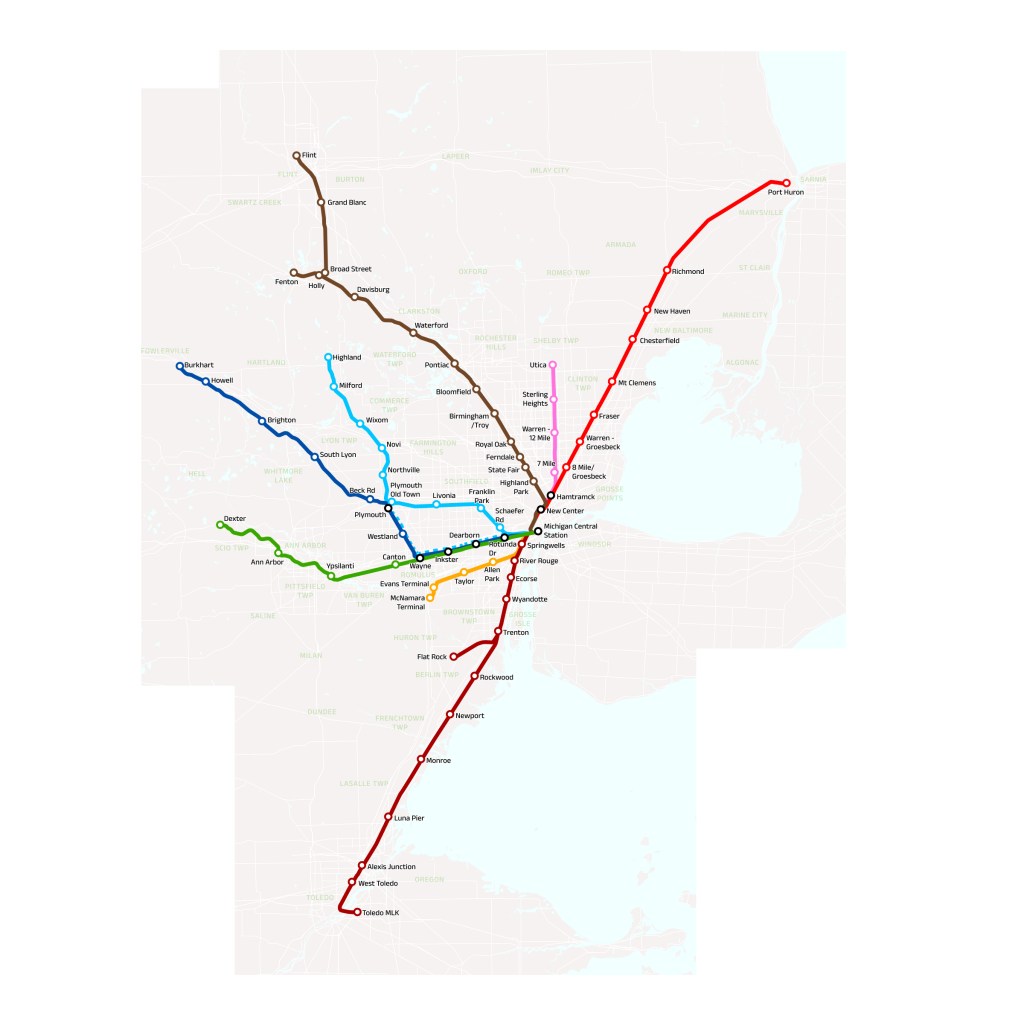
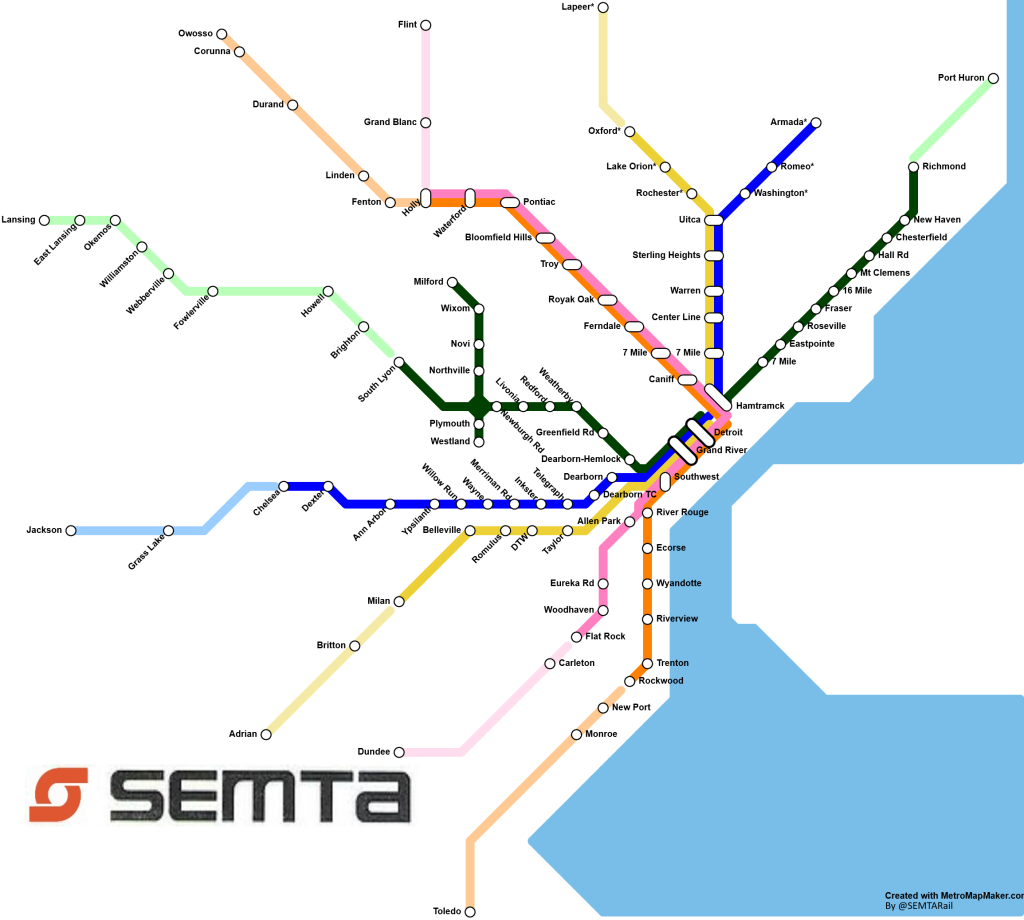
The above version of the SEMTA map shows the same system but the lines are lighter when the system leaves RTA territory. RTA is the current 4-county regional transit authority, and if we wanted to fund this system without state help this is what that system would likely look like. The big thing this version of the map lacks is larger anchor cities on the ends of lines that would likely be drivers of ridership.
My hope with this post is to help people dream of a modern transit system for Detroit that would both serve the region well and feel realistic to dream about. I believe the system I have mapped is a realistic system to dream of given our region’s stubbornness with building regional transit. Future improvements could be:
Tunneling under downtown to move the transfer stations down from New Center
Expanding the Green Line branch to be its own line going from Flint to Monroe
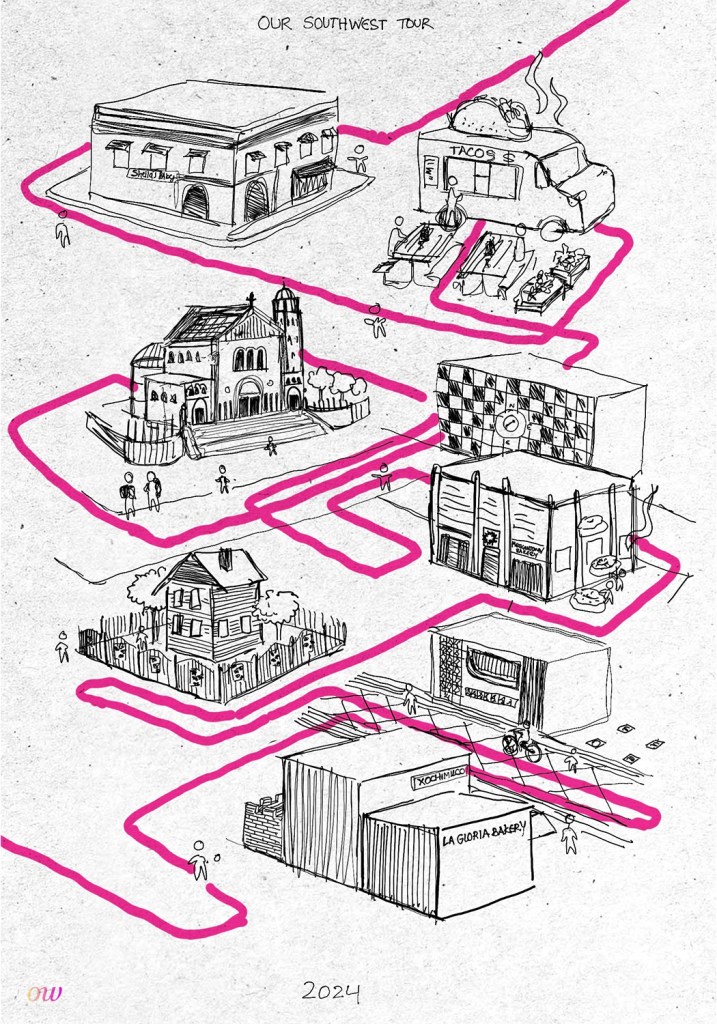
‘Our Southwest Tour’ map was initially created to explore new forms of graphic representation, but quickly turned into a piece that we incorporated into one of our current Southwest Detroit projects, a boba tea shop. As we began the process, we wanted to be intentional about how we blended the history of boba tea into the history of Southwest. In order to enrich our research and gather information to use in future projects, we spent a day on what we call, “Our Southwest Tour.”
This tour was done by other work designers Tian Li and Lauren Forgacs, and the map was digitally hand-drawn and created by Lauren. To begin our tour, we focused on some areas that we intentionally wanted to explore; Bagley, Vernor, and Springwells, in that order. We spent a day taking our time walking through each area, and noted architectural details and specific spots that really stood out to us. We paid attention to repetitive color schemes, murals, patterns, and constructional details. We took lots of photos of each area, and now have a large library of images from Southwest.
Concerning the details of the map itself, the pink line is loosely our path through the spots. Starting from the bottom, there is the Bagley Area. You can see where Lauren drew the pedestrian oriented streetscape, La Gloria Bakery, Xochimilco, and the building across the street that had notable ironwork in the window and on the wall. On the bottom left, there is a house depicted in the neighborhood on Bagley, and it has some of the ornate floral details we saw within the ironwork on the fences in that location. Moving further up the map is the Vernor area. You can see MexicanTown Bakery, and above that the mural with a compass is pointing to South West. On the right, there is Most Holy Redeemer Church, and some students coming out of class. Moving further up, you can see El Imperio taco truck, where Tian and Lauren enjoyed some delicious Birria tacos. To finish the map, on the top left is Sheila’s Bakery, which marked the last area Tian and Lauren explored.
by: Gene Estrada, Detroit River Story Lab, University of Michigan
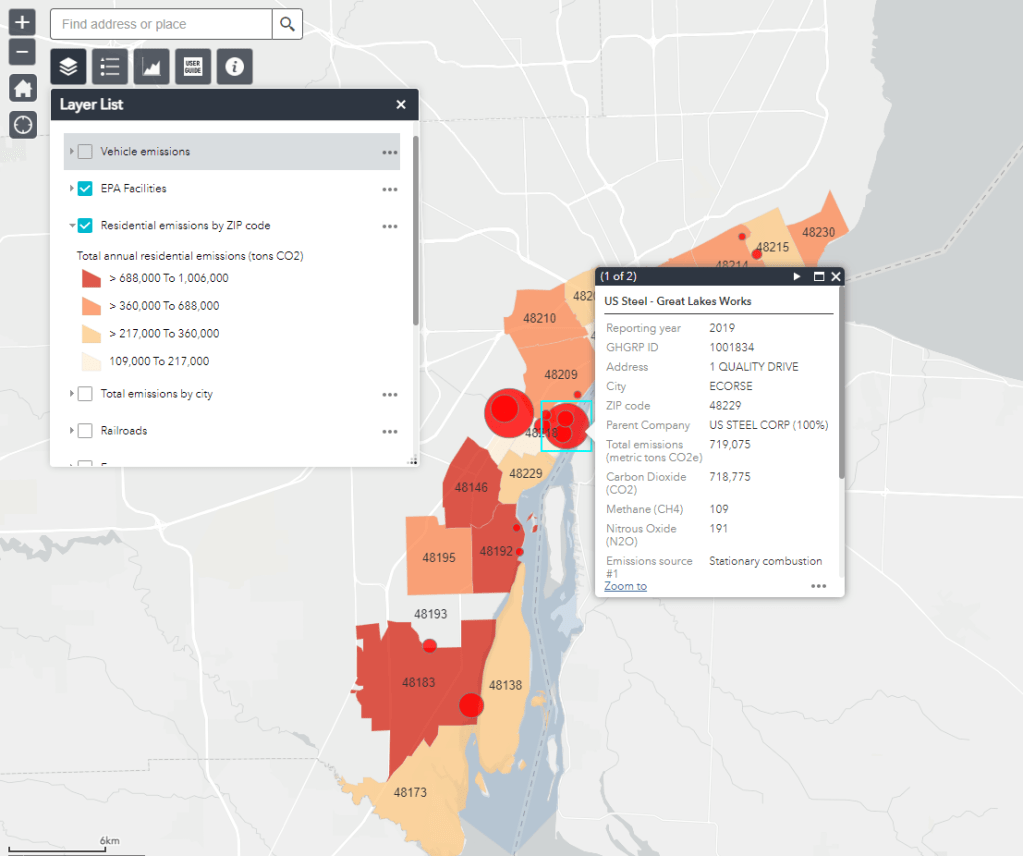
This map was created by the Detroit River Story Lab at the University of Michigan, Ann Arbor. Our goal is to estimate the total amount of greenhouse gas emissions (i.e., create an emissions inventory) for the Detroit River Corridor. We created this online, interactive map as an accessible tool for anyone interested in understanding carbon emissions at a local level. We are currently working with local educators in Detroit-area schools to include the use of this tool in school curricula.
To create this map, we collected carbon emissions data from a multitude of sources, including the U.S. Environmental Protection Agency’s Greenhouse Gas Reporting Program, the Database of Road Transportation Emissions, the U.S. Army Corp of Engineers, and more. Each carbon emissions source (facilities, vehicles, river cargo shipping, etc.) is displayed as its own map layer, which users can toggle on and off, and contains detailed information available the carbon and other greenhouse gas emissions associated with that layer and components within the layer. A full list of data sources, with links, used to create this map, and a summary of the approach we used to construct the map, can be found in the About tab.
We implore users to explore the map layers and look for patterns in the spatial distribution of emissions. We also provide layers showing major freeways, railroads, and U.S. Census data to encourage users to look for associations between infrastructure, demographics, and carbon emissions in the Detroit River area.
Contact
Submit a map or just get in touch. Thanks for following!