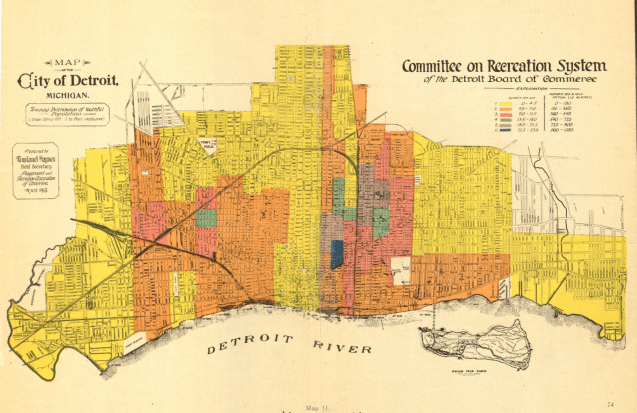
This fun colored map was included in the 1913 Detroit Recreation Survey put together on behalf of The Detroit Board of Commerce.
This fun colored map was included in the 1913 Detroit Recreation Survey put together on behalf of The Detroit Board of Commerce.
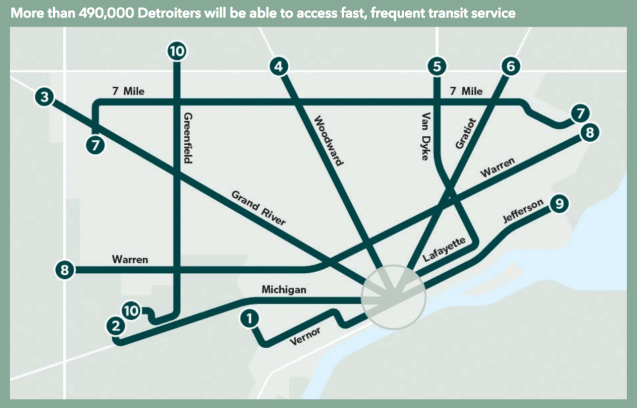
This map comes from the new “Detroit Strategic Plan for Transportation” representing DDOT 2.0, a high-frequency transit system that serves 60% of Detroiters.
Check out the full plan HERE
Possibly the most exciting elements of the plan are for reductions in parking and removal of requirements for parking at new developments when located near transit.

This beautiful perspective pictorial map was shared by the Harvard Map Collection. Downtown in 1945 seems pretty sparse compared to today, but there enough familiar places to notice.
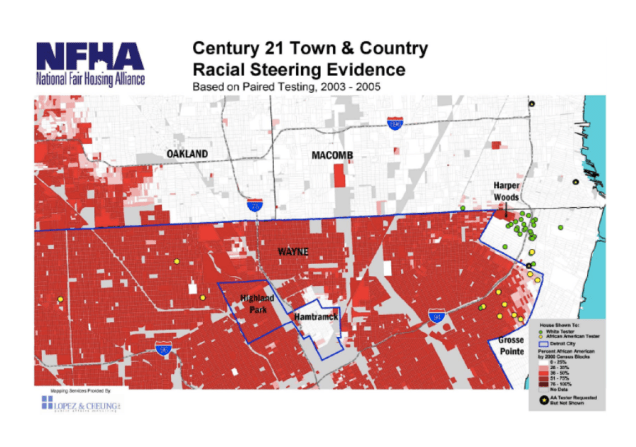
In 2007, the National Fair Housing Alliance (NFHA) filed a lawsuit against Century 21 Real Estate LLC and it’s franchisee, Centry 21 Town and Country, in federal court. During the 2003-2005 period, NFHA tested 14 real estate agents of which 9 engaged in “racial steering” encouraging whites to seek homes in predominantly white neighborhoods such as the Grosse Pointes and blacks to seek homes in predominantly black neighborhoods such as East English Village.

WHEN: September 23 – 25
Together, we’ll dive into issues related to inclusion and equity in public life—the everyday social life of parks, plazas, sidewalks, and other spaces between buildings—and share approaches to planning, designing, and sustaining quality public spaces. Last year we developed an agenda for action. This year, we take it further—but we need your ideas.
ATTENDANCE:
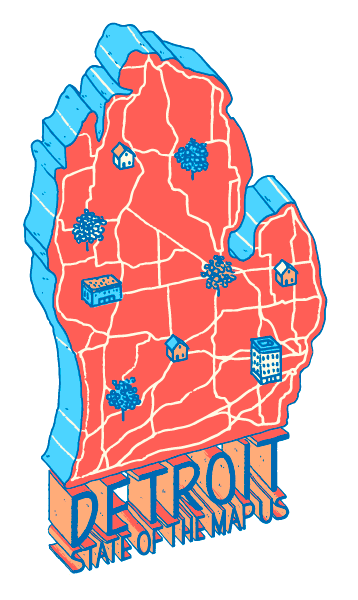
(*Note: Detroit is not the entire Lower Peninsula of the State of Michigan)
WHEN: October 5 – 7
Join the OpenStreetMap community at State of the Map US in Detroit, Michigan. Connect with other mappers, businesses, government agencies, and non profits, all collaborating around the free and editable map of the world. Share your vision for the project, learn how to work with OpenStreetMap data, and hack on the latest mapping improvements.
ATTENDANCE:

WHEN: October 28 – 30
What can city leaders do to fuel innovation that improves quality of life for all? What can rising cities learn from the challenges faced by peers? At CityLab 2018, The Atlantic, The Aspen Institute and Bloomberg Philanthropies will convene the world’s city and community leaders to consider a new narrative worthy of the many global cities whose history may weigh heavy, but whose future holds the promise of a fresh page.
ATTENDANCE: Invitation only

This street map of Detroit was created by city surveyor, Eugene Robinson and published by the Silas Farmer Company (31 Monroe Ave, corner of Farmer St.)
An additional ink stamp on the map reads:
“Waterman’s Real Estate Exchange. First-class Private Residences, Vacant Lots on the Best Streets. Business Property for sale by WM. J. WATERMAN, opposite the Post Office.”
Maps have been such an impactful tool for real estate and land developers for over a century.

Have you visited the Spirit of Detroit plaza recently?
Now there is an awesome abstract map painted on the ground by Summer in the City youth.
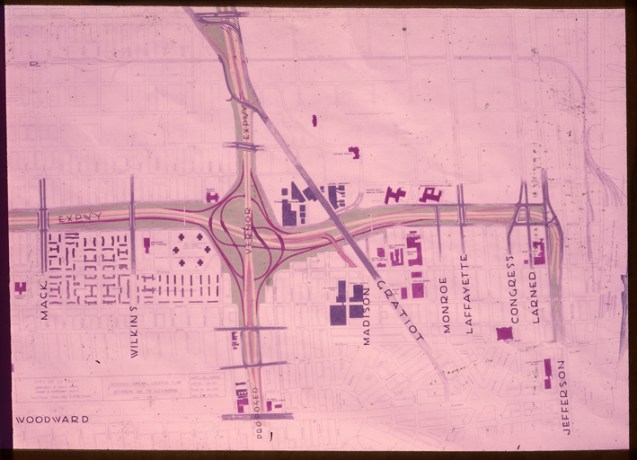
This map of the proposed location of what we now know as Interstate 75 comes from the Detroit Public Library Digital Collections. I had heard plenty about the expressway razing Paradise Valley and the center of Detroit’s black community along Hastings Street, but never heard the expressway referred to as Hastings-Oakland.
Map of Hastings-Oakland Expressway in Detroit; proposed general location plan Jefferson Ave. to Alexandrine. Label on mount: “Hastings-Oakland Expressway, River to Mack.” Printed on mount: “Produced by Florez Incorporated, Detroit, Mich.”
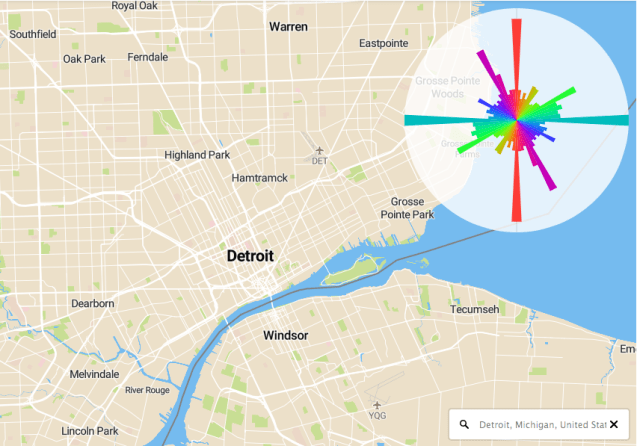
Mapbox engineer, Vladimir Agafonkin, decided to make the polar histogram of roadways interactive with this map inspired by the work of Seth Kadish and Geoff Boeing. Incredible method to summarize the development patterns of cities.

Detroit from City Street Orientations by Geoff Boeing
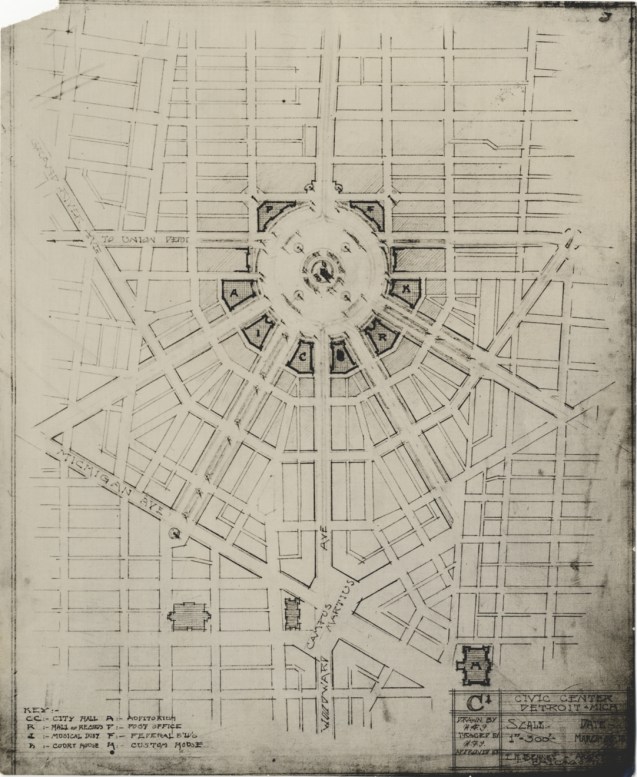
File this under the “unbuilt Detroit” category, (traced by H.F.J.) from E. H. Bennet architects in Chicago. North of Campus Martius, this “civic center,” located at what is now Grand Circus Park, would have functioned as a true Downtown hub for government, entertainment, and city life.
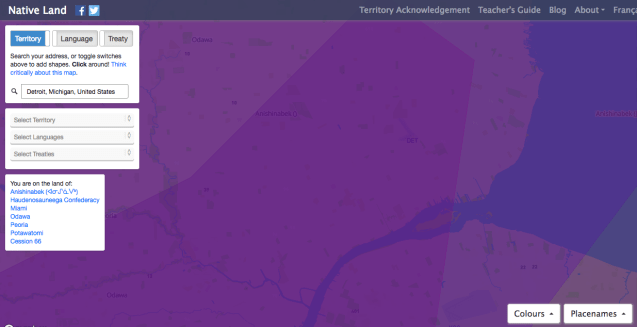
Just a reminder that the land you may or may not own or occupy in Detroit was never anyone’s to take, divide, or sell. We are all on native land. In Detroit, that means the land of:
Understand more at native-land.ca
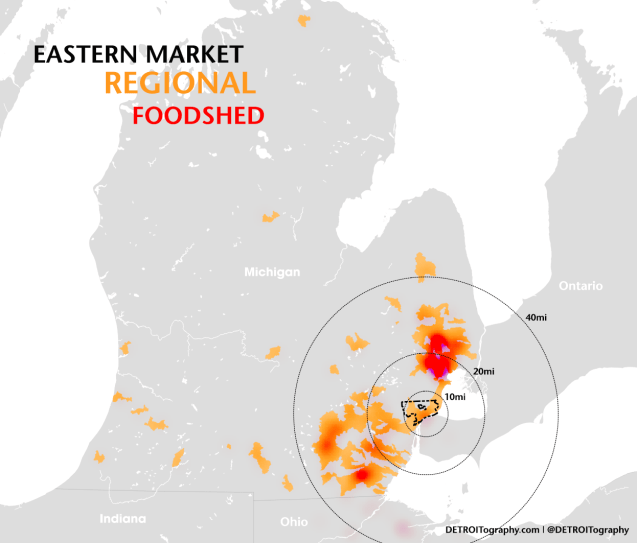
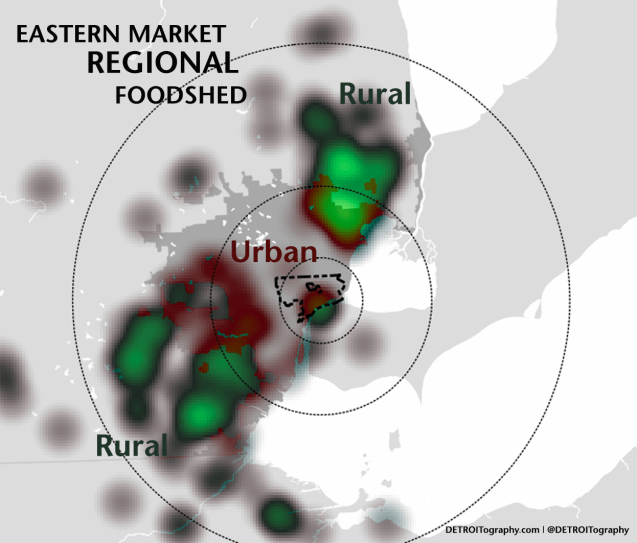
Detroit’s Eastern Market is known as a regional food hub, where producers and consumers meet to connect the food system supply chain. I was curious as to the extent of Eastern Market’s ability to aggregate and distribute fresh produce in the region and decided to map growers and farmers from the list of weekly Saturday market vendors.
While Eastern Market’s reach is statewide even into Ohio and Ontario, the vast majority of food hub participants are within 40 miles of the market. There are a very small number of growers from within the City of Detroit and the majority come from Macomb and St. Clair counties to the Northeast. These areas within the 40 mile range are, not surprisingly, at the edge of the urban – rural transition.
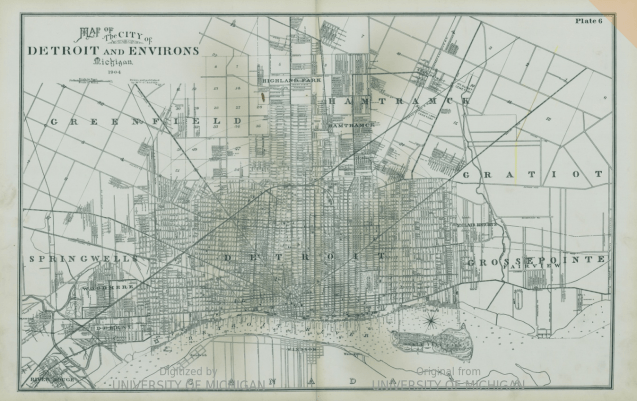
This map is from the “Detailed official atlas of Wayne County, Michigan” from 1904 “compiled and drawn from Authentic records and private surveys by W.C. Sauer, C.E.
If you happened to live East of Conner Street in 1904, you were a Grosse Pointer.
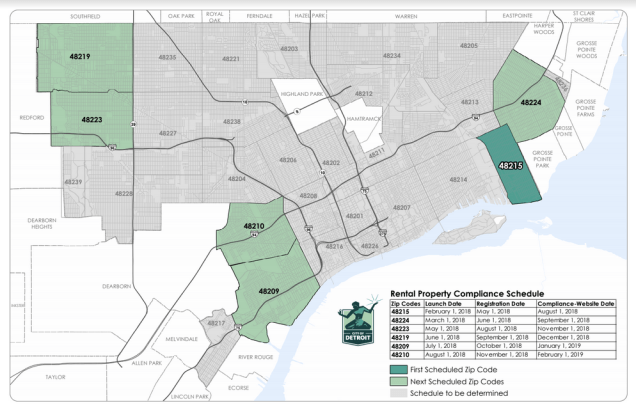
In 2018, the City of Detroit launched a massive effort to determine a baseline for all rental properties and their levels of compliance within the city. This year will cover 5 zip codes, with others (total of 31 zip codes) being assessed in following years up until 2020.
“City of Detroit building inspectors will begin their efforts on Feb. 1 to identify every rental property in Detroit and have them registered in compliance with city codes. The goal of the new ordinance is to ensure that every renter in Detroit is living in a property that is safe and up to code by the middle of 2020.”
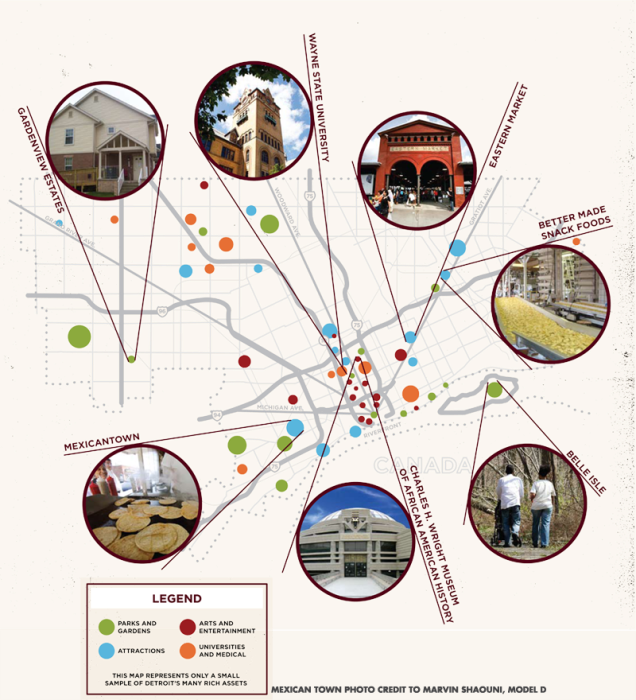
This map was used on the “Building from Strength” section on Mayor Dave Bing’s “Detroit Works Project” that ultimately became Detroit Future City. The map was to anchor the idea that Detroit has plenty of assets to build from rather than focus on the negatives.
There’s plenty to work with. Detroit is the city that put the world on wheels. A city with rich cultural heritage, ethnic tradition and a legacy of innovation. The middle class was born here. We built the Arsenal of Democracy and the first expressway to help expand it. It’s a city where bold ideas have become very real and set the example for the world.
It’s time. Time to think big.
It’s already happening. Gardens are springing from empty lots. A riverfront has been transformed. Business incubators are popping up, more and more. This is the moment to pull together what’s already happening and consider even bigger “what-ifs.” It’s time to work together towards something better. To once again define a path for us, and urban America. To define a future for Detroit that works. Now.
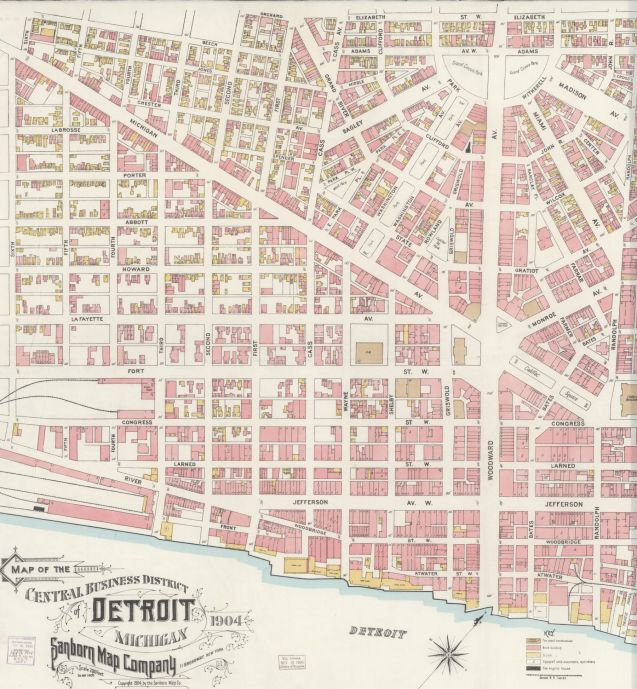
Sometimes it’s just interesting to sit back and look at what used to be.
Downtown Detroit in 1904 looks nothing like it does today besides a handful of landmark buildings, such as the County Building. Many of the parks remain the same Downtown, however West Park is now where the Rosa Parks Transit Center resides and Campus Martius has expanded considerably.
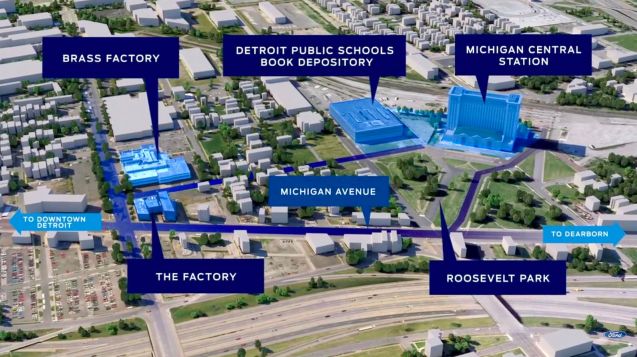
The well-loved and oft-mentioned, oldest, and “revitalized” neighborhood of Corktown is seeing its own kind of re-revitalization with the arrival of the Ford Motor Company. This depiction shows just a few of the well known buildings that Ford has bought in the neighborhood, yet there are reportedly nearly 50 properties tied to Ford that have been purchased recently.
This presents an important reminder that even with Detroit neighborhoods that seem to be all that, there is still countless opportunities to do more. Besides reminding us of the potential for a large corporation to move into a neighborhood, this should also remind us that there are countless opportunities to do development differently, better, and more equitably.
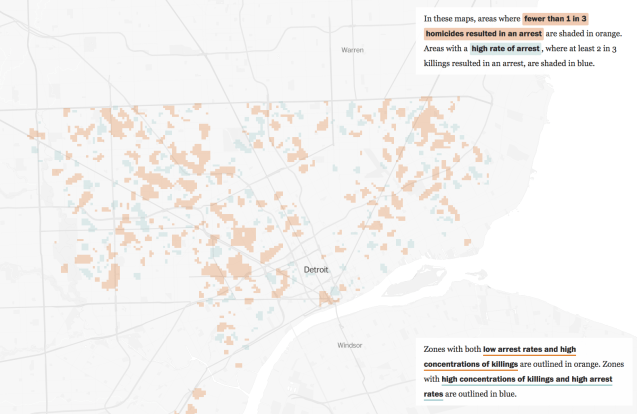
The Washington Post looked at 2,519 homicides in Detroit between 2010 and 2017 to find areas of high and low arrest rates related to homicides over the 8 year period. Detroit’s overall rate, based on the data, is 59% of homicides without an arrest while the average of the 50 cities they examined was 51%.
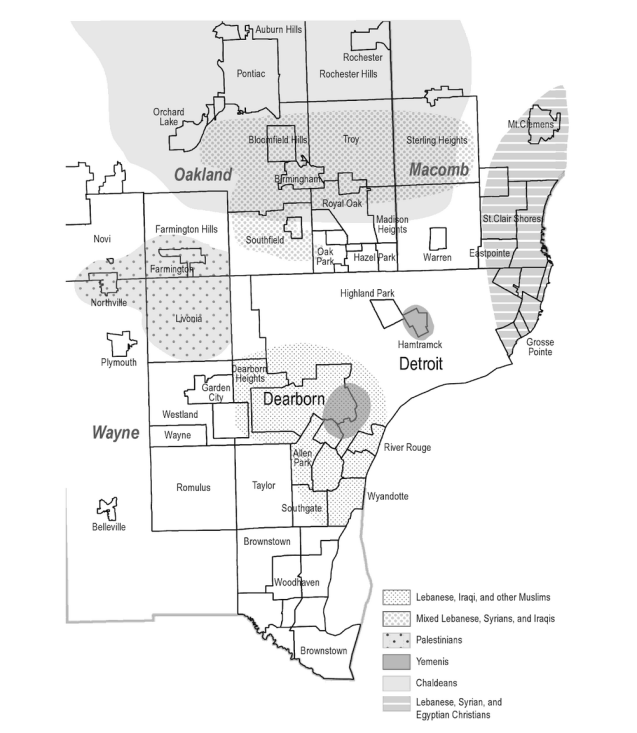
This map (without data sources or references) is featured in the book Arab Detroit 9/11: Life in the Terror Decade by Nabeel Abraham, Sally Howell, and Andrew Shryock. It’s unclear what year this represents or the source of information. Based on the chapter I assume the data comes from the “Detroit Arab American Study” (DAAS) in 2003.
“Although Arabs can be found throughout metropolitan Detroit, there are tow areas that contain the major concentrations of people of Middle Eastern descent. Each area contains about half of Arab Detroit’s population and includes a band running from east to west. One area runs across Wayne County, and the other lies in the suburbs north of Detroit in Oakland and Macomb counties. The first area is centered in the city of Dearborn, which borders the western edge of Detroit and, with one-third of its population classified as Arab (2005 ACS), is often considered to be the largest concentration of Arabs in the United States. This is the historic home of most Lebanese Muslims and more recently includes Yemeni, Palestinian, and Iraqi Muslims. The area extends eastward from Dearborn into the west side of Detroit, includes portions of Downriver to the south, and, moves across through Dearborn Heights into Wayne COunty’s western suburbs. […]
The second area lies mostly in the suburbs north of Detroit, in Oakland and Macomb counties, and is home to the Iraqi Christian population, the Syrian population, the Lebanese Christian population, and a mix of other, largely professional Arab Americans. As Dearborn has historically been the entry point for Lebanese Muslims, the initial area for newly arriving Chaldeans has been a cluster of blocks surrounding Seven Mile Road in Detroit, now called Chaldean Town. The area still houses a number of Chaldean-owned businesses and a small population of Chaldean immigrants, but the vast majority of Iraqi Christians have resettled in Southfield, Oak Park, West Bloomfield, Troy, and other suburbs, especially Sterling Heights, home to the nations largest concentration of Chaldeans.”

Matthew Desmond’s Eviction Lab examined eviction rates and poverty rates by census tract in Detroit. Around 2009, evictions were more prominent in Downtown areas with more high-rise apartments, but now it seems to have followed population movement to outer neighborhoods.
Exactly. One in twenty renter families were evicted in Detroit last year, or roughly 45 people a day. Here is a map of evictions in Detroit by poverty rates. pic.twitter.com/eQL3FaouJj
— Matthew Desmond (@just_shelter) April 30, 2018

The Detroit Greenways Coalition wants to “Envision Detroit as the Greenways Capital” of the world.
Fifty years may seem like a long time away, but with the rapidly increasing development of bicycle infrastructure across Detroit we need to set the table for the future. This report provides ideas and designs that can be incorporated into today’s projects such as the Inner Circle Greenway and the protected bike lane network. An important role of the Detroit Greenway Coalition is to be the keeper and advocate for this long-term vision.
 DETROITography