by: Rod Arroyo
Milwaukee Junction was the heart of early automotive manufacturing in the United States, and many consider it the cradle of Detroit’s auto industry. The area takes its name from the railroad junction formed by the Detroit, Grand Haven and Milwaukee Railway (later the Grand Trunk) and the Chicago, Detroit and Canada Grand Trunk Junction Railroad (later the Grand Trunk Railway of Canada).

Originally developed in the 1890s to spur industrial expansion in Detroit’s North End, the area was first home to businesses producing wooden horse-drawn carriages. Over time, more than 20 companies tied to early automobile manufacturing set up shop there, including Ford, Fisher Body, Regal, Studebaker, and others. Wooden carriage plants gave way to metal stamping plants, numerous Fisher Body plants, assembly plants, and more.
The Piquette Plant
Henry Ford’s Piquette Plant, built in 1904, was the first plant Ford owned. It produced a range of Ford vehicles, including the Models B, C, F, K, N, R, and S. In 1908, Ford, C. Harold Wills, and Joseph Galamb spent nine months working in a secret room at the plant to develop the Model T, the first car designed and priced to sell to the masses. The first 12,000 Model T cars rolled off the line at Piquette. Manufacturing then transferred to Ford’s Highland Park plant.
The Piquette plant was also where Ford developed his concept for a nationwide network of automobile dealerships, as well as the idea for the automobile assembly line, which he later put into practice in 1913 at the new Highland Park Plant. For more on the plant’s history, visit the Ford Piquette Avenue Plant.
Ford later sold the Piquette Plant to Studebaker, which operated there until 1933. Today, the Piquette Plant operates as a museum, while most of the former Studebaker plant has been converted to residential use.
Mapping the District
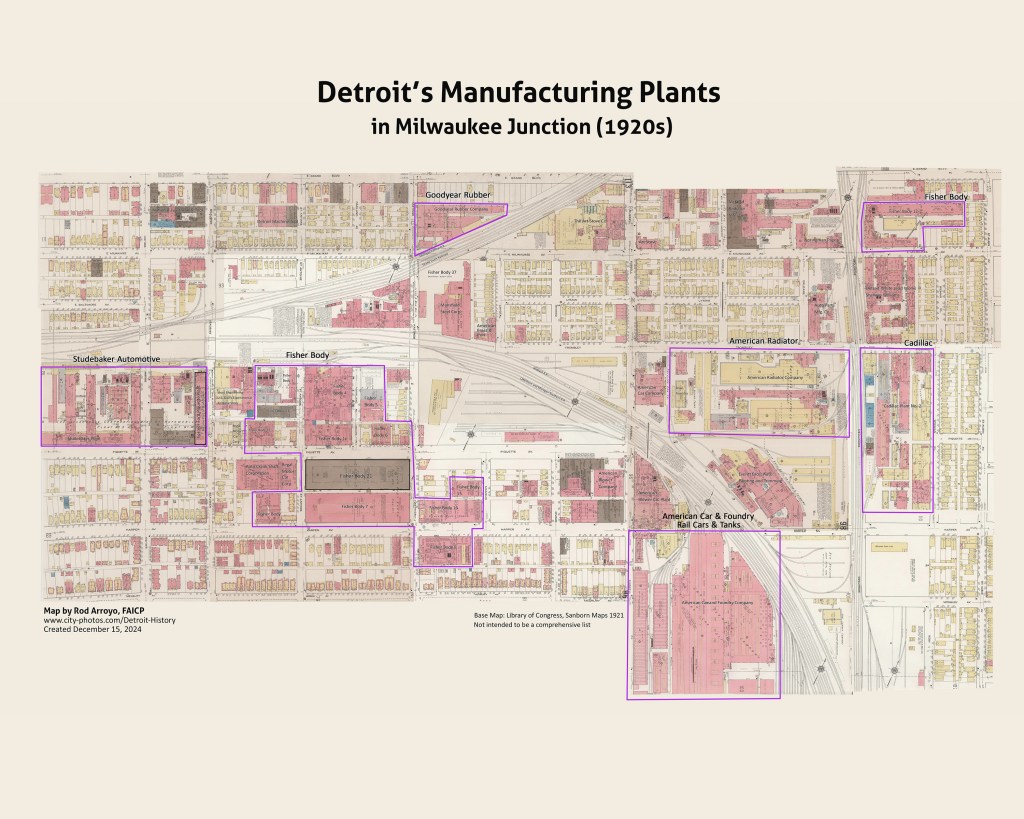
Using 1921 Sanborn Fire Insurance Maps, I created a map highlighting key automobile manufacturing sites in this district as they stood that year.
Have you ever wondered where all the Fisher Body plants were located across Detroit? I also put together a separate map pinpointing many of them — you can explore it via this Google Map link. If you know of any that are missing, please let me know, and I will add them.
The map included in this post documents 19 Fisher Body plants (Numbers 1–16 and 21–23) plus the A.W. Fisher Building. In total, Fisher Body operated more than 40 plants across Detroit, Cleveland, Flint, and Ontario, with the majority concentrated in Detroit. Also shown are other plants from other manufacturers, including Goodyear, Cadillac, American, Mansfield Steel, American Brass, and more.
Rod Arroyo, FAICP is a Detroit-based urban planner, researcher, and educator with a Master of City Planning from Georgia Tech. A Fellow of the American Institute of Certified Planners, he served as a Partner at Giffels Webster, one of Detroit’s leading planning and engineering firms, and as an adjunct professor at Wayne State University. His research focuses on downtown and Detroit’s historic and predominantly Black neighborhoods, including Paradise Valley, Black Bottom, and Sugar Hill. Rod shares that expertise as a lecturer and as the owner of Detroit Legacy Tours, connecting residents and visitors with the city’s diverse and complex history.

