by: Andy Frantz
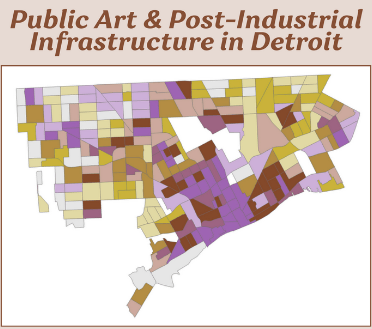
“Public Art, the Post-Industrial, and Economic Opportunity in Detroit” examines the geospatial and demographic relationships between Detroit’s physical and creative infrastructure with community financial prosperity. The practice of creative placemaking asserts that public art supports community and economic development, and Rust Belt cities such as Detroit have utilized their vacant areas as canvases for these efforts. On the other hand, vacant areas may also suggest a lack of community and economic development. Through using ArcGIS and open data, this research serves to answer the following: What correlations exist between public art and economic opportunity in Detroit? Are these trends impacted by a location’s relative blightedness?
This work explores correlations between creative and physical infrastructure, as well as the trends of economic health and opportunity for census tracts within each bivariate quadrant.
This map was part of the Visualizing Detroit: The Art of Data competition and exhibit in March 2026.
Andy Frantz is a graduating urban sustainability student at Oberlin College. She plans to pursue graduate study in urban planning this fall, focusing on community-driven economic development and public participation efforts, especially those involving public space and cross-sector collaboration. Her research focuses on pubic art and creative economic development in post-industrial spaces.

