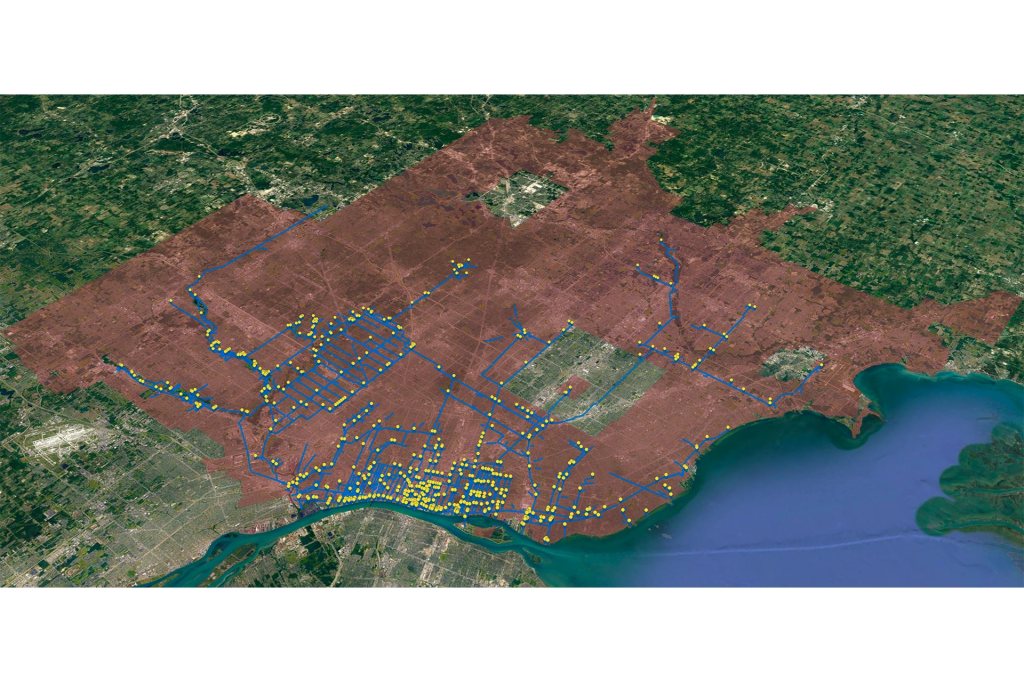
The University of Michigan Urban Collaboratory worked with the Great Lakes Water Authority (GLWA) in 2018 to better handle combined sewer overflows in real-time. More from the project:
… they found that Combined Sewer Overflows have been occurring when additional sewer capacity is available. Rather than increasing the amount of storage with costly infrastructure improvements, the research team was able to demonstrate their ability to use a real-time control approach to significantly improve the existing GLWA wastewater and CSO management system by reducing both the occurrence of CSOs and peak flows going to the treatment facility.
Welcome to our Data Forum where we will discuss the education system, how data is tracked, and how data can be used to improve student outcomes.
We’ll be joined by the Jeremy Singer, GO DATA Commissioner, Stacey Brockman of WSU’s Education Leadership and Policy studies program, and Titus Scott from the Skillman Foundation.
Don’t miss out on this opportunity to connect with fellow data enthusiasts and expand your knowledge.
WHEN: Friday, December 19th, 12:30-1:30pm
WHERE: Virtual
WHAT: Join us for our Data Forum where we will discuss education data and uses.
Make it count! Detroit By The Numbers latest monthly segment on the Authentically Detroit podcast is live! We highlight significant data and numbers from the past month for Detroiters!
Number of pages in the recent Detroit Reparations Task Force Report (BridgeDetroit).
36.6%
Percent of Detroit households that rely on SNAP/Food Stamps to put food on the table. Among households with children the rate is 25.9%. (U.S. Census)
$63M
Amount invested in home repair interventions in 2024. Most of the funding came from ARPA (43.5%) and were utilized for roof repairs. In all 3,058 home repair interventions were conducted at 2,628 addresses. (Detroit Home Repair Census)
11,021
Research-grade observations within the city of Detroit on iNaturalist, a social network for tracking biodiversity indicators like animal sightings, plants, and other observations from nature. (GBIF)
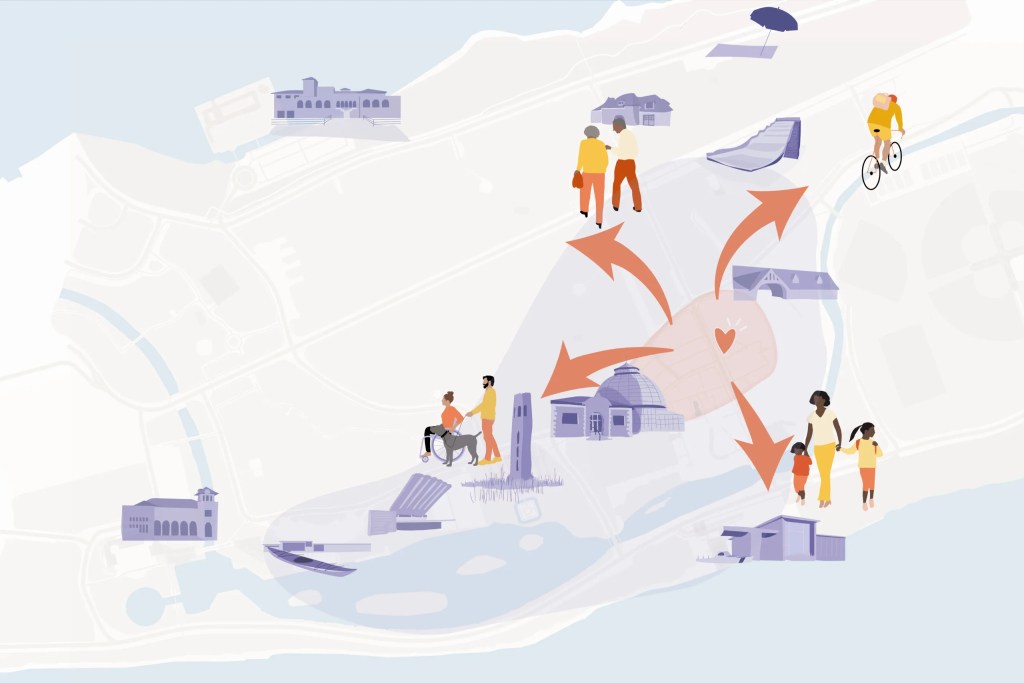
Gehl worked with the Belle Isle Conservancy to reimagine what the area around the major cultural institutions on the island. More from Gehl:
Belle Isle is Detroit’s premier large open space and home to some of the city’s iconic cultural institutions. Today, however, the public space around the core destinations of the Isle invites for car-first, one-off visits — rather than a continuous, lingering experience. Gehl was engaged by the Belle Isle Conservancy to reimagine this key area of the isle as the Belle Isle Commons: a cohesive, welcoming public space that connects cultural destinations, and a destination for Detroiters and visitors in its own right.
Welcome to our Data Forum where we will discuss open data portal and geospatial data sources.
We’ll be joined by the Julian Bruinsma from DetroitData.org, Ann VanSlembrouck of SEMCOG, and Zachary Manring from the City of Detroit, Open Data Team.
Don’t miss out on this opportunity to connect with fellow data enthusiasts and expand your knowledge.
WHEN: Friday, November 21st, 12:30-1:30pm
WHERE: Virtual
WHAT: Join us for our Data Forum where we will discuss open data portals and geospatial sources.
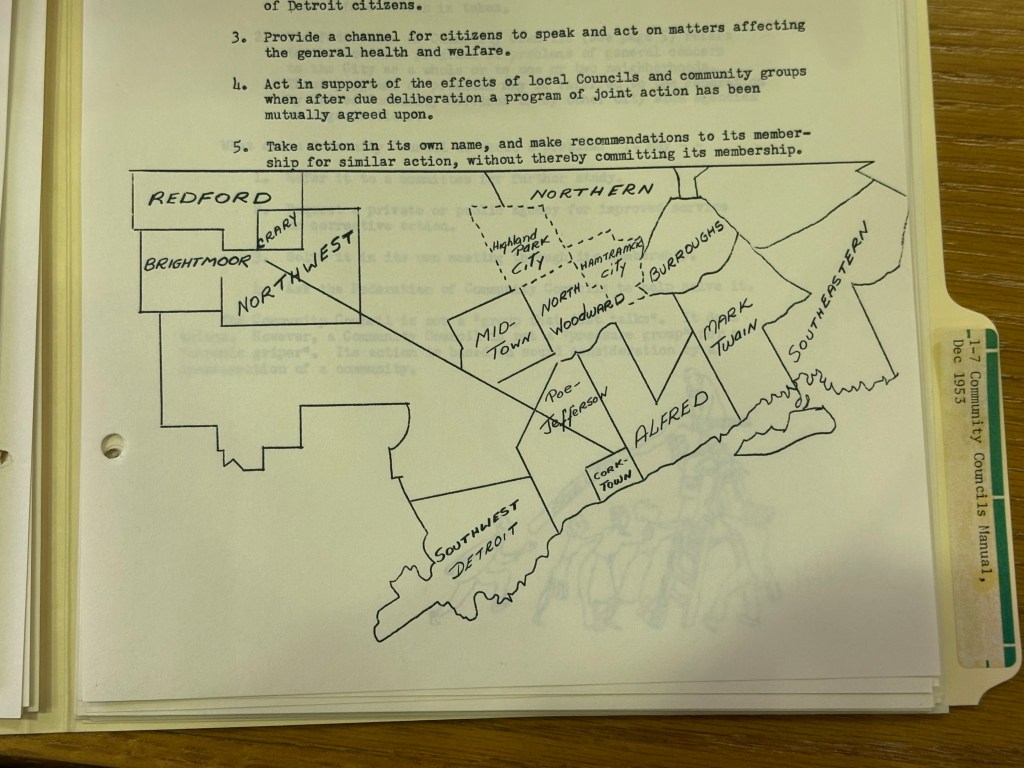
This historic gem of a map comes from the Reuther Library and Archives, “Community Councils Manual, Dec. 1953” (page 5) published by the Detroit Federation of Community Councils. I’ve been diving into neighborhood histories and came across mentions of a “Midtown Community Council” in the 1950s and had to dig in further.
The Detroit Federation of Community Councils was an association of 14 community councils in Detroit. United Community Services, which was a precursor to the United Way, sponsored the Federation and its member Councils, and supplied them with professional staff to assist.
The Midtown Community Council was one of those broad neighborhood associations that served an area now represented by the West Grand Boulevard Collaborative. A focus of the Midtown Community Council was activity on 12th Street, promoting positive race relations with new Black residents, and preserving some the Jewish heritage of the area. Council meetings were held at the Grace Episcopal Church, the Duffield Library Branch, and the Jewish Community Council.
A newspaper clipping from the National Jewish Post in 1947 noted that the Jewish Community Council began a study of potential legal action, “to stop the efforts of real estate dealers seeking to capitalize on panic sales among Jewish property owners in the Detroit 12th street district because of an influx of negros.” The Jewish Community Council leadership noted that mass evacuation would harm both Jewish and Black families. The real estate dealers were found to be non-Jewish and were not members of the community.
It’s interesting to find these bits of history where blockbusting tactics associated with real estate redlining were actively harming communities and they were actively trying to find alternatives. This is an important point in the history of 12th street as we think about the long process of racial discrimination that led to the 1967 civil disturbance.
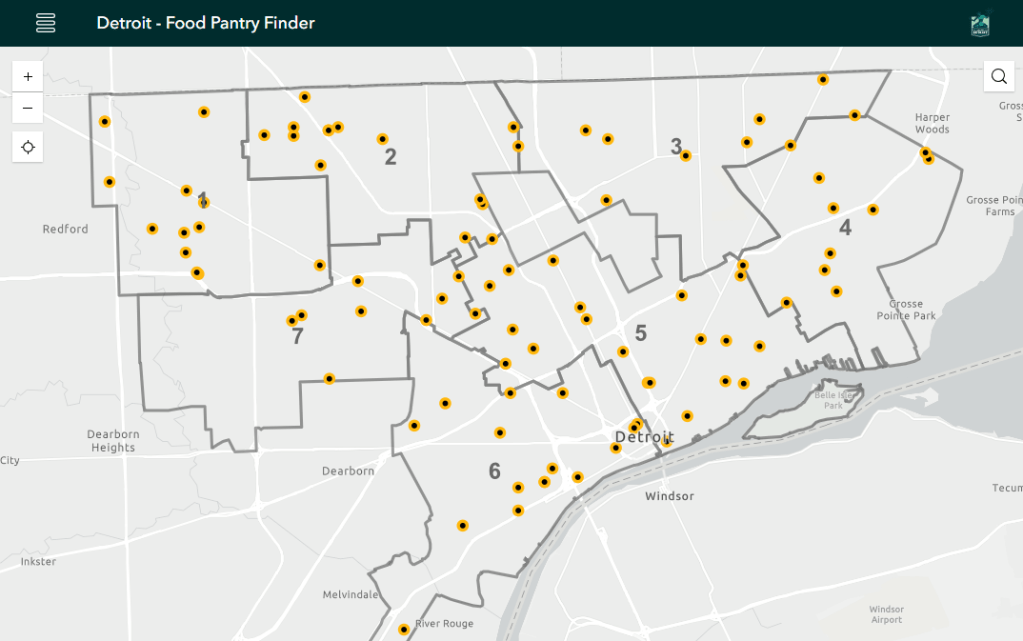
The City of Detroit has taken small steps to better engage with the food system in moments of crisis. The first was food box distribution during COVID-19 and now they have a team verifying food pantries in the midst of uncertainty with federal nutrition benefits. This kind of verification is critical to make sure people can find the right resources and I truly hope this is connected to the wider safety net efforts of the United Way’s community information exchange.
Make it count! Detroit By The Numbers latest monthly segment where we highlight significant data and numbers from the past month for Detroiters!
21
New DDOT bus bump-outs along Jefferson Avenue (APTA).
23%
Detroit lawmaker attends less than a third of all sessions, but is now running for City Council District 7 (Detroit News)
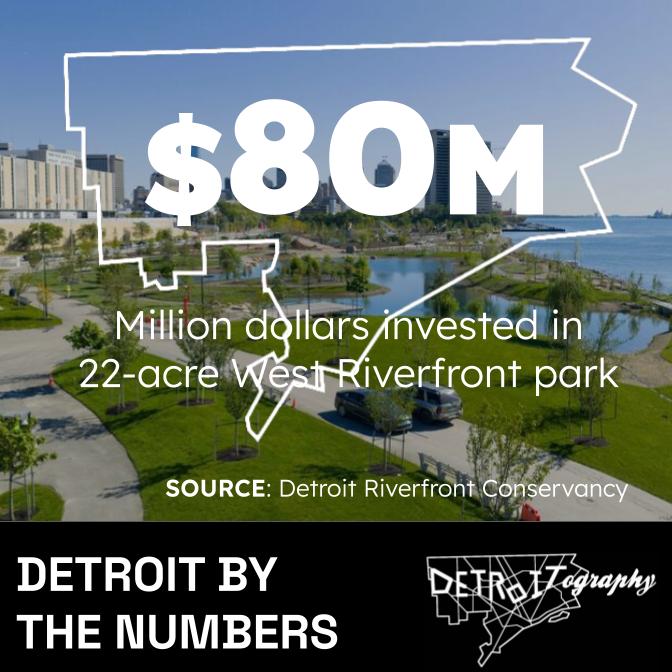
$80M
Riverfront park opened, funded by Ralph C. Wilson Jr. Foundation. (Detroit FreePress)
51%
Children living in poverty. This is a reversal from past improvement. Overall Detroit has a poverty rate around 34%, but it is much higher for children. In the recent State of Michigan budget $270 million was allocated for the RxKids program that has seen success in Flint. The State funding could allow the program to expand into Wayne County and specifically Detroit. (Local 4)
We’ve enjoyed featuring Jake Berman‘s transit fantasy maps that include Detroit. Come hear him talk about the resulting book “Lost Subways of North America” at Next Chapter Books.
WHEN: Thursday, November 13th @ 6:30PM
WHERE: Next Chapter Books, 16555 E. Warren, Detroit, MI 48224
WHAT: Join us to hear Jake Berman and Alex Hill in conversation about Detroit transit and other cities that have lost subways.
Welcome to our Data Forum where we will discuss wildlife in the city. Join us online for lunch-and-learn filled with insightful discussions, tips, and tricks on all things related to the data.
We’ll be joined by the Nyeema Harris from the Yale University, Ava Landgraf of Detroit Bird Alliance, and Joanne Coutts, who has mapped animals along Detroit’s historic waterways.
Don’t miss out on this opportunity to connect with fellow data enthusiasts and expand your knowledge.
WHEN: Friday, October 24th, 12:30-1:30pm
WHERE: Virtual
WHAT: Join us for our Data Forum where we will discuss wildlife in the city!
Make it count! Detroit By The Numbers latest monthly segment on the Authentically Detroit podcast is live! We highlight significant data and numbers from the past month for Detroiters!
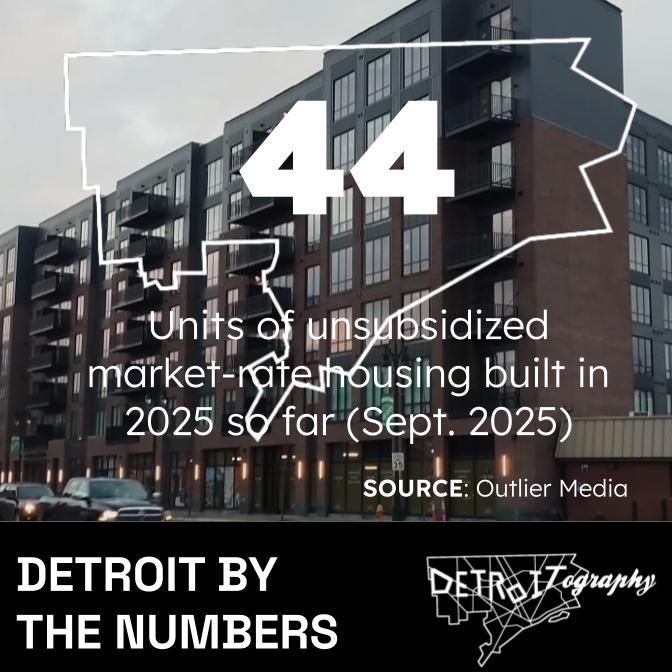
Units of unsubsidized market-rate housing constructed so far in 2025. Many apartment buildings are going into foreclosure. Property insurance has doubled in the last few years. Interest rates are up, making loans or refinancing more expensive. Construction and maintenance costs are still sky-high. And Detroit has some of the highest property tax rates in the country. There are strong concerns that rent prices will increase to cover costs. (Outlier Media).
100%
The pay gap between commuters and Detroiters with jobs is double (average commuter wage is $100,000 vs. Detroiter wage is $53,000). The recent City of Detroit University Economic Analysis Partnership highlighted this disparity. Commuters hold almost 75% of all jobs in Detroit. Tracked from 2010 to 2020, the gap has only gotten worse. (Axios)
48,823
DPSCD student enrollment is up! This same time in 2024: 48,386 and 2023: 47,401. “As of Day 11, we are trending 437 students more than last year and 1,422 more students as compared to two years ago,” Vitti said. Total enrollment: 52,505 K-12 students are enrolled in DPSCD compared to 2024: 53,044 students. (BridgeDetroit)
20
This is really important, but we don’t think about it as much as we should. Detroit is bordered by 20 other local municipalities including two fully surrounded by the city, and one international city (making it 21?) – Windsor (239 municipalities in 7-county region). Shoutout to the Greater Detroit Windsor Project Conference set to happen at the WSU Law School on October 17th to explore connections and opportunities in our region!
Agendas and speakers to follow. Don’t miss out on this unique opportunity to be a part of a dynamic community dedicated to driving positive change in the region. Reserve your spot today!
WHEN: Friday, October 17th, 8:30am-4:30pm
WHERE: Wayne State University Law School, Spencer M. Partrich Auditorium
WHAT: This day long event will bring together professionals, experts, and enthusiasts from across the region and both sides of the Detroit-Windsor border to explore innovative ideas and foster partnerships.
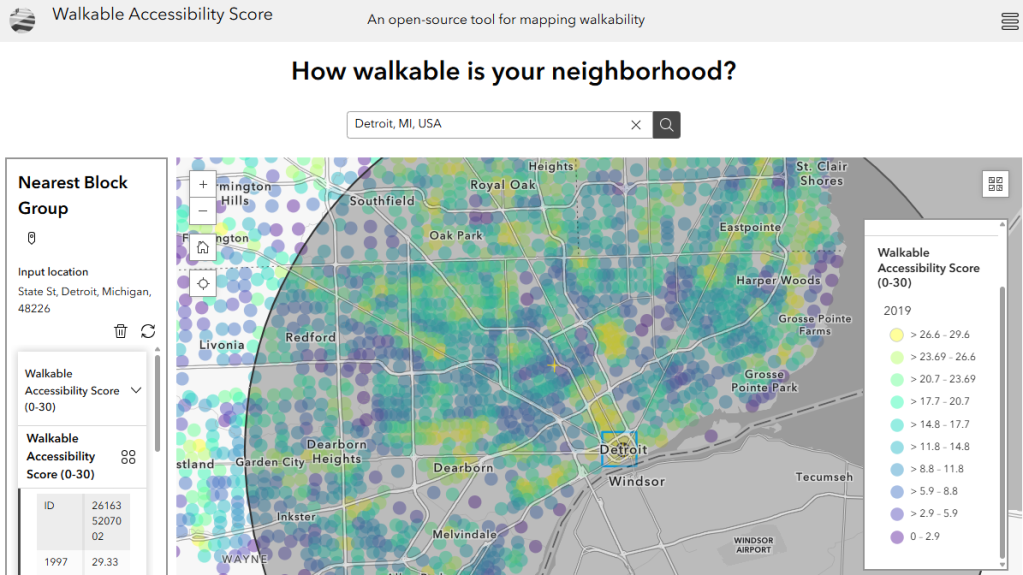
… the Walkable Accessibility Score measures the average accessibility to nearby urban amenities from neighbourhood centers. To create the WAS, we first calculate the distance from every block group centroid (shown on the map above) to the nearest30 grocery stores, pharmacies, retail shops, banks, bookstores, schools, parks, hotels, restaurants, cafes, and bakeries. Then, the distance to each of these amenities is weighted by how far away it is from the block group centroid, up to a maximum distance of around 1600m. A block group with 30 amenities all located within a very short distance of its center (e.g., 400m) recieves a full value of ’30’ for the WAS. Using POI data, we are able to calculate the WAS for every block group in the continental US for every year from 1997-2019. For more detail, see the full paper here.
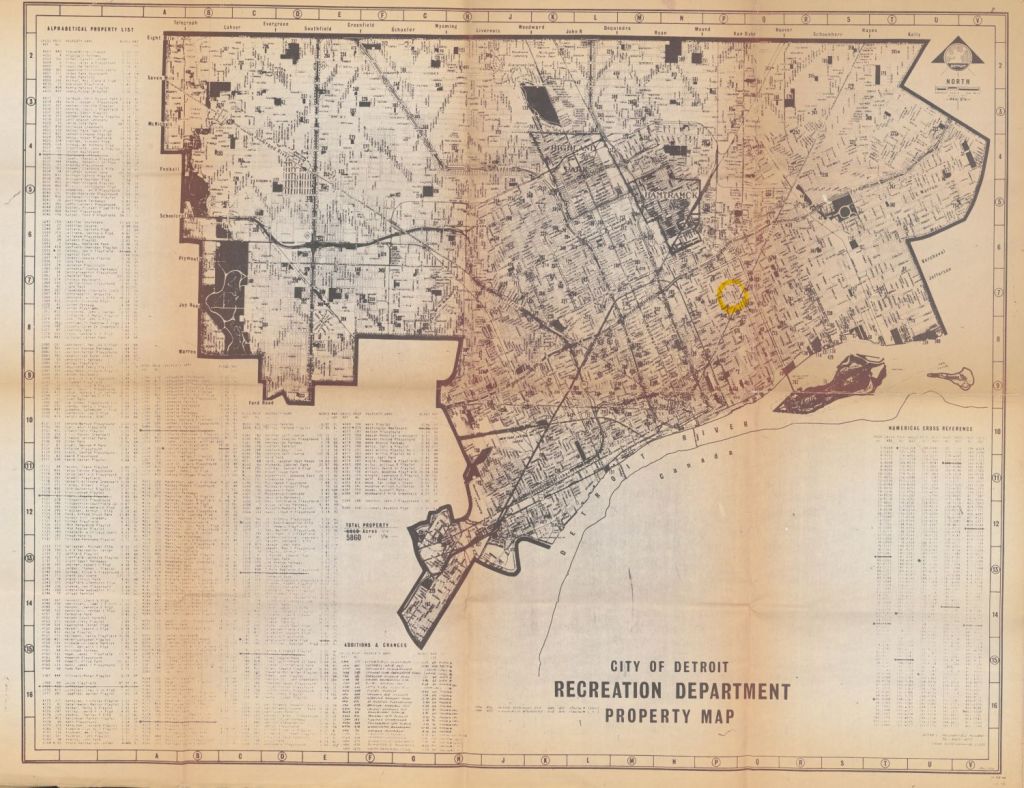
I can’t remember where I found this map, but I’m glad that I did. The map is huge and could only be scanned using the large format, flat-bed scanner at the Reuther Library. This map is printed on this heavy paper, thick to the touch almost like a stiff fabric.
The map has some weathering and discoloration, but was clearly a map in active use from at least 1972 to 1976. What I love most about it is the active crossing out of property locations, like the “Seward 12th Playlot” and the active “Additions & Changes” including name changes, like “Seward-12th Playlot.” The map total the acres for the recreation Department at 5850 as of 1/72 (January 1972) and 5860 as of 1/76 (January 1976). There is a mystery highlighted circle at Mt. Elliott north of Gratiot. What was the Recreation Department planning in 1976?
This map is part of the Hill Map Collection digitized in partnership with the Reuther Library and Archives as part of the Detroit Atlas Collaboration funded in part by the WSU Union of Part Time Faculty (UPTF) Professional Development Fund.
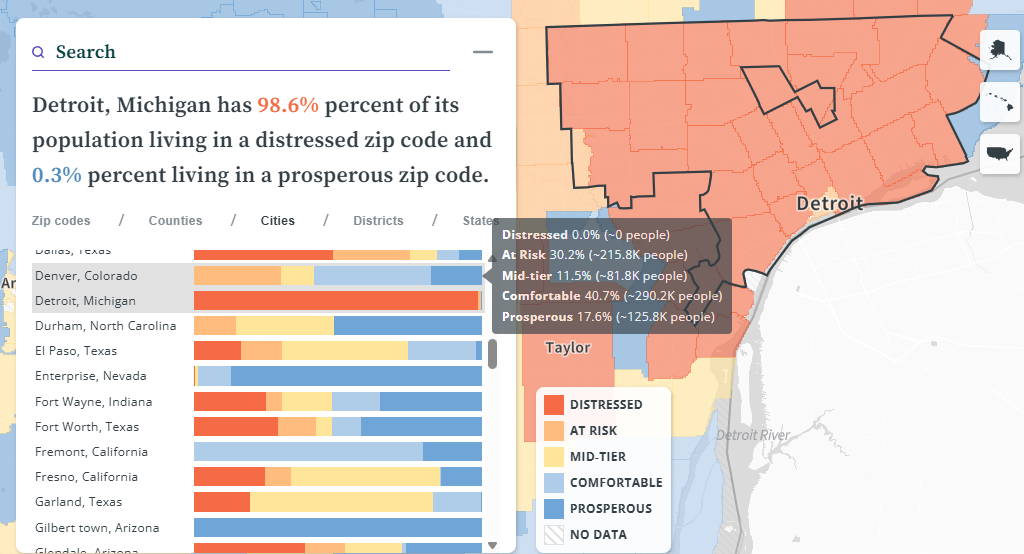
I don’t generally look to these index rankings of Detroit, but the comparisons are powerful. Detroit is a donut hole in the region; surrounded by communities of higher prosperity and higher opportunity. The city sits on par with Cleveland, Buffalo, Newark, and Memphis.
What are the known strategies and policies that build opportunity in distressed communities?
Make it count! Detroit By The Numbers latest monthly segment on the Authentically Detroit podcast is live! We highlight significant data and numbers from the past month for Detroiters!
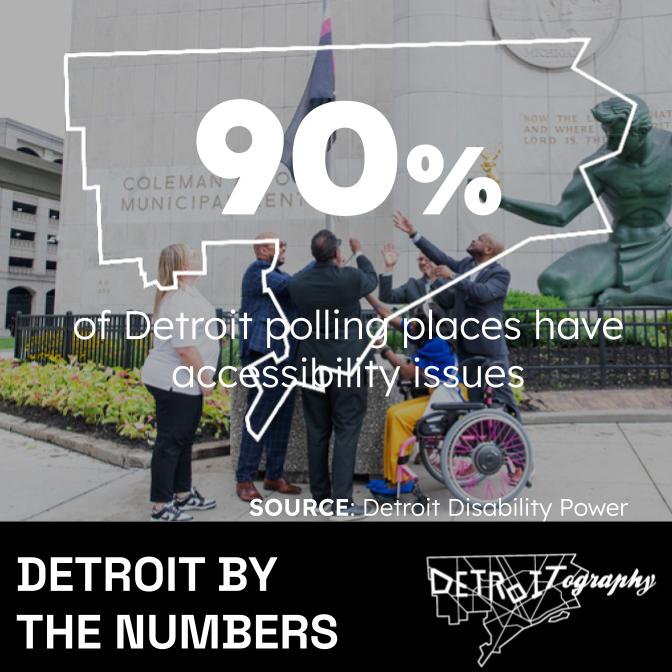
The overwhelming majority of polling places have accessibility challenges. Detroit Disability Power (DDP) have conducted a regular poll audit and recently updated their polling place audit, “accessibility problems at more than 90% of Detroit polling locations” – you can now check your polling place and its accessibility at VoteDetroit.org (WDET)
$144M
Total investment in Belle Isle since 2014. Michigan Department of Natural Resources and the Belle Isle Conservancy have launched a survey, open through Labor Day, asking visitors to rank potential investments. (Planet Detroit)
96
Events for Detroit Month of Design next month. Check out the list of locations and events back to 2019 on DetroitData.org (DetroitData).
Bonus: check out our recent Data Forum on Arts and Creative Ecosystems (Youtube)
$2M
$2 million has been spent ($2.5M raised) by mayoral candidates in the primary already. The bulk of the funding was raised by Mary Sheffield ($1.3M) which is on track with Mayor Duggan’s re-election bids in 2018 ($1.2M) and 2021 ($1.1M). (BridgeDetroit)
Welcome to our Data Forum where we will discuss traffic data, mobility, and safety in the city. Join us online for lunch-and-learn filled with insightful discussions, tips, and tricks on all things related to the data.
We’ll be joined by the Darius Mason from the City of Detroit’s Office of Mobility Innovation, Patrick Bowman of UM Transportation Research Institute, and Jenya Abramovich from SEMCOG.
Don’t miss out on this opportunity to connect with fellow data enthusiasts and expand your knowledge.
WHEN: Friday, September 19th, 12:30-1:30pm
WHERE: Virtual
WHAT: Join us for our Data Forum where we will discuss traffic data, mobility, and safety.
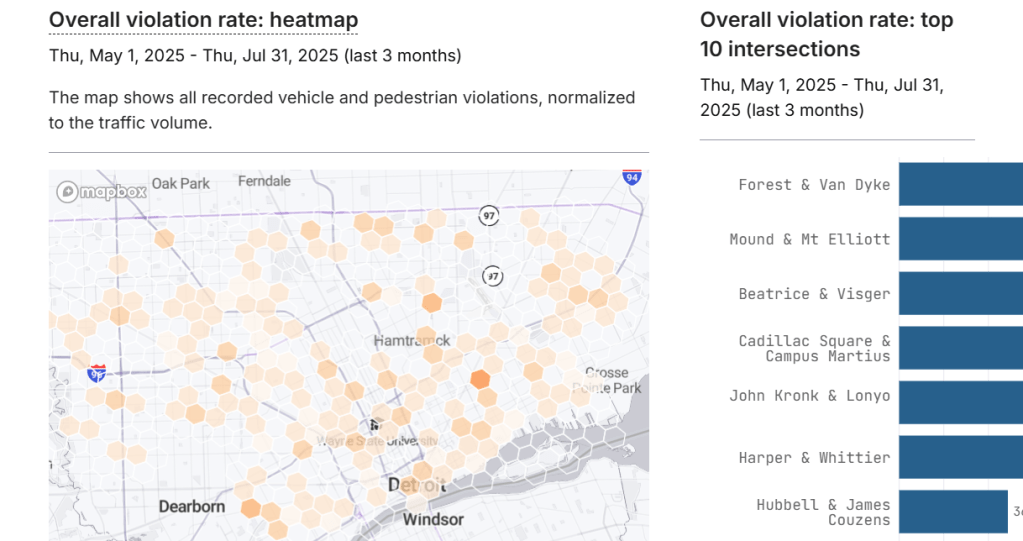
The City of Detroit has launched a new tool to track road safety:
The Detroit SMART MODES dashboard is officially live! This powerful new tool uses real-time data to detect near-misses and support smarter, safer street design across the city. Developed in collaboration with leading tech partners and community stakeholders, the dashboard marks a major step forward in making Detroit’s mobility system more connected and people-centered.
By streamlining the analysis and intervention process, Detroit MODES aims to significantly reduce the time required to address traffic safety issues, ultimately saving lives and enhancing the overall efficiency of the city’s transportation system.
I really enjoyed collaborating with Sidewalk Detroit on developing trail maps and wayfinding markers for Eliza Howell Park. My early foray into mapping was when I was in high school and used by uncle’s handheld GPS to trace trails at a local park that did not have an accurate trail map. I used an early GIS program to load the GPX files and created the finished product by hand. It was exciting to apply my collected years of GIS mapping to create these updated trail maps.
The Sidewalk Detroit team had done an incredible job of tracking and planning what they wanted to see on these maps. I dove headlong into best practices for trail maps and wayfinding design. One data oddity was that we discovered the data file for the Rouge River sourced from the EPA was not accurate. Based on the Sidewalk Detroit team knowledge and some satellite imagery referencing, I updated the correct curvature of the Rouge River through the park.
Contact
Submit a map or just get in touch. Thanks for following!









 DETROITography