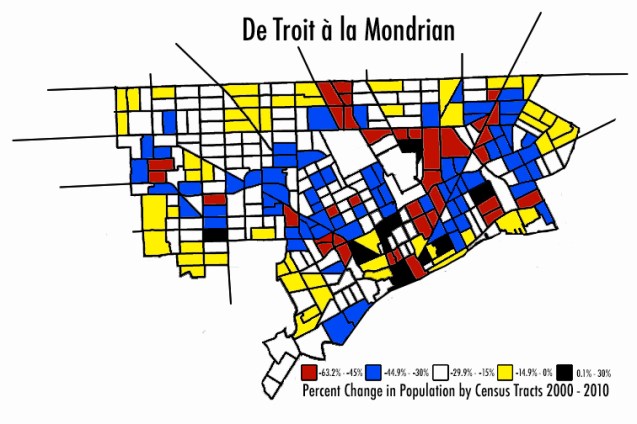
De Troit a la Mondrian

mondrian_detroit

While looking at the 2010 census data on population density and the percentages of change between 2000 and 2010, I kept imagining the Detroit census tract grid in the style of Dutch painter, Piet Mondrian. He began painting his primary color grid works while studying in Paris.

Then I saw this Mondrian world map and went for my own version of Detroit’s percentage of population change.

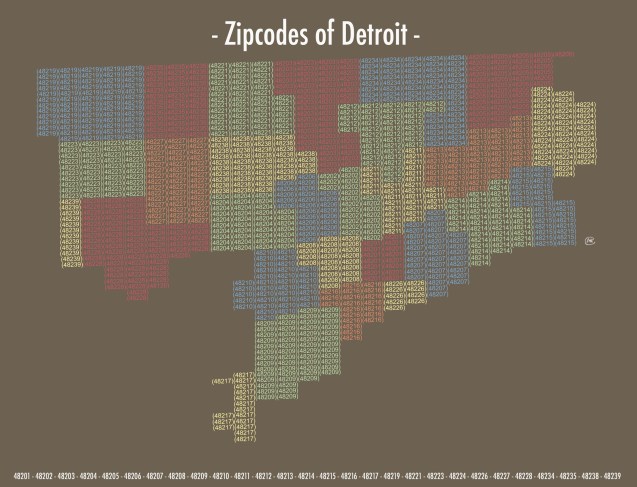
Zipcodes of Detroit Map

detroit_zipcode

This was a fun typographic/ numerical mapping idea that I thought of the other week and decided to make it happen. It took a bit of time, but turned out how I imagined.

The Crayola Crayon colors that I used are: Blue Gray, Brick Red, Burnt Sienna, Canary, and Granny Smith Apple.

Reference: Zip Codes | GIS Maps | City of Detroit

Map: Detroit Downtown Population Growth

detroit_ann_arbor

Many recent maps have highlighted the population loss of Detroit. Although the Census data and population loss is disputed, the interesting bit highlighted by this map (that does not have a legend or map key #fail) is that it shows population growth in the downtown region (blue) surrounded by a sea of population loss (red) with growth in Detroit’s suburbs.

Not many maps have taken time to demonstrate that there are some areas of population growth in Detroit, however this is largely due to new incentive programs to live near downtown Detroit and the influx of some large corporations who also incentivize employees to live in the city.

Source: Stephen Von Worley | http://www.datapointed.net/visualizations/maps/growth-rings/detroit-michigan/

Detroit’s Income Inequality from Space

detroitsquaremile

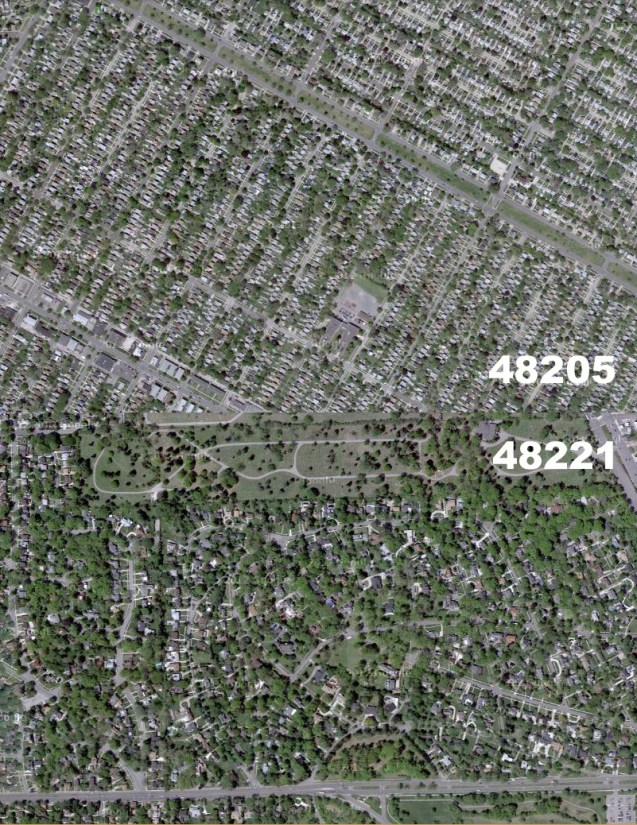
Firstly, this was not my idea, but I wanted to test it out in Detroit. Tim De Chant posted on Per Square Mile that inequality can be visualized from space via satellite images on Google Maps/Earth. He previously wrote about the concept that the lack of urban trees represented the absence of wealth in certain areas of a city.

“Research published a few years ago shows a tight relationship between per capita income and forest cover. The study’s authors tallied total forest cover for 210 cities over 100,000 people in the contiguous United States using the U.S. Department of Agriculture’s natural resource inventory and satellite imagery. They also gathered economic data, including income, land prices, and disposable income.” (source)

The research basically stated that with an increase in income the demand for trees increased likewise decrease in income showed a decrease in demand for trees. As De Chant writes, the authors found that trees were seen as a luxury item.

This all made the gears turn in my head about how this research and De Chant’s image grabs from Google satellite imaging applied to Detroit.

48205 Osborn (“Deadliest” Zipcode)


I choose 48205 because, “The neighborhood of 44,000 residents accounts for 6 percent of the city’s population, but was home to 15 percent of its murders and 13 percent of its shooting victims.”

48221 Palmer Woods

I used to live in this zipcode, in the University District. I would often run around the Palmer Woods neighborhood because I was fascinated by how different running south past 6 Mile Rd. and running north above 7 Mile Rd. could be such different environments. Census data pegs this zipcode as one of the highest income areas of the city.

The idea seems to work well in Detroit neighborhoods, however the Greening of Detroit is working hard to plant more trees every day in both wealthy and poor neighborhoods.

“Between 1950 and 1980, around 500,000 trees were lost in Detroit to Dutch Elm disease, urban expansion and attrition. During that same time period, economic constraints prohibited the city of Detroit from replacing those trees. […] In 1989, Detroit, a typical American city, was losing an average of four trees for every one planted.”

The organization is estimated to have planted over 65,000 trees since its inception in 1989.

Cross-posted from Alex B. Hill