
by: Jeremy Singer, Wayne State University
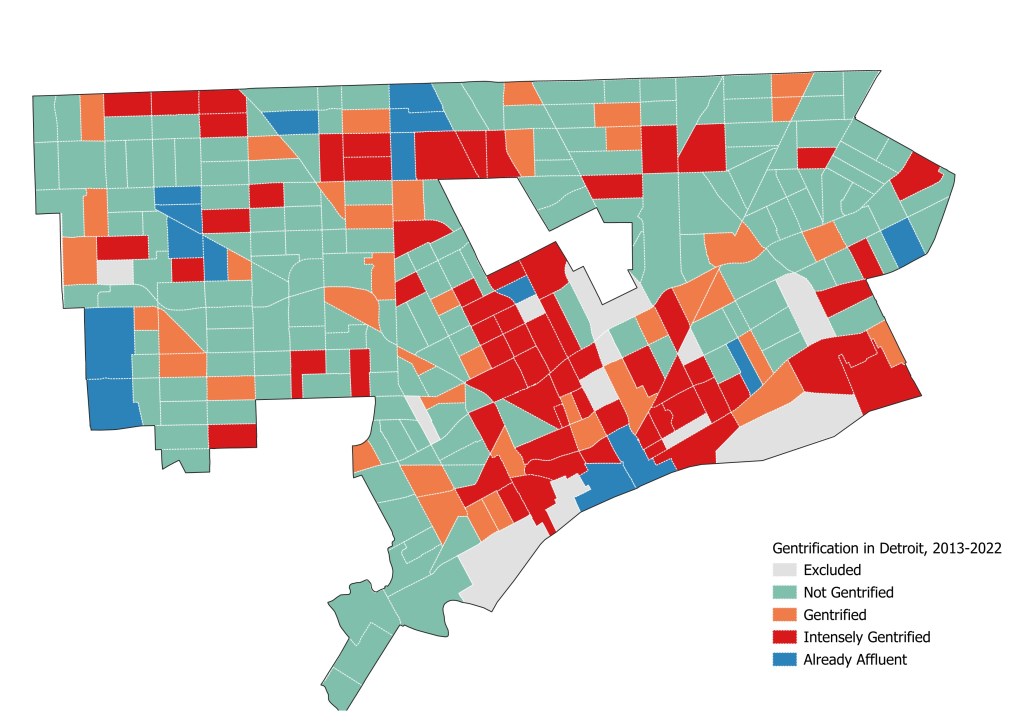
In a recent study, Alisha Butler (Wesleyan), Danica Brown (independent scholar), Michelle Taylor (Wayne State University), and I studied the dynamics of gentrification in Detroit and its relationship with middle-class families’ school choices in the city. As part of their analysis, they prepared a map of gentrification status by Census tract. The map provides a useful update on gentrification status after a decade of substantial but uneven development throughout the city. These findings update prior work from the 2000s and early 2010s, which had documented intense gentrification downtown but low overall levels of gentrification in the city.
We used a measure of gentrification proposed by the Urban Health Collaborative (UHC) at Drexel University. Their measure is based on changes over time in local incomes, college education levels, home values, and rent prices. Census tracts are classified as “not gentrified,” “gentrified,” or “intensely gentrified”—which helps goes beyond a binary of either gentrified or not. Their measure also provides guidelines for excluding tracts based on low population (<50 people) or missing data; and labeling tracts as “already affluent” based on high starting levels of household income, home values, and education levels. Following this method, we used one decade of Census Bureau tract data—from 2013 through 2022—to produce our measures of gentrification in Detroit.
We found that about 22% of Census tracts in the city intensely gentrified between 2013 and 2022, while another 14% gentrified (but not intensely), and 55% did not gentrify. We also identified 5% of tracts as “already affluent” and 4% were excluded. From the paper:
Intense gentrification was concentrated in the greater downtown and midtown areas, as well as neighborhoods expanding southwest, southeast, and north of the city’s downtown. Some intense gentrification is also concentrated in the northern part of the city. Gentrifying tracts are found throughout the city, though they are often found adjacent to intensely gentrifying tracts.
Changes over time in the socioeconomic characteristics of these tracts help illustrate the contours of gentrification. Both intensely gentrified and already affluent tracts had sharp increases in the share of residents with BAs, the median income, home value, and median rent. Gentrified tracts, compared to those that did not gentrify, had greater increases in the share of residents with BAs, as well as slightly higher home values, but median incomes and rents remained comparable. In addition, the share of residents with BAs and median home values in gentrified tracts remains much lower than intensely gentrified and already affluent tracts.
The full paper can be found here.
 DETROITography