Development Creep: 40-years devaluing Detroit’s lower Cass Corridor

For nearly four decades, speculation in the lower Cass Corridor wreaked havoc on residents and shredded the community fabric that held it together. By the early 2000s, the area was largely deserted except for low income apartment buildings. The primary speculator in this neighborhood was the Ilitch family, the owners of a national pizza chain and two major sports franchises. The Ilitch companies bought the first property in the area in 1982, the same year they purchased a hockey team. The subsequent purchases in the 1980s and 1990s, and the intentional neglect of these properties, made it easier to acquire larger numbers of parcels. The competition among speculators increased as it became clear that the lower Cass Corridor was likely the site of a new hockey arena, but those bets on a future development meant there was little incentive to maintain properties in the area.

Meagan Elliott examined the consequences of this type of speculation in her 2018 dissertation, Imagined Boundaries: Discordant Narratives of Place and Displacement in Contemporary Detroit. Elliott’s research focuses on both the process of displacement and residents’ experience of it. She details how city government, quasi-public agencies like the Downtown Development Authority, and wealthy and politically connected developers such as the Ilitches work together. Even more important, her work explores the dissonance of residents’ experience in a multi-decade process of destruction in the lower Cass Corridor.

Screen Shot 2018-09-12 at 9.45.45 AM
Elliott, M (2018) Imagined Boundaries: Discordant Narratives of Place and Displacement in Contemporary Detroit. p 189.

Elliott captures a type of displacement that is often missed in academic work on gentrification and neighborhood change. Essentially, how some speculators/developers manufacture the gap between current value and potential value through a strategy to acquire and then blight. In her interviews in the lower Cass Corridor, residents told Elliott they believed the Ilitches were responsible for waves of vandalism that left broken car windows but no theft that further destabilized the community. Whether or not the Ilitches were directly involved, these longtime residents had a clear understanding of who was to blame for the creeping decline in their neighborhood.

In this case, speculation operates as a long term development practice. The multi-decade process of intentionally devaluing a neighborhood that makes property acquisition cheaper and eliminates obstacles to redevelopment plans. Basically, redevelopment becomes the only option after decades of destruction in a community.

The Ilitches recently opened an $863 million hockey arena in the lower Cass Corridor. It is surrounded by a sea of parking lots. The Ilitch family claims these lots will eventually become “The District Detroit,” a set of five off the shelf urban neighborhoods. Detroit has heard this story before, 25 years earlier when the Ilitches used public money to build a new baseball stadium. The promised entertainment district never materialized. Instead there are a sea of surface parking for events. A revenue generator for the Ilitch’s, but not much else.

The Ilitches appetite for public funding is only rivaled by public officials’ willingness to find increasingly creative ways to give it to them from signing over concession revenues in city-owned venues in the early 1980s, to cobbling together multiple downtown blocks to hand over to the family, to financing a baseball stadium, and a large portion of the hockey arena. The last give away came while the city was in bankruptcy.

The public subsidy of stadiums is always an economic loss for cities (cite). In Detroit, citizens were ahead of the curve in the early 1990s passing an ordinance to prevent public financing of stadiums. Less than five years later, the Detroit City Council overrode that ordinance and then handed over $283 million to the Ilitch family to build a downtown baseball stadium. Less than 25 years later, government officials were ready to try again providing nearly $500 million in incentives for the hockey arena.

Meagan Elliott’s dissertation can be found here:

https://deepblue.lib.umich.edu/handle/2027.42/144123

Further reading on the property practices of the Ilitches or its appetite for public money:

https://deadspin.com/mike-ilitch-was-no-saint-1792480558

http://www.crainsdetroit.com/article/20170910/news/638626/how-olympia-financed-an-arena-in-a-bankrupt-city

https://www.metrotimes.com/detroit/how-mike-ilitch-scored-a-new-red-wings-arena/Content?oid=2201553

https://www.guernicamag.com/joshua-akers-and-john-patrick-leary-detroit-on-1-million-a-day/
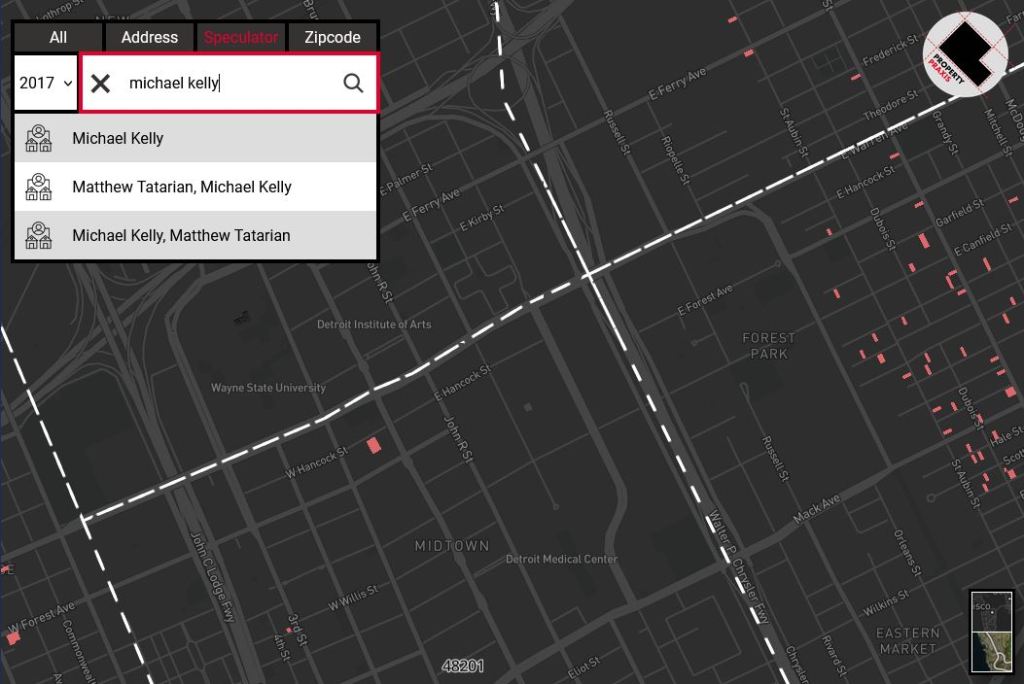
Serial Evictor: Michael Kelly and Detroit Property Exchange

Michael Kelly filed 1,160 evictions between 2009 and 2016. That is the equivalent of one eviction filing every 2.5 days. Kelly operates over 40 LLCs and currently owns over 500 properties in the City of Detroit. Kelly’s most prominent company is Detroit Property Exchange which offers low income residents land contracts on dilapidated housing. Houses most of them are eventually evicted from.

Land contracts are common in Detroit.  Traditional financing is often unavailable and housing prices are generally below the lending floor for mortgage brokers and banks. In addition, the longer history of racial discrimination in lending continues to limit credit opportunities for minorities, particularly in poorer areas of the city (NYT 2018).

These factors, combined with a flood of discounted housing in the 2006 mortgage crisis and the tax foreclosure crisis following the financial crisis, positioned speculators like Kelly to exploit Detroit residents. Detroit Property Exchange uses land contracts with large down payments, high interest rates, and clauses that make eviction easier and more likely. In these contracts, a late payment, of even a single day, often results in buyer becoming a month-to-month tenant facing eviction. Unlike a mortgage, and in the way these contracts are currently enforced by Detroit’s 36th District Court, buyers build no equity in the house and lose all of their investment when evicted.

In a 2018, study by my colleague Eric Seymour and I, Kelly had the highest rate of eviction of known contract sellers in Detroit. Between 2005 and 2015, Kelly acquired 777 properties, primarily from the tax foreclosure auction and turned his properties over through eviction 1.5 times between 2009-16. This churn rate does not account for the fact that only about 350 of Kelly’s properties were being offered on land contract or for rent, which is closer to 3 evictions per property.

In 2011, Kelly defended all of his practices telling Christine MacDonald of The Detroit News, “People went out West speculating for gold. That’s what it is. You need speculators. It’s called investors” (MacDonald 2011a).

Unlike many speculators who have one or two methods, Kelly’s holdings and speculative practices are multi-faceted. He is savant at catching wrinkles or errors in the city’s property records. Reports in The Detroit News covered his attempts to demand rent after purchasing a tax foreclosed parcel that included the front door and parking spaces at a strip club. Another time he threatened to evict an operating business from its plant after purchasing a parcel on the shop floor (MacDonald, 2011b, MacDonald 2012).

In addition, Kelly holds a number of parcels near potential development sites, buying low, doing nothing, and waiting to sell to the developer or city at an inflated price. Some of these properties are held by non-profits under names like Detroit Youth Gardens LLC.

Nearly a decade ago, Kelly actively used the Wayne County Tax auction to limit his property tax liability by allowing properties to go into foreclosure and then repurchasing them for the $500 minimum bid. There is more about that process here.

Wayne County’s tax foreclosure auction is the primary pipeline for property acquisition by Kelly. In addition to serving as a means to avoid tax obligations, Kelly purchased occupied housing in tax foreclosure, negotiated a land contract with the former owners still living in the house, and then failed to pay property taxes leading to a second foreclosure (DED 2014).

In 2009, at the height of the foreclosure crisis, undercover television reporters recorded seminars held by Kelly associates showing potential buyers how to take advantage of federal stimulus program. Participants were encouraged to buy derelict properties that Kelly’s companies acquired at auction and apply for the $8000 federal incentive. The incentive was split between the buyer and seller. Buyers were instructed to walk away from the property. The walk away was essential as the stimulus money did not have to be repaid if the house burned or was destroyed within two years (Wolcheck 2009, Oosting 2009).

In all, Kelly is one of the most creative and effective purveyors of misery and blight in the city. Despite the notoriety of his practices the Wayne County Treasurer continues to sell properties to Kelly and his companies at auction. Until recently, the City of Detroit has done very little to intervene in his treatment of tenants or his production of blight. The 36th District Court which hears landlord-tenant actions has ignored the broader legal questions around Detroit Property Exchange land contracts and more often than not sides with Kelly over Detroit residents.

References:

Akers, J and E Seymour (2018) Instrumental Exploitation: Predatory property relations at city’s end. Geoforum 91: 127-140.

Akers, J (2017) A New Urban Medicine Show: On the limits of blight remediation. In Why Detroit Matters, (ed. B. Doucet) Policy Press: Bristol UK.

DED (2014) The fight for Sandi and Kenny. http://www.detroitevictiondefense.org

NYT (2018) The Race-Based Mortgage Penalty. March 7 https://www.nytimes.com/2018/03/07/opinion/mortage-minority-income.html

MacDonald, C. 2011a. Private landowners complicate reshaping of Detroit. The Detroit News, Mar 03.

MacDonald, C. 2011b. Detroit area investor gains from others’ real estate mistakes. The Detroit News, Mar 03.

MacDonald, C. 2012a. Homeowners buy back own property, dodge taxes. The Detroit News, Feb 03.

Oosting, J. 2009. ‘Walk away stimulus plan’ uses tax credit to scam. Detroit: mlive.com.

Wolcheck, R. 2009. Walk Away Stimulus Plan. Hall of Shame. Detroit: WJBK Fox 2.

Where is Dan Gilbert, Detroit’s parking garage and skyscraper king?

The line between speculation and investment can seem arbitrary. In fact, some of the largest speculators in the city of Detroit often characterize their activities as investment. In 2010, Manuel “Matty” Moroun told the Free-Press his holdings represented his commitment to the city. “Our fortunes are linked to the city. If the city doesn’t have any prosperity, we don’t have any value in the land, right?” Another of the city’s largest speculators, Michael Kelly, invoked the frontier to justify his activities to the Detroit News in 2011. “People went out West speculating for gold. That’s what it is. You need speculators. It’s called investors.” One of the difficult parts of this project was finding a line between speculation and investment.

The absence of Quicken Loans founder Dan Gilbert on Property Praxis has drawn attention from media (here) and some users. If one were to measure property holdings solely on square footage, Gilbert is one of the largest property owners in Detroit, but based on parcels he is way down the line, at under a 100. That Gilbert’s holdings did not appear on Property Praxis was a surprise to us and demonstrates the strength of the definition of speculation within the project to demarcate speculation and investment. What sets Gilbert apart from many of the large property holders on the list is that his holdings are sites of active investment.

There are very real impacts in Gilbert’s remaking of downtown Detroit into a modern company town has on long-time residents, particularly the poor and people of color. There is more commercial activity in the core, but it is accompanied by hyper-surveillance, increased security patrols and higher rents pushing people out and generating increased pressures on those that remain. Quite simply, Gilbert is not waiting for someone else to make an investment to increase the value of his property. Though there is a long term strategy in his buying that is similar to Moroun, this urban renewal plan requires density so adding apartments and office workers require immediate renovations in hopes of filling storefronts and pushing land values higher. That’s a long-term bet that requires a lot of money, both private and public, up front that may or may not pay off.

But this could change. One can be a speculator and investor at the same time. We are currently working on an update of the map using recently released city assessor data. The flurry of announcements, particularly those regarding Brush Park over the past year, may present a much different picture of the landholdings of Gilbert and his array of companies.

REFERENCES

GALLAGHER, J. (2010) Matty Moroun and his big slice of Detroit. Detroit Free-Press, May 11.

MACDONALD, C. (2011) Private landowners complicate reshaping of Detroit. The Detroit News, March 3.

Speculation and the City “It’s not a bug, it’s a feature.”

Property speculators own nearly 20 percent of all property in Detroit. The parcels caught up in this web of speculation are spread across the city and come in a variety of forms. At their worst these owners are buying and selling houses that rapidly decline into vacant and abandoned shells.

Too often neighborhoods and the public are forced to bare the cost of these activities from the daily reality of physical deterioration, to declining property values, and increasingly costly demolitions. The recent mortgage crisis created a large inventory for speculation while most government response at the federal, state and local level is dedicated demolishing the aftermath of these activities. What is not addressed is the production and producers of these conditions.

In Detroit, speculation is the third largest category of ownership after individual owners (50 percent) and government agencies (30 percent). Property Praxis is a visual representation of these speculative activities. The intent of this project is to show who is speculating on properties across the city and where these are located. It is a tool for understanding and action. Property Praxis uses data from the City of Detroit Assessor to identify these property owners and their holdings across the city.* It allows you to see both the size of a speculators holdings and where these properties are located. In addition, it identifies the owners or members of limited liability companies (LLC). These organizations are shell companies that protect owners’ personal assets, such as their own house, in case they are sued or go bankrupt, but it also can hide a person’s identity. An exhaustive review of records filed with the state of Michigan or the state where an LLC was incorporated identified over 98 percent of owners or members.

If you are in Detroit and would like to meet up please let us know. If you are interested in building a similar project in your city it is open source and available to you.

*The City Assessor labels the current data 2015. We refer to this as “City Year” as it is clear from the analysis that not all records are up to date. There is a lag time in recording and city record keeping. Once the 2016 data is analyzed the site will be updated.

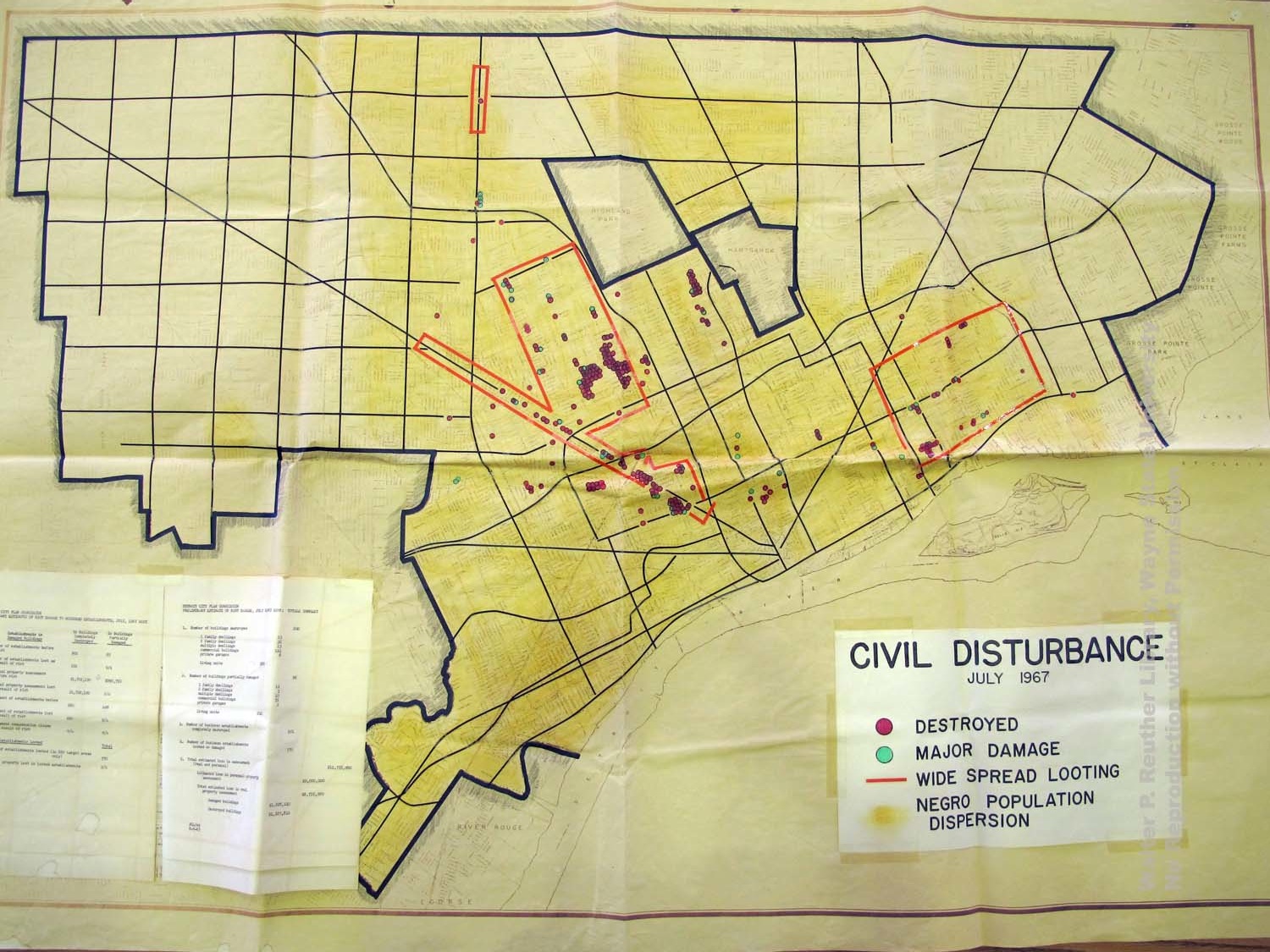
Map: Detroit Civil Disturbance July 1967

Civil Disturbance July 1967

This map shows the “Civil Disturbance July 1967” from the Jerome Cavanagh Papers in the Walter P. Reuther Library at Wayne State University. The additional image shows damage estimates and structure conditions which are fixed to the lower left corner of the map.

Civil Disturbance Map Attachment 1

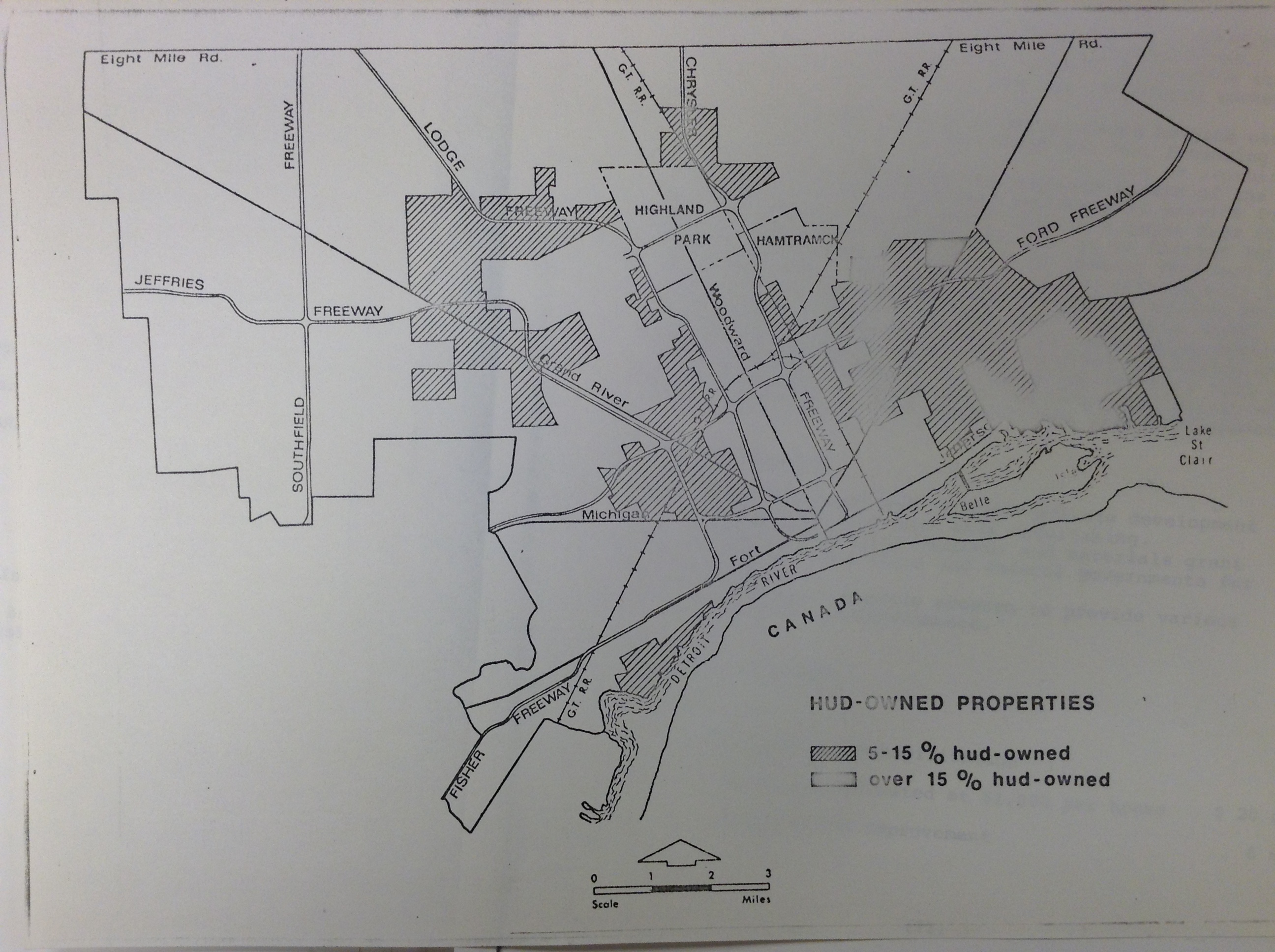
Map: Detroit HUD Owned Properties in 1975

HUD-Owned Properties (1975)(1)This map comes from the William Milliken Papers in the Bentley Historical Library at the University of Michigan. The map represents all HUD owned properties in 1975. The highest concentrations (blurry areas) currently match where a lot of housing cooperatives and senior apartments now sit along the East Riverfront. There is also an interesting concentration in the Corktown (north of Michigan Ave.) area.