by: Rod Arroyo
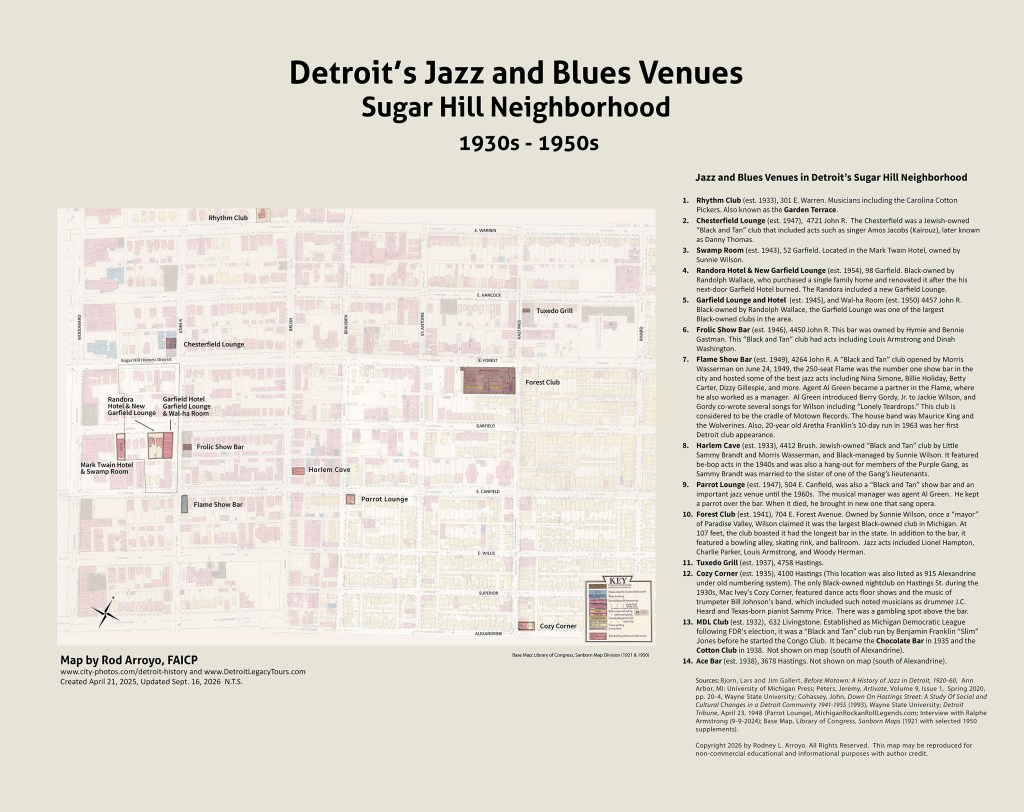
Just north of Paradise Valley, Sugar Hill became an important jazz and blues district, likely borrowing its name from Harlem’s Sugar Hill (where sweet, good things happened). Packing more than a dozen clubs into a few blocks along John R (the “Street of Music”), Hastings, Brush, and Garfield between the early 1930s and 1950s, the district took off after Prohibition’s end in 1933 with venues like the Rhythm Club, the MDL Club (later the Chocolate Bar, then the Cotton Club), and the Harlem Cave, setting a pattern of small, densely packed rooms that mixed local talent with national headliners.
Black entrepreneurship anchored the neighborhood. Sunnie Wilson, a former mayor of Paradise Valley, built an entertainment empire including the Swamp Room and the Forest Club, reportedly Michigan’s largest Black-owned club, drawing Lionel Hampton, Charlie Parker, and Louis Armstrong. Randolph Wallace grew his own footprint on Garfield and John R with the Garfield Lounge and Hotel (1945), the Wal-ha Room (1950), and later the Randora Hotel and New Garfield Lounge. The district also housed integrated “Black and Tan” clubs including, but not limited to, the Chesterfield Lounge, the Frolic Show Bar, the Harlem Cave, and the Parrot Lounge, known nearly as much for its opera-singing parrot as its music.
No club mattered more than the Flame Show Bar, opened in 1949 at 4264 John R, whose house band, Maurice King and the Wolverines, backed many national and local acts. The Flame hosted Billie Holiday, Nina Simone, and a 20-year-old Aretha Franklin in 1963, when she sang just a few blocks away from where her father, Rev. C.L. Franklin, preached. Its deepest legacy was as a Motown incubator: agent Al Green introduced Berry Gordy Jr. to Jackie Wilson there, and several house musicians became part of the Funk Brothers, the Studio A backing band to so many hits. By the 1950s, urban renewal, freeway construction, and Medical Center expansion demolished much of this district block by block — but its concentration of clubs left an outsized imprint on Detroit’s musical DNA, Motown included.
Urban planner, Detroit tour guide, and jazz archaeologist Rod Arroyo, FAICP, created this post and map.
 DETROITography