by: Emma Loveland, City of Detroit
There’s been a lot of attention on Detroit’s affordable housing initiative recently from politicians who planned on using Detroit’s policies as an inspiration for the country’s policies. Having family who grew up in Detroit in the lower income brackets rallied my interest in what’s going on in Detroit’s housing department; I wanted to see how the City’s helping the less fortunate, and why it’s gaining so much attention. From HUD.gov, “The Project Based Voucher (PBV) program is a component of the Michigan State Housing Development Authority’s (MSHDA) Housing Choice Voucher (HCV) Program. The HCV program is federally funded by the United States Department of Housing and Urban Development (HUD) Public and Indian Housing (PIH) and is the primary resource for providing rental assistance to very low to moderate income families. MSHDA’s PBV program targets extremely low income (30% AMI) supportive housing target populations.” Also “The Project Based Voucher (PBV) program is a component of the Michigan State Housing Development Authority’s (MSHDA) Housing Choice Voucher (HCV) Program. The HCV program is federally funded by the United States Department of Housing and Urban Development (HUD) Public and Indian Housing (PIH) and is the primary resource for providing rental assistance to very low to moderate income families. MSHDA’s PBV program targets extremely low income (30% AMI) supportive housing target populations.”
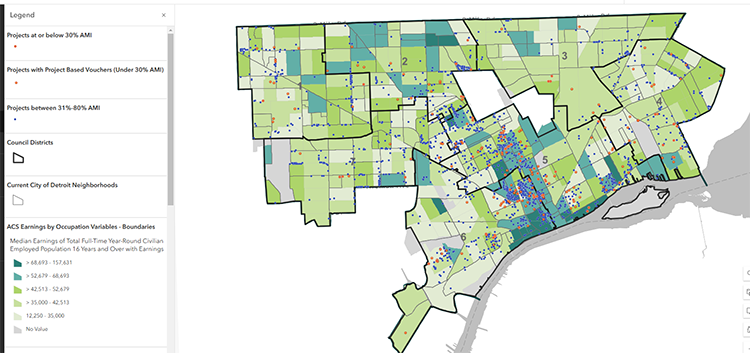
In this map, the red dots show the ‘deeply affordable’ units, which is made up of 30% AMI and below, and projects receiving project-based vouchers. The blue dots show all other units that are still affordable between 31% AMI and 80% AMI. This shows there is a good spread of ‘deeply affordable’ units across the city, particularly in the higher earnings areas in the middle of the city. Using earnings as a proxy for higher opportunity areas, this shows a positive trend for the City. The colors of the map are broken out into different income levels shown by different colors. This information comes from the City’s Open Data Portal.
Overall, the City has a good spread of affordable housing, even in the lower income areas; this provides the resources for people to live comfortably, when they perhaps, otherwise, couldn’t. Deeply affordable housing in higher opportunity areas means that lower income individuals and families can benefit from living in these higher opportunity areas, and it’s a positive trend as the City aims to be somewhere where all can thrive as it redevelops post-bankruptcy.
Dataset(s) Used:
- Existing Multifamily Housing Data
- ACS Earnings by Occupation Variables – Boundaries
- ACS Employment Status Variables – Boundaries
This map was part of the Visualizing Detroit: The Art of Data competition and exhibit in November 2024.
 DETROITography