by: Rachel Trudeau, Wayne State University
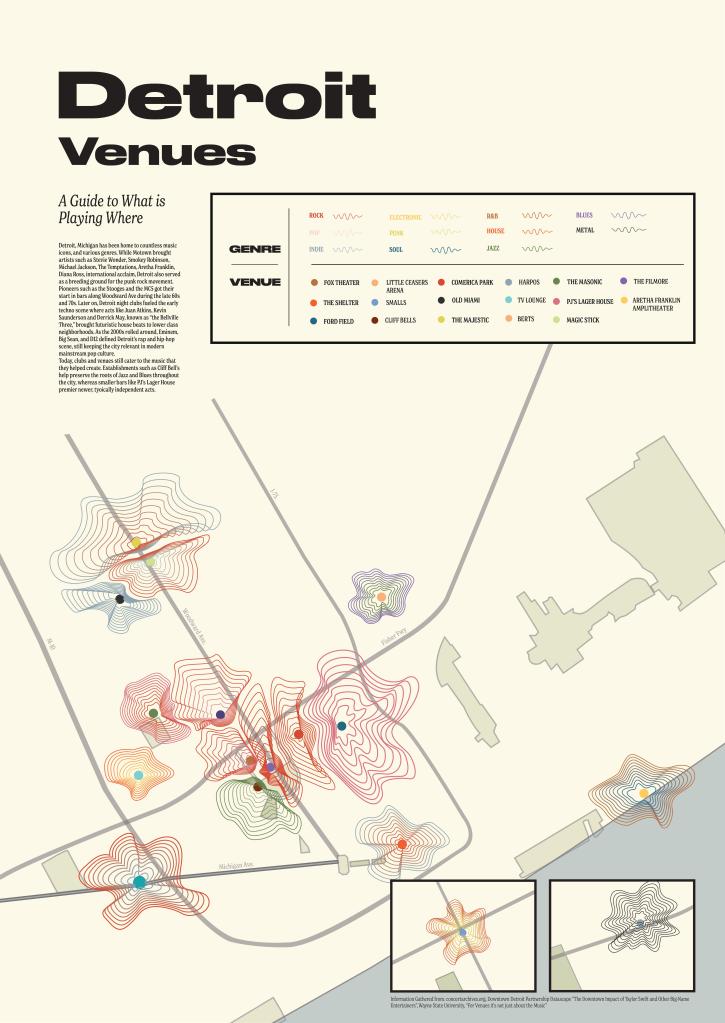
I was inspired to show the spread and growth of Detroit’s music scene. Detroit is home to countless music icons, and various genres. While Motown brought artists such as Stevie Wonder, Smokey Robinson, Michael Jackson, The Temptations, Aretha Franklin, and Diana Ross, international acclaim, Detroit also served as a breeding ground for the punk rock movement. Pioneers such as the Stooges and the MC5 got their start in bars along Woodward Ave during the late 60s and 70s. Later on, Detroit night clubs fueled the early techno scene where acts like Juan Atkins, Kevin Saunderson, and Derrick May, known as “the Bellville Three” brought futuristic house beats to lower-class neighborhoods. As the 2000s rolled around, Eminem, Big Sean, and D12 defined Detroit’s rap and hip-hop scene, still keeping the city relevant in modern mainstream pop culture. Today, clubs and venues still cater to the music that they helped create. Establishments such as Cliff Bell’s help preserve the roots of the Jazz and Blues throughout the city, whereas smaller bars like PJ’s Lager House premier newer, typically independent acts. I feel it is important to show the history and innovation that music has played in the city of Detroit. I wanted to show this movement of music through sound waves. These sound waves spread over the city to communicate how many shows play at each venue and what genre of music.
Works Cited: – Schroeder, Anjana. “The Downtown Impact of Taylor Swift and Other Big-Name Entertainers.” Downtown Detroit Partnership, 31 July 2023, downtowndetroit.org/news-insights/the-economic-impact-of-big-name-entertainers/ . – III, William E. Ketchum. “How Detroit and Flint Became Havens for Rap Dark Horses.” NPR, NPR, 27 July 2023, www.npr.org/2023/07/27/1189985872/hip-hop-50-detroit-flint
Dataset(s) Used: – Wayne State University “For venues, it’s not just about the music” – Downtown Detroit Partnership “The Downtown Impact of Taylor Swift and Other Big-Name Entertainers” – Concert Archives
 DETROITography