Brownfields are properties that are “contaminated, blighted, functionally obsolete, or historic properties.” Regardless of their classification, all brownfields face economic barriers to reuse and redevelopment.
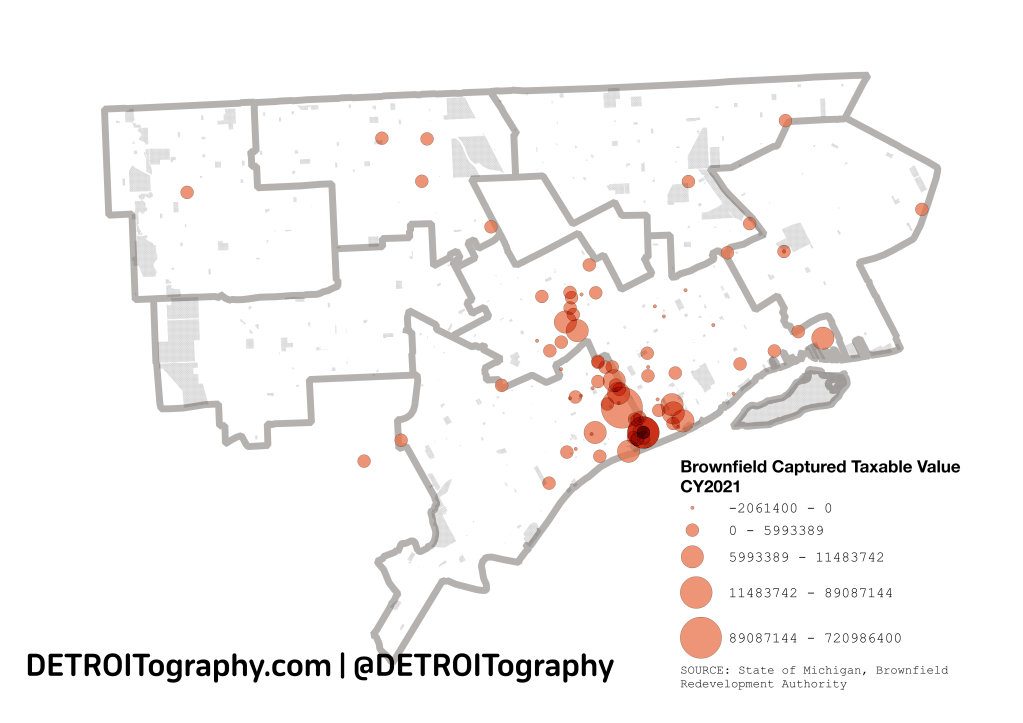
Through the Brownfield Redevelopment Financing Act, Brownfield Tax Increment Financing (TIF) allows applicable taxing jurisdictions to receive property taxes on the property at the current level and capture the incremental increase in tax revenue resulting from a redevelopment project. In Detroit, the majority of these sites are located in the Greater Downtown area – they may also be some of the larger sites where TIF is lucrative enough to offset a big project.
Luckily, the Brownfield Redevelopment Authorities are required by law to report Act 381 Brownfield TIF to the Michigan Economic Development Corporation (MEDC). Reporting data is due no later than August 31, 2023 via the online portal. BRAs are not considered compliant until MEDC Brownfield Staff have reviewed and approved all reported data. The 2021 data was the latest available. I’m not sure how negative tax capture can be reported, but that’s what was included in the MEDC data tables for some brownfields.
The Detroit BRA is led by the Detroit Economic Growth Corporation (DEGC), which I believe is the largest BRA in Michigan by project volume and amount of tax capture.
 DETROITography