The tweet that started it all came right after the Mayor’s Mackinac Policy Conference (MPC) speech:
https://platform.twitter.com/widgets.js#DetroitByTheNumbers for @MayorMikeDuggan
— DETROITography (@detroitography) June 2, 2023
28 (+12) hardware stores: https://t.co/YiVrIvOKkP
64 (+11) full-service grocery stores: https://t.co/GCBjypBj0U
1 (-1) movie theater: Bel-Air is the only one. Big Sean cinema coming 2024? RenCen4 is long closed
454 Scrap yards??? https://t.co/Fzbq9XoAcy
The actual number the Mayor used was 452, but still that number just didn’t sit right. I began searching high and low for where the Mayor possibly sourced the data. The open data portal came up empty, the new business data explorer was no help, even point of interest (POI) data providers didn’t show much. Meanwhile colleagues on the open data, GIS, and data strategy teams all said they had no involvement in the MPC data efforts on auto/scrap yards.
Finding Data
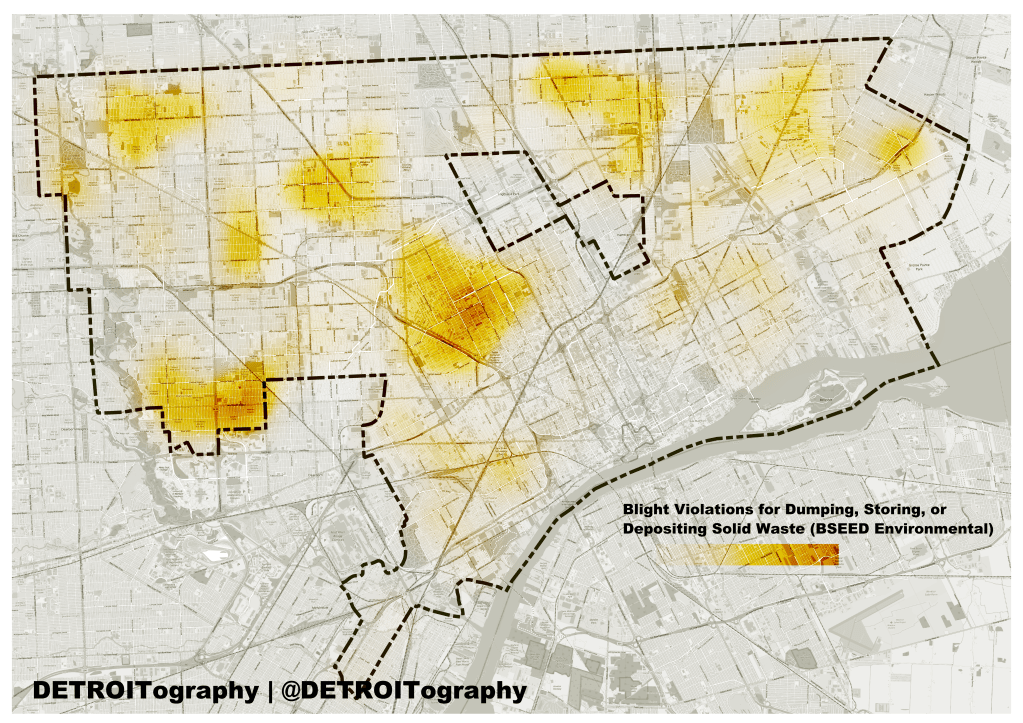
I first checked the BSEED blight violations of bulk solid waste on the open data portal, assuming these sites might show up. There were a few varied definitions, but I stuck to the below categories to begin exploring what became a new set of sites well above the 452 auto/scrap yards.
| BSEED Environmental Affairs | Totals since 2006 |
| Dumping, storing or depositing medial or hazardous waste on any publicly-owned property, or private property or water, without a permit | 0 |
| Dumping, storing or depositing solid waste on any publicly-owned property, or private property or water, without a permit | 279 |
| Dumping, storing or depositing solid waste 5 or more cubic yards on any publicly-owned property, or private property or water, without a permit | 475 |
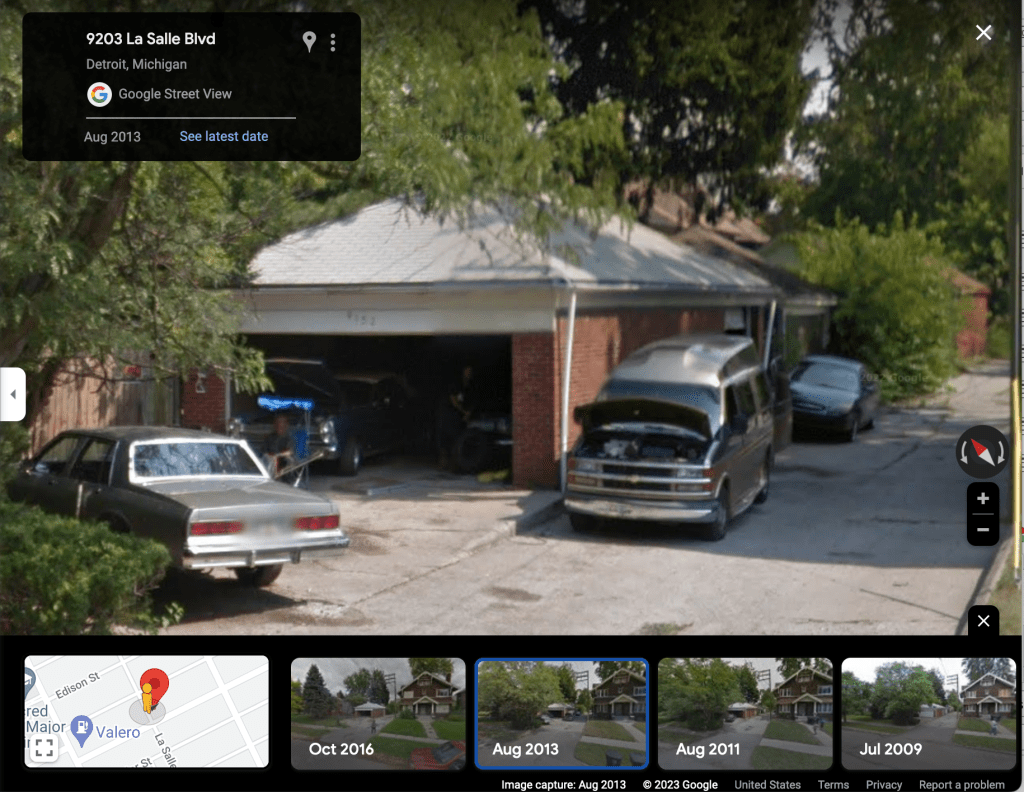
One of the first sites I checked on Google Streetview actually did appear to be an auto/scrap yard operation in a residential alleyway. There were too many sites to individually verify each, so I shifted my focus as to how these locations might be regulated.
Comparing Data
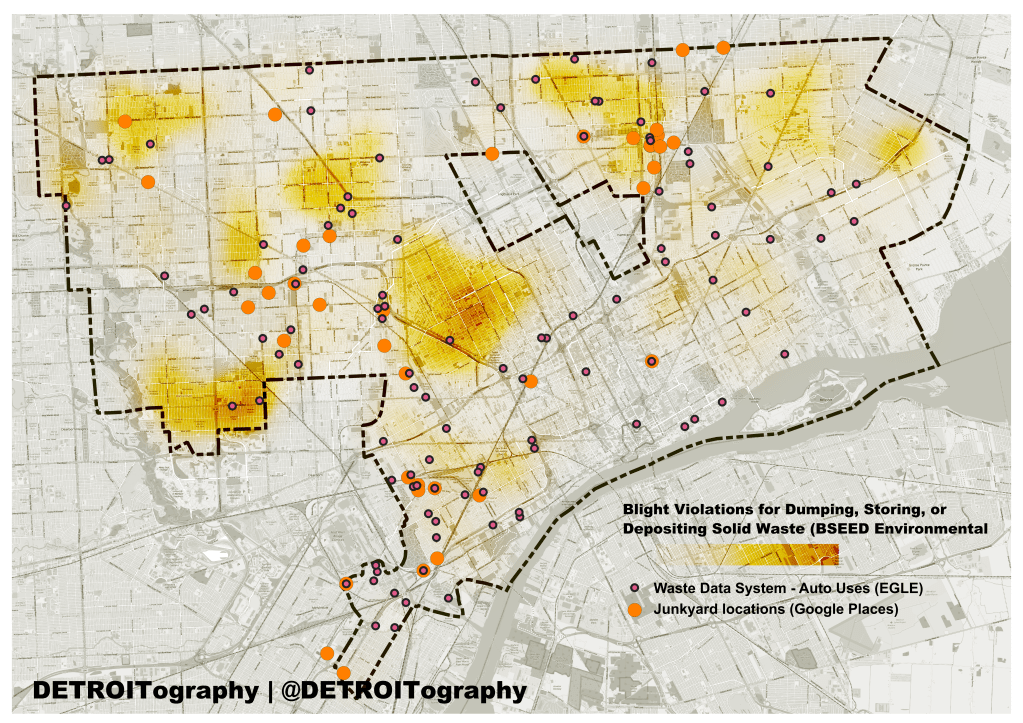
The State of Michigan Department of Environment, Great Lakes, and Energy (EGLE) ended up having a more helpful and knowledgeable social media team than their legal team handling FOIA requests. I was able to search the public “Waste Data System” to find 110 used auto parts and metal recycling sites. Still a very low number compared to the 452. A quick search of Google Places also got me to the number of “junkyards” in the city (n=37).
I decided to start engaging the Mayor’s office for some clarity on data sources. That yielded insight into where some of the numbers came from, but only more confusion related to auto/scrap yards. I finally realized that this was part of the Mayor’s January 2019 moratorium on new auto or scrap yard businesses as part of the “blight to beauty” campaign and tracked down a June 2022 presentation made by BSEED to the City Planning Commission (CPC). The end goal of the effort being updates to zoning, code, and enforcement for auto related businesses and land uses. In a 2022 DONCast video presentation Dilip Patel of BSEED noted he used Secretary of State data sources to compile a list of sites. The Secretary of State maintains searchable databases for both auto repair and auto dealers as part of their online services.
| June 2022 Presentation to CPC | BSEED/Mayor’s Office Memo | SOS Data check | Enforcement Effect??? since 2019 | 2023 Totals | Source | |
| Auto/scrap yards | 1548/1405 | 1414 | 1248 | — | 925 | |
| Towyards | 11 | — | — | — | 14 | Google Places |
| Junkyards | 95 | 122 | 110 | — | 110 | EGLE Waste Data System |
| Auto repair | 925 | 920 | 725 | 221 | 504 | SOS online services |
| Auto dealer | 374 | 372 | 413 | 116 | 297 | SOS online services |
Now, not much of this made sense. The Mayor’s office shared a memo written by BSEED that attempted to lay out some methodology, but that included an assumption that 50% of auto repair shops were or were not active at a given time. BSEED notes they have a master list of 1,414 sites which is slightly higher than what they mapped out in June 2022.
They also shared a spreadsheet of 121 business shutdowns related to auto uses enforcement. I was interested to see what kind of impact there was from the legal effort. I assumed there would be overlap between BSEED’s list and the Secretary of State’s, but there wasn’t much. Since 2019, 116 auto dealers and 221 auto repair facilities had closed, had their license revoked, expired, or suspended.
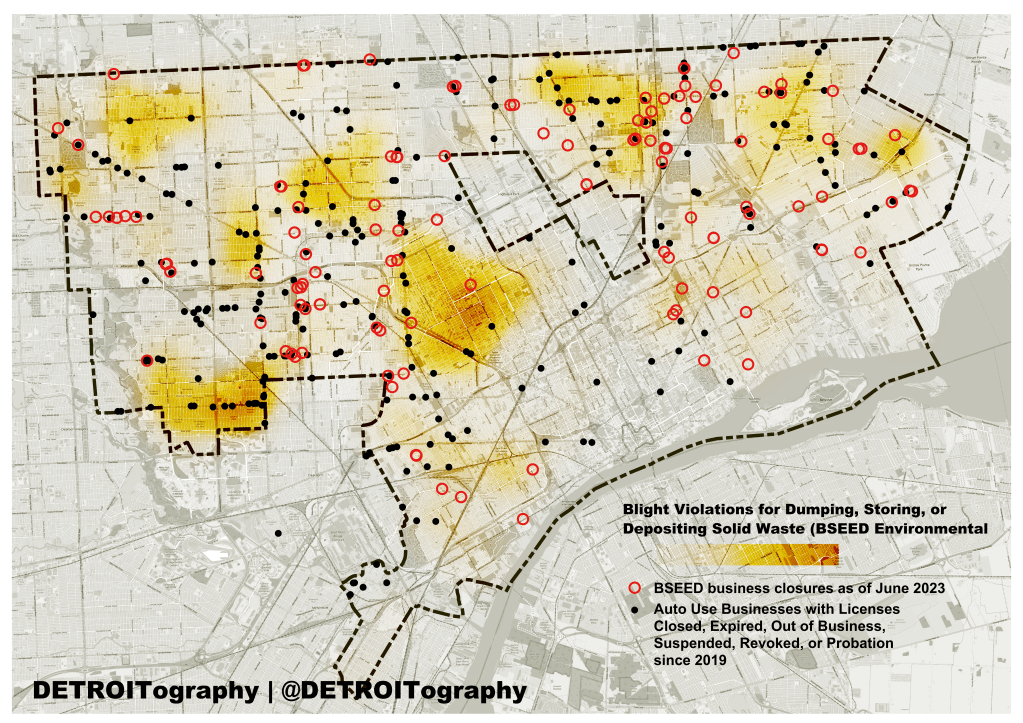
Among the locations that closed since 2019, just 7 overlapped with BSEED business closures. A few seemed to just be name changes such as Saad Motors to Platinum Auto Parts. The license expired, but the new entity was still shutdown by BSEED. Interestingly, none of the actual scrapyards were part of the BSEED closure dataset. Now I’m not sure what 114 additional sites BSEED closed are as part of the crackdown on auto/scrap yards.
Conclusion
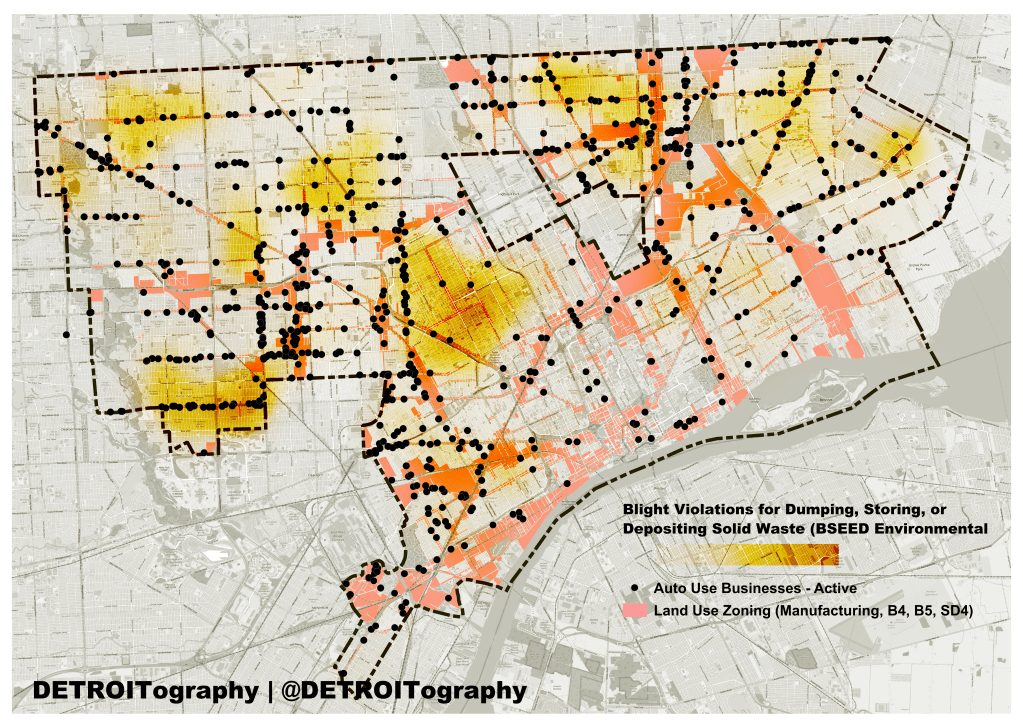
Maybe this numbers story isn’t done, but the conclusion is that what many observers assumed was widespread scrapping in the city. In reality there is a small subset of scrapping happening (likely larger than in other cities), but the majority of the concern is around piles of old cars and their parts that have been left to decay and create eyesores. I think those are two separate stories. Unfortunately, because of the way the data was presented, one mostly negative narrative has emerged about scrapyards in Detroit that includes small businesses operating as car mechanics or used car sales.
Data is a hot commodity and its tough when used in unverifiable or confusing ways. When the city references data in public it should be readily available on the city’s open data portal in the same way that meeting minutes could be checked for accountability and transparency. The numbers help us track progress and identify what assets we have available. Data and numbers matter, maybe not as much to every person, but they seed the narratives of our city and drive perceptions of the people who live in Detroit.
 DETROITography
Pingback: Detroit By The Numbers: December 2023 Data Roundup | DETROITography
Pingback: One Detroit debate: What counts as a scrapyard?