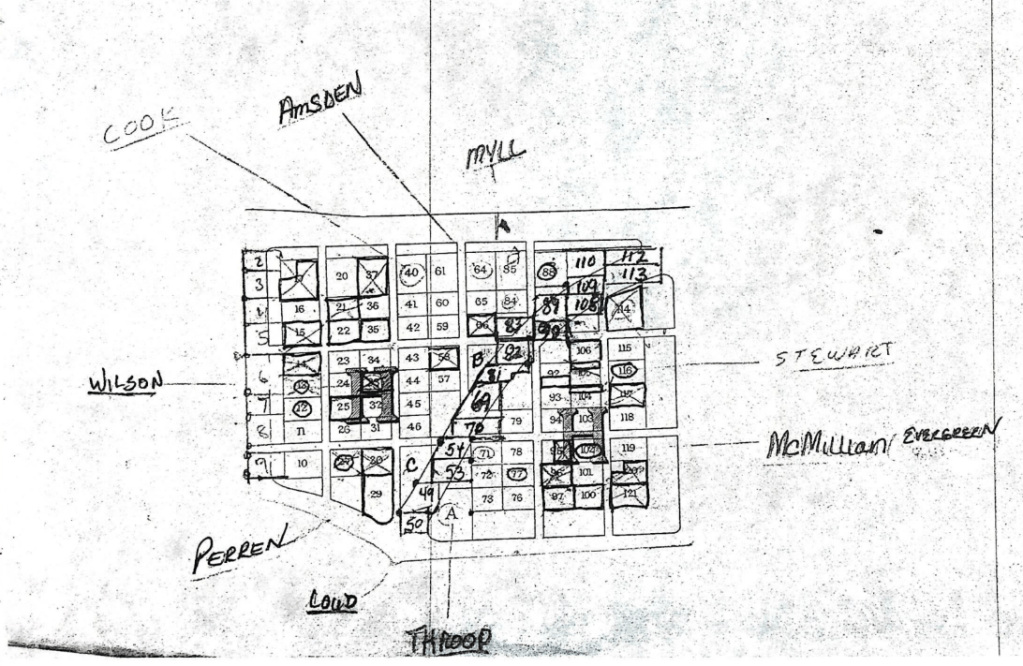
If you’ve ever visited Elmwood Cemetery and asked for the location of a gravesite, we may have given you a map. That map probably looked like this:
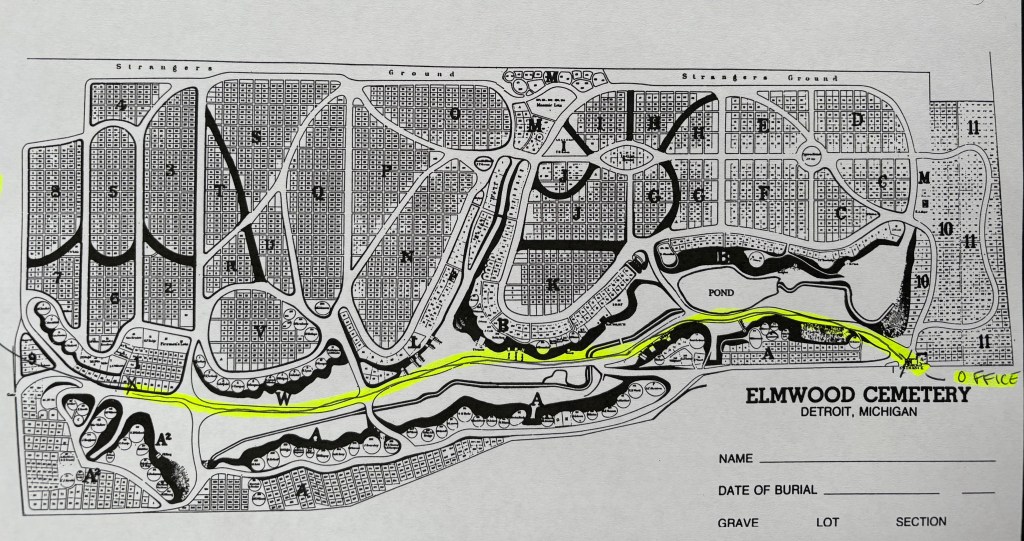
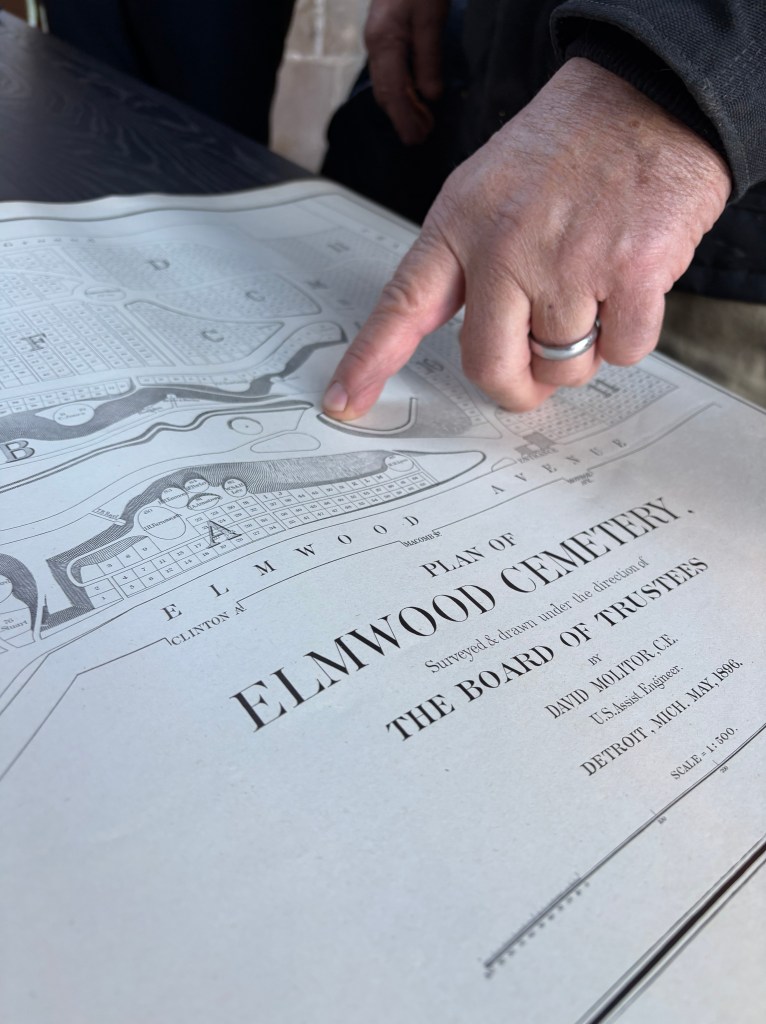
Hopefully, that map got you where you needed to go. If it did, you can thank our helpful staff, but also David Albert Molitor, who surveyed and mapped the cemetery about 130 years ago, when he was 30 years old.
Several other cartographers and surveyors have made significant maps of Elmwood throughout our history. Our first map was reportedly made by Augustus Canfield of the U.S. Army Corps of Engineers, although no copies of this map apparently survive. (The trustees reported they’d lost hope of finding it way back in 1880). Legendary mapmaker and historian Silas Farmer published a beautiful map of Elmwood in 1865, and our visionary superintendent A.W. Blain made his own map 20 years later. But the Molitor maps have a special place in our history as the maps that have lasted the longest, and the maps we still use today.
Molitor, born in Detroit in 1866, would become a civil engineer of international repute. Shortly after completing the Elmwood map, he went to work on the Poe Lock at Sault Ste. Marie, the largest lock in the world when it opened in 1896, where he oversaw construction of the lock’s gates. In 1906 he was commissioned to work on the Panama Canal, where he was the designing engineer of its locks and emergency dams. He worked on the sea walls of the Toronto Harbor and the superstructure of the Memphis Bridge over the Mississippi River. I think of Molitor whenever I see the Fisher Building, a crown jewel of Detroit architecture. You already know it’s an Albert Kahn – but David Molitor designed its steel frame.
When Elmwood’s trustees hired Molitor to make a new map of the cemetery in 1895, it was a pivotal time for the cemetery. The trustees were working to implement a set of recommendations from influential landscape architect Frederick Law Olmsted to preserve Elmwood’s historic and natural character. (These recommendations included removing excessive lot decorations, investing heavily in tree maintenance and planting, and avoiding straight lines and 90-degree angles when laying out roadways.) A new public mausoleum was under construction along the creekway. And they were adding acreage and laying out new burial lots to serve a population that had grown tenfold in the half-century since the cemetery was established.
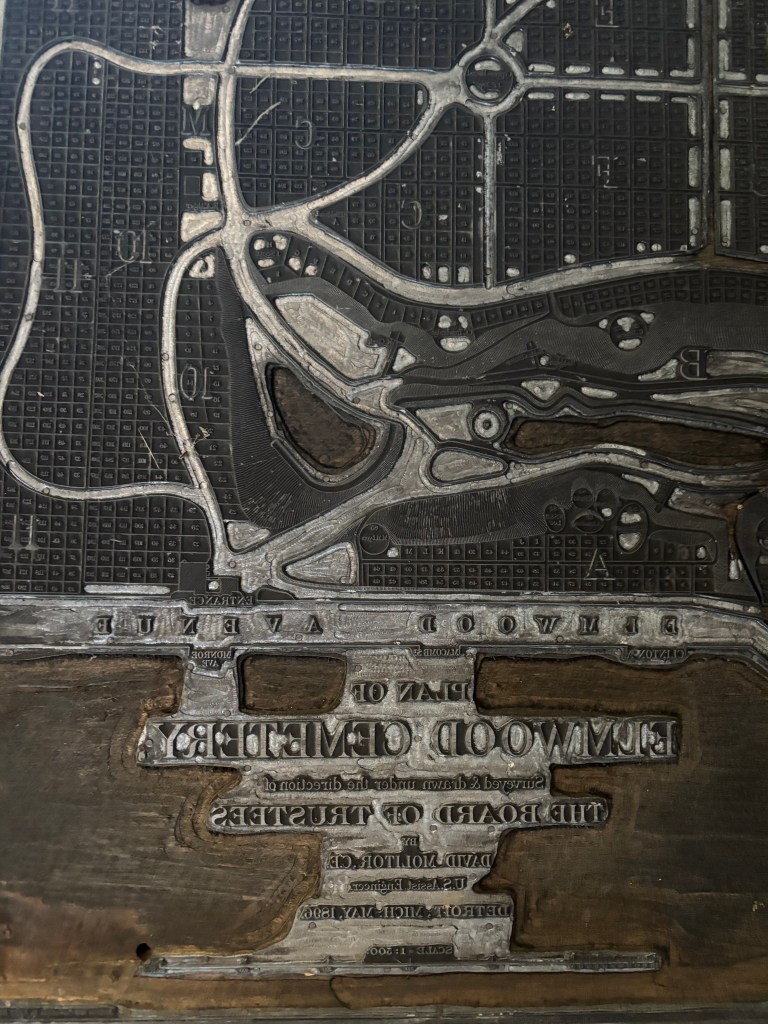
Molitor agreed to a fixed $500 fee for the entire project, which was completed the following year. Molitor joined several board meetings to discuss his specifications for the map and to present his drafts and invite critique. According to our minutes from these meetings, the trustees were pleased with his work and approved the final design without much back-and-forth. We still have the original copper plate that was used to print the Molitor map.
American cemeteries are designed with eternity in mind, but of course they do change over time. Elmwood’s boundaries are more or less the same today as when Molitor made his map, but more than a few things have changed on our grounds since then. We’ve laid out new burial lots, constructed a new public mausoleum, bumped out hilltops and infilled roads. Some of those changes were added to the Molitor map in 1906, when we hired the engineer Paul Heinze to make a few updates. Heinze began his career as a railroad engineer but later became known for his cemetery lay-outs; his c.v. includes Grand Lawn in Detroit, Roseland Park in Royal Oak, and Michigan Memorial in Flat Rock.
But in the century since Heinze added his byline to the Molitor map, we’ve made map changes in-house – by hand. It’s not the most sophisticated system, but it does what we need it to do.
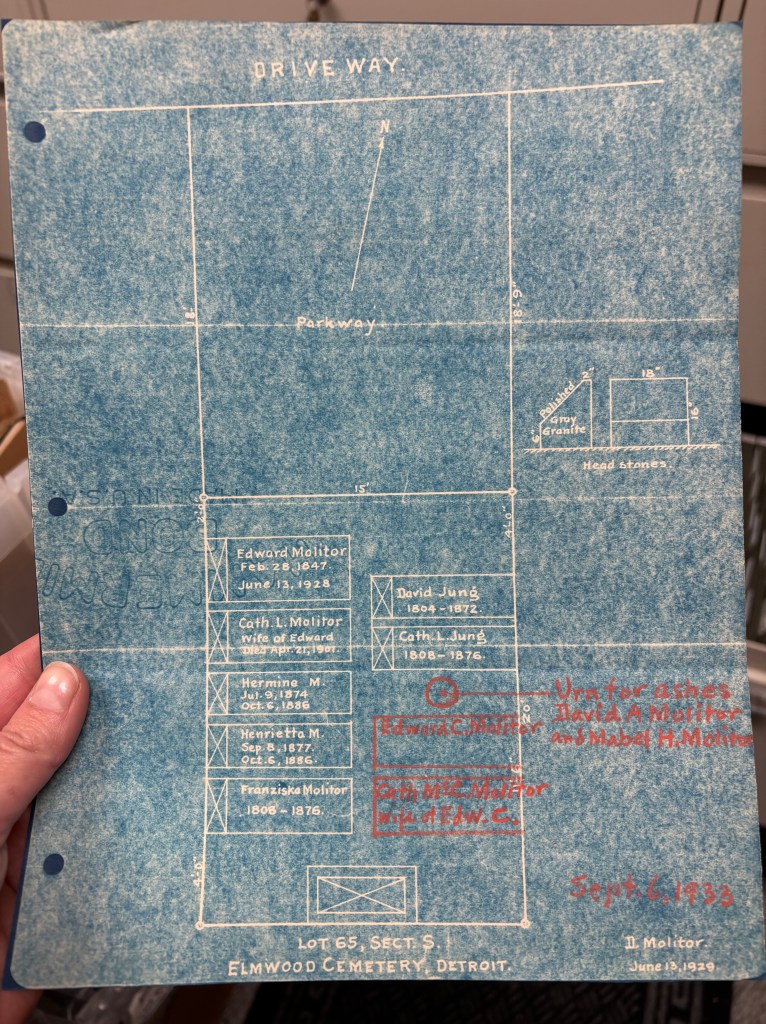
Molitor died in 1939 and was buried on his family lot at Elmwood on Section S. He designed the lot himself.
There will come a day, and it may not be too far in the future, that we retire the Molitor map. But for generations of staffers and visitors, the Molitor map is the map of Elmwood Cemetery. Ask for a copy next time you stop by the office. Molitor made it to last.
 DETROITography